
EPISODE · Jul 10, 2026 · 45 MIN
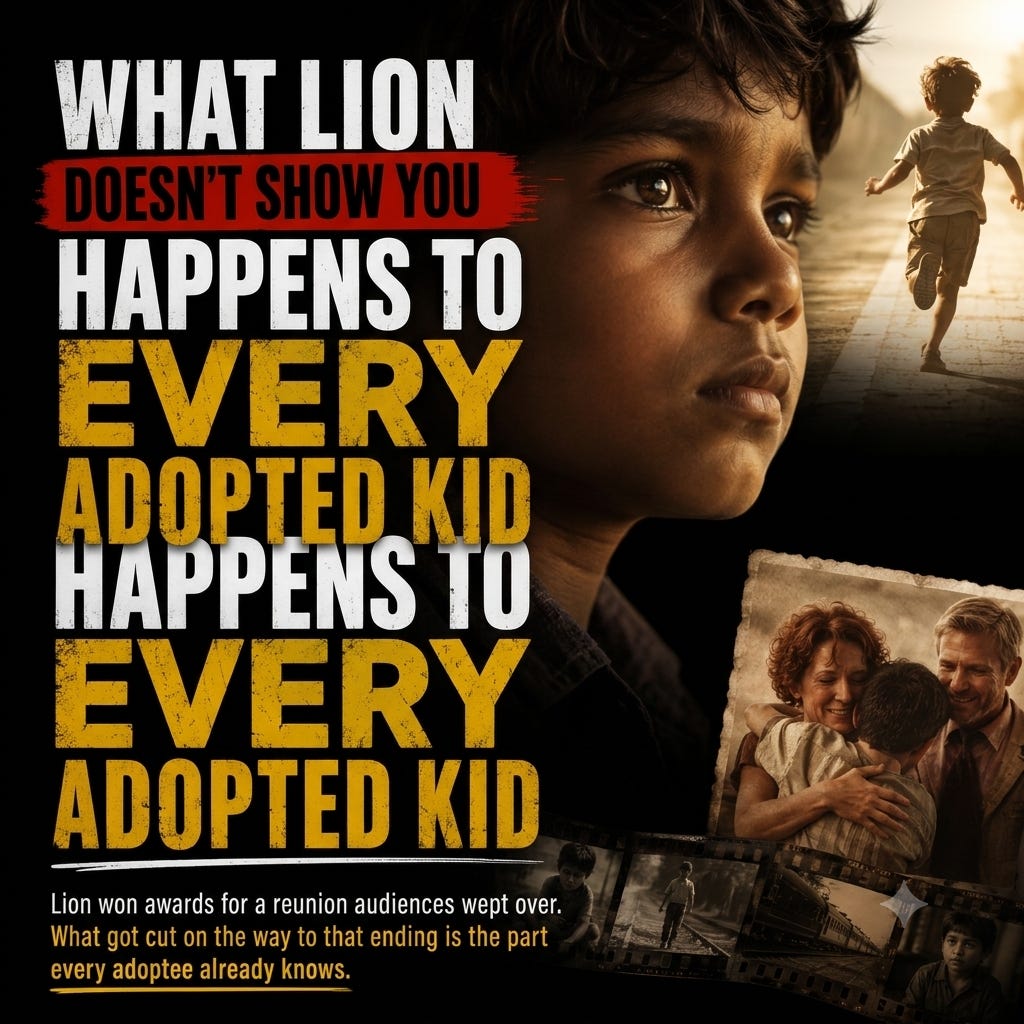
What Lion Doesn’t Show You Happens to Every Adopted Kid
from The Experience of Adoption · host Thoughtless Delineation
There’s a particular kind of hunger that has nothing to do with food. I know it because I’ve felt it — the body remembering something the mind has no words for yet. So when I watched a grown man go still over a plate of jalebi, watched a decade of constructed adulthood crack open at the smell of fried batter and sugar syrup, I didn’t see a movie mystery being solved. I saw a nervous system doing what nervous systems do when the past has never actually left — it just went underground and waited for the right frequency.That’s the moment everyone remembers from Lion. Google Earth, the search, the tearful village reunion — a five-year-old boy separated from his mother in India, adopted into a loving Tasmanian family, finding his way home twenty-five years later through sheer technological grit and love. It’s the film Netflix wanted you to see, and it’s a good film, on those terms. Sweeping score, warm light, an ending that lets everyone exhale.But there is a second film sitting inside the first one, and it’s not the one anyone applauded for. It’s the one that shows up if you refuse to read the story through the lens the adoption industry has spent forty years building — the lens where love is the variable that fixes everything, where a good enough house cancels out what happened before the child arrived in it. Look at Lion through that other lens and it stops being a story about reunion. It becomes something closer to a diagnostic report on what the system doesn’t want named: that the adoptive home, however resourced, however warm, is not a repair station for a nervous system that was organised around threat before it ever crossed the threshold.The Boy Who Learned to Disappear, and the Boy Who Couldn’tTwo brothers enter the same house. Same parents, same country, same second chance, at least on paper. Saroo becomes the story everyone wants — quick with language, quick with school, quick to look like the adoption “worked.” Mantosh becomes the story nobody wants to look at directly — self-harm, rage, a kind of unravelling that the film treats almost as background noise to Saroo’s quest.Here is the part that the popular reading skips straight past: those are not two different outcomes to the same intervention. They’re two different survival strategies responding to two different depths of rupture, and neither one is a verdict on how much love was in that house. Saroo’s fluency is not proof that displacement can be undone by a good family. It’s proof that he had the neurobiological room to build a performance sturdy enough to keep the fracture invisible — to himself, and to the parents who needed him to be fine. Mantosh had no such room. What arrived in him from institutionalisation and repeated relational betrayal didn’t have anywhere quiet to go. It came out through his skin, his fists, his refusal.I recognise both of them. Most adoptees do, in one proportion or another — the part that learned to be exactly what the room needed, and the part that couldn’t hold the performance and stopped trying. The film frames this as two different boys with two different temperaments. The more honest read is that it’s the same wound expressed by two different capacities to disappear. And when Mantosh eventually estranges himself from the family in adulthood, the film treats it almost as an afterthought — a shame, a shrug. It isn’t a shrug. It’s the direct, logical outcome of a system, and an era of adoption practice, that assumed love was the whole treatment plan.The Gift That Was Never a GiftThere’s a scene that does more damage, quietly, than anything involving the brothers directly. Saroo, wracked with guilt over searching for his mother in secret, tells his adoptive mother that he and Mantosh weren’t the blank slates she must have wanted. Sue’s answer is warm, and it is also the whole architecture of the problem in one sentence: she didn’t adopt out of a longing for a child specifically — she adopted because bringing more children into an overcrowded world felt wrong to her, and she wanted, instead, to give a home to a child who already existed.Sit with that for a second, because the film wants you to feel only the tenderness in it, and there is tenderness in it. But underneath the tenderness is a transaction most adoptees will recognise instantly: the child brought into that house wasn’t only there to be loved. He was there to complete someone else’s ethical accounting. That’s not a monstrous thing to want — but it is a heavy thing to hand a five-year-old without either of them knowing it happened. Saroo’s whole life becomes, in part, the unspoken labour of proving the arithmetic was right. Mantosh’s collapse becomes, in part, what happens when a child cannot do that labour. Neither of them signed up to be someone’s moral proof of concept. Nobody ever does.This is the part Respectful Adoption Language was built to soften — the “gift,” the “blessing,” the gratitude framing that asks a separated child to carry the emotional cost of somebody else’s decision as though it were their own good fortune. It wasn’t fortune. It was a system, moving a child from one set of circumstances to another, and asking him afterwards to feel lucky about it.Where the Film Stops, and Where the Real Story StartsLion ends on the reunion — the walk into the village, the woman running to meet him, the tidy revelation that his name was a slightly mispronounced version of the word for lion all along. It’s a beautiful frame to end on, and it’s also a lie of omission, the kind mainstream adoption narratives tell instinctively because the truth afterwards doesn’t fit in a closing scene.Because reunion isn’t the end of the story. It’s the start of an entirely new, unglamorous one. It’s a grown man who thinks in English trying to build a relationship with a mother who speaks a language he no longer holds. It’s the discovery that geography can be recovered and time cannot — that finding the place does not hand back the years that were spent somewhere else, growing into someone she never got to watch. It’s the strange, permanent condition of belonging to two worlds at once and, in the quiet moments, to neither one fully. The credits roll on the homecoming. Nobody was ever going to film what comes after, because what comes after doesn’t resolve — it just continues, differently.I don’t say any of this to take Lion down a peg. I say it because the omission is instructive. It shows you exactly where the culture’s imagination for adoption stops — at the airport arrival, at the tearful hug, at the roll of credits — and exactly where the adoptee’s actual life keeps going, unfilmed, unfunded, undramatised. The industry loves an origin story. It has far less appetite for what a person has to build afterwards, alone, with no script to follow.The Actress Who Got to Stay in the FeelingNicole Kidman’s own public account of playing Sue Brierley never left that same comfortable register. On the record, across multiple interviews, she described the role as “hugely emotional, instinctual,” said what drew her in was the chance to explore “unconditional love,” and summarised the entire film as being about “the power of mothers.” Confronted with the actual facts of what happened to a five-year-old boy before the Brierleys ever entered his life, her response was that it seemed almost impossible to believe any of it had happened at all.That’s a genuine reaction, and there’s nothing dishonest in it. It’s also, tellingly, exactly where the culture’s imagination for adoption is content to stop — at wonder, at love, at the miracle of the happy ending — without ever being pushed toward the specific, structural questions this essay has spent several thousand words on. What does a five-year-old’s nervous system actually do with that kind of rupture. What does it cost a child to become someone else’s proof of moral goodness. What does a sealed record actually withhold, and from whom. Kidman gave a performance precise enough to earn award nominations for it, and in every interview available on the public record, she was never asked to sit with any of that — and she never volunteered to either. That’s not a personal failing specific to her. It’s the same reflex the industry runs at scale: the performance gets to live entirely inside the feeling, and the feeling is allowed to stand in for the analysis nobody in the press cycle ever asked anyone to do.The Privilege of Never Having to Answer For ItLion is a film Hollywood made about adoption. But Hollywood is also, as an industry, one of the highest-profile adopting classes on earth — a small population of enormously wealthy, enormously connected people who choose to adopt at a rate the general public notices, and who therefore have more access to lawmakers, media platforms, and philanthropic capital around this issue than almost anyone else who touches it. That’s not a criticism of adopting. It’s a fact about leverage, and the historical record shows exactly what’s been done with it.For decades, celebrity adoption has functioned as one of the most effective public-relations tools available to the industry. Media coverage of famous adoptive parents has run almost uniformly positive, with the complicated parts of adoption left out of the frame entirely. Public figures have used exactly this kind of coverage to promote adoption as an unambiguous good, sometimes formalising that advocacy into outreach programs pointed at expectant mothers and prospective adoptive parents. That advocacy has not, as a rule, extended to the unglamorous fight adult adoptees have been waging for decades: the right to their own original birth certificates. Sealed-records reform is still, in 2026, a state-by-state and country-by-country grind, decades after adoptee-rights organisations first named sealed records an affront to basic dignity. There’s at least one documented case of the leverage running the other way entirely — a sitting legislator, sibling to a high-profile adoption advocate, on record refusing to support a bill that would have unsealed adoptees’ original birth certificates.Deborra-Lee Furness, married to Hugh Jackman, is often cited as the exception — a sustained, well-resourced advocacy campaign, Adopt Change, running in Australia since 2008. Look closer, though, and the exception proves the rule rather than breaking it. Her advocacy is explicitly framed around making adoption faster and easier, modelled on the U.S. system she has said she found preferable after finding Australia’s process difficult enough to walk out of. Within the adoptee community itself, that campaign has drawn direct criticism, not applause — the push to loosen the process by which parental rights are terminated has been read by adult adoptees as advocacy for moving children out of struggling families and into wealthier ones faster, not as advocacy for the rights of the adopted person once grown. And the scope stops precisely at the border of the country she found inconvenient. Furness and Jackman adopted their own children in the U.S., a system with a far larger and more heavily documented record of trafficking, falsified paperwork, and coerced surrender than Australia’s, and one where sealed-records reform remains a fractured, state-by-state fight. None of that has drawn comparable advocacy from her. The leverage went precisely as far as fixing the one system that had personally inconvenienced her, and no further.That is the pattern, not the exception to it. The industry has real access. When it spends that access, it spends it on making the front end of adoption move faster — not on the back end, where the adult adoptee is left to fight, alone, for the records and the truth the system sealed on their way in.This is the same mechanism as Lion’s ending, scaled up. The individual film stops at the reunion because that’s where the story becomes usable. The industry, as a class of people with real power over this issue, stops at the humanitarian narrative for the same reason — because that’s where adoption becomes an asset instead of a liability. Neither one is a personal failing so much as an institutional reflex: take the part of the story that flatters, leave the part that would require actually spending something.What This Is Actually ForHere is where I could leave it — in the wreckage, in the accurate but exhausting observation that the system asked two children to metabolise something it never gave them the tools to metabolise, and that one of them is estranged from the family that raised him, and that the very people with the power to change the system for everyone else have mostly declined to spend it. That reading is true. It’s also not where I’m willing to stop, because stopping there is its own kind of surrender.What Lion hands us, without meaning to, is a working diagnostic — proof, on screen, of things adult adoptees have been saying for decades without an audience: that love is necessary and not sufficient, that gratitude framing is a grief suppressor, that a somatic memory doesn’t wait for permission, and that reunion is a beginning, not a finish line. None of that is despair. It’s material. It tells adoptive families what actual repair requires, beyond resourcing and beyond love — trauma-literate support, room for a child’s dysregulation without treating it as an indictment of the household, and a total abandonment of the idea that any child owes their family proof that the adoption “worked.” And it tells the people with real leverage over this issue — including the industry that keeps profiting from the feel-good version — exactly where the unfinished work is sitting, waiting for someone with power to actually pick it up.And it tells adoptees something too, something I’d have wanted at nineteen: that the performance and the collapse are not opposite fates. They’re two branches of the same tree, and neither one is a character flaw. The way forward was never going to be found in the jalebi, or the map, or even the reunion. It’s in what a person builds afterwards, on purpose, with eyes open about what actually happened to them. That’s not a Hollywood ending. It’s a better one — because it’s the only kind that’s actually available to build a life on. This is a public episode. If you'd like to discuss this with other subscribers or get access to bonus episodes, visit thoughtlessdel.substack.com/subscribe
Embed this episode
NOW PLAYING
What Lion Doesn’t Show You Happens to Every Adopted Kid
No transcript for this episode yet
Similar Episodes
No similar episodes found.
Similar Podcasts
No similar podcasts found.