I, V, M. On pretty much everything and. Wow, that's a. Yeah, we have.
We have a few things. Economy of our words. Like words. Famously.
Yeah. Besides two words, the ratio is very high. We say so much using so few words. We might as well have been a LinkedIn post.
Yeah. So. So welcome everyone. Hi.
To yet another episode of Simplified, it's the world. Same whole idiots minus one because he is. Also the temperature where. So the well, I don't know how, you know, how things are going in your part of the world, but I've found myself drifting without sort of any motivation.
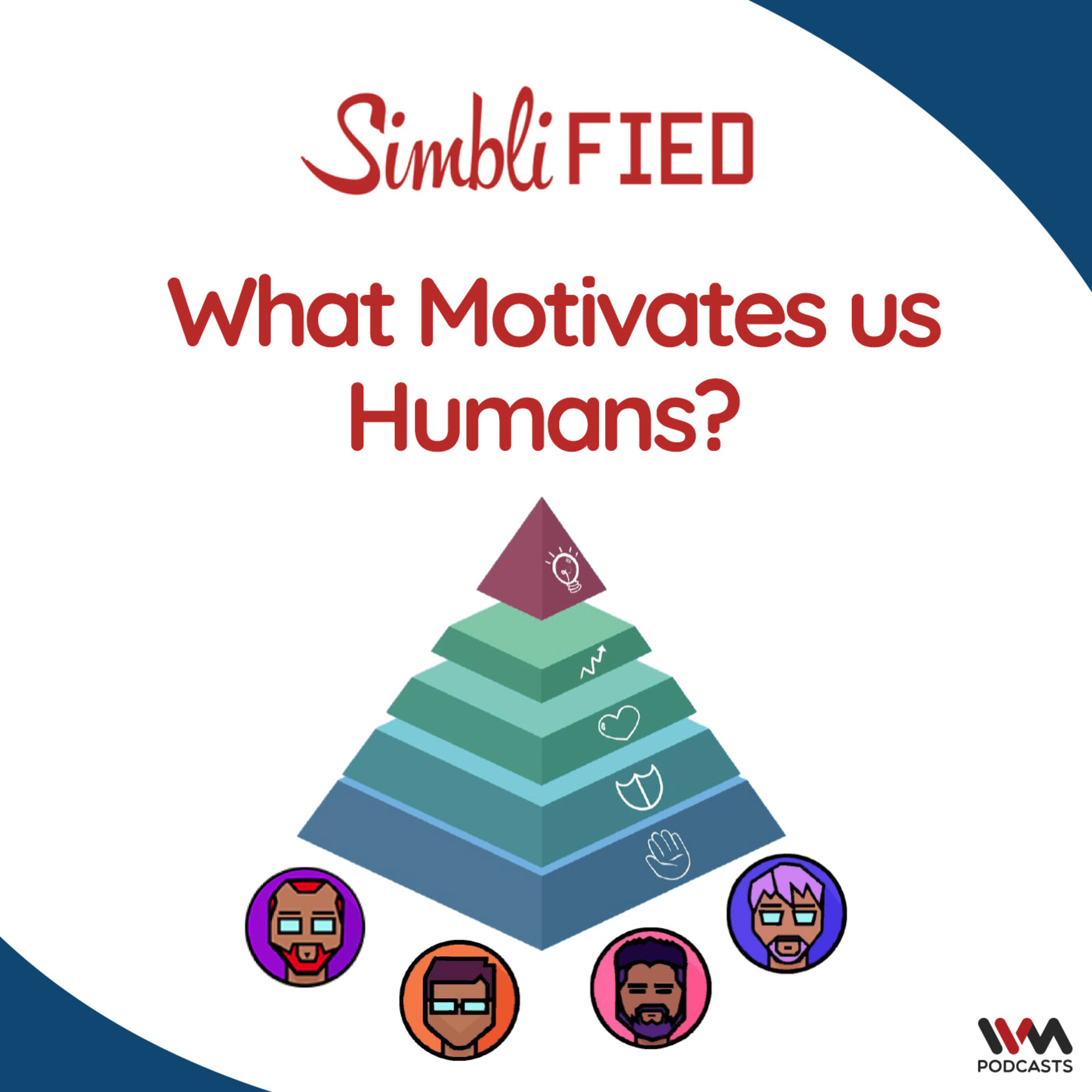
So I thought let's let's find out what motivates us humans. Right. So like, okay, not just three of us like just generally. And yeah, we're in a stretch in a sort of burst of the cleanest.
I'm going to include the three of us in the definition of humanity. That would be debatable. But yeah, humans too. Since we couldn't get any real humans, you'll have to do with the simple.
We should ask GPT for not to see how human it actually is. We should actually ask what motivates you. Actually, we do that. What does GPT stand for?
What does GPT stand for? General purpose transformer, I think. Moon transformer. Yeah, that's a technology, you know, that's what the transformation technology.
No, anyway, but I'm not going to answer. I'm not going to generate to be pre-trained transformer. Sorry, it's GPT stands for general purpose. One word.
One out of three correct. One out of three. No, no, the important one I got right, which is. Yeah, your question.
Yeah, my question to you guys is what is the most motivating thing that someone has said to you or that includes WhatsApp forwards. But what is it that's, you know, like an aha thing, if at all, if there is any, you said, wow, this is something. I'll go first because I have a very specific answer for this. The thing that has motivated me the most in my life happened approximately 12 years ago.
When the director of Microsoft said, listen, we are in a recession. It started with that. I won't fill up the rest of his words. I'm a deal.
That was pretty motivating many for the inter-electronic scenario in front of us. But yeah. But Jack, can I ask you more specific question? I like, I've known you, I think, for over a decade, probably two decades.
No closer to one. Oh, yeah. Yeah, yeah, yeah. But probably for like 15, maybe 10 to 15 years, you've been pursuing project 72.
But something switched, I think a couple of years ago. What changed? No, I mean, we're going there directly, is it? Yeah.
I think you should tell what project 72 is for the three people who are due to this. Very long back 2009 or 2010 or something. I came across this stat that, or this piece of health advice, that your ideal weight is your height in centimeters minus 100. So I'm 172 centimeters.
So a simple high school maths told me that my ideal weight was 72. And I had just moved to Bombay then. So I figured, OK, I'll start getting fit. And the reckless thing that I did was put this out on Twitter at a time when there was many mischief moments around.
So project 72 was a thing. And I publicized the fact that it kept failing month on month. And then it started becoming a small bit of a joke. Not that I was unhealthy.
It's just that, you know, just kept poking from the fact that it was 80 or whatever. An accident in a couple of surgeries didn't help. We kept on the wrong side of 80. But anyway, I think what happened over the last couple of years when I got into a little notice, I think, I mean, one, of course, is the general sense around the pandemic induced, which is, OK, we should all just be a little healthier and all that.
But I think another thing for me was it wasn't motivation as much as realization about what I was doing wrong in my previous way of working out, which was just reckless, mindless cycling and nothing but I think somewhere during the pandemic, I realized that I was just strength training and all that is also required. So I kind of had that. So I didn't say that was motivation as much as figuring out what I did wrong. Hope that makes sense.
I don't know if you were expecting a more profound or funny answer. But yeah, I mean, all this is very difficult to put it all. Watch that forward. But yeah, I do.
But I sat on a chair and I broke it. That's when I realized I should be getting bigger. Yeah, that's much better. What's that?
Tony, you're talking. No, so I mean, like actually wrong thing to ask me at this point because I am going through a phase where there is zero motivation towards anything. And I'm in that phase where I'm realizing there are thresholds to side of things as to what amount of money would make you happy or what would you do that biases towards action as opposed to sitting on a chair. And the actual matter of fact is that very few things matter in the sense that you can't change things around you as much as you think you could once you were a little younger.
And the world is going to burn itself down. So like why waste your energy on trying to sort of wave out of fire that is like widely burning. Right. So I mean, things that used to motivate me in the past once I went out of weight loss thing and did it quite easily was like when my friends shamed me.
But I think that is quite literally a thin desire. So at this point I'm actually going to feel so so. So now right back at you. Yeah.
So I find it very easy to be motivated. Right. A pep talk, nice article, a good book. The problem is a sustainable motivational sort of paradigm.
Right. It's that's missing. So there's some way of looking at the world, which suddenly gives meaning to whatever you're doing, then whatever you want to be doing or whatever you think you ought to be doing wouldn't be so difficult to do. We all do that at some level or the other.
We want to do something. We keep putting it off or we choose to do something else and knowing that we have to, for example, in my case, if I have an hour of free, I'll just sit down somewhere in play chess. I feel really guilty about it afterwards. Right.
What's the motivation for playing chess? Yeah. So I figure now after a lot of armchair is just so that I don't have to face any of the things I should be doing. So for example, let's say I want to complete the damn book of mine, right?
And somewhere inside me, there's a little voice saying that boss, you're not up to the task. Don't do this. You write the book. Everyone's going to laugh at you and everyone's going to stay.
This is stupid. And I don't want to admit that to myself. So I end up wasting my time playing chess or watching something on television or YouTube or whatever. It's incredibly much of a joke to declare that on a podcast.
I know what you mean, by the way, I think I write a quote somewhere like the most productive person is the person who actually has to write a book or a creative project. I end up clearing the floor, organizing the book. Getting a head. Getting a shower.
I have a theory that the most number of bots during engineering happen under evil's the exception. Yes, because you get extra marks for smelling. I have a theory. Sorry, I have a theory.
But don't forget what you're about to start. I have a theory that, at least for me, that fear acts as an incredible motivator. Fear of whatever. I may be to give a more philosophical take to Tony's question.
I forced myself to get better with respect to fitness because I was scared of whatever. Seeing a few elder people who I know and who weren't doing very well. I didn't want to be that when I was 50, 60 or whatever the case may be that was motivated. I know that at work many times I did go beyond calling because I was scared of irrational as it may be of being fired or losing my job or just being told.
Yeah, or just being told that this was a bad piece of work compared to what you've done before and all that. So I think at least for me, I have kind of come to terms of the fact that fear is an excellent motivator, especially for me. Whether it's the best motivator, I'm not completely sure. But it sure works for me.
Yeah, actually on that note, deadlines are a great motivator for me. So if something is being done in seven days, first, six and six point seven days, I completely useless. Nothing happens. But the last point two, five days, when I'm back into a corner, yeah, then that I don't know, something kicks in, some kind of a panic response or whatever.
This is true for so many people. I remember even Sithin saying this. He has this insane capacity for sitting and doing great level of work at one sitting. But he will choose to do it at the last possible moment.
So absolutely. I don't know whether this is about, this is point about motivation per se. But I often find that accepting that fact, which both of you just said, which is, okay, for six point five days, I'm going to do nothing and then point five days, everything's going to happen. Actually accepting that and kind of like turning, kind of like aligning your life according to that, I think might end up working better because you don't feel guilty about wasting six point five of like for example, so a couple of months back, I started this mini consulting offering as a freelancer and kind of made me like their questions and all that.
And then I would start thinking about it beforehand and I would spend the not in it amounts of time on it. And if I didn't spend enough time on it and I would feel like full panicky before the call started. And then I just changed everything around and said, I'm going to think about this only one hour before the session actually is that just insane motivator because you really have only one hour to prove yourself and everything that I said, right, fear, right, you don't want to look like any to get your charging so much and you don't want to come across like, Oh, it's like full Fafone is being given. So that's how I operate now.
If I have a call, in fact, this before the side of college went from five to six, I blocked a four to five just for that. So maybe accepting that and realizing that you work well in patches and you know, not being bothered about six point five days, maybe a maybe that's one solution over there. And nothing I would highly encourage you to enjoy chess as John Lennon said time that you enjoyed wasting wasn't wasted. So please, please, but not as a distraction from writing a book.
I'm man. This is very good. Yeah. You know what, Anthony, please keep your button.
Please keep your finger ready on the button. Thanks. That's all I wanted to say. That was pretty emphatic.
Yeah. So I was reading an article which spoke about what on a slightly more metal level than this, right? So the author listed the following, right? So when he says economists model, of man as a rational being trying to maximize a reward or minimize pain or both, which is what we all, you know, think about and think works.
But interestingly, several studies so this, the original study was done in MIT in Massachusetts, and the study was you gave people class to do and a person who performed like, okay, got a X monetary reward, person who did better than that got say, two X and a person who did really well got four X. So that was the thing. And they found that it works very well for monotonous, repetitive kind of work, right? So it works very well.
But moment you get something which has any kind of cognitive sort of decision making or something which needs creativity, anything which is not strictly mechanical. They found that the difference between the middle level and the worst performing is not much and the different, I mean, the highest reward and the sort of the middle reward and the worst reward and the highest reward guy is actually performed much worse than the middle level guys. So it was very confusing. So they thought that it must be because the people don't care about those kind of these for done in university settings in the US.
But they took the study to India and the same reward system was in place and there because the dollar value was much higher, the rewards were translated into like two to four months of pay and even there they were able to replicate the results of the first study. And then psychologists, after psychologists replicated the result, they're not able to figure out why this should be so. So there are some theories. So one thing which is established is that the economist theory of rewards and punishments is not a very good one at predicting what will motivate people.
Then someone came up. One question, do any of them speak of thresholds? Which is like what I feel I haven't seen any of. It's very surprising because like, would you want a billion dollars for working every other day or would you take one million dollars if you had to work only like $1,000,000?
So these would have to be thought experiments, right? Unless somebody actually want to give you a billion dollars, they'll have to be thought experiments. So thought experiments are not very reliable. That's why they want to have actual monetary compensation and do that.
What they are serviced or what they thought was that maybe it is status that people were looking for. So status within a group is a powerful motivator. It is a powerful motivator because the problem is status, it is a zero-sum game. It's not an economic reward system can be a positive sum game.
So all three of us are competing, but we could all work together and mutually benefit everyone. So this happens in economies all the time. I take money from it. It's a zero-sum game.
So you don't have to say it's not a real thing. It's not a real thing. It's not a real thing. It's not an equivalent of status.
Even though he says this account may be legacy verified or paid for, there is no way you can figure it out. I think that's not status. It can't be. Status has to be defined by you.
No, and it's defined by you. So what is status to you? Only you can define it. So maybe you don't care about your physical appearance.
So it doesn't matter that you're less well-traced than someone else in a group. But hey, if somebody said that you're not the best crossword setter or whatever you care about, then that would be a status thing. You would be motivated to do something which would reinforce your position as the best crossword setter at the expense of someone else. So if your status is higher, it necessarily means the other guy status is lower because that's all that.
It's like a lot of its governments or Woody Allen said, I refuse to be part of any club that would have me as a student. What are the other points, you said, there were a number of things that are common. The other one is sociological imperative. So there was a sociologist's name, I forget his name, Collins, who said...
That's a safe bet. That's a safe bet. That's a safe bet. That's a safe bet.
That's a safe bet. That's a safe bet. That's a safe bet. So it's very important for us, people do go nuts if they're finalized or if they're like, if you put prisoners in solitary confinement, they are known to really go crazy.
One of the topics that I am personally very impressed in is Universal Basic Income, as we have discussed on this show many times before. And one of the criticisms that UBI often has, is that if people get free money they will just sit on their asses and do nothing productive all day. And that might be true for some people, but the counter argument to that is exactly what you're saying, among us is that as a species I've evolved meaning for wanting to do something and for some status within society within our group and all that. So even though we might still get money, we might still be motivated to go out there and do something.
And in fact, maybe UBI will free us off wanting to do something that necessarily is linked to commercial impurities and actually might end up doing something for say, like, a good or whatever the case may be. But yeah, it goes back to the point which you were making, which is we always want to signal something to ourselves, if not the outside world. So yeah, I, by the point, it also fits nicely with every MBA student's favorite organization behavior model, right? Yeah, but it's, meaning is not just tied to money or status.
It can be as simple as like the most basic human instinct, which is, I think, which is actually, that's why I went on in a complex manner called the endowment effect, but in like a normal manner called teda, heper, mirror, right? Like you could just like be a mother or a father to like two or three children and find meaning in that. And like, but that goes back to meaning, right? What you said?
No, no, I'm saying so it doesn't mean that being a parent necessarily gives you status or money, right? It can just be that you feel like this is yours. Therefore, like you were something. No, it is very interesting because this leads to the other fourth source of motivation, which is the most elemental of all is the Darwinist, the selfish gene theory.
So we are all, we are a genes way of making more genes, right? So humans, we are just, we are just a vessel for making more genes. So we have biology, a social behavior, everything is controlled by our genes, everything. So there is a theory that people do whatever they do at a subconscious level in order to maximize their chances of getting laid.
So it's, you know, many people I know who sort of are not late. Not late, no. No, not late. Getting late.
And it's a powerful order, right? So people do that. You see dominance, for example, and you see, you know, displays of alpha behavior. They are meaningless.
Often times you'll see raw aggression in situations where it cannot be of any practical use whatsoever. It's usually harmful to the person who even displays it. But that wasn't, just can't help himself or herself. It's just there, and usually himself more than myself.
So that's also a, and humans are a mixture of everything. A human motivation is probably a mixture of all of these. So very difficult to disentangle one from the other. We are all probably on a big spectrum of different stages of whatever it is.
But I, yeah, I thought that was a founded interest. I was just trying to wonder what it might be that really motivates us to do things. So, okay, we know that it's impossible to disentangle combination of all these factors. How do you make sense of all this and go ahead and get on to do whatever you want to do?
How do you do something which will take you closer to your goals? And how the hell do you find out what your goals are? That's also an important question. So any thoughts on that?
That's a loaded question. But I'm glad. Okay, so I don't have an answer, but I'm actually very glad that you started off by giving that little addendum to your question, which is figuring out what goals are. Because as I get older, I figure out that that's the question to really ask, right?
Like, what do you really want out of this? Like, anything that you're doing, no matter what the motivation is, is it worth doing at all for yourself or for whoever? And many times I have found myself questioning many things that I'm doing, maybe even things that I'm good at doing, and maybe even things that have been a habit. And just thinking, hey, what is the end result of all this?
Like, does the outcome really matter? You know, I'm highly motivated, not motivated. That's the, I should be careful of the nuance of that word if you're doing the context of this recording. But one of the quotes that I remember very vividly, which I think about all the time, is it was set by somebody who used to work at, what are the DARPA agencies in the US back in their golden era, 5060s or whatever.
And the quote was, the question to ask is not, will this work? But if it works, does it matter? And I think that's a very nice line. I give it to marketing students saying that, hey, okay, when you're thinking about marketing ideas, don't think about, oh, can we do the social media?
Of course you can. But think about, does it matter if it becomes a success? I think that's a big question to us. So as I get older, I think it's been less about the motivation and more about the goals, because I think that the motivation kind of aligns itself, if that kind of makes sense.
I don't know if I'm just speaking randomly over here, but I feel like questioning the goals and questioning what you want out of it, all those philosophical questions that we use to laugh at when we work kids or, you know, are the earliest teenagers. I think those are the ones that make more sense and the ones that are most difficult to kind of answer. True. Yeah, I mean, it all goes back to the question of meaning itself.
And like when you say things like productivity or does it make sense, et cetera, all of it comes from a unfortunately very characteristic view of looking at it. But look at some of the people who are retired and living in your society and who fight over things that seem meaningless like being the secretary or head of the residence welfare association. Like there is zero monetary reward. There is nothing tangible that comes out of you, like putting in lots of effort into it.
But you can add it to those skills. Yeah, I mean, really no one cares. But like for them, it is the most important thing. So much so there is a family function.
You have to make sure that there is no RWM meeting at that particular time because they have to attend the meeting. And so like I think meaning changes very frequently over a period of time. And like also like the status that you attach to it changes. Like when you are in school, like, I mean, what you sort of gave importance to is probably by and last defined by what teachers and parents defined for you that you get into, let's say, college and stay in a hostel here.
I mean, you don't really need to go to class. Like, can I be the best shooter in Quake III or the best FIFA player or some shit like that? Right? Like, so I mean, that's like, I really don't have an answer to this question.
Because like I said, like, I mean, that phase where I don't think there is anything that can motivate humans through their entire life and like, good as to people who can find things that can motivate them. So it's also interesting that the same thing can have can motivate people in different ways. For example, like, you might follow a cricket match, Tony, because you are deeply connected to the integrity and feel like it's your patriotic duty to support them and in blue, no matter what. For me, and this took a while actually for me to realize, I always used to watch cricket in the whole that something historic will happen during this match, you know?
So hence the old fights that we used to have, unless there was something interesting happening in this match, I would rather India lose in a historic match rather than win a boring match, hence all those fights are different. Somebody else might go to the one can day for just the social location and being there to take a selfie or whatever the case may be. So to me, that's the other thing that's interesting, how the same we use, I use the example of a sporting event, but it could be music, it could be even work. How that could motivate people in, you know, the same thing can have different motivations for different people to do the same task or attend the same event or whatever.
So it was completely disconnected thought from what you said. But yeah, right. So I was saying that there is another lens for looking at motivation. So somebody proposed that there are three sort of things that, you know, so one is autonomy, one is mastery and one is purpose.
So autonomy, there's this Australian software company called Atlassian. Yeah. So Atlassian once every quarter or something, they have a 24 hour period where you can do anything you like, literally anything. I love the employee soon.
The employees, yeah. They can work on anything they like. And the only condition is that 24 hours later, they have to give a presentation on what they have done. And they found that that autonomy worked beautifully.
So people would work on bugs that existed in the software's for ages. They managed to get them out. Interesting new idea, interesting product ideas, interesting ways of doing work. Everything emerged out of that autonomy.
So that was one. So the conclusion is that if you have a team or a bunch of people that you have to work with, you, it's much better to give your team a high level of autonomy than restricting their sort of tasks or movements very closely. So that makes you a compliance oriented management system, which is people learn how to game it. So nothing is going to happen.
And autonomy seems to work in quite the reverse way. So just because nobody is noticing the status thing sort of seems to kick in and people seem to come out with much better results than they would have come out with otherwise. So Google in its famous good old, don't be able to add a stated policy that 10% of the time that he spent on Google can be spent working on a personal pet project. If you remember Google apps and all of the fabulous things that came out of the social world.
Yeah, pretty much an entire thing called Orpita. But since we are in the HR realm, I think, and we're speaking about motivation and in the interest of calling this podcast simplified, we have to simply mention Hersberg's two factor theory, which is basically from the past. Yeah, and it's actually very simple and makes a lot of sense to say that in terms of organizational behavior, the two factors that motivate employees are job satisfaction and job dissatisfaction. And basically they seem like opposites, but they're not necessarily the same.
So satisfaction is basically like your hygiene requirements or hygiene factors, which are defined by Hersberg as salary, job security, work environment, job policies, supervisory practices to have to fill a time sheet, company policies and administration. And simply the brand value or company reputation, whereas the others, like motivators are much different, right? And like hygiene motivators are two separate things, which lead to, in a sense, job satisfaction versus job dissatisfaction, right? And some of the motivators are like achievement, it's like what you do, like are you rewarded for it?
Recognition for accomplishments, advancements, like promotion, et cetera. Creativity, variety, independence, interesting work. I think that is a fundamental thing that is changing a lot, responsibility, accomplishment, personal development, interpersonal relationships and last but not least status, right? So in that sense, like, I think what he's trying to say is that the opposite of satisfaction is not dissatisfaction, it is just that it is apathy or something like that.
You don't care. People not caring. Yeah. Yeah.
Yeah. So yeah, but not anything. The other lens of looking at is mastery. So people seem to like to do their work, not all people, but many people like to become better and better at what they do.
It may or may not be work related. In fact, I know people who play, I mean, my H people who are playing musical instruments or learning, singing or things like that. I mean, come on, you're close to 60 years old, no one's going to pay to hear your perform, but that drive is so strong. So the feeling is that if you somehow manage to sort of encourage your people to pursue mastery, to get better in the work, that itself is not, it is not that they have to get better than somebody.
It's just that they have to get really good at it for their own sake. That is a powerful motivator at doing things. So that's one. And the third item on that list is purpose.
So we discussed that in our man's search of meaning episode. It's very important for people to know what the purpose of their life is. And that makes people really do good quality work or do satisfying work or do just be more satisfied individuals. Yeah, this is great.
I think I completely agree with this autonomy, mastery, purpose. I think that sums up a lot of my own thinking around what makes you happy, why take the jobs that you do, etc. For example, for me, when I got into freelancing, it was very clearly about the autonomy. And I often say that that might not be the answer for everybody.
Like some of you might want the other two, for instance, like you might want to master a skill and you're not able to do that at work, or it doesn't give you enough time to pursue a skill that you want to master outside of work. The final thing could just be purpose. You're unable to find what your life's calling or whatever it is at your current job. But for me, it was basically autonomy.
I didn't want to be thrown around by clients and timelines anymore and wanted to dictate that on my own. So for me, it was like it's a beautiful, beautiful apprentice. I haven't come across this before, but yeah. Completely different.
But one other sort of thing that in principle seemed fascinating to me. I just not had the discipline to follow through on it. But it sounds like solid theory. It is James Gere and Atomic Habits.
And what he talks about motivation is that basically motivation comes after new behavior and not before. And the common misconception is that you will passively consume a motivational video or read an inspirational book and that is motivation. But actually, he says that motivation is the result of action, not the cause of it, which is interesting enough itself. When you start doing anything new, it is the first part is always the toughest.
But to master it or to necessarily get good idea of to keep doing it over and over again and make it a habit. So maybe not the inspiration part, but the perspiration part is where motivation kicks in also. So it's like a different sort of thing. And then James Gere sort of way of putting it.
You have to look at yourself as the end person that you sort of want out of this. Rather than the thing itself. Which is again interesting. Why do you want to work out?
Cannot just be like a lose weight. It is like a bunch of factors to say that I am the kind of person who does these things. Like take care of the health and also like is active and also happy and stuff like that. So like you define a personality and then sort of follow through on it and stuff like that.
But yeah, asking the, yeah, this is like, I can something if you remember Amit third or said in that 300th episode that we recorded with him. I think I reminded him of the court that he told me at some point of time. He just don't worry about, you know, the awards. Don't worry about the outsides today where you might be in an award or whatever.
But think about the person you want to become what is your average day look like. Are you happy with that life? Then you just when you know you made it like that was very sage, a choice on his body. I just wanted to mention that as well.
And now we are motivated to take a small break. It feels like everyone's talking about two things right now. Pickleball and podcast. So what happens when someone who's lived her whole life on the court decides to bring those two worlds together?
I'm Sanya Mirza and I'm bringing you a brand new podcast. Serving it up with Sanya. I've had some incredible conversations with friends, fellow athletes, artists and entrepreneurs. Each episode starts with a game of pickleball and once the rallies are done, the real topic is serving it up with Sanya, watch and listen on YouTube and wherever you get your favorite podcast.
Are you looking for finance products and services that can enhance your personal finance experience? Are you looking for a space to talk about your financial product or service? And are you looking for a Chris Rock Show where the conversation is all about money? Well, your search ends here.
Hi, my name is Arupak Gupta and I post other best of the podcast. And I invite you for the conversation about your personal finance for each Monday on the IVF podcast app or the website or any podcast streaming platforms. See you folks. And now back to the show.
I hope you're motivated to listen to the rest of it. And the thing is, at one level, I think all of us realize that life is very meaningless, right? So you live and Monday you die and that's the end of it. So you have to have some kind of motivation going.
A lot of the motivation, just like James Clear's findings are not intuitive. You will not know amount of talk or no amount of sort of someone coming after you or pushing you to do something is going to help you get where you want to be getting. So that's a great point. Yeah, ultimately, I think it just boils down to as clichéd as it might sound, what gives you happiness or what makes you happy.
I think this is current debate happening about it. It's not happiness. It's satisfaction. Whatever gives you either of those and kind of like trying to orient your life, have its work and all that accordingly.
So I mean, we have been asked many times and we've asked each other this question, what motivates us to keep this show going? I'm just seeing autonomy, mastery, purpose. I think that's a debate we'll discuss that at some point of time, whether each one of these leaders actually is purpose, I suppose would be the closest to what we are going for over here. But yeah, jokes apart, I really think it's about asking that annoying question why, like going back to Tony's example of losing weight.
Like, okay, why do you want to lose weight? And then you realize that that by itself is really not that's meaningless. I suppose I had achieved Project 72, but vent about it by whatever amputating a leg or something that I would have achieved my quote unquote goal, but probably in a very bad way. So ask yourself why and okay, if this again, that quote that I said, if this would succeed, does it really matter?
And somehow again, I mean, whether it's a high paying job or whether it's autonomy or whether it's traveling the world or whether it's seeing your favorite team and action or whatever. I think this boils down to personal definitions of satisfaction and happiness. I mean, I think all motivation eventually points towards that and motivation at best can be a compass, but it's a little too profound for the show. Yeah, we are getting very deeply into WhatsApp territory.
So, I think that all internet actually more than WhatsApp. LinkedIn is the new WhatsApp these days, right? Actually, come to think of it. I have zero presence on LinkedIn.
I mean, I have a lot of followers and I follow a lot of people, but I haven't been putting anything out there. So maybe motivation is the thing to do. No, just get Twitter below you a lot. I'm coming to me becoming a LinkedIn.
Yes. I'm writing out to test on a LinkedIn. Probably this show also becomes way too serious anyway. Yeah, I'm trying to think of a joke going on for, going on for close to 14 minutes without not even bringing up a P.G.
would have said. So maybe that's the purpose of simplify to give Narin a vessel in which she can give a weekly P.G. would house or yes minister code. So on our end all yours, what motivates I really have to work on this because nothing is popping into my mind.
Otherwise, like, whatever it should be just like you've won. good of the reference should be shoving the other way. No, no, no, no, me first, me first. And it's so I haven't, I haven't done my homework well enough clearly.
So next time I promise I will shove in opposite and sort of funny. But you see the thing that fascinates me is that realistically if you're talking about meaning, like all of what you're taught growing up is stupid, right? Like you could find meaning by actually being in an astronaut and serving a swami or something for your entire life and lead a much happier, more satisfied life than someone else or you could probably look at some other thing like just supporting your local football volleyball team, right? And like just seeing them through their ups and downs and the fact of like endowment effect plus this creates a scenario where the more losses your team takes, the more attached you feel to them because like it is you against the rest of the world, right?
So you're suddenly like, oh, what if Chennai Super King sucks every alternate year, you know, like we are sort of like the siege mentality kicks in, right? And like you find full purpose to say that they are amazing and Dhoni should play till 2050 and stuff like that. So I mean, whatever works for you, but like I think the key to it is to take yourself into one of these things. Yeah, absolutely.
You know, Tony, when I was saying that, I just remember one of the happiest people I ever saw, which was a dive instructor in the Maldives I dive with last year. So we were on our fourth day of diving, I think off a boat, and we were searching for a whale shark, which is sort of like the largest fish that exists. And it's quite a majestic sight. It's, you know, it's pretty huge.
We went to a spot just to find that thing. We spent one dive and we couldn't find it. So a bit of a you know, recent dive, but we didn't seem find what we were looking for. And the second dive, they went over, we didn't see anything at all.
You would am disappointed underwater. And at the very last minute, like about five minutes left for us to surface, I mean, shark, and all of us were obviously very happy because we many of us had never seen one before. But what blew my mind or what what, what, what drove my attention was our guide who's probably seen hundreds, if not thousands of these animals before he was super happy and super excited. And he was like, full like, like completely just having like a blast underwater.
And when I went up, I asked him, like, you've probably seen like so many of these, you know, what motivates you to keep going back to what makes you so happy. He's like, listen, for me, my motivation is to, I love the water. And it's my motivation is to share this with others. And for me, if I don't, like people come from all over the world spending their hard on money to do this.
And if they don't end up seeing this, it makes me sad. So I, so it makes me very happy. And this is what drives me to make sure that I can find the site that these guys like and find and curate a dive that all of you will enjoy. And I thought there was a lot of truth in this room because this guy is like, far more he stays in the remote condo, the Maldives.
And you know, I thought that's so beautiful that philosophy of making others happy or just sharing this beautiful world with his, you know, world with others. This is totally relatable. This is totally relatable, because like, I over a period of time shared a few Maldives that I think that I'll be there, even though they don't know the language should watch. And like, even one or two people, you know, like back to me saying, we saw it and we loved it, then you automatically feel like, you know, like, okay, it's something like you share that the people.
Yeah. So yeah, maybe it's not about a big thing. It's about, yeah. Yeah.
We have suddenly got all sorts of things. What could that impulse be? It's purpose probably, right? I don't know.
It's definitely not a desire for mastery or autonomy or whatever. Yeah, it's just purpose. Yeah. Yeah.
I mean, it's it's, I mean, it's, I mean, maybe his one is very different. Yeah. Is it purpose even? I am attaching to something that is created by someone else as like, and like, I am sort of saying that because I have access to the language and it found this movie first and I spent time watching it, like, I am in a way that is purpose, right?
Like you sort of like, want other people to know, like, I relate because I try to do the same thing with what you're doing with say music, for example. Yeah. I think that there's a lot of great music out there that more people should listen to. And I find it very happy to only like, similar to you and other people can say, I discovered this band because of you, I love this song, I love this view.
So for me, it's definitely not on, that's definitely not on your mastery. So for me, I suppose that would be somewhere like purpose. I don't expect to make money out of it or whatever. But yeah, whoa, this has been an uplifting episode.
And it's a very easy one for Nariin to end on. I'll have another point. Sorry. No, it's pretty much a whatever, I know.
So yeah, it was nice. It was soul searching. Oftentimes when you talk about something as Humphrey would say, eventually you start thinking about it. So that's, that's right.
So beautiful. You had to stick it up last night, like my bail shark in the dive at the very last minute of this episode, Nariin snuck in that. So yeah, I hope all of you, you know, it's got all of you thinking a little bit about what motivates you and what it might be that might make you more happy. So let's sign off now with like no brainer, stay safe, stay motivated and stay certified.
See you next week. Bye. Bye.