For most of the history of professional sports, there was a wall between the game and gambling. Then suddenly it was everywhere, but that wasn't supposed to include the players themselves. Understood the big bet. Find us on CBC Listen or wherever you get your podcasts. At Capital One, we don't just use technology, we architect it. Our teams have true end-to-end product ownership, shipping distributed systems at scale right here in downtown Toronto. That's technology at Capital One. Search technology at Capital One Canada. Hey everyone, it's Mary, and I have a confession for you.
Before I took this job hosting a daily news show, I really think I thought it was kind of glamorous, which it is in some ways. I get to talk to really smart folks, elected officials. I get to press them when I think they're selling some BS. I get to follow my curiosity. But the thing I realized once I got going here at What Next is that a whole lot of my job, no matter who I'm talking to, is about you. It's about our listeners. When I'm writing questions, I'm thinking, what do you need to know? When I'm brainstorming a show, I'm wondering what conversation do you want or need to be having right now?
And at this very moment, I'm thinking about you two. It is pledge drive season here at Slate. That means we are asking our listeners to join us and support the conversations, the ones we have every day. We're even offering you a deal, 50% off yearly membership. You'll get ad-free listening here at What Next, plus all access to Slate.com. You'll even get these weekly episodes of the show where Lizzie and I get a little personal. We call it off the record. We talk about stuff you can only know if you're a member.
So if all this sounds appealing to you, what you need to do is go on over to slate.com slash whatnextplus. That is slate.com slash whatnextplus. When you go to checkout, you just use the code whatnext50. That is whatnext50. You will pay that $59 for a full year. And every time I write a question, just know I'll be thinking about you because you made it possible. All right. Join us. On to the show.
There was this moment back in the summer that we did not discuss enough on the show, especially given how much it has influenced political discourse. This was back in August, an appearance on ABC by Congresswoman Alexandria Ocasio-Cortez. She's kind of doing a victory lap. But this whole 20-minute conversation has gotten telescoped down to what she said next. AOC was getting pressed on some of the more out there things her colleagues have tweeted about. And then she said this. And I have a local city councilman that has this saying, woke one was crazy. Woke one was crazy. It works because it's funny, right? It's also a phrase that sparked a million think pieces. First of all, because it is so broad. Like, what are we even talking about here? Defunding the police, gender stuff. Who knows? But also, is the congresswoman apologizing for that stuff?
Waving a white flag? Some people heard AOC say this, and they breathed a sigh of relief. M. Gessen at the New York Times was not one of them. When you see politicians saying stuff like, woke one was crazy, does it bug you? Yes.
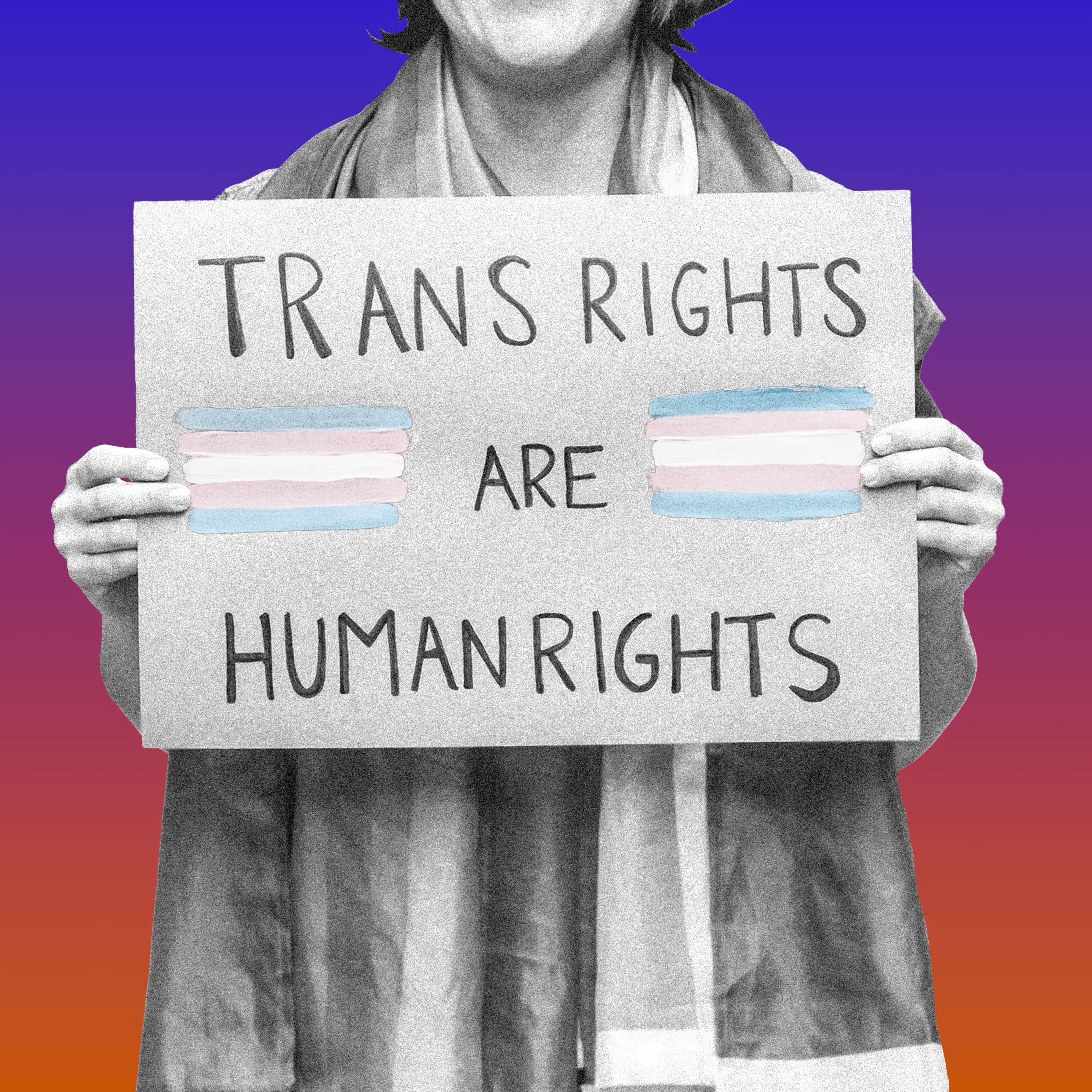
M is an expert in one particular corner of this woke one was crazy debate. The fight for trans rights. M's trans. They saw this discourse popping off a few weeks back and frankly, wondered what it meant for them. Because they can see this strategic turn happening. I think there's a belief in much of the Democratic Party establishment that Trump's anti-trans ads cost Kamala Harris the election.
It's a belief that's very difficult to fact check. Reading those ads, and if you remember, the ads had this tiny clip of Kamala answering questions about the rights of transgender inmates in California prisons. For prisoners, every transgender. An inmate in the prison system would have access. Hell no, I don't want my taxpayer dollars going to that. And then it said Kamala is for they them. Kamala is for they them. President Trump is for you. And you now hear that same line in ads for other people. You can hear that in like a Senate race in Ohio. And we do know that those ads were enormously successful. But the question you have to ask is why were they so successful? Is it because people are really so opposed to somebody being for they them? Or is it that she looked so bad in that clip? In a way that she looked very bad on the campaign trail.
And imagine that she answered, I was the Attorney General of California. I had a constitutional obligation to protect all inmates. And I made damn sure that every single person, whatever their personal gender identity, whatever their sexual orientation, whatever their background, whatever their disability status, was protected and received the proper medical care in the California prison system because that was my job. Yeah, that sounds much stronger. That's not a usable clip.
Nevertheless, this belief has spread so far that I think you do see a lot of Democratic politicians backpedaling in this moment. I think that some sort of two steps forward, one step back is normal in social change and cultural change. What we're seeing, though, is one step forward, three steps back. Today on the show, we're going to try to parse this moment, a moment when Democrats are building a case for themselves all over the country, but also run the risk of leaving some people behind, especially trans people. I'm Mary Harris. You're listening to What Next. Stick around. At Capital One, we don't just use technology. We architect it. Our teams have true end-to-end product ownership. Shipping distributed systems at scale right here in downtown Toronto. That's technology at Capital One. Search technology at Capital One Canada. For most of the history of professional sports, there was a wall between the game and gambling. Then suddenly it was everywhere. Ontario is all in on sports betting. But that wasn't supposed to include the players themselves. Athletes are the perfect gamblers.
Understood the big bet. Find us on CBC Listen or wherever you get your podcasts. So I want to diagram this moment we're in right now when it comes to trans people's civil rights. And I want to do it with you because I think Americans' concerns about trans people.
can get very abstract very quickly. And what I like about your work is that it's highly specific and concrete. And I think that's important right now. You went to Kansas to try to talk to trans people about how they're living their lives. And I just want you to start off for people who may not remember, why Kansas? Why did you want to go there in particular?
So I'll tell you why Kansas, and then I'll tell you why I went, because there's actually two separate incidents. So Kansas passed a law in February of this year that overnight revoked the driver's licenses of people who had changed their gender marker or whose driver's license did not match their sex assigned to birth. And imagine living in the Great Plains and not having a valid driver's license. Pretty much impossible. Yeah, you need a car to go anywhere. Yeah.
And that was widely reported in February when the law passed. And it struck me, you know, I think for Americans, driver's license is a very evocative object. The car is a very American object. The car is a very American object. The driver's license is this thing that makes you an adult when you first get it. For people from other countries, the identity document.
is a very evocative object, right? When I talk to my Russian friends about Kansas, like I can see them have a physical reaction to hearing that the people's main identity document became invalid overnight. Why? Because actually of all the reasons that apply to the United States too, but we just don't often think about it, it's very hard to be actually undocumented. The people we call undocumented are actually documented in the extreme, generally speaking, but it's very hard to move through the world without documents. You can't...
You can't vote in Kansas. Kansas has one of the strictest voter ID laws in the country. That's a civil rights issue right there. You can't pick up your kid from school. You can't enter a building with security. You can't buy alcohol. You can't enter a bar. You lose your world.
You become excluded from the national community. You become worldless, as Hannah Arendt would say. But as a Russian, you also had this experience with identity documents where you realized how they could constrain you, too, right? Well, everybody's identity documents constrain you and give you rights, right? That's the tension. But if you don't have documents, you don't exist. And in Russia, we even have an expression for that, which is, without a piece of paper, you're a little bug. So, you know, that's what really struck me about the...
the passage of that law. And at the time it was reported, and then six months later, people had sort of forgotten about it. But I have a book that's coming out with an academic press. And in the book, I make a passing reference to the denationalization of trans people. And denationalization is also a concept from Hannah Arendt. She wrote about how the destruction of European Jewry actually began with the denationalization of German Jews.
They were forced out of public spaces. They were forced out of certain businesses. They couldn't own bicycles. And then in 1935, German Jews were required to add a middle name to their identity documents. So women had to add Sarah and men had to add Israel to be identified as Jews. And she talked about it as denationalization. And the reason that I mentioned that it's academic press is because it had to go to a reader, right? And the reader sort of pointed out that line and said, well, that's an exaggeration. Trans people are not being denationalized. Not in the Arendtian sense of the world.
And I was like, oh, you know, and this was like an incredibly friendly read. And it was this person wasn't trying to invalidate any answer. And I thought, OK, this is this is somebody I have kind of an idea of who it is, who is very much in the middle of the political conversation, very, very well informed. And they don't know that this is happening. I need to go to Kansas and actually show what demationalization looks like. What did you find when you went there? Well, I found people who experienced it very much the way that, you know, that my Russian friends flinching.
would indicate. People who didn't know whether they could still move through the world. So there are two things, two provisions on that bill that are really scary. One is the driver's license, which I already mentioned. The other is bathrooms. So like many other bills around the country, this one makes it illegal to use the bathroom of sex not assigned at birth. But the Kansas bill, like the 2021 Texas abortion law, creates a bounty.
so that anyone can sue the person that they think is using the wrong bathroom for $1,000. Remember in Texas, the law allowed people who witnessed or thought they witnessed somebody who aided an abortion, an Uber driver, a friend who helped somebody get to the abortion, never mind doctor, nurse, et cetera. Yeah, an ex-boyfriend. An ex-boyfriend, whatever, yeah, to sue that person for $5,000. So that kind of law creates a system and an incentive for watching other people.
which was incredibly effective in Texas. Basically, abortions in Texas ended when that law passed, even though last I checked, no one had actually sued. Yeah. Right. And in Kansas, it creates an incentive for people to be watching other people to see if they're using the right bathroom. Were the people you spoke to feeling that? Oh, yes. How? Well, it's obviously an issue for trans women and for trans men in different ways. I think for trans women...
going into the men's room is not really an option. It's too dangerous, right? So they either avoid going to any kind of public bathroom, which, again, is something that takes you out of the world, or they hope to be able to rely on the kindness of strangers. Yeah, I mean, you spoke to a state legislator, Abby Boatman, who, like, there's one bathroom she can use. She, like, missed a vote at some point or at some kind of point of discussion. She missed a house call, yeah. And she told me another story, which was in some ways even more poignant, right? So there's, like, in the state legislature, in the state capitol, there's one...
old gender bathroom, which is also the lactation room. Right. So there was one time that the room was occupied for a long time and she thought maybe the lock was stuck. So she asked security to open it. And in the open and there's a woman breastfeeding. And Abby was like, well, great. Now you're like pitting a trans woman against a breastfeeding woman. Yeah. There was another person I spoke to who thought she worked in a supportive environment. She is a custodian in a university building. Everybody knows her. I mean, she cleans up after these people. Right. And she's somebody who got originally a letter.
requiring that she change her driver's license. And then after we spoke the first time, like two days later, she got a second letter. And it was a letter from HR telling her that they had been informed that she had been using their own bathroom in violation of SB 244. So it makes you question everyone around you. It was a question for everyone around, right? And then there are trans men who go to the women's bathroom.
And basically explain, if they encounter anybody there, explain that they're following the law. So like, you know, imagine having to come out every time you have to pee. Yeah. I mean, there are so many things that stood out to me about your reporting here. One was the fact that even trans people who complied with this letter.
could find themselves in trouble. So I think 1,700 people, about that many, got this letter saying you need to change your driver's license. You mentioned one person who complied immediately changed their driver's license back to their gender at birth, then got pulled over for something, presented their driver's license, and the cop's like, why is this here? Why are you lying? They're like, well, I'm complying with the law, actually. So it's like a trap. Yeah. And I don't think this trap is unintentional. And also, it's a very interesting illustration of what the state's interest is in this case.
Generally speaking, and there's a scholar named Hazel Cora who does really good work on this, right? He writes about what the point of identity documents is. The point of identity documents is to make it easier for the representative of the state, whether it's a policeman or whoever, to make sure that you are who you say you are. The point of identity documents is not to establish the objective truth. It's to facilitate this interaction between the state and the individual.
So the state actually has, under ordinary circumstances, a vested interest in making sure that the cop who stops you for speeding, or in that case for not having your lights on in the rain, looking at you and looking at your identity document can match the two to each other. So if the gender that they perceive, which in the case of that woman was clearly female, doesn't match the gender that's in the driver's license, that's a problem for the state. Unless the state's interest in identifying trans people supersedes its interest. in just matching person to document, right? Right. And that's what Kansas has communicated to its trans people. We want you to be immediately identifiable, which is also the reason that I think that using the word fascism is right in this case, right? It's exactly what Nazi Germany communicated to Jews when it made them add the middle name or wear the yellow star.
Yeah. I mean, you made this interesting choice in this article, which is very early in the article. You use the word fascism and you basically explain why. I'm going to use this word and it's going to feel hyperbolic, but I'm going to explain to you why it's not. And I thought it was very effective. And I wished more people in power would simply state the case the way that you did. Like not get worked up and like in a lather, but you're like, this is fascism and let me explain why.
Oh, yeah. I wish a lot of our political conversation were less vibes and more evidence. Yeah. Yeah. I mean, the other thing that was in this article that stood out to me was that...
A whole lot of trans people in Kansas had not gotten a letter from the state saying, change your documents, which is interesting to me because I didn't know how to see it. I didn't know. And I'm sure they didn't know how to see it either. Like, should I self-identify at the DMV and like take care of this so there's not trouble later? Or should I remain in my current state? And a number of people seem to have this question. To you, is that intentional too, like creating confusion? I don't think it's intentional, but it has the effect.
that fascist laws have, right? Fascist laws create random legal requirements aimed at particular groups that are being excluded from the political world. And then they also create random enforcement mechanisms. It doesn't really sound like law at all because it's not straightforward. It's not a rule. Because again, the point of the law, right, is to exclude an entire group of people. The point of the law is not to do anything about driver's licenses. Nobody cares about driver's licenses. They care about exclusion. So the situation that's created, right, is people who haven't gotten the letter,
and sometimes go on the Kansas DMV website to check whether their driver's license is valid, you know, and find out that it's valid, don't know if they are quote unquote legal. I mean, because actually they're not, right? The law says that if your gender market was changed, your driver's license is not valid. It's just because it comes up as valid on the Department of Motor Vehicles or whatever they call it in Kansas website doesn't mean that you're complying with the law. But can you also go to the DNA and change your gender marker? Well, actually, you can't just willy-nilly change your gender marker. You have to have some documentation. So they're being forced to be in violation of the law. Exactly. That's how the exclusion works. We'll be right back after a quick break. In 2002, Ryan Wedding was an Olympic snowboarder at the top of his game. He controls one of the most violent drug trafficking organizations in this world. The Most Wanted Olympian. Available now on CBC Listen and everywhere you get your podcasts.
My reg league goalie says he plays for the love of the game. You gave up six goals last week, Steve. Maybe play to win, huh? Like with Bet365, I get paid the second my team goes up big with early payout and can cash out at any time before the game ends. Come on, Steve. Bet365, the home of winning early. Must be 19 and older, Ontario only. Please play responsibly. If you or someone you know is concerned about gambling, visit ConnexOntario.ca or call 1-866-531-2600. Terms and conditions apply.
I noticed in your piece on Kansas, there were a couple of people you did not talk to. And it stood out to me because so much of the public conversation about trans people involves these groups. I'm talking specifically about children. I'm talking specifically about people involved with sports. Why didn't you talk to people in those groups? Because it seemed like a choice to me and an important choice. It's a great question. I mean, I think that it's harder to make the case for gender affirming care for minors.
I would make that case, but it is harder than making the case for not excluding an entire group of adults from public life. And incidentally, we exclude children from public life systematically, which I also think we shouldn't do. And it's harder to make the case for sports. I have written about trans people in sports and I will continue writing about trans people in sports. And I think that that conversation is completely, you know, the people who've made it a political issue have not acted in good faith for one second. And I think that some of the same issues are in play in the sports conversation because really the way that it affects high school athletes.
middle school athletes, whoever, and that's the actual population that it affects, right? We're not talking about elite athletes. That's where this sleight of hand happens, is to exclude them from public life, right? To exclude them from public life from an early age. But here I wanted to focus on people whose belonging in the public should be uncontroversial. You know, just adults who are not in prison. Yeah. And, you know, it's interesting that you asked that question. I sort of feel compelled to defend that choice because another way to look at it is, well, look, you know, I don't like...
When I write about some particular Jewish issue in the United States, nobody asks me why I'm not writing about all the other Jewish issues. Trans people have a lot of different things happening to us. You know, I had a political strategist on my show a few days back, Sarah Longwell. She's gay. She's a former Republican. And I basically pressed her on this issue about whether strategists like her are willing to basically accept soft bigotry on trans issues, immigration issues, because they think they need to do so in order to win.
And her point to me was that she thinks people need to be more patient with American politicians and Americans in general as they go through a big social change. Basically, don't force politicians to take a stance here if they don't have to. And I was just curious what you made of that take. You know, I mean, it sounds to me from your description that she didn't answer the question. Like, yes, it takes time for cultural change to take hold. And yes, it usually happens to step forward one step back. And yes, we should absolutely be willing to talk to people who are potential allies, but haven't gotten all the way there. And that, you know, that to me applies to people who are okay with trans adults.
but have the heebie-jeebies when it comes to trans kids. And it also applies to people who were ardent Zionists three years ago and have come to doubt their Zionism, but think the only problem is Netanyahu, right? These are positions that are very, very far from my own political beliefs. But I think it's important to talk to people as they make their way out of their political comfort zone or their cultural comfort zone. But that's not the question you ask, is it? I think the question you were asking is,
A lack of clarity on major cultural issues, whether or not they deserve to do major cultural issues. Is that lack of clarity a viable political strategy? And it's not. It never is. To me, it all broke down because the people being targeted now are often children, like literally the most vulnerable. And I'm like, I just but I did feel myself getting stuck in the like, I just think this is wrong. And I was like.
That's what I got here. Yeah, and I just think this is wrong. It's not unique to you. Even people who, again, have the heebie-jeebies when it comes to kids, which is what makes this such a powerful political tool, they think there's a right and wrong here. And dealing with politicians who will not say that there's a right and wrong is really unsettling. We expect leadership from politicians. And if the right has succeeded in making trans kids, trans adults, trans athletes into
political issues, then you have to take a stand on it. Yeah. Em, I'm really grateful for your time and for a little extra time. Thanks for coming on the show. Thank you for having me. Em Gessen is a Pulitzer Prize winning opinion columnist for The New York Times. And that's our show. What Next is produced by Evan Campbell, Madeline Thames Ducharme, and Patrick Fort. Paige Osborne is the senior supervising producer of What Next and What Next TBD. Mia Lobel is the executive producer of podcast here at Slate. Ben Richmond is the senior director of podcast operations. And I'm Mary Harris. You can go track me down on Blue Sky. I'm Matt Mary Harris. Thanks for listening. Catch you back here next time.
At Capital One, we don't just use technology, we architect it. Our teams have true end-to-end product ownership, shipping distributed systems at scale right here in downtown Toronto. That's technology at Capital One. Search technology at Capital One Canada. Support comes from Wise, the smart checking account for home and abroad. Got a Canadian salary, property in the U.S., sending money abroad? You're juggling multiple accounts, currencies, and a headache. Manage it all the smart way with Wise. Save up to 65% on exchange fees and give your everyday money a boost with interest. Plus, switch your direct deposit to Wise for the monthly chance to double your paycheck. Be smart.
Get Wise. Canada residents only, excluding Quebec. Up to 60 winners. Odds depend on entries. Offer ends September 14, 2027. Learn more at wise.com.