What people get wrong about Joe Biden, memory and aging
from The Signorile Report Hosted by Michelangelo Signorile
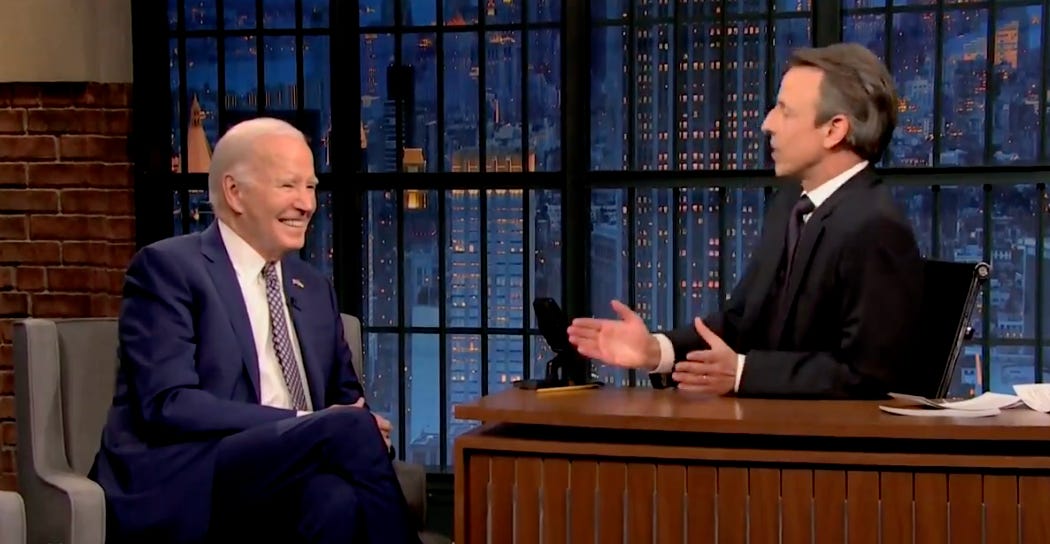
President Biden on “Late Night with Seth Myers” last night, joking: “You gotta take a look at the other guy. He’s about as old as I am... but he can’t remember his wife’s name." Last week, Dr. Charan Ranganath, a University of California, Davis, neuroscientist who focuses on the the study of memory, came on my SiriusXM program to discuss the issue that had blown up in the media: President Biden’s age. He’d written an op-ed for the New York Times that was a rare bit of solid media coverage in a sea of sensationalism. There is a lot of misunderstanding—and a great many stereotypes—about aging and the brain. That is certainly clear if the polls are to believed (or even are close) regarding Americans’ concerns about President Biden (even if it’s not going to change the way they vote, according to most of those same polls). And our media hasn’t done much to enlighten people, choosing instead to feed their worst fears. So I invited Dr. Ranganath on my program to give us some insights. You can listen to the full interview here. A transcript, slightly edited for clarity and space, is below. Let me know your thought! The Signorile Report is reader-supported. If you’ve valued reading The Signorile Report, consider becoming a paid subscriber and supporting independent, ad-free opinion journalism. Thanks! Michelangelo Signorile: I'm so looking forward to this conversation. Why are so many people thinking about President Biden's memory and age, and that includes the majority of Americans—if we're to believe polls—in the wrong way? I'm really glad to have on the program Dr. Charan Ranganath, who is a professor of psychology and neuroscience and the director of the Dynamic Memory Lab at the University of California, Davis, and the author of a book soon to be published, "Why We Remember: Unlocking Memory's Power to Hold on to What Matters." Doctor Ranganath, thank you so much for joining us. Dr. Charan Ranganath: Well, thank you for having me. I'm always excited to share the word of memory with people. MS: Yeah, it's really been dispiriting seeing a lot of the way this has been discussed, because the media coverage has been just overwhelming, the discussion of President Biden's age and then how that connects to the issue of memory and the issue of decision making, which connects, obviously, to memory. And what's been dispiriting is not necessarily the discussion of it, because obviously it's something that Americans are concerned about, at least a certain number of them. But there really hasn't been a sort of moment of education about what it really means. And you provided that in an op-ed that you wrote in The New York Times. Talk a little bit about the way that we're looking at this and why it's not quite getting it right. People are not separating out the different kinds of memory, or, as you say, forgetting with a small f and Forgetting with a capital F. CR: Yeah, I think this is a very important issue. And, you know, I want to be clear that this isn't—this is something that cuts across party lines. I mean, Donald Trump is also fairly advanced in years. And, let's face it, 1 in 6 Americans are over the age of 65. So I think when I read Special Counsel Hur's report, or at least the quotes from it, and have gone through a little bit of it, it just seemed to be hitting at people's stereotypes about aging. And when I actually read the piece, a lot of the examples of what they were talking about with Biden's forgetting were not actually the kinds of things that I would worry about as someone who studies memory. So, as you pointed out, I say that there's forgetting with a lowercase f and there's Forgetting with the capital F. So we all do both. Let me be clear but let's first talk about the first one, which is really what researchers would call retrieval failure. And this is when the memory is there, but we just can't find it. So these would be things like, you know, I had a conversation with you yesterday and oh, what were we talking about again? And then a day later it comes to you. So that's one of the memories there, but you can't get it. That happens a lot as we get older. On the other hand, there's Forgetting with the capital F, which would be like, I had a conversation with you yesterday, and I have no memory of it whatsoever. And that would be Forgetting with the capital F. Everyone who's been studied shows some kind of Forgetting [with a capital F], but it does happen a little bit more as we get older. But really, if it happens a lot and it happens for things that happened just a short while ago, then I would be worried about that. The examples that I've seen from Biden, however, they don't seem to be forgetting with the capital F. So, for instance, there's nothing that indicates that he couldn't remember anything from his last year of his vice presidency or, around the time that his son died. And yet he just couldn't name the years in which these things happened, which is something that does happen a lot with age. People will remember what happened, but they start to lose some of the details about the context, or they just have trouble pulling it up when they need it. Some of the other issues that I think were brought up weren't even memory issues at all. They're things like, you know, mixing up in the media. People made a thing about mixing up, instead of saying the president of Egypt, he said, the president of Mexico. And it's not like as if the president doesn’t know the difference between Egypt and Mexico, right? It was what people would categorize as one of Biden's gaffes, which is not finding the right word when you need it. And again, this is something that happens to many people. As you get older, you make more of these verbal mistakes, and you can't necessarily correct it as quickly. But that doesn't mean that there's a memory problem there. MS: I speak three hours a day every weekday, and this must happen to me every day or every couple of days. I mean, you pull up the wrong word, you pull up the wrong name. I think I just did it with neurologist versus neuroscientist. Right. So, I mean, it does happen to all of us. And there's also, I mean, I speak to people who I've known for many years and tell me about something that happened like 30 years ago. And like, I realize I've forgotten that whole thing. And yet I remember it when they tell me. That’s pretty normal, too, right? CR: Oh, yeah, that's a perfect example of lowercase f forgetting. Because often the memory is there, and we just can't find it when we need it. I have all sorts of experiences like this, too, both with the kind of mixing things up. In fact, just yesterday I did an interview where I was literally talking about Biden, and I couldn't find the right word, and I said the wrong thing, and I had to correct myself and do the take over again, so I can relate. MS: So that's where I think there has been an enormous amount of misunderstanding in the public and not enough educating. And it's such a moment to educate people about memory and about aging and how they are not understanding how it works, because if we're to believe some of the polling or the interviews, people seem to believe that because somebody, doesn't have of the word, you know, correct at a particular moment in talking about a country or, doesn't seem to be speaking at a certain speed or is speaking in a slower cadence or something, that it means that it somehow affects their ability to make major decisions, major, complex decisions about foreign policy, or other issues. I even heard people in a focus group saying, it makes me worried that he'll forget where the nuclear codes are or something like that. So talk a little bit about that and how that is just a complete misunderstanding of how this works. CR: Well, yeah, I mean, first of all, I don't know much about how the presidency works. I imagine that he doesn't really have to seriously memorize nuclear codes and keep them at a moment's notice. I'm sure there's more of a process to it… This is a public episode. If you'd like to discuss this with other subscribers or get access to bonus episodes, visit www.signorile.com/subscribe
Embed this episode
No transcript yet.