
EPISODE · May 27, 2026 · 11 MIN
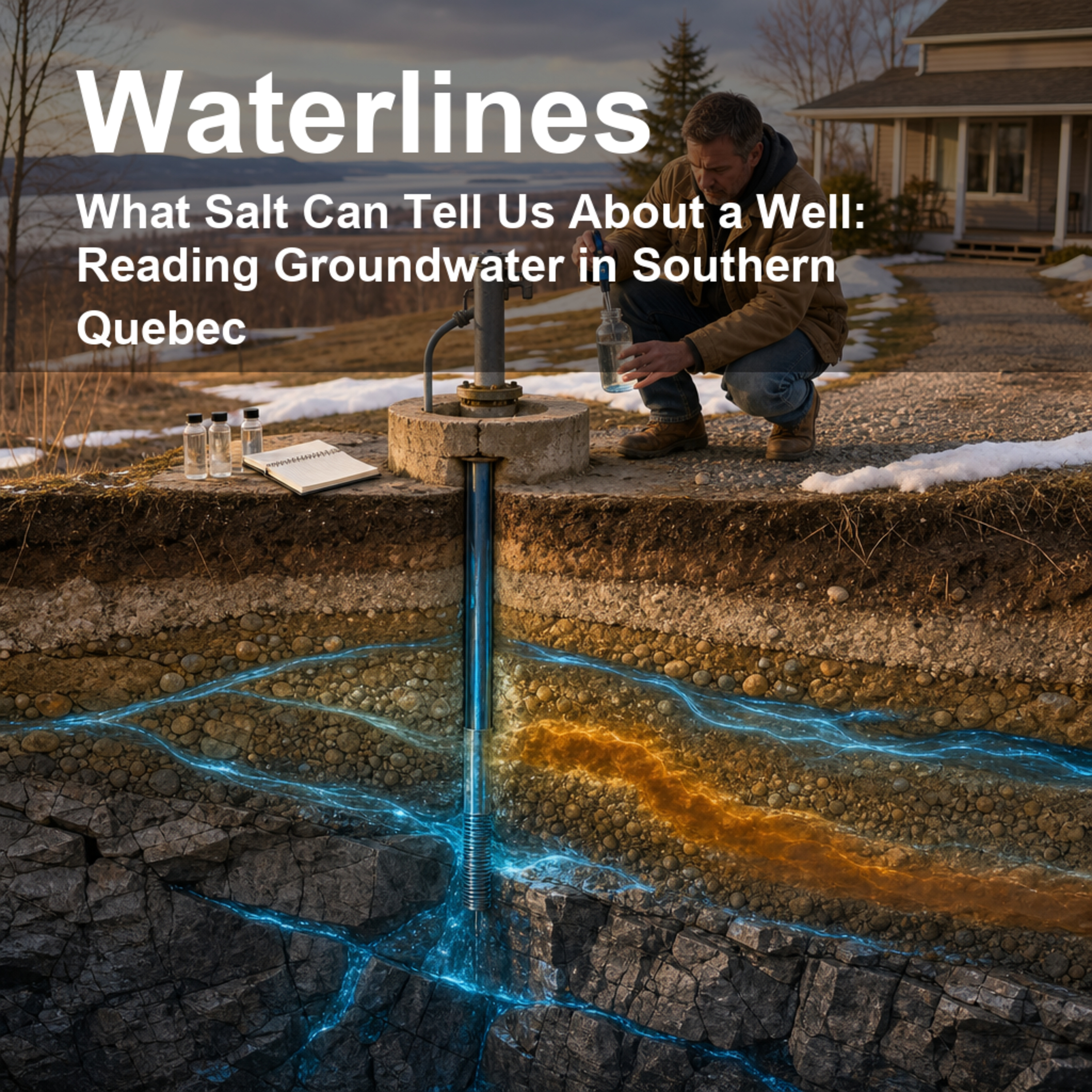
What Salt Can Tell Us About a Well: Reading Groundwater in Southern Quebec
from Waterlines: How Water Shapes Our World · host jaywen
A glass of well water can look perfectly clear and still carry a hidden story from ancient seas, road salt, bedrock, clays, and slow underground flow. This episode matters because millions of people rely on private wells, and testing every possible chemical is expensive. We explore a practical question: can one easy field measurement give homeowners and water managers an early clue about what else may be in groundwater?The paper takes us to Southern Quebec, where researchers used 2,608 groundwater samples from a large public knowledge program. They sorted the samples by chloride, a common marker of salinity, then watched how 12 other dissolved ingredients changed along that saltiness scale: bicarbonate, sulfate, calcium, magnesium, sodium, potassium, boron, barium, strontium, silicon, manganese, and fluoride. Their key insight is not that chloride explains everything, but that it often travels with a broader chemical shift. Low-salt waters tended to look more like calcium-bicarbonate groundwater; high-salt waters shifted toward sodium-chloride water, with some elements rising along the way.We talk through how a simple electrical conductivity reading, taken in the field, can be converted into an estimated chloride level and used as a rough chemical profile. We also emphasize the limits: this is a regional, empirical model, not a replacement for drinking-water testing, and high-salinity samples were fewer than low-salinity ones. Still, it offers a powerful public-science lesson: groundwater quality is shaped by geology, history, and human choices, and sometimes a single signal can help us ask better questions.Citation: Boumaiza, L., Walter, J., Chesnaux, R., Stotler, R. L., Wen, T., Johannesson, K. H., Brindha, K., & Huneau, F. (2022). Chloride-salinity as indicator of the chemical composition of groundwater: empirical predictive model based on aquifers in Southern Quebec, Canada. Environmental Science and Pollution Research. https://doi.org/10.1007/s11356-022-19854-zDisclosure: This Waterlines episode package is written for public science communication and uses AI-generated voices for the hosts.
Embed this episode
NOW PLAYING
What Salt Can Tell Us About a Well: Reading Groundwater in Southern Quebec
No transcript for this episode yet
Similar Episodes
No similar episodes found.
Similar Podcasts
No similar podcasts found.