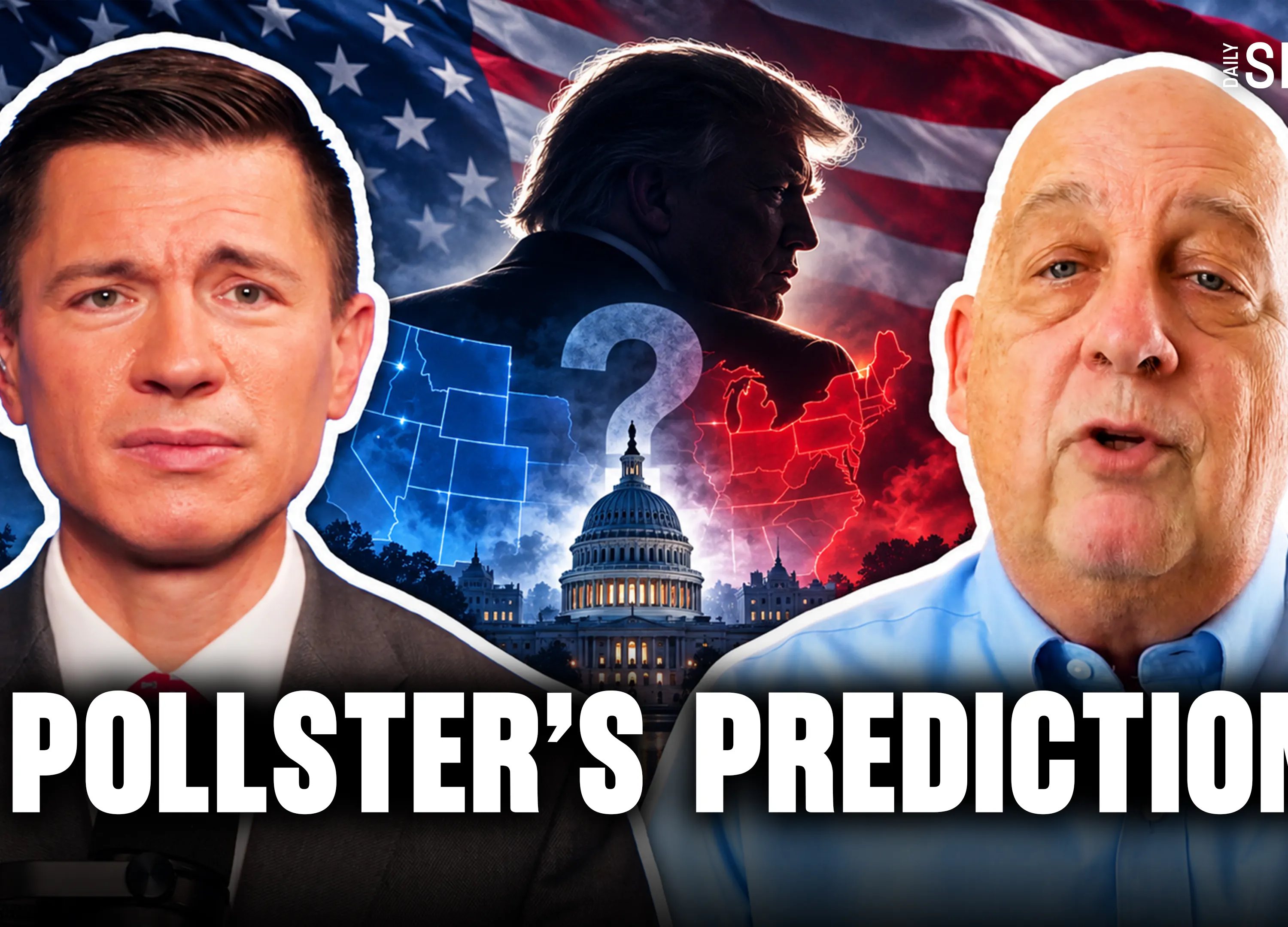
Welcome to the Daily Signal podcast, where we provide intelligence for the intelligent. Now, without further ado, here's today's take. Ken Paxton in Texas, you know, that race is far closer than anybody expected it to be or Republican wanted it to be. Now, Republicans believe it's still Texas. You're undercounting voters, Republican voters, and he's going to pull it out. And that may very well happen because there's something that I call political gravity. You know, those people who are undecided about whether they're going to vote or who they're going to vote for, at the end, usually come home to the normal drift of that state.
We are joined on The Daily Signal today by Scott Rasmussen. He is the president of RMG Research. You can find a lot of their polling work on the Neapolitan News website and social media feeds. It's certainly a reliable source that we turn to at The Daily Signal for the latest. Scott, thanks for joining us today. Rob, happy to be with you. It seems like we do this every election. I do. I remember two years ago, the interview that we did just took off. It was one of those viral interviews where people were really eager to have somebody who has experience like you do explain so many of the numbers that are being thrown at them on a daily basis. And so I thought it would be appropriate to start.
by just reminding people about maybe what is the most important polling question that they could be paying attention to, or if there's more than one, you can share that as well. Well, you know, in a typical election season, especially in a midterm, the single most important thing to pay attention to was described by James Carville in 1992. It's the economy, stupid. How are people feeling about the economy? And right now, by the way, they're pretty depressed. That's the defining feature of any election. And, you know, beyond that, that sets the baseline. Then you can look for particular issues or candidate quality or some other things.
But I always start with how are people feeling about their own personal finances? Are they getting better or worse? And I'll just get to it right away. The reason we're in the political environment we're in today is because people are just as pessimistic about their personal finances today as they were on the eve of election 2024, two years ago. Scott, we know that Donald Trump capitalized on that frustration that people had about their personal finances that propelled them back into the White House.
I hear people within the Trump administration talking about all the positive economic indicators, the investments that are happening in the United States and states across the country. I mean, you hear President Trump say it as he's barnstorming across the country, predicting strong fourth quarter growth. And yet there seems to be a disconnect between some of those economic metrics and how people perceive on their own personal level. Can you unpack or explain why that might be? Well, let me let me do this in two parts. When we break down polling on this, we find that the people who are part of the Trump base still strongly approve of the way he's handling the economy and even strong 74 percent of the Trump base.
approves of the way he's handling the issue of inflation. The challenge is that more traditional Republicans, not even just Democrats, more traditional Republicans, they're not at all happy. Only 26 percent of them approve of the way the president is handling inflation. So if you're part of the administration, if you're part of that Trump base, you're looking at those economic metrics and you're saying, wow, these are good indicators that the market's doing this and we're going to have good growth. hardly anybody else in America is seeing that. Now, the reason is, and I think it's because when we use a term like the economy, economists and political people look at GDP growth and all kinds of other indicators.
For most voters, it has to do with their own personal situation. It's not really about the economy. It's about their lifestyle. And why I bring that up is more than half the country, just over half of all voters live paycheck to paycheck. If you live paycheck to paycheck, you know, most of your money goes to rent or a mortgage. It goes to car insurance, car payments, all those basic things. And you have a limited amount of cash to spend each week, a little limited amount of discretionary spending. When the price of gas goes up.
That amount of discretionary spending for everything else goes down. In fact, the biggest thing that people cut back on when gas prices go up is groceries. People who are a little more affluent cut back on eating out and they have more meals at home. So when the Trump administration is talking about the statistics and the economy, by the way, the same as the Biden team did two years ago, they're really missing that impact because every week when you go to the gas pump, you feel like you got a pay cut from the week before. And that's the primary driving force in this pessimism.
And Scott, here we are just two years removed from the last election when Democrats were thrown out because Republicans made a case that they were better stewards of the economy. Do people just have short memories or is it really just an anti-incumbent mentality that we're seeing across the country right now? Well, from the moment Donald Trump got elected, from the moment he won the election up until February of this year, people were feeling less and less pessimistic about the economy. I mean, there were hiccups along the way during the government shutdown or other things. But broadly speaking, for about a year and a half, people were feeling better and better. In fact, we reached the point where the number of people who told us their finances were getting better finally equaled the number who say it was getting worse. If you had asked me in February, I would have said if the trend continues, the trend that we've been seeing continues.
the Republicans are going to have a very good political environment in November. However, I didn't anticipate the war with Iran. And I want to be clear, what I'm about to say is not a policy question about the wisdom of the war or how evil Iran is. Clearly, they're a force for evil in the world. But from a purely political point of view, that war has been a disaster for the GOP. Pessimism spiked on the economy, along with gas prices going up. It's dragged on far, far longer than people thought. And we're seeing it play out in a lot of different ways.
One of the most significant, by the way, is that within the Republican Party, the Trump base has been shrinking and people are beginning to say maybe we should be looking for something else. So that war with Iran, it's not short memories of voters. It's not anything else. It's that that particular policy decision changed the dynamic. Thank you for explaining that. You also track President Trump's approval. And as you talked about that base perhaps shrinking, President Trump has made this election very much about himself. You see him every day on the campaign trail and you've even heard him say, pretend that my name is on the ballot because we know from previous elections when Trump's name is not on the ballot, Republicans tend not to fare so well. How do you think that's ultimately going to play? Could that backfire in some districts across the country where his popularity has sunk into the 30s? Absolutely. We asked a question a week ago about when you go to the polls, you're going to be looking for someone to.
place a check on the Trump administration or to support the Trump administration. And by a two to one margin, voters are saying we want to place a check on it. And once again, you have this divide within the Republican Party. The Trump base naturally wants candidates who will support the president. But the more traditional Republicans say, we think we need to check on this. And look, I believe the administration made a mistake strategically. I believe when the president says it's about him and he wants to he was trying to drive out, get the base out to vote. The reason I say that's a mistake is because the Republican base, the Trump base.
who remains fired up about voting in the election. Those who remain part of the base are just as fired up as Democrats, and usually the opposition party is more enthusiastic. It is those more traditional Republicans, maybe someone who voted for Trump in 24 because he was the lesser of two needles in their eyes. Those voters decidedly unenthusiastic about this election. I think more attention should have been paid to getting them out to vote. But, you know, that was a decision made some time ago, and there's really not much that can be done about it at this point.
That's interesting. I heard Speaker Mike Johnson, he had during an appearance on Laura Ingraham's Fox News show, talking about how he doesn't trust the polling. He says that when he goes to these rallies, there is great Republican enthusiasm. He cited a couple of these polling firms, these fake polling firms, Wedgwood and I think SoCal Strategies, that have come out and said that they deliberately did things just to see if news organizations would bite. So really a two-part question here. I'd like to address, I'd like to come back to the fake polling firms in just a moment. But when you hear somebody like a Speaker Johnson talk about that,
Is that just campaign talk? Or is there a reality that there could be a situation where Republicans really do turn out to vote, maybe both the MAGA base and the traditional Republicans, and we're in for a surprise on Election Day? Well, Speaker Johnson, I believe it's just campaign talk. But there is a reality that the polling could be off by a couple of points. And just any minor changes, there are so many close races, could have a huge impact. But I think, you know, if you want to look at this in perspective, the problem is not so much the polling, it's the analysis of the polling. You and I have talked before.
Back in 2016, the year that supposedly the polls got it all wrong, the polls were actually very good. The national polls predicted Hillary Clinton would win the popular vote by three points. She won by two. In 47 of the 50 states, there were no surprises. There were three states that surprised us on election night that year, Michigan, Pennsylvania, and Wisconsin. In Michigan and Pennsylvania, the polls showed that the race was within the margin of error, and the last poll in each of those states showed Trump ahead. Only in Wisconsin was the polling way off.
But what happened was the people who were on TV talking about that race couldn't imagine that Donald Trump would win. So they looked at the data and they said, well, Hillary's got a little bit of an edge in Michigan. She's clearly going to win that. It was it was an analysis error. So this year, look, I don't know what's going to happen, say, in a state like Texas. Tallarico is up by a point or so in the polling averages. On the other hand, it is Texas. There is political gravity. They may pull Ken Paxton across. If Ken Paxton wins by a couple of points and the poll said he was going to lose by a point.
That's not really a polling error because a one-point lead is just telling you this race is too close to call. And a lot of times we make those assumptions. And then, of course, with the benefit of hindsight, we said, well, I knew that polls were on all along. Is it, one of the other things, I do want to get to the fake polling first, but one of the other things that I heard Speaker Johnson say is that Republicans don't respond to the polls, to calls or, you know, different methods that you use to find voters. Is it increasingly difficult to get people to participate in polls? I mean, you've been doing this for a long time. You're somebody that would obviously know what it's like to actually engage with voters.
It is much more difficult. I mean, just to give you a sense of scale and also to unfortunately date myself, you know, when I started polling, the new technological challenge for us was answering machines. People can start to screen their calls. It used to be they just picked up the phone. So yes, it is far more difficult. And I think the challenge isn't so much that Republicans are unwilling to take polling calls or other things. It has to do with the dynamics.
of the types of people who take polls. People with a postgraduate degree love taking polls. They are among the most avid respondents. Well, people with a postgraduate degree voted for Kamala Harris by nearly 30 points two years ago. People in the most rural areas, fewer than 250, fewer than 500 people per square mile, they take polls less than other people. So unless you make a real effort to include all of these groups, you are going to have a biased sample of some sort. And I'll just give a really simple example, Robbie. A lot of pollsters say we have a split between people with a college degree and without a college degree.
That's not good enough because you have to make the distinction between postgrads and bachelor's degree. People with a bachelor's degree have much more in common with people without a degree than they do with the postgrads. Look, the details aren't as important to what I'm saying. You have to get a good sample. Right now, the people that are hardest to get on the polls are those who are likely to lean Republican. So you have to make a special effort.
That's good to know. Thank you for explaining that. Scott, I do want to come back. And you reminded me, I have to ask you about the 1%, which we've talked about quite a bit in the Elite 1%. But let's talk about these fake polling firms. You're somebody, and you're not alone in the polling business, who really stakes your reputation on having accurate, high-quality results that the American people have come to rely on. And certainly as I started this conversation, I said we do at The Daily Signal, rely on the work of you and others. So on the one hand, how damaging is it to have these fake firms come out just simply to try to manipulate a news cycle or change the narrative about a race? And what can be done? What can we in the news business and the media do?
make sure that we're scrutinizing when we receive a press release that's potentially fake. Yeah, it's obviously embarrassing when something like this comes out. And then if you come out with a poll somebody doesn't like, they'll tell you you're just like those other fake polls. I think, though, the bigger embarrassment should be for the media and for the polling aggregators who published those polls. And this is a problem that goes back a long way. You know, back in the early 90s, I was the first pollster to put information directly on the Internet. And back in those days, we still had print newspapers and a thing called the Burrell's Clipping Bureau.
And I would start to get clippings from newspapers who had read my poll online, published the results, and never called, never asked a thing. So there was an opportunity for problems right from the beginning, and somebody took advantage of it. What can you do about it? If I was creating a polling average today, I would not include anybody who didn't have results from a previous cycle. Prove to us that you're a credible pollster by performing one year, and then we'll consider you for the next time. Media outlets should probably focus more.
on polling averages, less on individual polls like that. But again, if a poll, if someone puts out a poll and you want to report on it, I think it would be incredibly important to say, we've never heard of this firm. They've never polled before publicly. Whatever it is you're going to do. But it's a real problem for anybody in the broader election forecasting and news industry.
Well, take that to heart. We'll certainly appreciate your advice here at The Daily Signal, Scott. Let me talk about some of the specific things that we should be watching for on election night. Obviously, there is big implications for the final two years of Donald Trump's presidency if the House or the Senate flip. So when it comes to the House...
So what races or what trends would you be following on November 3rd? And won't we even know an answer on November 3rd? I don't know. That's a question I think a lot of us can't answer because these elections may be so close that there could be recount. But let's start with the House. What sort of things are you seeing in House races that our viewers should pay attention to? The first thing, to put it in perspective, we rate every race as either safe, likely, lean, or a toss-up. And currently, we have 224 House races that are either safe or likely Democrat.
So that's six more than they need for the majority. You know, if we're right on those ratings, the Democrats are going to take control. And the only question is how many seats. I don't think it's going to be a mass. It's not a Tea Party type of tsunami, but they could have a decent margin. So what I would watch for on that are signs in the earliest races that are called. Are there any surprises in that? Are there particular races where we thought or any of the forecasters thought was going to go to a Democrat and instead it went Republican or instead it's too close to call hours and hours after the.
polls have closed. I don't expect to see that, but if we do, you know, there is an opportunity for the Republicans to retain control, but it's pretty slim at this point. Even when we look at the upside scenarios for the GOP, they could barely be clinging to power. And so I think, you know, my, what's the old line, you know, nothing is certain in life except death and taxes. Well, control of the House isn't quite that definite, but it's getting there.
OK, let's flip over to the Senate now. The Senate was supposed to be the backstop that Republicans would have. It was a tough, tough cycle for Democrats. And yet we see Democrats competing in places like Alaska and Kansas and even Mississippi, where President Trump was this week. Yeah, this is something that is a direct result of the economic concerns. And and I think it's also a little bit of you hinted at it earlier, the idea that President Trump wanted to make it about him. And I think maybe more than that, this idea we haven't seen.
a consistent, disciplined message from the Republican side saying, this is why we're in Iran. This is why we have to endure these high prices. You know, let's stay the course. We have seen distraction after distraction on the campaign trail, and that's been a problem. So when you look at the Senate, In our ratings right now, we have 47 seats that are safe or likely Democrat. 46 are safe or likely Republican. Seven are competitive. Four of them, we count as pure toss-ups. Three are leaning a little bit in the Democratic direction. What does that mean? It means there are seven seats that we really don't know who's going to win. And some of them have oddities. In Maine, the numbers tell me it should be a Democratic seat.
it's really hard to bet against Susan Collins because she always does better than the numbers. So if we find out early in the evening that she's winning, well, that's a good bonus for the GOP. Ken Paxton in Texas, that race is far closer than anybody expected it to be or Republicans want it to be. Now, Republicans believe it's still Texas. You're undercounting voters, Republican voters, and he's going to pull it out. And that may very well happen because there's something that I call political gravity. Those people who are undecided about whether they're going to vote or who they're going to vote for.
at the end, usually come home to the normal drift of that state. But let's watch and see what happens in that. It's probably the most significant. Probably, and certainly a significant amount of money. Yes, yes. Unbelievable. Not just on that one, but all across the board. I want to also say, some of these things we're talking about, like Alaska, we're looking at that as leaning a little bit in the Democratic direction, but you can't have a lot of confidence in that for two reasons. Number one, it's notoriously difficult to poll in Alaska. Few people do it well. So we don't have...
the data that we do from other places. Second, they've got a ranked choice voting system that is still a work in progress. So nothing would surprise me coming out of a state like Alaska. We could very well end up with a 50-50 Senate, and that raises all kinds of other crazy possibilities. It sure does, yeah. Power-sharing agreements and all sorts of things that'll probably take a long time to sort out. Scott, I had a couple of final questions for you. In the past, we've talked about the elite 1%. I'm wondering if you have any updates you're able to share on that group of voters and just how different they think about the issues than perhaps your everyday American.
Well, to suggest that they don't see the same world as the rest of us is a gross understatement. Remember now, our definition of the elite 1%, it's an influence elite, not the 1% richest people in the country. These are people who have a postgraduate degree. They live in densely populated urban areas and they make a lot of money, but not Elon Musk type of money. And consistently, these voters tend to have less faith in voters and more faith in government. Nothing we've seen in the last year has changed that. Half of these voters think you should, half of these elites think you should not.
be allowed to vote unless you have a college degree. That's a little bit unnerving from my perspective. But Rob, you've given me a great chance to plug a book. I wrote a book earlier this year. That was my last question. Tell us about the book, Scott. Oh, good. Well, the book is called Out of Touch, The Elite 1% and the Battle for America's Soul. And this really is what drives this distinction. There has been a move going on since the late 19th century to overtake, to reject America's founding ideals of freedom, equality, and self-governance. I trace it in the book all the way back to Woodrow Wilson.
who openly advocated for a Prussian form of government. He wants unelected bureaucrats to set the rules and to protect them from influence by voters. Exactly the opposite of a system where you're supposed to get your authority from the consent of the government. So I talk about the book. I talk about the elite 1%, some of the issues, but the real takeaway from it is given away in the fact that I dedicated the book to the nation's 519,000 state and local elected officials. These are the people that we need to lift up and support and empower.
if we want to get back to our founding ideals. They're closer to the people. You know, if you're a city council member in most places, you run into your constituents at a grocery store. I suggest lots of ways we can do that, lots of things that we can do. And, oh, by the way, at the end of the book and all the way through everything I see through this election season, I remain an optimist. America's best days are still to come. And the reason for that is because despite what our political leaders sometimes do, the American people continue to embrace the founding ideals of freedom, equality, and self-governance.
Scott Rasmussen, thank you so much. Ending on a high note there and an optimistic tone as well. Certainly appreciate your belief in that concept of subsidiarity. I certainly take it to heart in my own community. And I think that that's one thing that everybody who's listening or watching today, yes, you really can have an influence over the direction of this country. But oftentimes it starts right in your backyard close to home. We'll be sure to include a link not only to the book, but to the polling resources that you've discussed.
today. And Scott, thank you. Hopefully, we will not be in store for a drawn out weeks long waiting period here after Election Day. But always appreciate your insights and helping us to better understand what to make of the numbers. Thanks, Rob.
Many Americans are going to have a big wake-up call. We have never seen net migration as high as it has been in the last few years. This year, there have been more people coming to the UK in small boats than ever before. You did an extreme thing to the country. Britain is facing a migrant crime epidemic. We don't actually know where they're coming from, who they are, how old they are. Why would you let in millions of people who are undeaded if not to change the country from within? There is no other word for it. Demographic replacement.
The Immigration Crisis. Watch now on the Heritage Foundation's YouTube channel.