
EPISODE · Feb 6, 2026 · 1H
What theory is not, theorizing is. (Weick 1995) - Weekend Classics
from Revise and Resubmit - The Mayukh Show · host Mayukh Mukhopadhyay
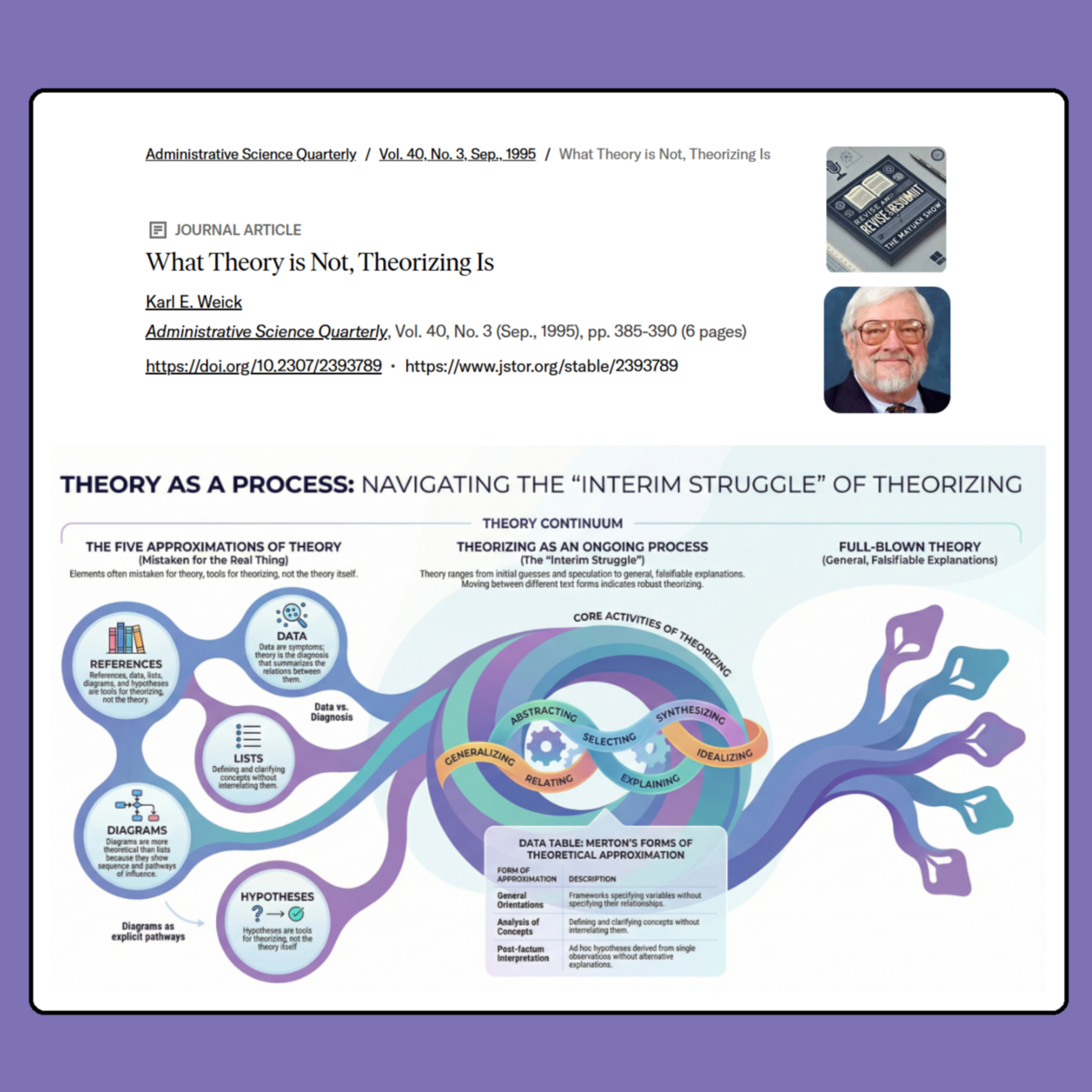
English Podcast starts at 00:00:00Bengali Podcast Starts at 00:18:35Hindi Podcast Starts at 00:34:08Danish Podcast Starts at 00:45:51ReferenceWeick, K. E. (1995). What theory is not, theorizing is. Administrative science quarterly, 40(3), 385-390. https://doi.org/10.2307/2393789Czarniawska, B. (2005). Karl Weick: Concepts, Style and Reflection. The Sociological Review, 53(1_suppl), 267-278. https://doi.org/10.1111/j.1467-954X.2005.00554.x Youtube channel link https://www.youtube.com/@weekendresearcherConnect on linkedinhttps://www.linkedin.com/in/mayukhpsm/Welcome to Revise and Resubmit 🎙️, and to our episode series, Weekend Classics 📚✨There is a particular kind of academic heartbreak I know well. It happens late at night, when I have a document open that feels both heavy and fragile. Heavy with citations, tables, careful wording. Fragile because I can sense, in the quiet behind the sentences, that I am still circling what I really want to say.I remember one such evening: my notes sprawled like a minor accident across the desk 📝☕. I had the familiar pile of “almosts” that academia rewards and punishes at the same time. A paragraph of claims. A diagram that looked persuasive until I stared at it too long. A list of constructs that behaved like labels, not explanations. I had evidence, yes. But I did not yet have understanding.Karl E. Weick’s 1995 article in Administrative Science Quarterly (Volume 40, Issue 3, October 1995) has the calm, surgical honesty of someone who has watched this struggle for decades 🔍🧠. The paper is titled What Theory is Not, Theorizing Is, and its central move is deceptively simple: stop treating theory like a monument, and start noticing theorizing as the worksite.Weick argues that what we often submit as “theory” in organizational research is usually an approximation, a text written in lieu of strong theory. And here comes the clinically precise part: references, data, lists, diagrams, hypotheses, these five things can look like theory from a distance, but they are not theory in themselves. Still, dismissing them outright can be a category error with real consequences. Because the same outward artifacts can come from two very different internal conditions: lazy grafting of theory onto stark data, or an earnest, interim struggle inching toward something sturdier.That distinction matters. In medicine, we do not confuse a symptom with a diagnosis, or a test result with a treatment plan. In scholarship, Weick reminds us, we should not confuse the scaffolding with the building 🏗️. The scaffolding may be all you have at first, and it may be exactly what you need to keep climbing.So today, in this Weekend Classics episode, I want to sit with that uncomfortable in-between: the stage where your work looks like fragments, but might actually be the beginnings of form. The stage where “not theory” can either be a warning sign or a progress report 📈🧩.Before we begin, subscribe to Revise and Resubmit on Spotify 🎧 and check out our YouTube channel, Weekend Researcher ▶️. You can also find this podcast on Amazon Prime Music and Apple Podcast 🔊🍏.And with thanks to Karl E. Weick and SAGE Publications 🙏📘, let me ask you this: when you look at your own references, data, lists, diagrams, and hypotheses, do you see an attempt to decorate a result, or the first honest footprints of theorizing in motion? 🤔
Embed this episode
Ready to play
What theory is not, theorizing is. (Weick 1995) - Weekend Classics
No transcript for this episode yet
Similar Episodes
No similar episodes found.
Similar Podcasts
No similar podcasts found.