
EPISODE · Jul 1, 2026 · 51 MIN
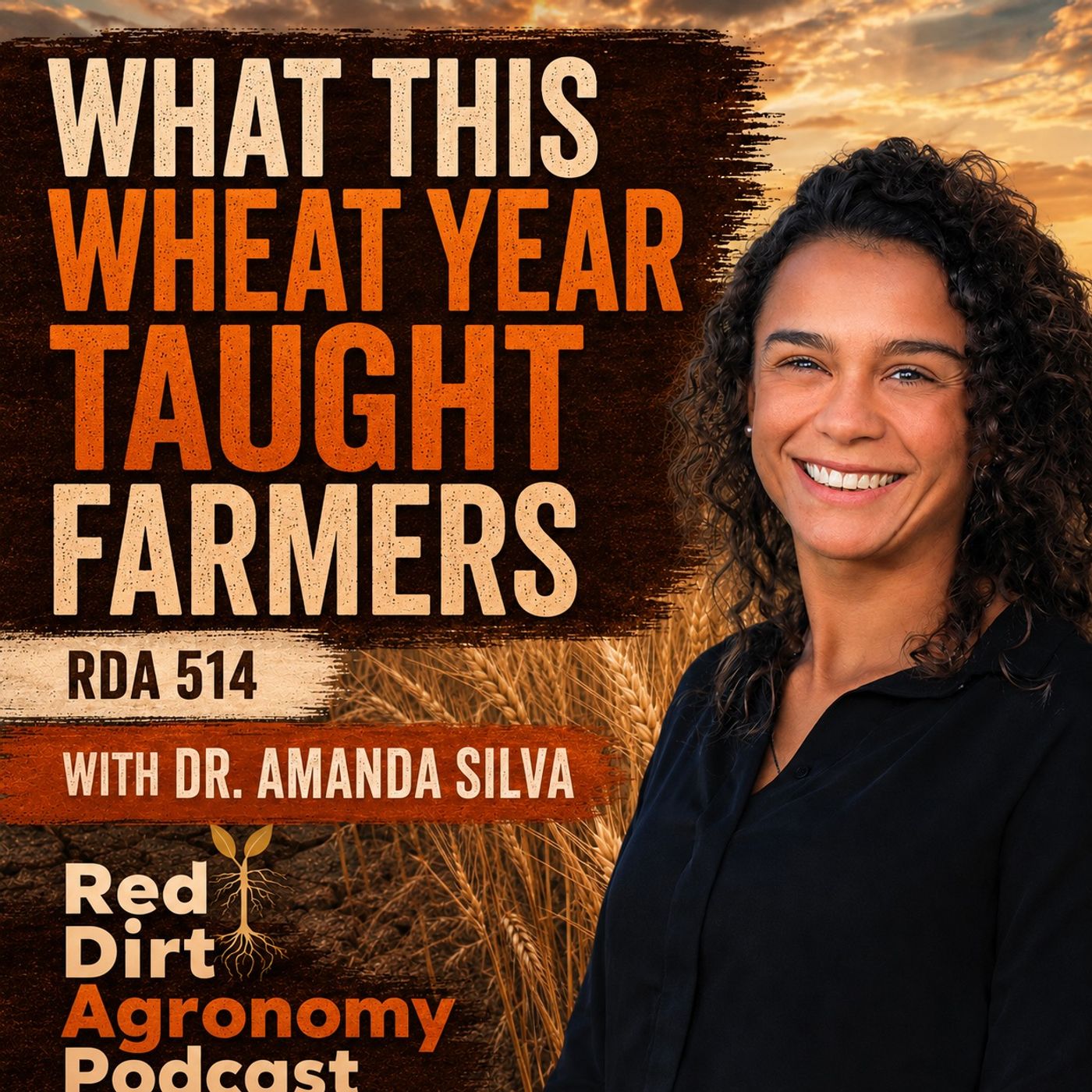
What This Wheat Year Taught Farmers
from Red Dirt Agronomy Podcast · host Dave Deken, Brian Arnall Ph.D., Josh Lofton Ph.D., Amanda Silva Ph.D.
A hard wheat year can still teach Oklahoma producers something useful about risk, timing, and variety decisions. In this episode of the Red Dirt Agronomy Podcast, Dave Deken, Brian Arnall Ph.D., and Josh Lofton Ph.D. talk with Amanda Silva Ph.D., Oklahoma State University Extension small grains specialist, about the 2026 Oklahoma wheat crop. They discuss drought stress, scattered rainfall, early crop development, planting date decisions, test weight, wheat streak mosaic virus, and what variety trials can still tell farmers in a difficult year. Key takeaways: Rain timing drove much of the difference between fields, even within the same county. Earlier crop development, warm winter conditions, and a cooler grain-fill period shaped yield and test weight outcomes. Planting date can be used as a risk-management tool, especially when paired with different maturity groups. Wheat variety trials are still valuable in stressful years, but researchers must carefully judge data quality, CV, blocks, and field variability. OSU research continues on late-planted wheat, seeding rates, nitrogen management, forage production, coleoptile length, and deeper planting to chase moisture. Detailed timestamped rundown 00:00–02:14 — Intro and setup Dave opens Episode 514 by framing the conversation around the Oklahoma wheat crop and why a hard year can still shape decisions for future crops. He also promotes the Summer Crop Demo Day near Chickasha and introduces Brian Arnall Ph.D., Josh Lofton Ph.D., and guest Amanda Silva Ph.D.02:17–06:19 — Field-tour context and statewide wheat observations The group talks about seeing wheat across Oklahoma through field tours, Oklahoma Wheat Commission work, and research stops from Apache and Greenfield to the Panhandle and northeast Oklahoma. Dave notes how seeing the crop in person gave a fuller picture than just looking at numbers.06:27–09:10 — A hard, variable wheat season Silva describes the season as one of the hardest since she started at OSU. She explains that southwest and western Oklahoma were especially rough, while some locations saw enough rain to produce pockets of better wheat. Rainfall patterns created major differences, even between fields in the same county.09:11–12:02 — Stand establishment, planting timing, and grain fill Josh compares the wheat variability to what he saw in canola. Silva and Arnall discuss how some locations benefited from earlier establishment, while others struggled with stands and canopy closure. Cooler weather during grain fill likely helped preserve some grain quality and test weight.12:04–15:17 — Why wheat matured early Arnall asks why wheat was running ahead of schedule across a broad region. Silva points to warm late-winter and early-spring temperatures that moved the crop through growth stages quickly. The group also compares how those conditions affected canola and freeze risk.15:17–17:40 — The critical period for yield Silva explains that the jointing-to-flowering period is especially important because key yield components are being set. Moisture or stress during that window can strongly shape final yield.17:45–20:35 — Diversifying planting dates Arnall raises the idea of spreading planting dates as another form of risk management. Silva agrees that stacking planting dates could help, especially when combined with different variety maturities. She clarifies that “early” for grain-only wheat may still mean mid-October, not September.20:36–23:53 — Dusting in wheat and chasing moisture Dave asks when dusting in becomes worth the risk. Silva explains that farmers and researchers both have acreage and time constraints, and sometimes planting dry is a practical choice. The group also discusses deeper planting, coleoptile length, and whether Oklahoma could learn from dryland systems in the Pacific Northwest and Australia.23:54–28:13 — How much water does wheat really need? Dave asks whether researchers can determine a minimum moisture requirement for wheat in a controlled setting. Arnall and Lofton explain why lab or pot-study answers do not always translate well to field decisions because soil, temperature, humidity, wind, rooting environment, and other factors change the outcome.29:09–32:19 — Silva’s research program Silva outlines current OSU wheat work, including planting date, variety maturity, nitrogen management in late-planted wheat, seeding rates, forage response, grazing recovery, nitrogen uptake, protein, and nitrogen-use efficiency. She notes new forage-focused seeding-rate work at El Reno and possibly Chickasha.32:20–36:47 — Variety trials and disease pressure The group discusses OSU’s wheat variety trial network, the number of varieties being evaluated, and the inclusion of irrigated wheat work in the Panhandle. Silva notes wheat streak mosaic virus pressure in irrigated plots and explains that water alone does not remove the impact of disease.36:48–45:45 — How researchers judge trial data Arnall asks Silva and Lofton to explain how they decide whether trial data is trustworthy. They discuss CV, blocks, reps, averages, plot-by-plot review, field notes, drone imagery, canopy gaps, and the challenge of publishing fair comparisons when field variability is high.45:46–49:10 — Lessons from a stressful wheat year Silva’s big takeaway is the resilience of wheat and Oklahoma producers. The group points out that hard “scientist years” can reveal useful information about stress tolerance, variety response, and management, even when they are not the years producers hope for. RedDirtAgronomy.com
Embed this episode
What this episode covers
This week on the Red Dirt Agronomy Podcast, Dave Deken, Brian Arnall Ph.D., and Josh Lofton Ph.D. sit down with Amanda Silva Ph.D., Oklahoma State University Extension small grains specialist, to unpack one of the toughest Oklahoma wheat seasons in recent memory. The conversation follows the crop from dry planting conditions through warm winter development, cool grain fill, scattered April rains, wheat streak mosaic pressure, and the uneven results showing up across variety trials from southwest Oklahoma to the Panhandle. The biggest lesson is that this year did not come down to one simple answer. Moisture timing drove much of the story, but planting date, variety maturity, stand establishment, disease pressure, and trial variability all shaped what producers saw in the field. Silva also explains why stressful seasons still matter for research: even when yields disappoint, Oklahoma’s wheat trials can reveal which management choices and varieties hold together when conditions get rough.
Ready to play
What This Wheat Year Taught Farmers
No transcript for this episode yet
Similar Episodes
No similar episodes found.