And we are live. Dave Kittle, Tony Maritato back on July 28, 2026. Dave, what's going on? How are things in New York? Morning. Morning. All's well here. How are you? I'm doing great. Jimmy is going to try to join from the office at prompt, but let's go ahead and get started because we missed out on Tuesday.
That's right. Have you had a chance to see that post that I shared? I'm curious to get your perspective on Sophie Cunningham. My prediction, she's going to be the first WNBA billionaire with a B. Mostly just because of like the crazy social media success she's having. Was she also the one that did like the, I don't know what the name is, like the ring girl or something from the recent fights? What was the, was it the Jake Paul fight or what was the fight? The UFC.
Ultimate Fighting Challenge Championship. She talked to Dana White. She was like, hey, I want to hold one of those cards. He was like, absolutely, you got it. That opportunity opened up for her, they said, because of the pointing meme that just went crazy viral. Then she got in the headlines again with some comments about boys and girls sports and she dropped a shoe release.
Sold out instantly. I think it was Reebok maybe. I don't remember. No, it was Adidas. Adidas sneaker. Sold out all the inventory as soon as the shoe dropped. Everything's in place. Like this young woman has the personality. She has the appeal. She's got the public behind her. I could see her going the way of other females that have gotten product deals and started companies with, you know, partners that launched to a billion dollar brand.
Also, just a reminder that Tom Brady has been doing a lot more social media stuff. In fact, a couple weeks ago at the Fanatics Fest here in New York City, he slapped Logan Paul in the face on stage. But he's getting criticized. He's getting criticized that it's damaging his brand. And that was a publicity stunt. He's doing other publicity stunts. So my pushback to you would be...
Do the publicity stunts help if you're Sophie Cunningham earlier in your career because you're lesser known and it makes sense for you to be known? Whereas Tom Brady is kind of very established and well-known. And now it's almost like, why are you doing these silly PR stunts just to get headlines? Are those two different things? Or is it always good? Or is it bad? Or is it hurting Tom Brady but not hurting Sophie Cunningham? That's my question for you.
I think we have to be cautious not to confuse what we're hearing. So you're hearing that it's bad for Tom Brady. Who's saying that it's bad for Tom Brady? Who's looking at Tom's bank account? My understanding was he lost a ton of money on crypto and other deals that he was in. So I'm guessing he's probably trying to rebuild what he lost. But, you know, haters are going to hate. Like you've said it. I've said it. Jimmy said it. When you're succeeding, people are going to try to tear you down. They're going to try to support you when you're down.
I don't know. How are we supposed to know that he's not doing well with these stunts? P.T. Barnum, I think plenty of people hated his guts and thought that he was taking advantage. And if you put P.T. Barnum in today's market, forget it. Like there'd be protests and people would go crazy about it. Yet he would be home smoking his cigar, loving his life because he would be winning on every front. So I don't know. So one of the negative comments was from Dave Portnoy, who is probably a little less wealthy. Probably he's got to be less wealthy than Tom Brady, but he's like big enough or loud enough or popular enough. And he was one person of other people that.
were talking uh poorly about tom brady and portnoy is a patriots fan so he is a tom brady fan and a patriots fan of tom brady's career and he was still saying tom brady's doing this like these stupid pr stunts but also like dave portnoy does like silly social media stunts absolutely he was just on uh family feud portnoy was he was you know he does the pizza reviews like he does all this crazy stuff and he is an abrasive personality that plenty of people don't like um yeah i mean and he is not the one seeing tom's bank account you know so whatever tom's doing i mean he's had plenty of success he's had plenty of experience he's a super smart guy from what i've seen i believe he is making calculated decisions but my big thing for all of this is How does this tie into the profession of physical therapy? And so we talked about this with Caitlin Clark. Now we've got Sophie Cunningham to discuss, but it's like, all right, these girls are playing basketball. They're not getting rich playing basketball. If I remember Caitlin Clark was making like 80,000 a year, 70 something thousand a year for playing basketball. She wasn't making much money, but she's making all of her wealth from the brand deals associated with her ability to play basketball. Sophie is making tons of wealth and will probably make significantly more than Caitlin with this kind of social media attention.
You put that in the world of physical therapy, you know, I kind of feel like I'm on the cusp of completely replacing my physical therapy income with social media income. And I'm not near what a couple other physical therapists out there are when it comes to scale. I think a physical therapist should have physical therapy in their back pocket. It's their passion. It's their hobby. It's the thing they like to do. But it's a tenth or less of the revenue profit generator of something else, whether it be a business that they run, whether it be real estate that they're involved in, whether it be social media, digital products, you know, whatever it's going to be. The wealth shouldn't necessarily come from patient care. It should come from some other vehicle. And I think you saw the post where I was discussing something like that. And I got a little resistance, which is awesome, where they said, you know, we got to be careful. We can't make.
physical therapy about the money. It's got to be about the passion and the professionalism and the excellence. And did you catch any of that? I didn't. You got to fill me in, but we can certainly riff on it. Well, tell me about what you're thinking so far while I look for it. Well, also, so Jimmy posted something about on LinkedIn. He posted, I just had it. He posted like your most, what is your most, let me pull it up. Let me pull it up. While you're finding it, I thought Jimmy had a great post where he was talking about, did you use more words or?
What did he? Oh, more steps, more words or more steps in the clinic during patient care time. Talking about documentation. Yeah, I did see that. Jimmy, I can't find the post on LinkedIn. It was something like, what's your most impressive or valued recent metric in your physical therapy practice? And I kind of hesitate because for us, it's like in terms of knowing if you have successful patients or successful clinic. And I wanted to kind of say like retention, like someone who pays out of pocket and like we're continuing to help them reach their goals. But listen, if someone just pays.
a thousand bucks to work with us like that's that's amazing and if they got the result that they were looking for and we helped them with that that's amazing and if they're independent enough to like continue their you know exercise and progression on their own like that's awesome that that's also a win um but obviously like financially if someone stays with us and spends tens of thousands of dollars over time or in some cases a lot more money than that over time uh because we're helping them incrementally like achieve new goals like get back to golf and then get back to get back to putting first then get back to the golf simulator and then it's like get back to like six to nine holes outside and then it's like complete a full round of golf outside and then it's um two rounds of golf or two rounds of golf in three or four days in that time window or something. And then it's going on a trip to Europe and not being...
wiped out and having enough endurance and strength to like actually enjoy the trip with your spouse like those are those are like incrementally some goals for like one person that we work with and that's that's one thing where like i'm trying to make sense because like you know we sometimes shy away from like the like the revenue and the profit stuff with like physical therapy in general and so if there's like a 20 or 30 year old that just spends like a thousand bucks with us and they get a win and they we help them get back to crossfit or high rocks or just running in central park like whatever it is like that's still equally as much of a win as helping someone who's 70 or 80. incrementally with these other goals, but they just want more accountability. They just want more oversight. It's a combination of multiple things. Maybe they're a little lonely. Maybe they want the accountability in person. Those are some things that came up when I saw that post from Jimmy. And since Jimmy's joining now live, we'll have to ask him about that recent LinkedIn post. Which one was that? And this is cool. I was just using my new scooter to commute to work. And I got to be honest, I was listening to you guys as I'm cruising up the street in Hoboken. It sounds like a morning radio show. It's a little different when you're listening in the environment. And without you, that is high praise this morning. That's great. So what was the post on LinkedIn? I heard you guys talking about my...
Itchy questions like steps or words, right? And you thought it would go all one way. It was like people were making arguments. And that's the point. It's not social media. It's supposed to be media that's social. What was the LinkedIn post that you were asking? I didn't hear that one. There was something. I'm looking. I'm on your post right now. I'm looking. There was something like, what's your best metric at your clinic that you're most proud of or something like that? Does that ring a bell? Yeah, I was asking. I think, was it a meme? Was it a picture? Because I asked. I did like one from the Big Lebowski. I was like, so cool that you have 14 KPIs. Which one actually shows you if patients show back up again? Oh, no, I got it. I got it. It's from one hour ago. Show and tell Tuesday. What's your?
What's one thing in your clinic you're irrationally proud of? Show us. And you said it could be a piece of equipment, your clinic space, the coffee set up, a workflow that saves everyone time, a teammate who makes work better, the clinic dog, anything that makes you say, yeah, this is pretty awesome. Drop a photo or a short video in the comments to tell us why. Now, I didn't pull this up. Now the audience heard the post. And I was telling Tony that what we are irrationally proud of.
is something that doesn't really get talked about a lot in physical therapy and in healthcare, which is retention. Like, if we help a 20 or 30 year old get back to their CrossFit or running and all they had to do was spend like a thousand bucks with us or whatever, like that's amazing and that's a win. But then we also have like 60, 70, 80 year olds that spend crazy money with us, especially over time, because we're incrementally helping them achieve other goals, like get back to golf, get back to half of a round of golf, get back to a full round of golf, get back to like different things that they want. And then every time, like some of these people that are very like type A personality of our clients. we help them with one goal and like there's always like it's always like the next goal is up like all right now i want you to help me with this and now i went on this trip and i was a little you know fatigued i didn't really like i couldn't tour and go around as much so i want to work on that i want to work on you know what is that what do i need to do for that right so okay strength endurance and how's your sleep and how's your how's your nutrition how's your stress all that type of stuff so those people spend more money with us because they want more help with like more goals over time. And that's one thing that we're irrationally proud of, which is like, we're growing really well this year. And that's one part of it. It's like some of these folks that are like 50 year old and plus that have a lot of goals that want to have discretionary money and want to just stick with us for all of their future goal setting. The first thing is the on-ramp and then you keep them on the highway for as long as possible. My post was looking for comments though. I'm trying to mimic Tony, which is like,
so i took a picture yesterday maybe you missed this one i got weird tchotchkes on my desk i got like little lego sets and stress jimmy's always playing with something i'm spinning pens i can't sit still i was like other people are probably like this what's on your desk and when you know it people are proud to show their things so then so i wanted either text responses what i really want was photos i wanted to show me and then i asked formerly on linkedin but differently show and tell tuesday So I'm watching what Tony's doing and I'm saying, that's cool. I don't want to copy him. I see the Steelers knee replacement. Good, good, good. What's my version of that? What is my version of that? What's my version of that? So that's what I'm looking to do. But yes, I don't know. I was thinking about you. Have you seen Pink's window washing? Yeah, maybe you won't see that in the city because of geotargeting. Pink's is a window washing service. Like Chris Corner would love Pink's. Have you seen ads for Pink's window washing, Tony? Yeah. I think we discussed it. Oh, okay. It's an irrationally boring.
service but like nobody wants to do it i even hire a woman every couple months to come clean my house and she's like windows are extra like even the cleaning lady who likes cleaning and pays to do like windows are extra so they're like we do windows and all their people wear the same color right it's like sort of in the line remember the guy next to the pizza place who would spin the thing it's like can i get attention so i'm sort of thinking like what's dave's version of that it would be irrational but what if you if you hit like 50 clinicians and you owned a neighborhood you owned a zip code You would wear a knee length white coat and carry a black leather bag. That is how you would treat. Do you know what I mean? Like that would be your billboard or like some spin of that. That might sound ridiculous. And that might not be the right answer. But the answer is probably far enough away from normal in any direction. Or you'd wear yellow hats. That doesn't make any sense. Like Savannah banana hats. Yeah. But it stands out. Like the only reason it makes sense is because it's a purple cow.
So I apologize. I didn't have a comment for your post. I'm doing it here verbally live. The post about the, what are you irrationally proud of with your practice? And you were saying you wanted comments. I'm saying I didn't comment on that, but I'm verbally commenting about it to you guys. Well, so I've been to clinics. Like I was at Alice Barnes is a clinician in Colorado.
just outside of Denver. You walk in and I know this is going to shock both of you, not a beige wall in sight. It feels like, it feels like a place NHL players or NFL players would go work out in the off season. They would just pay 10 grand for the year and call it, no more than that, 25 grand a year and call it a day. Cause it was all AstroTurf, sticks of everything, a recovery room. Like, but Alice has like, like she's got stuff around that are all wow moments. Do you know what I mean? Like a really cool painted wall with a mural on it or a coffee setup. Like each clinic has one of those things. And it's shocking that I know these people.
And I never see, they bury the lead. I'm like, dude, you have a $900 coffee machine that you just give away espressos? I'm like, you got to play that up, man. That's your weird. You lean into your weird. You lead with the weird. And a lot of clinics don't. They have a weird, oh, we have a rock climbing wall. I worked in a pediatric clinic that had a legit, legit zipline, like from a playground. And kids lost their minds. I'm like, why is that not the first thing on your homepage? Because a mom would be like, my kid might like that. And once the kid sees it, you think he's going to want to go back there? The answer was yes. What's your zipline? Should be my next post. Before you jumped on, can you hear me okay? Yeah.
Before you jumped on, we were talking about Sophie Cunningham. Yeah, yeah, I heard that. I was listening to that. I wanted to get some of your feedback on that. What were your thoughts? Proof of concept. And I know someone had in the comments, like, well, yeah, if you put away X number of dollars at 8%, that's not what you're talking about, right? Like, you're talking about being a billionaire in the next 10 years, right? Not when she's 65. And the answer is, she's a lightning rod. She's the one with the finger, right? She's pulling the finger and she's doing this. Fucking great move. Like, you know, people are like, that's unsportsmanlike. Like, have you seen some of the other stuff in other sports? Please don't say it when we can. Yeah, that's nothing. That's a two. That's a two. But here's the thing. It's a 10 if you're in the WNBA.
Because it hasn't been done there, and women don't do that. And for the podcast audience, I am throwing up air quotes left and right. Please don't come at me. I don't disagree. Let's put it this way. If anybody's going to be a billionaire from the WNBA, it would be her, or it's going to be the girl who's in middle school right now watching her going, I see what she's doing. Like, be a B-plus basketball player, and you'll get paid like a B-plus basketball player. Be an A-plus basketball player, and you'll get paid like a B-plus basketball player. That's just how that math matters. If you want to make more, do something outside, right? There was a story about Messi, how Nike turned him. His dad asked for an extra tracksuit.
Just wanted an extra zip-up tracksuit and windpans. And they were like, they ghosted him. And then he went to another brand. You lost Messi for $38 worth of windbreaker material. Like, you missed the boat. You missed it. Just like the Yankees lost Juan Soto because they would not give his family a suite for, like, the playoffs last year or the year before or whatever. It wouldn't get Griffey because apparently the Yankees slighted Griffey Sr. But that's it. That's public relations. You're either doing public relations well or poorly. There is no not doing public relations.
I thought it was funny. Dave is going to get into this world really fast. The thing that stands out to me about Sophie Cunningham and the pointing, there's all these clips coming out now where one of the officials is telling her not to step over. Can you not hear me? No, I'm sweating. It's telling her not to step over the three-point line and then she steps over it intentionally when he turns around. She does all of this stuff just to spite because she was told not to do it. It's exactly what a three-year-old is going to start doing.
You know, that is what's going to lead to the success. That's where people are going to say, no, she can't make that kind of money. Because I guarantee everybody before that incident actually assumed Caitlin Clark was going to be the biggest, you know, revenue producer, the biggest moneymaker. It's not. It's going to be Cunningham. Yeah, you're going to get more from you're going to get more from shoes. The resistance as I was finishing my scooter ride up Main Street here in Hoboken, get to the office. The resistance for PT is going to be from people who are staking their identity in the sanctity. And I'm using air quotes again in this is this.
And I think that's a giant mistake, but that's okay if that's you. What they're saying is you can't go on the Instagrams and teach people this because I took a decade to learn this. And I'm like, well, a really skilled person could educate in 30 seconds. That's not dumbing it down that simple. The dumbing it down, I thought I had a good analogy this past weekend. Someone said, oh, I see what you do. You sort of dumb it down. And it made me sort of stung a little bit. And I was like, well, I don't know. Do you think what I do is dumb? Or what you're saying is only dumb people can understand it. And then I use it. Which takes craft and you know that. Right. But the analogy I gave was, you know how to resize a picture, right?
But if you do it wrong, it gets warped. Unless you do it in scale, perfectly in a corner, the thing you get is messed up. So if I just simply took a complex thing and told it like a third grader, that might not land. You have to put it in context. You have to make sure nothing is lost. So dumbing it down isn't the answer. Watering it down isn't the answer. Perfectly scaling it down, that's different.
I was going to try and take a clip from an orthopedic surgeon who was talking about osteoporosis. And he comes on Instagram and he says, if this doesn't change your mind about osteoporosis, I don't know what will. And on the screen, he's showing an image, an illustration of trabecular bone and the matrix within the bone and showing how the bone disintegrates. I'm like... Nobody cares about that. That's not going to change any woman's mind about osteoporosis. Show the woman with a broken hip in the bathtub naked asking her son to help her get up. That's going to change somebody's mind. It's not going to be a graphic illustration of a bone. If you show a graphic illustration, as annoying as it is, it needs to be someone slightly bent over, face wincing in pain, and then on their back, something red like a heat map with little arrows coming. Listen, it communicates one thing. A picture says a thousand words, right? If you use it well, but...
How come you haven't shown the trabecular matrix in a bone? Because I don't know what the hell that is. That means nothing to me. You tried to, that surgeon tried to sound fancy, fancy, not clear. What else we got? Did you talk about, I mean, I know you probably mixed it in. The second topic that I saw come across the group chat was, do we want to spend time driving or do we want to spend time improving our car? Do we want to spend time just, just, just, why are we paying attention to the money and how much money we make? Is that the conversation we were talking about?
So I shared a post, which I've been thinking a lot about, and it basically said, you know, back in my day, started with back in my day, 100,000 a year was aspirational. Because I remember, like, going back a decade, if I put out that, hey, a mobile therapist can earn $100,000 seeing 20 patients a week, it was, like, amazing. I can't believe it. How can I make that much money? Now, it doesn't even move the needle. Like, nobody is even looking at that as something, you know, awesome. Now you have to be at 250 to 500 to really even get anyone's attention. No, I disagree.
Really? You still feel like 100,000 is enough for somebody to take notice? Wait, wait, wait. Depending on if they're the owner or the clinician, or they're the employee. We're talking about clinicians that are in the job market, right? Yeah, I think if you dangle anything north of 150, someone will pay attention. Because I think everybody's expecting 100.
Well, how come I have so much interest when I get inbound and then I send them a two-pager? These are potential therapist candidates. And it's a $77,000 to $87,000 base salary. And then the rest is all performance pay. And then they have to ask. Then they have to trust us. Like, hey, where do you get new patient referrals from? And how fast does it take me to ramp up my caseload and all that? So they want to know, when can I expect to be at $100,000 or more over what time? And then kind of maintain that.
So it obviously depends on our ability to do the marketing, get new patients, and their ability to be great clinically and have communication and retain a lot of those patients if those patients need it or want it and want it to continue with us. So that does not say guaranteed $100,000, although it's pretty easy. You're going to make $100,000 with us. But you're talking about, let's say, $150,000, right, Tony? Right, Jimmy? So it doesn't say guaranteed. You're going to make $150,000. But I have three therapists right now going through our recruiting process, our interview process. I have others that are interested in scheduling calls. They're looking at our social media. So it's not saying a guaranteed $150,000 salary. It doesn't say anywhere. We still have significant interest.
There's a decent path, right? And you're probably weeding those people out. Like, if they don't ask, you don't want those people. You want inquisitive people who are going to hustle. Those are the right people who ask the right questions and go, well, if I hit all my metrics, what would I land, right? And if someone did other things, what would they land? If someone did well, if someone did A- on all the things you just mentioned, where would they land ballpark? At least 120.
Pretext. In my memory, the posts that you've shared that I've seen, when you list a number, it's usually 127, I feel like I've seen, or something above 100. Yes, yes. But regardless, the point is inflation is driving expectations higher. And Scott Davis, great guy, follow him on TikTok, educator, amazing clinician. He talks about really, really great stuff.
um but he shared a sentiment that i've heard echoed through other clinicians especially clinicians that have been in the profession 20 30 40 years these are not sentiments coming out from new grads these are sentiments from you know consummate professionals and he's like look we need to acknowledge there's more to it than just the money we can't get you know so stuck on the number that we forget we're we're here to help we're here to change lives And I get it. I totally agree with everything that Scott's saying. Now, one part of this where I think he loses the attention of the viewer and the perspective person thinking about physical therapy, and it's the same with another person I'm thinking of in OT.
is Scott mentioned, you know, that he lives kind of a conservative life. He has a two-bedroom apartment, lives with his wife, like, fulfilling life. That's not really selling the dream, you know? That's not selling the shine and the glitter of, like, yeah, I want to do that. And this other person basically says the same thing. This other person's like, look, I have a small house, I have a conservative car, I drive all of these things. Okay, like, that's awesome. You can do that, and I feel like I live a very conservative life.
But that being said, that's not going to attract young professionals into the profession because you could do that without a doctorate degree. You know, you could do that in anything. What are you going to say, Jimmy? I shared something. See if you can bring it on the screen. I shared this post on LinkedIn and I got a lot of reaction. I got 29 comments and I shared it yesterday. And the post was, I think employers is going to go counterintuitive. Overestimate how much money alone makes a physical therapist consider another job. Everybody just thinks if you're hiring someone that money is going to pull them away.
I had a comment. You need to hit a floor. Everybody's got a number that will be like, okay, you could pay me $125,000, but if the job sucks, I ain't going. But you need a number. I need 98. That's my number because I know how much to live. I consider it, but it's these other things. Listen, you're going to pay me less money to do less work. I'm cool with that. If that's the person I am right now, right? I made like 90 grand a year in radio. I would have paid $62,000 to the radio station to keep doing that job, but it was the job. So there is a marriage of those things. There are other elements that come into it.
not just a salary, but you have to cross a threshold. And if you don't, it's like an insult. You know what I mean? It's not even above that. Dude, what are we talking about? I have a pulse and a license. That grants me at least the floor. Then everything else on top of that explains how high the ceiling is. Like Dave says, you want to make just this and do this? I pay you 82. Great. Do nothing else and you make 82. Now, hey man, between you and me, you want to do a buck 30? Do this for 52 weeks? I'll pay you 150. But that's where you become a part of the business. You own your schedule. That's different.
In healthcare, outside of healthcare, there's a lot of people that stay at a job that they don't really love, but they'll continue because it's convenient. It's kind of close by. The people that don't want to commute and they're like, I have a job that's two blocks away or two miles away or whatever. They'll complain about it to their friends at dinner and at the bar, but then they're also like, yeah, but it's close and I'm looking in the job market and all the jobs are way further away. There's pros and cons.
So my question with that though is, and this relates to the previous post, at what point when you start to feel like that, I'm not super happy, but it's a convenience. It's like the girl you're dating in high school and you're like, well, it's easier not to break up. I don't love her. I'm not even having that much fun with her, but it's there. It's there every day and it's easy. I got term. It's career cuffing season. That's what it is. It's like, ah, we hit fall. We're starting to go into November and December. I'm not finding a new girl right now. We're riding this one through till spring. That's cuffing season. Career.
cuffing season that's what it is so so my thing with it is we're therapists right if a patient comes to dave and the patient's like hey dave i've never been a runner never run in my life i sprained my ankle going down the stairs at home this is my opportunity i'm going to rehab my ankle and then i want you to help me run my first 5k right i what do we do we do an evaluation we establish starting point what do they have going for them what do they have that's a deficit we develop a plan to build strength build endurance build mobility build the capacity and then we take them into the training for the 5k my thing with therapy is Okay, look, we know that this is a relatively capped profession. We know that there's only so many minutes in the day. There's only so many billable units I could deliver. I know that I have bigger aspirations than 100, 120K a year. I'm going to make my money first.
And then I don't have to worry about the money. Then I can take a lower paying job that has greater satisfaction and I won't get frustrated. I won't get that feeling of I need to do something else. I can focus on the patient. I can focus on the intervention. I can focus on being the best therapist I can be because I don't have the need for additional money. I've already made my money, whether it's real estate, media, any other thing you can do. I still think, and I agree with...
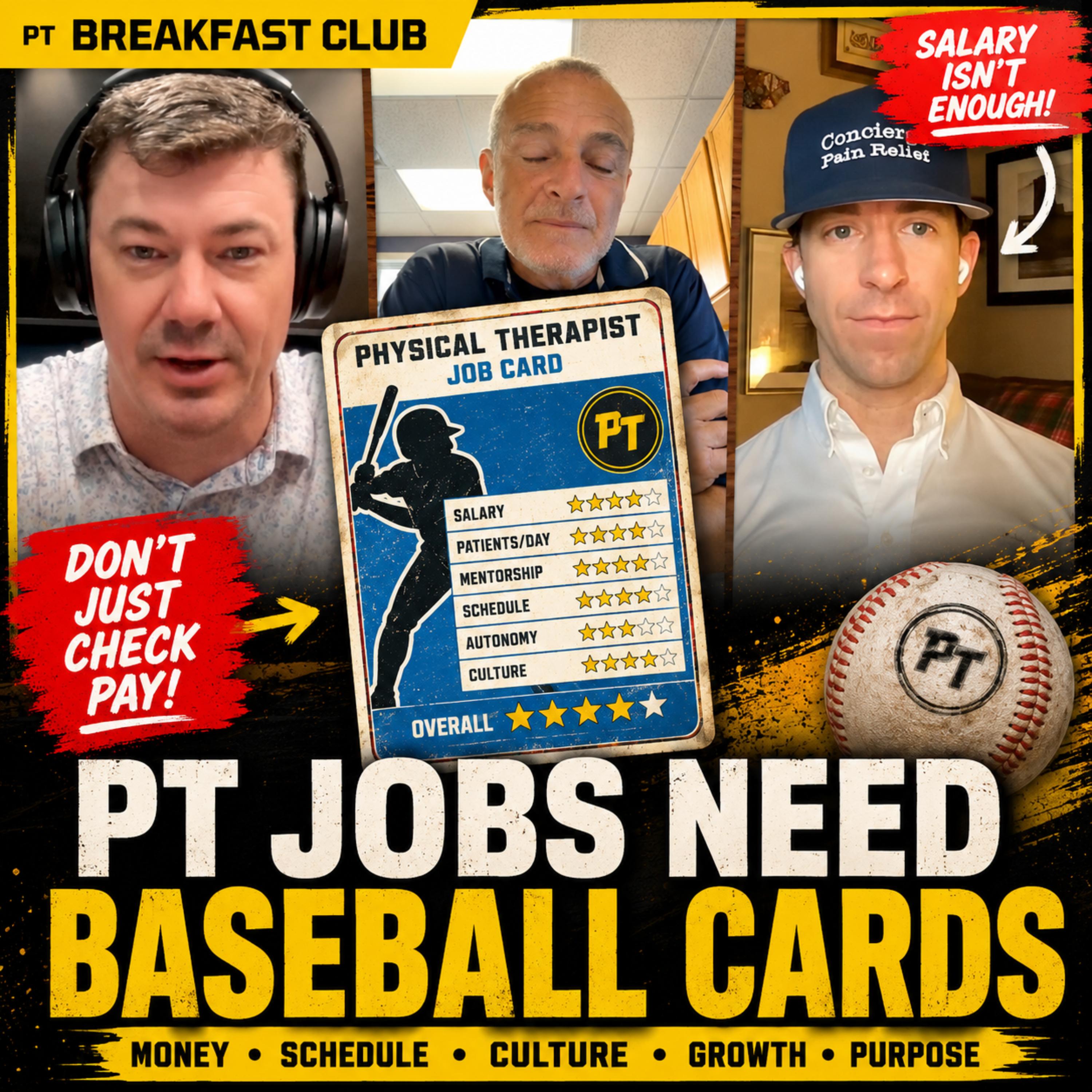
i think it was scott we don't have to tie finances to patient care we can keep them separate we can live in that perfect world where i'm not watching the clock for one more minute to get another eight minute billable unit right i can just focus on the patient but i can't do it if i'm struggling to pay my student loans pay my mortgage pay my car payment pay for my kids to go to school and all the other stuff associated with life yeah i went full tony on this one i'm sharing another thing tony see if you can bring that on the screen i think you're gonna love this because it has a baseball card so this is what i was trying to illustrate in this post i essentially was saying listen I said, stop looking at the salary. And all of a sudden, Tony would be like, what are you talking about? There's no money involved. David said, there's no way someone's going to pay attention. What I was really saying is play money ball. If salary is the only thing you're looking at, then salary is home runs. And you're neglecting the fact that this guy also, this job also strikes out 400 times a year. Yes, you get paid 150, but you hate it every time you walk in there. So what I was saying in here is what are the other stats that don't maybe make SportsCenter? Because everybody looks at this right away. Salary setting in hours. That's like back of the baseball card. Home runs batting average RBIs. But you need to pay attention to the other things. If you're going to be an employee, are you double booked or one-on-one? No judgment. Which one do you like?
How many patients in a day really? Is there a mentor you want to know? All the things people bitch about after they get their first check and go, oh, that divided by two checks a month isn't as big as it was after FICA shows up, whoever that is. So what I'm saying is what if all jobs, this might be one for Dave, what if you could give a baseball card for your actual job? Yes, salary should be on there. But also you get a 52 for caseload because that's awesome because normally people have to see that's 52 visits in a month where when you start to lay that out, if that bothers you, then you want to find a place that does the thing that makes you happy.
And there's a balance in all these things. So it's not just home runs, RBIs, and batting average. You got to figure out, can the guy field? Can he steal a base every once in a while? And the culture stuff, how are they going to be in the locker room? How are they going to be representing your brand? So I was trying to not make this about the clinician, not their clinical skills, but the job. Like, does it fit? Jimmy would not do well in basketball, but I'd thrive at ice hockey. Does that mean I'm a good athlete or bad athlete? It means I'm wrong for this, but right for this. Not all jobs are alike, but I feel like everybody, and now that I'm working sort of in the sector where I'm trying to connect clinicians to jobs.
I'm like, oh, this note looks nothing like this. Like your clinic environment looks badass, but you wrote competitive salary and great mentorship program. And I'm like, dude, that's mayonnaise flavored ice cream. That says nothing. No one asked for that. It's tangy, but I don't like it. Say something better.
Quick shout out before we keep going. I saw a post from Will Boyd. I don't know if he's on today. He is restarting his podcast. Totally unrelated to everything else, but if you guys don't know Will Boyd. It's not unrelated, though, because Will is like, okay, I'm going to use my clinical mind and I'm going to help people who run HVAC companies. Because HVAC people who run HVAC companies that he's helping don't have an HVAC problem. I keep putting piles of money into my bank account, but in six months, I don't have as much as I thought I did. He comes in and combs with a plate of spaghetti and figures it out. I picked up a Hormosey clip, an idea, and I wanted to see what you thought about it. First of all,
Hormozy just doing like these intimate like programs for like 10, 20, 30 grand. And then you get like an hour without Sormozy. And then sharing all the video is a brilliant move. It's a brilliant move. It's a brilliant move. But this was one. He was the guy runs a martial art studio. And he's like, I don't know how to make a high end, a high ticket offer. And then Hormozy, of course, because this is all he does. He looks at it through the same lens. He goes, I know how you do that.
You put the high-end ticket on the front. So you want to be in my judo class? You have to go through one-on-one until you get to the class. Conventional wisdom would go, I throw you in the class with everybody else for $100 a week. And then if you eventually want to move up, we move you up. He goes, no, you don't get to be in my class with everybody until you understand how the class works. And I decide how the class works. So he puts the gate on the front and goes, it's $1,000 a month until you can get to yellow belt or whatever it was. Then you can join the group class. The group classes I have are all for blues and higher. You can have the white belts over here for $99 a week. I'm not doing that. And I was like, oh, what if we use that route for Tony's 5K or marathon?
You don't come in and get a $300 eval and then 60 bucks a pop. You pay three grand. And then I decide if we keep moving on. It just reframes the value. And some people are going to love this. And some people are going to hate this. And it feels icky. And that's okay. You do you, boo-boo. You do you.
Real quick, Teresa has been super active in the chat. He's bananas today on LinkedIn. I remember this episode from friends where Rachel says, who is the Spica lady and why is she taking all of my money? There's a hilarious video meme reel that's out where this guy is looking at his paycheck and he sees the same thing and he's like saying how this person is taking all his money. You guys are probably too young to remember, but thank you for sharing that great memory. You just got to grow the top number. All right. And like to Jimmy's point is our offering allows you, we have a path for you to do that more than.
Most other places in healthcare. Yeah. Yeah. What's a 401k? That's a long race. I didn't run a race. Why did I get charged for a 401k? I ran a 10k three weeks ago. What is this? That's another reel. It's Will Ferrell. And he's like, look right here, we have $401,000 in this account. And they're like, no, it's a 401k. You have $11 in there, sir. And you actually owe us money. What do you guys look at? What's one thing you guys are working on to solve in your business this week? Like what's a big, hairy, scary? Dave? Big, hairy, scary thing that we're dealing with? We're trying to solve, did you say? Trying to solve. Like you're actively like, is it getting those people through the recruiting process to figure out which one's right? Or what is it?
So that also have a, we're looking at meta ads. So I'm speaking to two companies about running Facebook and Facebook and Instagram ads, which is like secondary. Like the main thing is recruiting, hiring. Secondary is the meta stuff. Also primary is we're hiring virtual assistants to answer our phones and do callbacks. And they have our customized script and all like in a design that they helped me make. That's a whole other story with like prompts and they're like copy, they're like copy this and paste it into like ChatGPT. And it just like asked me like 50 questions. And then at the end, it like gives me this document that's like, it's 20 pages and it's like designed.
perfectly and, you know, separate it out with like different like titles and sub headlines. But anyway, the recruiting is the main thing as well as at the same time, also equally as important is getting this virtual assistant company to be answering our phone calls, doing callbacks, textbacks, being in our high level to make calls from like a New York City number, even though they're going to be based in Costa Rica. And the two that we're having, we're going to be having to compete against each other. And in the short term, they're going to compete. We're going to see who wins and has the best conversion rate. In the long term, I think they're both going to work for us anyway. So.
I think for me, aside from the media stuff that you guys see me sharing, like my objective and what I'm talking to AI about is I just cracked a thousand a week in revenue from Facebook. 22 million views. I want to hit over 100 million views. I want to hit 10,000 a month just from Facebook ads, or not ads, ad revenue, income from Facebook. No digital product, no other thing, just Facebook paying me to share posts. But aside from that, more in Jimmy's world now. You know, as we're busy as heck in the clinic right now, I'm not hiring. I refuse to hire. So I need to optimize. I need to figure out, like, how do I streamline? How do I make effective notes? I ran into an issue, which shocks me, but it happens, where a single third party payer.
we we joined the network i sent documentation for submission they didn't want to pay me for therics and i was like what the heck why are you not paying me for therics and i realized it's because i inadvertently said range of motion within normal limits strength within normal limits well that's because to me it is you know that doesn't mean that this person doesn't need to exercise so like that was a technical mistake i made as somebody who teaches documentation at times And I'm like, I can't speak to the third party payer the way I would speak to Dave or Jimmy or another therapist. Got to play the game. Got to play the game. You got it. So now I need to refine a system that I had been working on for 20 years to make sure. No, I can't say that it's within normal limits. I have to identify deficits so that I justify the therapeutic exercise that I want to use. So it's that kind of stuff. It's dummy proofing the system. So literally I could pull somebody off the street. They could walk into this clinic. They could treat a patient and the patient gets a positive outcome and we get paid.
Bingo. Did you see what I was doing? I think I did one for both of you on Facebook, but Tony, I don't know if you saw it. I was sitting there and I was saying, what are some undoubted data points that clinics have that they could use even to just do some self-analysis and self-awareness? And I was hanging out with my buddy, Claude. Me and Claude were hanging. And Claude was like, why don't you check out clinics, Google reviews? So I found it. I just said, hey, drop your name of your clinic. I would go and find their Google reviews. I'd copy paste that into an AI. I gave it a little magical prompt that I worked on for about a half hour. And then I was like, do something with this. Like there's an internal version. Like, hey, Charlene, who's at the front desk pops up a lot.
Maybe understand that your front desk is crushing it and people are saying how great she is. So what it's doing is it's sifting through the haystack for the golden needles and telling you what to pay attention to. But it can also rewrite your marketing. Because we always say, meet the patient where they are. Yeah, yeah. And while you're there, talk to them like they talk. And if they're honestly giving good Google reviews, listen to what words pop up. And some clinics, I mean, I did one yesterday, seven years, and not one review was less than five stars.
With Dave, it said two reviews came up. But then it clearly analyzed why he got less than five-star reviews. And it was a missed expectation. And we talked about that before. Where I got that idea from is somebody tagged me in a video, or one of you guys tagged me in a video, where the fish bone museum, someone wrote a review that said, worst aquarium ever. It's a bone museum. It's like they have like skeletons of fish. And people are like, worst aquarium ever. It's like, sir, this is a Wendy's. This is not an aquarium. But I was like, what other old mine of blasphemous or really great content is out there?
It's fantastic. I mean, I did it. I did a Google review post in my local bike shop that Google, because Google tells me now they got 10,000 views. I got 10,000 views for saying, Hey, these guys are great. They sharpen my ice skates and fix my bike. Like people are willing to say stuff. What are you doing with that knowledge? So if you want that prompt, I'm doing it for a bunch of people who are now putting their links to their clinics on my Facebook account. I'm just running it through the same prompts. I'm giving them the results, but you can do this. This isn't magic what I'm doing.
By the way, Tony's walking around. Do you see that the camera's falling? I was going to ask him. I was going to ask him how he's doing. That's got to be something in StreamYard because that's nothing that I've done. I'm going to sign off because I've got a new patient waiting for me. I'll catch you guys next week. Sounds good.
Shout out Randall Williams. Finally caught a live here. Always appreciate you guys and all the input. That's awesome. Thanks for the feedback. Randall. All right. Let's do parting shots. Cause I'm like, I gotta go get like a coffee or something. I just did my morning scoot. I got it. I got a Segway scooter. Maybe. And this was, this is the lesson, right? Cause if you're on LinkedIn long enough and you stub your toe, you're like, I stubbed my toe yesterday. And here's what it taught me about B2B sales. Like you can spin anything into content, right? Hold on. You have a Segway scooter, like the upright ones, like just totally vertical. It's a regular scooter, but it's just electric. Okay. I would hurt myself on that. So I now commute once a week to the office.
The train is great. I love trains. Don't have to park. Don't have to think. You can work on a train. But then I get here and I got to walk like a mile and a half. And some of you guys are like, bro, get your steps in. Except I get to the office. You're sweating. I'm sweating. It's humid. It's humid here. It's humid, right? It's humid. Even early in the morning. But then I said, hey, man, let's get some, let's close some rings. Let's rent a city bike. You know what a city bike is for a mile and a half? It's like 10 bucks. I got the money, but it's like, it just, the train ride for two hours is $15. The city bike for a mile and a half is 10. I'm like, you know what? That doesn't make sense. It doesn't make sense city bike. But this shows you the irrationality. I'd rather buy a $400 scooter.
And do that because if I rent the bike, I still got to pedal the damn thing. I'm not solving the sweaty problem. And if I stop coming to this office, I can sell the scooter. I'm buying an asset that I can sell for less money than I bought it, but I got my mileage out of it. Anyway, it got me thinking about the golden mile problem, right? It's, I can get all the way close here. I can get to Hoboken, but I can't get to a mile and a half without walking or sweating, sweating through my polo here. So that's what you're solving. We can, people can go to AI and figure out my back hurts. How do I die? It's the doing and the organizing and the putting, it's the golden mile problem. That is why I think you're still incredibly valuable. It's not.
The physical therapist, the physical therapist, the practitioner. It is not the fact that you can pull a book off the shelf and it's, you know, it's, it's anatomy and physiology that is now Google boxable that you and your friend Claude can, can figure that out. It is the golden mile problem. You are putting it in context. You are getting a clear plan. You can pivot that plan over and over again. That is with human connection. That is not yet anyway, figured out by AI. So my golden mile problem was I spent 400 bucks without even thinking about it twice on a scooter. Cause I had a $400 problem and I had $400. I decided to solve it. If someone can't run into them.
That's a big, that's a $2,000 problem. And they have $2,000. If you don't ask for it, that's a bad move on your party. Parting shot to just double click on that is that I believe that our true patient client customer will always want our service. And I do not care how advanced AI thinks it'll be or will ever get that the last mile, the golden mile, the last mile that you're talking about, the same thing that HVAC will definitely never be replaced because you need someone to come here and your plumber and your roofer and any other service provider to, you know, work on your plumbing or whatever, your dishwasher, whatever it is.
And the same thing for your aches or pains or health. When you need accountability, when you need extra oversight, when you need someone to trust that, and maybe it's a second opinion, maybe it's a third opinion, whatever it might be, but it's not even like the human connection, but it's just like the human, the other human to help you in whatever it is, back pain, neuropathy, headaches, like whatever your issue is, walking. I mean, specifically, like, you know, half our business is geriatric where it's someone that like is mostly homebound. How is AI ever replacing that? It's not, it will never. We have someone right now that's being discharged from a Manhattan nursing home.
And we're helping with the transition to get this guy home to his home apartment. AI will literally never replace any aspect of that process. And then the next step, which is the service delivery of the home visits and charging $3.50 per visit out of pocket in New York City. And over time, we're going to raise our prices and we will never be replaced. It will weed out all the stuff that shouldn't have been a PT visit in the first place.
That is what it will do. And that's great. And I love that for the consumer. And I actually love that for the clinician because we want to be treating people who really need to see us long-term, right? I think it will weed out the stuff that never should have been on your caseload anyway. And that's good. Some of it will get through because that person just wanted reassurance from something with a heartbeat and a pulse. But I think a lot of it will weed out the stuff that never should have hit your schedule anyway. I will say my one caveat is this will make our job more complex because now you're not just doing out of 10 patients in a day, four easy, four medium and two hard to do the math right. Yeah. Now you're doing seven hard, three medium. There's no easy.
right and easy is relative i'm not saying anything is necessarily easy but you get what i mean it's like a lot of stuff's getting weeded out hey you just got more complex that's the bad news the good news is complex is valuable that's right people paid to solve it hell yeah they do uh we'll see you guys on thursday i'll be less i'll be less sweaty but maybe i will be riding the scooter around my driveway you never know