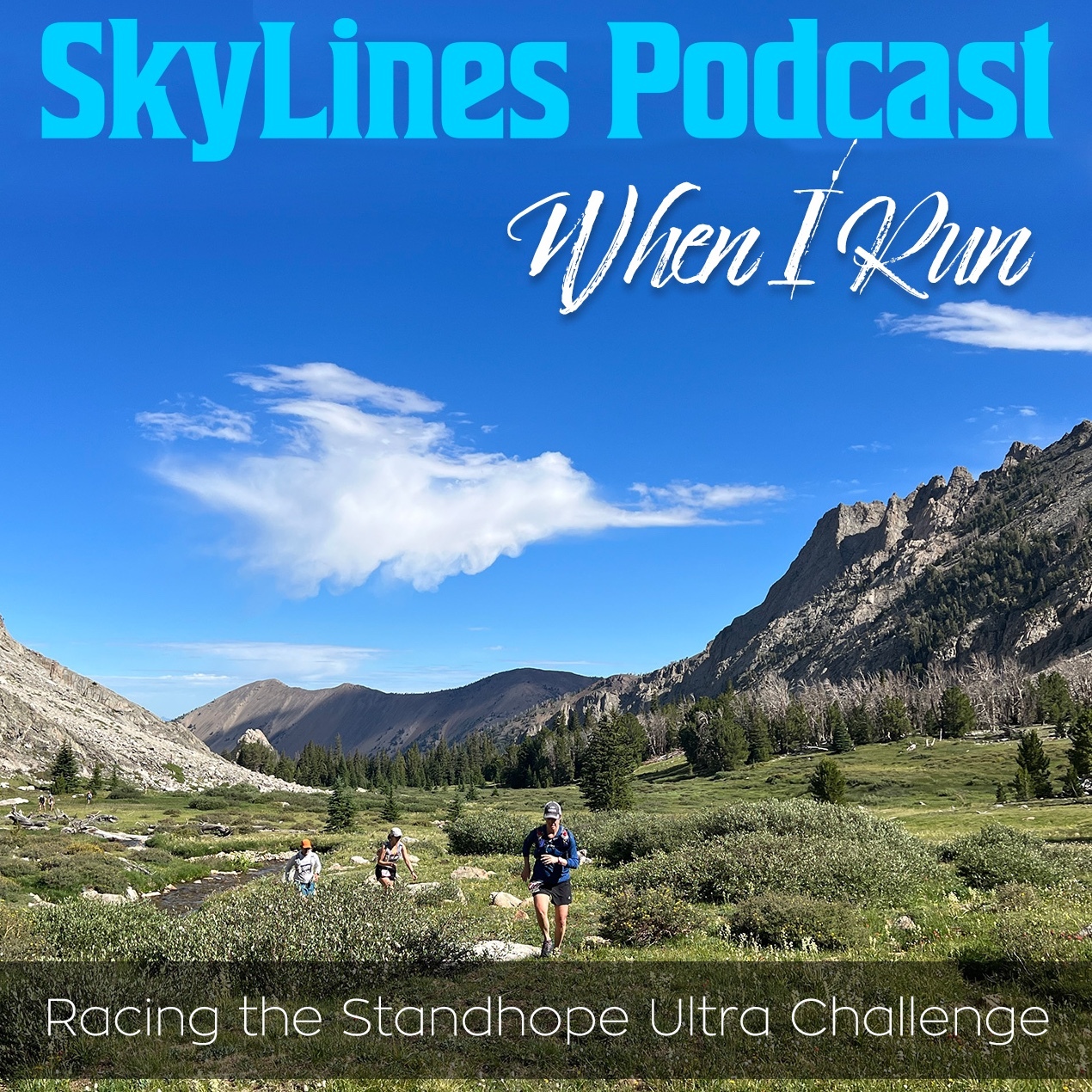
Hey folks, I can't begin to express how happy I am to finally produce another solid essay like this. It's been years since I've been able to do that. And the story that you're about ready to hear has taken me over six months to create. And I'd be lying if I didn't admit that I'm really nervous, hoping people like it.
So I hope you do. The story is about a trail running race that I did last July, and it's called When I Run. Also, for those of you who may prefer to read this, I do plan to post the script to my website, SkylinesAdventure.com. And it'll be a written essay there along with photos, because I took a bunch of photos during the event also.
So it'll be in the photo essay there. So check that out if you want to see for yourself if my descriptions of all the scenery and everything are accurate. And as always, thanks for listening and coming along. Enjoy.
They probably didn't realize I could hear them. But over my own breathing and rhythm of footfalls, I could tell that a couple others were trailing me and getting closer. I knew that I could go faster, but I held back to keep plenty in the tank. From behind me, I heard one of them say to his buddy that his heart rate was at 162, the max he'd like to reach on a race of this distance.
They abruptly agreed to slow their pace, and thus fell the sounds of their labored chatter and slowing steps on the trail. This prompted me to glance at my watch and note my own heart rate. 127. Seemed good, I guess.
The single track trail was steep, and thousands of feet of climbing over some 15-plus miles still laid in store. Ahead of me, a line of competitors moved up the trail at a brisk pace, faster than a walk, but not a lot of people. I wanted to pour on the coals and just run. I wanted to pass the endless train of racers ahead of me.
But I repeated in my head, just save it, and resisted the urge to declare out loud, on your left. This was my first jab at the stand hopulter challenge, a trail running race of 30k, 60k, and 100 mile distances in the Pioneer Mountains of Idaho, a paradise of high alpine peaks I've come to know and love like a second home. Just the baby of the three, I had a plan for this 30k, approximately 18 mile race, and I knew I needed to stick with it. Because I'm old enough now to know how to race, and finish somewhat ahead of my actual abilities, if I execute properly.
Feeling just barely prepared for a mountain 30k, I'd set a very conservative race plan, a plan that was going to require a lot of self-discipline and restraint. And perhaps, if played right, avoid a complete meltdown DNF. I had to refrain from running the bulk of this first portion of the race, ensuring that I held enough energy in the tank to simply finish. The three or so miles behind me at this point had unrolled up and over the gradual lower ramps of the massive glacial cut canyons that we raced participants were now confronting.
I'd followed my plan and casually jogged and even hiked much of this. Up the sagebrush step of native grass and mountain mahogany, we had transitioned into shady forests now. Above us, jagged peaks of rock and snow wore a band of timber around their midriff like a belt. The course we followed would traverse upward through this belt, then eventually scale an 11,000 foot saddle on the shoulder of stand-hoat peak.
From that high point of gray rock, white snow, and blue sky, we'd wobble back to blankets of green spilled down the canyon bottoms, between dots of alpine lakes placed like perfect jewels. Another forest would materialize and lead us down valley for several miles to one more substantial climb. Before an eventual finish at a cozy campground along Star Hope Creek, some 18 miles from our start, even with decades of experience and various types of competition, this level of restraint was still difficult to start so incredibly slow. But as a person who respects the facts of reality, and in the reality of my summer, I'd barely managed a single, often pathetic hike or run each week.
But I knew my old veteran whip could get me through, and if I played my cards right, I could coyote my way to the finish line. I also knew that I was in prime, savvy even, mental shape. I think good decision-making is essential to finish endurance events of any kind. For myself at least, I know that making a bad choice about pacing can smoke too much energy too soon, and make for agonizing suffering at the end.
I've learned to expect agonizing suffering at the end, but try to apply it to maximizing my finishing position, rather than struggling just to finish it all. In a month leading up to this race, I'd put a lot of focus on a balance of logic and preparation, my personal race craft, so to speak. And I likened my strategy to managing hypothetical fuel mileage. With my tank at this time, I can stretch to a maximum distance of, let's say, x miles, but only if I average x miles per gallon.
Hiking or jogging slowly in the green zone, I'd likely have enough fuel to finish the race very slowly. Moderate running in the yellow, I'd bonk out and collapse short of the finish. While pushing hard and actually running at a fast attack pace was in the red zone, which I'd only have a few miles worth of that RPM. I knew I could finish if I just stayed in the green, but not in a time that I'd be happy with.
I also knew that I could easily DNF if I didn't manage my pacing carefully. So my strategy was to chug along in the green zone for this first portion of the race. Once over the top, I hoped to dabble in some yellow pace for the 6-mile descent. And from there was the beginning of the second big climb, where I knew I'd really need a strong reserve of energy to get up and over.
In the final few miles were a gradual downhill to the finish at the Star Hope Campground. This is where I wanted to really fly and run in my red zone, ideally passing others and heaving my body across the finish line with the last drop of fuel in my tank. And then collapse and hope I don't die. At mile 4, we'd climb some 1,400 feet as the course headed up a trail where runners were starting to jam up a bit.
The line was crowded, but everyone seemed to be moving at a pace they liked. Until now, I'd been content taking it easy and being patient, saving reserves and cruising in my green zone. But as the trail narrowed and started up a steep 20-plus percent grade climb, large rock and boulder fields choked runners down to stop and go hiking pace. While I could afford to be patient, but not at a pace so slow that I felt entirely held up.
Most of these runners were using trekking poles, which, especially in technical areas like this, just seemed to tangle up and slow things down. So I needed to start making passes. Calling out on your left, I hustled past runners clambering up the boulder staircase. Popping and bouncing over broken rocks and cooler sized boulders, I was burning a tad more energy than I wanted to, but felt the pace of this train was just too slow to remain where I was in line.
As bad as I wanted to finish this race and finish strong, another feeling was burning hot deep inside me. A hatred of failure. I knew that I would bask in the sense of accomplishment should I finish this race, and finishing mid-pack would be about the best result I could realistically hope for. That would feel good.
I'd be stoked, a little proud even. If I failed to finish this race, however, it would stomp me in a way that I didn't even want to contemplate. I kept those thoughts out of my mind. Not so much because of strategic optimism, but to be honest, out of fear.
And I hated that fear. Competing emotions were in unison, driving me towards the same outcome. My desire for what I'd consider a respectable finish was powerful, but I doubted it carried nearly the punch of regret that would haunt me should I fail to finish. This hate, this pride, this fear were not emotions that rode with me present on the surface with the balance of every step, but I knew they were there.
Sure is my shadow. I don't that often look down and watch my shadow, but I know it's always there, depending on the light. And maybe that's how I was keeping all this at bay during the race, just by playing the light. I'd confront that shadow, only if and when I needed to.
Otherwise, why bother watching, looking back just to see if it's still there? Like a U-shaped halfpipe, thousands of feet tall, the canyon stared down at us. Old-growth Douglas fir trees cast deep evergreen shade on our chugging train. Fluorescent yellow lichens, the color of road worker vests dangled from the trees shattered bark.
Tumbled white granite boulders gathered in piles and aspens congregated around them. As the mid-morning thermals of summer heated the sagebrush foothills below, a steady breeze pushed uphill, and the aspen leaves fluttered, that each grove we passed. At mile 5.4, we'd climbed over 2,000 feet and arrived at Surprise Valley, our first aid station, where tables loaded with snacks and food awaited us. Music popped from portable speakers while some racers took time out for a break and others hurried through.
Rumors of bacon drew me to a table where I snatched a disappointed bite of energy bar and offered my gratitude to the volunteers that packed this goodness clear up to this remote station. I'd barely touched my own water reserve at this point, so no refilling was needed. And to eliminate the issue of littered paper cups, no pre-poor drinks were at the ready. Instead, runners were instructed to pack their own hand-held cup or bottle to fill and drink from at these stations.
I didn't bother carrying a vessel and wasn't going to fuss with opening my pack and bladder to collect a bonus gulp or two. The 100-ounce camel back I'd filled at the start would have to suffice until the second aid station called Baptie Lake, which waited another 2,500 feet up and then 1,400 feet down and 4.6 miles of trail away. Maybe they will have bacon, I thought to myself. Chapter 2.
In the steep miles leading up to this point, I'd move forward considerably through the pack and now seem to be among very capable runners. My pace had settled into the traffic around me now, as the course wiggled between islands of timber the deepest green, almost black, and leafy, wet meadows beaming bright like backlit neon. As we approached the timber line, trees became scarce, and I could see far up the canyon ahead. The trail now appeared not as a dark line of dirt cut from the lush grassy carpet, but merely a stamp of bent over grass from the morning's flurry of trail running shoes and carbide-tipped trekking poles.
With growing frequency, the trail became indiscernible, and knots of pink flagging were all that marked the route. Runners in their tracks braided their way up the valley floor like animals migrating the Serengeti. The soil and grass were now combined as a singular layer, creating this high alpine floor. Tiny creeks cut then hid their wandering ways, in some places beneath bending grass and nearly impossible to spot before stumbling into one.
Running here was tricky, not only for the challenge of not seeing what Nehi foliage was hiding, but also for the fact that the spongy permafrost-like ground felt like running on a mattress. A soft layer that soaked up the landing impact of each step, yet gave nothing back in return, only absorbing the foot's energy, pushing off for each stride. The stand-hoped summit dips across the Idaho sky like the space between two giant waves. Looking up at it for the first time from a mile or so below, my eyes immediately spotted dots moving over the top of it, like fence posts on a conveyor belt.
Lucky bastards rolled through my inner dialogue. Not that I was especially suffering or dreading the trail getting to that point. I was just in a hurry. This was a race after all, and I was in a big hurry.
That's a funny thing about running for me. To be at a race or a training run, I often get bored, and I just want to get to the finish and be done. My favorite thing about running is being done, and my primary motivator to run faster is simply to be done sooner. Indeed, running on its own is not something I especially enjoy.
It's the reward of improvement or the satisfaction of accomplishment that I appreciate about running. If I couldn't time myself, major progress, utilize Strava or actually compete, I'm not sure you'd ever find me out there running for fun. It's my current role as a stay-at-home father that has rattled other interests and life away, to the point that running is the sole activity left standing for me. And to be honest, I'd much rather be racing mountain bikes and motocross or chasing trout and bass and steel head around with a fly rod, while ushering our kiddos into those worlds along the way.
But they are still a bit young for those things, so running is the short and concise activity that I can fit into my world two or three times a week, and make a run at being competitive at it. Picking a race, setting goals, and plotting a training regimen is fun, no matter the sport. And it's just simply that racing itch that I need to scratch a few times each year. Running races has been a part of my life since childhood.
My dad was a runner, and when I was in fourth grade or so, I started racing 10k's with him. He had done a lot of marathons and eventually started poking around at Ultrus. I have fond memories of traveling with him to Nevada in 1990, where he raced a 50k with crazy elevation range. The following year we went again, this time for the 50miler.
I was still just a youngster, but serving as my dad's support crew was a memorable experience. Being part of that team at Aid Stations was fun and exciting. Watching endless lines of competitors coming into view, ever hopeful to see my dad's form, or finally spotting the right color of hat or shirt he was wearing. I'll never forget the amazement of seeing runners' faces, delirious in the agony of each one's own choosing.
I get lost in memories when I'm running. I also spend a lot of time thinking about the things I'm most looking forward to at that moment. Or things I hope to do. Like trying to write a book about the things that I think about, all the other things I wish I was doing when I'm running.
I was swapping betwixt hiking and jogging at this point and just wanted to be up and over that summit. To have the beast climb of this race behind me. To be up there so I could finally run fast and feel a little bit more like I was racing. I wanted to break free from the shackles of my race plan, which mandated that I hold back and just hike this major ascent slow, smooth, and steady.
The weather and conditions were just perfect on this day. Occasional clouds put on their postcard best. The sky was 1950 blue. Our spring of 2023 had pounded feet upon feet of snow atop these Idaho peaks.
And now at the end of July, huge drifts still remained. The stand hope summit runs roughly east west like the spine of a saggy A-frame tent. And we were climbing the north-facing side where deep banks of corny snow still filled the crags between rocks and boulders. As we neared the top, we were climbing through the snow, slipping and clawing each step up the vague switchback trail.
No one in the group that I was with was actually running this section. It was incredibly too steep for us. But I'm sure near the front of the pack. There were some who ran every step of this race, including this formidable ascent.
Leaning forward of my own steps, adrenaline of the moment helped me float uphill. As I finally stepped up and over the top where a handful of other runners had paused to snap photos and give high fives. I even caught wind of a safety meeting nearby. From this vantage, 11,023 feet above sea level and nearly 4,000 feet above our start.
The view was incredible. For each of us, however, I think it was especially rewarding given the effort of getting there. I took just a moment to spy a few familiar landmarks and admire the fresh perspective. The condemned waters of Wild Horse Creek and the Big Lost River convened below.
Stand hope peak and pyramid peak had us cornered from above. Entirely everything around us was broken rock. Considering how thin the air was up here, some 8,000 feet higher than where I live and trained all year, I felt really good. I recall noticing that my breathing was different, but not in a way that bothered me too much.
I spent a lot of time up in this high country each fall, archery hunting deer and elk, so this felt moderately normal to my body. I snapped a few photos and sized up my timing to hit the downside trail. There were a handful of others looking like they were about to do the same, so I felt like I needed to make a quick decision. Chapter 3 I latched onto the back of a trio of runners made up of a man and two women.
They were all light spirited and bantering happily among each other. I could tell by their remarks that they were quite familiar with the trail we were on and likely local veterans of a stand hope. At the tippy top of such a descent is where I really hope to have had open trail ahead of me, to flow into my own pace without anyone to distract or hold me back. The trail dropping down the other side would be steep and narrow, meaning that any passes I wanted to make would require calling out to the person ahead, disrupting their flow and asking them to step aside to allow my pass.
I hate disrupting others. But this trail was running fast and I deemed it wise to sit back and just be patient. I had a long ways yet to keep my powder dry. Over the summit the trail base was soft dirt and loose shards of sharp shale rock as the level tread of the path had been cut from the mountain.
A golden eagle caught my eye, balancing almost stationary riding in the wind high above us. Across the barren south facing slope we stitched together multiple series of switchbacks like a leaf falling through the morning calm. Up close however we were nothing like a falling leaf, but more like an avalanche of boulders, cartwheeling, bounding and bashing down the rock faced mountain. The four of us were hauling, arms out wide for balance and legs letting loose for our bodies to flow as gravity pulled our pace faster and faster.
In the chaos of dust and footfalls I saw a grapefruit sized rock bounce between feet then produce a dead knock clunk squarely cracking the exposed inner ankle of the woman ahead of me. I winced as she skidded to a stop and crumpled in pain. As her partners peeled off to attend to her I wished her well and set my gaze to the next runner, a few hundred yards and couple switchbacks below. I was in my element with this type of running.
I love running fast downhill. In a steeper, rockier or more treacherous it is, the better. Since early childhood I've had a mountain goat comfort with rock hopping. Following my dad to a lot of bushwhacking fishing spots always involves steep trails down ravines, roadbanks or rock slides.
Managing a fishing rod and tackle blocks while slipping through mud over greasy wet logs and mossy boulders all on the steep angles became part of the fun with all the intrigue and adventure of fishing waiting at the bottom. I always ran fast down stuff like this because I was so excited to reach the river. Decades of off-road to wheel racing later taught me to trust in momentum and become comfortable at any relative speed. A trout's nose broke the porcelain surface of Glacial Baptiste Lake.
The disturbance sent delicate circular waves ringing away from the spot. I wondered how the fishing was. I'd heard that rare entrance of this race will carry ultralight fishing rigs with them and make catching a fish a bonus box to check. Another trout rose.
I wondered how long it would take me to catch one. Then I was glad I didn't have to think about that. Perched on a knob above the southeast lake shore, our second aid station was settled in the shattered shade of long dead white bark pines. I love being in the company of white bark pines.
As these icons of the Rocky Mountain High Country are often indications of quality deer and elk habitat. Over the past century, many of these trees have died off from outbreak of fungal disease and pine beetle infestations. Nowadays, up here in high elevation white bark country, the majority of large mature trees are dead, standing skeletons of often bizarre shape and character. But the bulk of trees taken to root more recently are doing better, so there is often stronger representation from young, healthy trees.
I was grateful to refill my water and thank the aid station volunteers. Regrettably, no bacon was encountered here either. A suspiciously content looking dog slept in a coral under a tree. I think it was a border collie.
Chapter 4. The steepest grades were behind me now. However, the trails at this point presented entirely different make-up and challenges. Above and behind me, the surface was all sharp, plate-like rock, but it was loose.
Everything moved. Now, the trail entered areas of Alpine fur and white bark pine, which meant tree trunks, branches, fallen logs, and primo of tripping hazards, exposed roots. Also, and perhaps most notably, unlike the steeper sections, mixed among plenty of loose rocks in this section were large and solid ones anchored deep in the ground, and they did not move. Unlike climbing this kind of debris-litter trail, now running fast downhill, footing here was entirely more about seeing where you could step without landing on an ankle twister or stubbing a toe than tripping.
This was like running down a twister mat and only able to step on say blue or green dots. Stride was sporadic, different with every step. Balance was constantly shifting left, right, forward, and back. Vision had to be fast while keenly focused and watching ahead was precision.
It was the exact reason so many, if not the majority of entrants, used trekking poles to double their points of perceived stability on the ground. This winding, Alpine serpent of a trail twisted between ancient timber, glacial lakes, and coursing snow melt for mile after mile. It was so much fun. And I was passing other runners, like they were standing still.
Some five miles down now from the summit, the pitch of our descent had flattened, and I slowed my pace considerably, knowing I needed to prepare for another big climb coming up. Until this point in the race, I'd steadily increased my pace, working forward through the pack. I had overtaken countless runners and been passed myself only once by an elite runner, going nearly twice our speed, whom I'd presumed had been late to start. The race had not exactly begun as I'd planned for myself either.
Traffic getting to the starting location was painfully slow and took much longer than expected. I was standing in line for a much-needed visit to the porta-potty, when an indistinguishable voice from a bullhorn far in the distance, labs something about a new start location. Then a trumpet began to play, the signature starting ceremony for this race. Apparently, race officials needed to relocate the starting line back 500 yards to achieve the accurate 30k distance.
There was a mad dash from the official staging area now to get lined up over in the new location. The crowd and bathroom line I'd been standing so strategically in fled. For a moment, I held out hope the porta-door would fly open. Then, cussing under my breath, I made a run for it too.
Just to make the starting line at the sound of the gun. For the hours and miles since that starting gun, I'd still been making a run for it. And now, I had to confront the reality that I needed to get off the trail, dig a hole, and duke. Frustrated as I was at the haphazardness of the start, I kept telling myself how it was such a long race in the six or so minutes this untimely pit stop was costing, was recoverable in the greater race picture.
When I finally rejoined to the course, I found myself behind runners I'd passed, factoring the steep and rocky downhills. It was a bitter trade-off, taking such risk and bold moves over those portions of the race, only to give all those proceeds away and be once again passing those same runners for a second time. But this is a commonality with all types of racing and is really just one of the many ingredients that make it spicy and delicious. In the moment, my mood about all this was sour to say the least, especially as the trail had now mellowed into wide and flat meandering along a gradual declining slope.
Not at all the kind of segment I should be pushing to make passes or gain time. And I was in fact reminded that this is where I needed to hold off and really try to store up energy. I'd studied the course map carefully, and the white mountain climb we were coming up on was seriously steep, and in my estimate, potentially the most dangerous. Positioned around the three-quarter point of the race, I viewed this push to get up and over white mountain as having all the ingredients to crush the will and spirit from weary racers.
Following miles of adrenaline pumping downhill and accomplishment of cresting the mighty stand-hope summit, the sleepy section I was in had lulled my body into a tight post-climax grind. I knew I needed to stay mentally fresh and physically limber. Long ago, I committed to a fundamental mantra of endurance. Drink before your thirsty and eat before you're hungry.
As that phrase rattled into my head, I peeled a few ears of dried mango from my shorts pocket and hoped that I'd acted in time. I needed to get fueled up well in advance of white mountain so my body would have time to settle before the grueling push up and over its northern shoulder. Sun punched hot through the lighter screen of jack pine needle shade and the day began to bake. I sucked steadily from the hose valve of my camelback and swallowed measured gulps between breaths.
The straps were getting light and I could feel the loose gaps spacing out between my strides, indicating my water was getting low. Since 2001, this pack had become a stalwart member of my long-as-it-lasts collection of most cherished goods and belongings. It's ridden my shoulders on countless epic adventures and shows only superficial wear for such an accomplished tour of duty. I talked to the hose and bite valve securely under the opposite shoulder strap and decided I was adequately refreshed.
Jagged white lines began to stand out on the black straps where waves of sweat had soaked to a high mark, then retreated. I noticed this and realized that I wasn't sweating anymore. So I drank again. To the point I could feel in the hose that my water was indeed nearly gone.
I'd been on the heels of a runner for a while now and decided he was holding me up enough I should move past him. The trail was open and free of hazards at this point, wide enough in general for probably three abreast. At an especially straight and open area, I called out the custom area in now well-worn phrase, on your left, as I pumped up some tempo and pulled along his side to pass. When I broke the plane next to him, as if I didn't exist, he suddenly surged forward and bumped his tempo up a couple notches.
Well okay then I thought, good for this guy. I had no interest in matching much less or passing his new pace, and feeling satisfied with the cushion now between us settled back down into my preferred pace. It wasn't a hundred yards later however, before his spurt ended and he slowed considerably. I was back on his heels again and had to slow down.
If there is a football game in which one coach is wearing a visor, I'll always root against the visor guy. Just something about the visor look is I don't know off-putting to me. This guy ahead of me was wearing a visor, a red visor. In the next open area, I repeated the passing courtesy and was met with the same maneuver.
This time however, I was irritated and not in the mood to know or care what game he was playing. I surged harder, opened my stride and powered ahead of him with a commanding pass. I chuckled to myself how this guy was like the driver on a twisty highway, seemingly terrified to approach the posted speed limit, but then accelerating at passing zones or lagging in the left lane, caging traffic up behind him. Sliding over to the center of the trail, I felt a small sense of guilt, wondering if there had been some kind of misunderstanding.
Feeling an obligation to give my move earnest a meaning, I ran much faster than I wanted to, in order to ensure and pad a decent gap between us, even though I presumed his pace would once again dwindle slower. Chapter 5. A mile or so later, a stack of five-gallon water jugs appeared in the middle of the trail. I wasn't certain if there'd be another aid station, so I sure was relieved to at least see water.
I whipped my trusty camelback straps from my shoulders and poked a kick at the closest jug, testing its weight. It tipped over. Empty. Gripping a jug stacked atop another, I groaned as it moved, lightened, easy in my hand.
Nearly empty. The one remaining jug would have to be tapped to get more than a few cups of water left in the stack one. This meant re-securing my open bladder, rearranging the bottom jug, removing and reversing the spigot valve, and starting over to fill at least a little more into my nearly empty camelback. As luck would have it, my buddy in the red visor came thumping up just as I got the jug's arranged to pour.
I still felt a touch of guilt for some reason, and thus invited him to refill first. In an awkward team exercise, I helped tip and compress the jug to get water to pour. Of course, it seems to me in my competitive mindset, like he was taking way too much water and time. Finally, topped off and finished, he spun and disappeared down the trail, somehow ahead of me once again.
A small note was all that indicated the crucial importance of this location. For off to the west, a sparse and timid trail departed this main arterial path we had been running down. This was the infamous and often missed intersection, where the course headed up the last big climb over White Mountain. As I settled the contents of my camelback and eased the 22-year-old zipper's home, a woman arrived looking big-eyed at the water jugs and side to side at the trail options.
I explained which turn we needed to take, pointing mockingly at the tiny note indicating such. And then I just couldn't leave her to tip, balance, tilt and pour her own water without offering a hand. Once we had her water filled, I decided I'd burned enough time here and I may be wise to make the most of it. I pulled out my trusty titanium spork in a pouch of tuna.
I'll eat on the run, I smirked with a good-by wave, and turned to the trail that headed straight for the imposing climb, towering above us. The guy in the red visor was long gone, pleased I'm sure with the several minutes of lead he'd managed to gain on me. I struggled to swallow mouthfuls of tuna while desperately attempting to slow and control my breathing. The trail was unrelenting and steep as hell, some 800 vertical feet at a 15% grade over a shy mile.
My legs were wobbly and lower back was becoming super tight, having miles of downhill body position and relaxed form now converted to steep uphill lunges. I was ferried and back to a walking pace for the first time since cresting the summit. This felt weird following the thrills and high tempo of previous miles. Despite eating and drinking in preparation, the climb was kicking my ass precisely the way I predicted it would.
A throbbing headache was beginning to grip my skull and sunlight burned hyper-bright. I swallowed a sweaty handful of ibuprofen. I wanted to stop so bad. I knew I couldn't actually sit or lay down, for I'd tighten up and never get moving again, but I just wanted to stop, to lean into some of the cool shade I was passing and let a tree trunk absorb some of my balance, weight, and fatigue.
Just a moment or two couldn't possibly rob too much from the outcome of my race effort. In fact, a stop would more likely turn into a net gain for my finish, letting the burning fibers of my legs cool, allowing my runaway poles to slow and breathing to normalize, and turn my whispers around. Then I'd be fresh and all set to regroup, take off at a stronger pace, and certainly overtake the sorry progress on the course which I was currently crawling about. I'd made an appealing pitch.
The offer was slick and sweet and made only of benefits. I wanted to stop. I needed to stop. Stopping was the answer.
The problem in the end was that I'm a harder sell than I am a good salesman. No chance I'm stopping. I growled back. Ahead of me, on the now hot and dusty trail, an orange-needled pine lay across the path about as high as my waist.
Then too more. Any normal day, getting over or around the blockages wouldn't draw a second thought. But I was so painfully sore and stiff. The mere sight of the downfall felt soul-crushing.
Using my hands, I lifted my leg to get footing over the first, then got down on all fours to crawl under the next two. A part of me grumbled why the hell the event crew hadn't bothered to check the course and clear up issues like winter downfall. I wondered if any of the event staff had even traversed this section to know. A few minutes later, I encountered even more fallen trees blocking the trail.
And then I smiled. Weather race organizers even knew about the trees or not. I suddenly snapped back to the person I am in better times, and I appreciated the added challenge and bonus character this brought to the course and would be accomplishment. Suddenly, I was glad for the unclear downfall, wished for more, and hoped the race organizers did know it was there, but intentionally left it just for the added personality and flair.
I felt ashamed of myself for whining like a sissy about such a common feature of the backcountry trails I love and enjoy so much. Hell, I felt lucky to be on a trail at all. Given that nearly all my time up here every fall, it involves epic hunts carrying heavy packs and never walking around so pampered as an actual numbered trail. I recalled various times I'd been in endless tangles of downfall with a 100 pound pack filled with elk meat on my back, swimming in sweat while crawling over and under trees that made this trail look like a playground.
I recalled a marathon a few months prior that consisted entirely of sidewalk and bike bath, how boring and monotonous 26 flat miles of that was. I thought about how much better trail running felt on my body because of all the different angles, motions and leaning as part of running over a varied and mixed terrain. I thought about how easy it was to move without cold weather clothing, boots, a heavy backpack, and bow, rifle, or shotgun in hand. I thought about the way that pine bark smells like syrup when it's hot like this.
It had worked. My self-tricking strategy of daydreaming had distracted my focus from the suffering at hand and was only interrupted by the fate and sound of voices in the distance ahead of me. Peering through the tangle of trees, I caught a few colorful flashes of movement. I had been alone on the course throughout this brutal climb, and as bad as I was feeling, I expected any other runners I'd encounter would be catching up to me from behind.
I couldn't believe that I was actually catching up to runners ahead of me. As I watched to gauge how far out they were, I realized the climb was actually leveling out, and I was cresting over what looked to be the gentle bulge of a summit. The amount of blue sky I was seeing ahead of me to the west convinced me that I'd made it. Chapter 6.
Indeed, over the top, and with runners ahead of me within striking distance, my persona broke free from the suffering victim and puffed up the vital competitor within me. The sight of runners flickering through the trees was like a shark getting whiff of blood in the water. I was especially keen to hunt down those who may be in my class. Like a rusted suit of armor coming out of a lube bath, I quickened to my pace and shook my body loose.
I started running again. Everything hurt. And so I ran faster. As the trail began a quickening descent, I cautiously lengthened my stride, leaned forward with momentum, and swung my arms in deepening strokes.
I was excited to see if these were middle-aged men ahead of me, and opportunities to bump my in-class finishing position. My hands relaxed back to their default running form of thumb's touching middle fingertips. I focused on deep breathing and flow, and started hauling the mail. It didn't take me long to catch the runners ahead of me, and as luck would have it, two of them seemed quite likely to be in my age class.
I rolled up a few additional women and younger and older men that would improve my overall results. I hadn't spent much time thinking about what kind of finishing position I'd hoped for. This kind of race was new to me, and I was more so focused on how I could just merely finish, and saved the indulgence of placement aspirations for this very in-the-moment time and place. Now was my time to dream, to imagine how well I could do.
I'd done the hard work. I'd survived the greatest challenges. I'd managed my food and water consumption, and most importantly, executed my race plan. I could burn my remaining field reserves now hot and fast.
I was within a few easy miles from the finish, and it was finally time when I would allow myself to go as hard as I wanted. I could put it in the yellow red zone now, as long as I saved some red for the final mile or so. Unlike any finishing position, I did have something of a time goal in my head. I was running fast and free while feeling great.
I had not looked at my elapsed time yet, and honestly didn't want to. Why spoil such a moment I figured? I'm having fun and feeling strong. If I look at my watch right now, it could really take the wind out of my sails if I'm off of where I'd hoped I'd be.
I'm just gonna run, focus on the moment, and making passes. Around the next corner, another trio of runners came into view. More prime-looking targets. Ahead of them, I glimpsed a flash of red as it disappeared into the thick, alder brush and willows of a wet creek crossing.
I quickly reeled the trio in and passed them just after the creek. Red Visor was next ahead of me, and I could not wait to pass him and put him behind me once and for all. It looked like he was hurting pretty bad as I caught up to him, and I didn't bother with the courtesy heads-up announcement of my upcoming pass. I just ran around him.
With surging tempo, I pulled away from the various runners I'd passed since this last summit, and estimated I was getting down to just a few miles before the finish. The course had dropped below the timber now and rolled over, around and down through sagebrush foothills. Short ups, followed by steep downs, became the rhythm, and it was finally feeling like a race at this point. Chapter 7.
It was a monotonous middle-of-nowhere step when my left foot hit the dirt and a jolt of pain shocked upward from the inside of my knee to my groin. The stride of my next step, shortened by half, as did the next one and everyone after. Years earlier, in a freak motocross incident, my toe caught a root hidden in some soft loam while I was laid out sideways like a flat track racer midway through a turn. The root snagged my boot hard enough to straighten my left leg out and back, snapping the thick tendon and my groin off the bone.
It never was the same after that. And I never got the sound of that snap out of my head. Now straddling the pencil line of trail, the pain was only dull, but it was stout and unmistakable, like the first scent of smoke in a tinderbox forest. It was a hallmark indicator that my quads were cramping up.
My reflex reaction pushed the bite valve to my lips and I drank several deep gulps between breaths. Next, I shook my arms down to my fingers, leaned back to open my diaphragm and focused on my stride, trying to keep it open and free. Check running down the steep path, I swam my arms carefully through the air. But it wasn't more than a minute or two before I smelled smoke and my other hamstring.
And the pain was creeping around, staining the front of my left quad now too. I knew exactly what I was feeling, what it meant, and why it was happening. I also knew it was all downhill from here. And downhill was the problem.
Cramping is something that I've been susceptible to in my entire life, and when it hits me, it cripples me. I've had to hop home on one leg for miles and even creep backwards hundreds of feet down off the Chucker Mountain. Cramps, in particular, facial tissue at the front of my quads, have brought me to the ground in screaming pain more times than I care to remember. With months of training under my belt, I was surprised that this type of cramp was showing up now.
It typically struck me during the off-season or early on in training. Paramount of my concern, it had never let up until activity ended. In a matter of 50 or so strides, the dull, tightness in one groin had evolved into a piercing, sharp pain in both quads. Cramped up and straight-legged, I could barely assemble consecutive steps at all, and each one delivered sickening jolts to my core.
I desperately tried to stretch, even crying out, maxing my pain threshold in frantic efforts to keep moving down the trail. The motion of stepping downhill is what initiates and aggravates this particular cramp. And I have many times been forced to walk backwards or even uphill to gain if only temporary relief. With another creek crossing, I took great, yet measured comfort, seeing the trail rise slightly, but only for a short distance, before resuming the inevitable fall to Star Hope campground in the valley floor.
I was able to string together moderate walking steps along the flat trail, the barely up-hillish section. The sound of running shoes came splashing from the creek I had just crossed, and I didn't have to look back to know that it was a red visor. I was limping along the trail as fast as I could, but like a wounded animal on the prairie, red visor overtook my position with ease. I could barely walk.
I watched red visor disappear, dropping, falling, sinking so effortlessly down, down, downhill towards the finish. At the gentle crown of such a modest gnoll, I stood stiff and shuffled my feet. I tried to lift my heel behind me and grab a toe to stretch, but I missed miserably. I tried to squat, but I couldn't take the pain.
Like a cuffed and condemned sailor looking down the plank, I waffled with dragging steps as the trail slid away, ever so slightly so easy it slid, downhill. From behind the inevitable sound of more footbeats rose from the distance. They were coming, all of them. Everyone I had passed over the hours, miles, and vertical feet that day.
All of them were coming, and all of them would pass me if I couldn't get moving. Each step I took felt like knitting pins were pushed upward between the skin and muscle of my quads like pin strikes. I must have looked like a barefoot castaway, walking on hot coals as they approached. Over my shoulder, the trio of runners I'd overtaken a mile or so back were right behind me.
With staggering commitment, I stepped back into the trail not 20 yards ahead of them and pushed myself into their path, like a raft lunging into the current and right away of downstream boaters. I couldn't bring myself to make eye contact, but if they were going to beat me in this race, I was going to force their hand and make them pass me, like a guy in a red visor would do. This was absolutely a dick move in terms of trail etiquette, but we were in a race, and I remained in that frame of mind. I'd happily offer my apologies after the finish line, and still it was all downhill from here.
My only hope was if I could force myself to open my gate and regain a run, perhaps I could literally shake my quads loose and get past the cramps. The burst of fight or flight adrenaline got me going, and looking back now, I realized that I was choosing both fight and flight. I could only imagine what the trio behind me were thinking. I hobbled like I was on two broken legs, my breathing was tight abrupt huffs scorched with whimpering yelps between each step.
I had to be the sorryest sight they'd ever seen or heard. If only they could see the agony on my crinkled red face, could the scene look any more pathetic? But they couldn't see my face, only my back, and I aimed to keep it that way. My lunge off of the symbolic cliff seemed to be working, partly out of embarrassment, partly out of anger, and partly out of fear.
I just ran like hell, and I flew, with all the grace of a free-falling chicken. I tried to run fast enough to run over my cramps with each stride. Quickly, I shifted my focus from the agony behind me and the runners on my tail to an imaginary scenario ahead and below me, to a scenario in which I was setting sail and peeling off six minute miles. I imagined running cold and clean.
I imagined tall and elegant cans of icy bushlight rising from the vintage metal cooler in the back of my truck. The chilled snicker-doodle cookies from the local bakery, and how I abstained from such delights for weeks leading up to events like this. Rounding a corner, the hairy sagebrush horizon floated away as I recognized acres of black timber panels shaped like giant puzzle pieces. I recognized the canyons where I'd hunted elk over the years.
I saw the tributaries that merged to form Star Hope Creek, where I'd fished for grailing and stunning cutthroat trout. Laying before me were the upper reaches of the great copper basin. I recognized the portion closest below where I'd camped years before, and now, somewhere in that sprawl of trees and campsites, a finish line awaited. And somewhere between myself and that finish line, a red visor bobbed down this very trail.
The large swath of trees the campground was among looks to be about a mile away. It was open sage and rolling hills from here to there, and as soon as I looked hard at the folds of terrain, I spotted red visor. Now was the time to attack. Now was the time I'd saved my last stash of reserve energy to let my body rev all the way out and gorge in the red zone.
I pulled ahead hard, as if red visor were the finish line. I let my emotions take over, and I gave no thought to anything but catching my target. He must have heard my approach like the sound of helicopter blades pounding the air behind him. The heavily used single track trail was now braided with several distinct lanes.
Steeper and steeper the grade fell away from us, and loose rocks of various size littered the multi-track trail. He held the inside left lane as the road veered left, then he switched to the right as the path bent that way. It was obvious he knew I was right there and had begun his fight to defend his position. Our pace was escalating very quickly.
The trail fell faster. More and larger rocks were free everywhere as the steep grade, gravity, and decades of treads had turned them loose. The strokes of my arms transitioned from the foreign aft emotion of a punching steam train into circulating windmill wings, frothing the atmosphere for balance. Red visor was matching my effort and cutting into my lane, defending his inside line with each turn of the trail.
Reaching the bottom and steepest grade of the hill, the path became rutted with dugout holes from spinning ambitions losing grip. Rocks were strewn everywhere. The risks we were taking to run at absolute max speed down such a course were outrageous. I moved into the left lane, bounding over rocks, ruts, and rubble.
I attacked. The sight of me must have broken his spirit because in a distinct moment, red visor let off and dropped behind. I could still hear his shoes pounding the tortured dirt, but they faded quickly and he was gone, and I was gone. A lightness came over me as I bounded freely towards an open green gate marking the boundary of the campground.
A few spectators walked along the road, watching hopefully for someone else. Just past the gate where the road became manicured gravel, my wife in love allie cheered and clapped. I bounced past her, wearing a big smile and floating on the euphoria of being done. Chapter 8.
Like a ghost ridden bicycle coasting alone after a kid jumps off. Something was wrong. Looking ahead, I saw a long straight section of road cutting through shady patches of forest. There were no other spectators.
No overhead banner with a giant word finish. No bull horn announcing bib numbers. No yellow tape directing finishing shoot. No cheering.
No barbecue smoke billowing from easy up tents. No kids and diapers rolling in Gatorade mud. Just a long, gritty sword of gravel road with a couple more runners, tiny in the distance. It got so quiet.
I was in real trouble here. I was seriously like that ghost ridden bicycle with only a few more yards of viable momentum left. From what I could see, the finish was still not in sight, and I could see four or five hundred yards of road ahead of me. My steps in the gravel sounded so loud, too loud, aggravating even.
I felt like I could black out at any moment. How was I going to make it any further? I had blown all the fuel in my tank and pushed my body beyond its max. My heart was pounding in my chest.
My guts were pounding in my chest. And I could feel the cramps in my legs staging a vengeful comeback. I knew this was the finish area. I'd just seen Allie.
She was to be at the finish. But where the hell was the course taking us now? In all my confusion and distress, I was still running somehow. The poor fella I made out ahead of me also looked to be in the state of self-destruction.
I latched onto his presence like a handrail I needed to keep from falling. But then I passed him. He was in my class. Ahead, I saw another runner I recognized.
Sam, I think his name was. He seemed really neat. We had conversed quite a bit in the miles approaching the summit. This was his second time in the race.
His wife ran it with him last year, but she was injured now and couldn't make it. He had children. Maybe a daughter. He lived somewhere.
It's the Sun Valley. Maybe an Idaho. His shirt was white. No, socks.
White. Shirt is blue. He's right in front of me. I can't hear.
Anything. It's too loud. This hill is so fucking steep. I'm pushing as hard as I can.
Harder still. Fast as I can. I can't breathe without sound. Kids are running next to Sam.
I think they are cheering for him. I see writing. My shoes.