
EPISODE · Feb 24, 2025 · 16 MIN
When Neutrinos Don't Point the Way: A Blazar Mystery
from Multi-messenger astrophysics · host Astro-COLIBRI
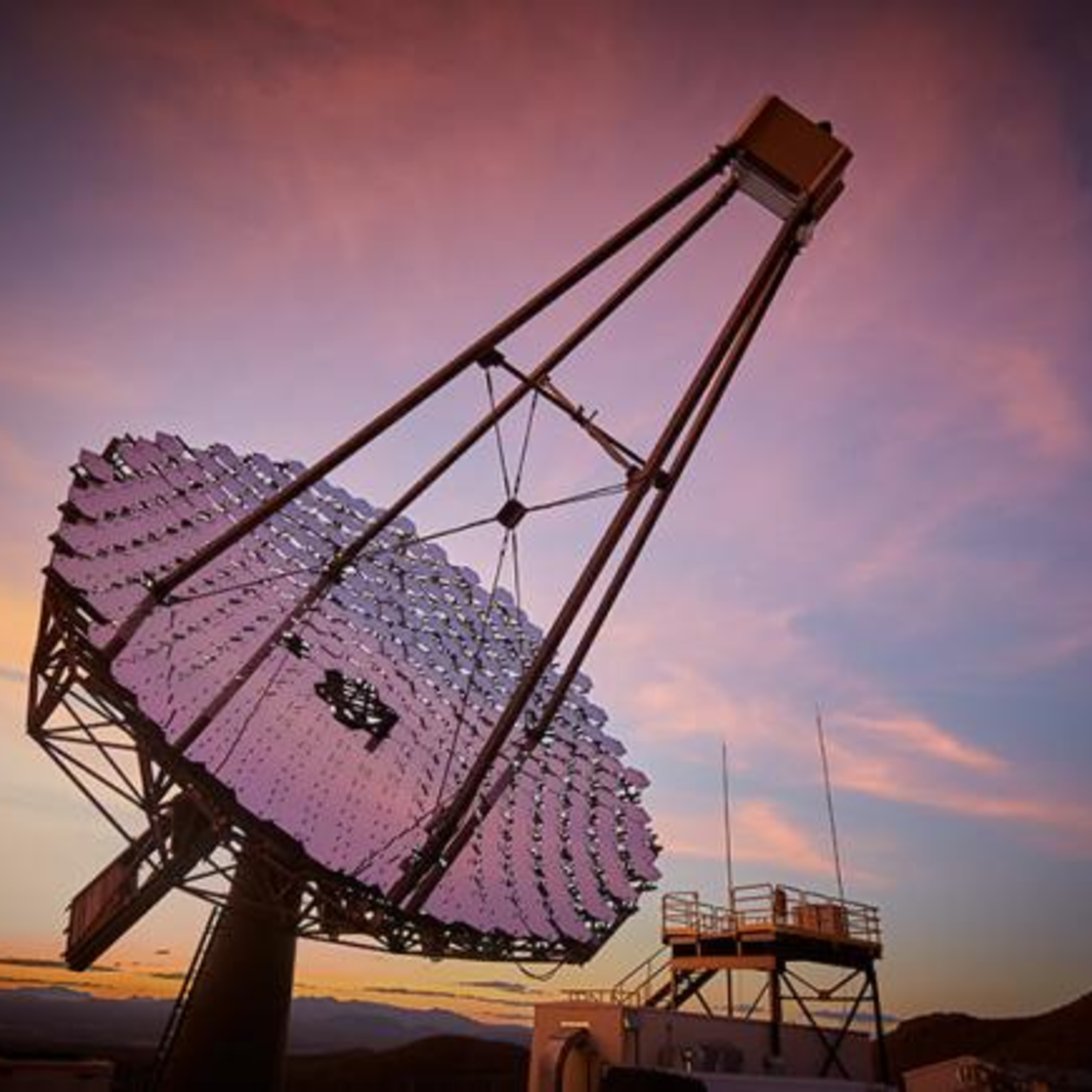
**Introduction:*** This episode discusses the search for the sources of high-energy neutrinos using the example of the blazar B3 2247+381.* The IceCube Neutrino Observatory detects astrophysical neutrinos, and scientists are working to find their origins by looking for correlations between neutrino alerts and electromagnetic radiation from objects like blazars.**The IceCube Alert and B3 2247+381:*** IceCube detected a multiplet of muon neutrino events, which appeared to be coming from the direction of the blazar B3 2247+381 between May and November 2022.* This triggered a multiwavelength observational campaign, including observations by the VERITAS telescope.* The Gamma-ray Follow-Up (GFU) program is a method used by IceCube to enable follow up investigations of known gamma-ray sources for which IceCube has detected a cluster of candidate neutrino events.**VERITAS and Multiwavelength Observations:*** VERITAS did not detect B3 2247+381 during the time period of the neutrino alert.* The source was in a low-flux state in the optical, ultraviolet, and gamma-ray bands during the neutrino event.* B3 2247+381 was detected in the hard X-ray band with NuSTAR during this time.* Data from Swift-XRT, Swift-UVOT, ASAS-SN, ATLAS, and the 48” optical telescope at the FLWO were also used in this study.* The multiwavelength spectral energy distribution (SED) was modeled using a one-zone leptonic synchrotron self-Compton (SSC) radiation model.**Analysis and Findings:*** The observed neutrino excess had a significance of 3.2σ but was likely not fully corrected for trials. The corresponding false alert rate was 0.0355 per year.* The neutrino events associated with B3 2247+381 had energies primarily between 0.5 TeV and 6 TeV, making them likely to be atmospheric neutrino background.* The lack of detection by VERITAS, combined with the low multiwavelength flux levels during the neutrino alert period, suggests that B3 2247+381 is an unlikely source of the IceCube multiplet.* The neutrino excess is likely a background fluctuation.* The study highlights some of the challenges in searching for neutrino-emitting blazars, such as the limited localization precision of the IceCube Observatory and the effect of weather on IACT observations.* The one-zone leptonic model reasonably fits the SED, suggesting that no hadronic component is needed to explain the data.**Conclusion:*** This study is an example of a follow-up to an IceCube alert within the framework of the GFU program.* Further multiwavelength observations, especially during flaring periods, and improved understanding of instrument uncertainties, are needed to identify neutrino sources.* Future neutrino detectors are expected to improve sensitivity to high-energy neutrino events.**Reference:*** Acharyya, A., et al. "VERITAS and multiwavelength observations of the Blazar B3 2247+381 in response to an IceCube neutrino alert." *Draft version February 7, 2025*Acknowledements: Podcast prepared with Google/NotebookLM. Illustration credits: CfA/Rick Peterson
Embed this episode
Ready to play
When Neutrinos Don't Point the Way: A Blazar Mystery
No transcript for this episode yet
Similar Episodes
No similar episodes found.
Similar Podcasts
No similar podcasts found.