
EPISODE · Feb 3, 2026 · 1H 2M
When Opposites Don’t Attract (Pollock and Rindova 2026) | FT50 JMS
from Revise and Resubmit - The Mayukh Show · host Mayukh Mukhopadhyay
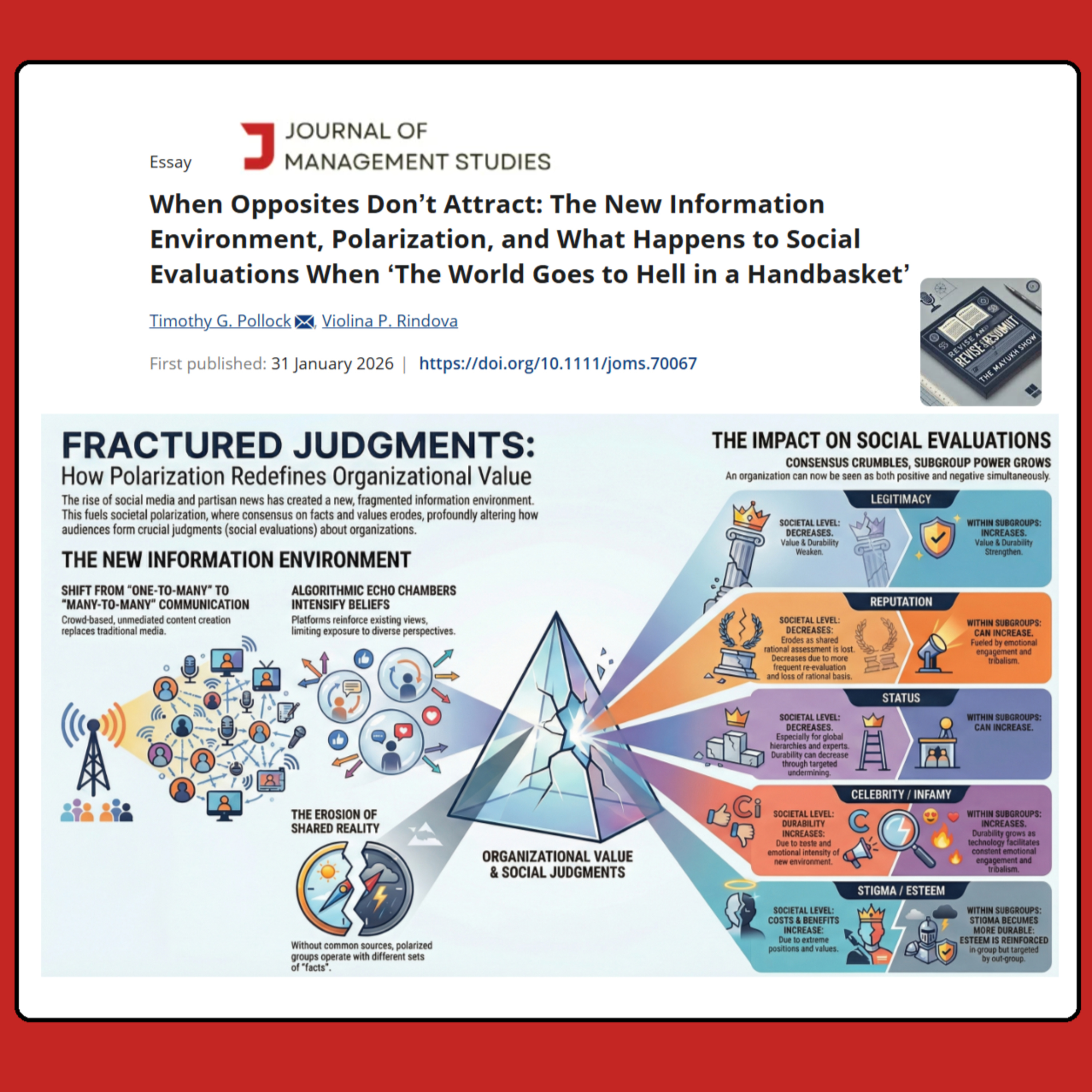
English Podcast starts at 00:00:00Bengali Podcast starts at 00:17:22Hindi Podcast starts at 00:31:58Danish Podcast starts at 00:46:36ReferencePollock, T.G. and Rindova, V.P. (2026), When Opposites Don’t Attract: The New Information Environment, Polarization, and What Happens to Social Evaluations When ‘The World Goes to Hell in a Handbasket’. J. Manage. Stud.. https://doi.org/10.1111/joms.70067Youtube Channelhttps://www.youtube.com/@weekendresearcherConnect over linkedinhttps://www.linkedin.com/in/mayukhpsm/Welcome to Revise and Resubmit 🎙️📚 where we take serious research, bring it down to human height, and ask what it means for the world we actually live in.There was a time when “public opinion” sounded like a single room. Noisy, sure, but shared. A few major outlets, a handful of anchors, a common set of facts that most people at least argued from. Now it feels like the room has splintered into a thousand smaller rooms 🔀📱 and each one has its own lighting, its own soundtrack, its own version of what counts as reality. You can walk from one doorway to the next and feel the temperature change. And in this new air, organizations do not just get judged. They get split-screen judged.Today’s episode follows that unsettling shift through a brilliant, timely piece: “When Opposites Don’t Attract: The New Information Environment, Polarization, and What Happens to Social Evaluations When ‘The World Goes to Hell in a Handbasket’” by Timothy G. Pollock and Violina P. Rindova, published online 31 January 2026 in Journal of Management Studies 🏛️✨ a prestigious FT50 journal where some of the most influential management scholarship lands.The authors look straight at the modern information environment, the technologies that changed how information gets made and spread, and the unintended consequence that has started to feel like the main consequence: polarization ⚡🧠 In that world, the social processes behind evaluation do not simply “update.” They mutate.They animate five classic kinds of social evaluation, and you can almost hear them creak under the pressure:Legitimacy: Who gets to be seen as acceptable, or even real ✅❓Reputation: What you are known for, and whether that “knowing” is shared 🌪️🗣️Status: Who is ranked above whom, and by whose ranking ladder 🪜👀Celebrity or infamy: The heat of attention, whether it burns or blesses 🔥🌟Stigma or esteem: The moral stamp, the social stain, the gold star, the scarlet letter 🏷️⚖️Here’s the twist that lands like a quiet punch: in a polarized environment, evaluations can become less stable at the big, societal level, yet more intense and durable inside tight, ideologically aligned communities 🧲🧱 So an organization can be admired and despised at the same time, not because it changed, but because the audience fractured. The “average” stops being informative. The subgroup becomes the story.If you want more episodes like this, subscribe to Revise and Resubmit on Spotify 🎧 and join us on the YouTube channel Weekend Researcher 📺 You can also listen on Amazon Prime and Apple Podcast 📲⭐And now, the curious question to carry into the episode: if legitimacy, reputation, and status can all be rebuilt inside separate echo chambers, what does it even mean for an organization to be “trusted” anymore, and trusted by whom? 🤔🔍Thanks to Timothy G. Pollock and Violina P. Rindova, and to the Society for the Advancement of Management Studies and John Wiley & Sons Ltd. for publishing this research in the prestigious FT50 Journal of Management Studies.
Embed this episode
Ready to play
When Opposites Don’t Attract (Pollock and Rindova 2026) | FT50 JMS
No transcript for this episode yet
Similar Episodes
No similar episodes found.
Similar Podcasts
No similar podcasts found.