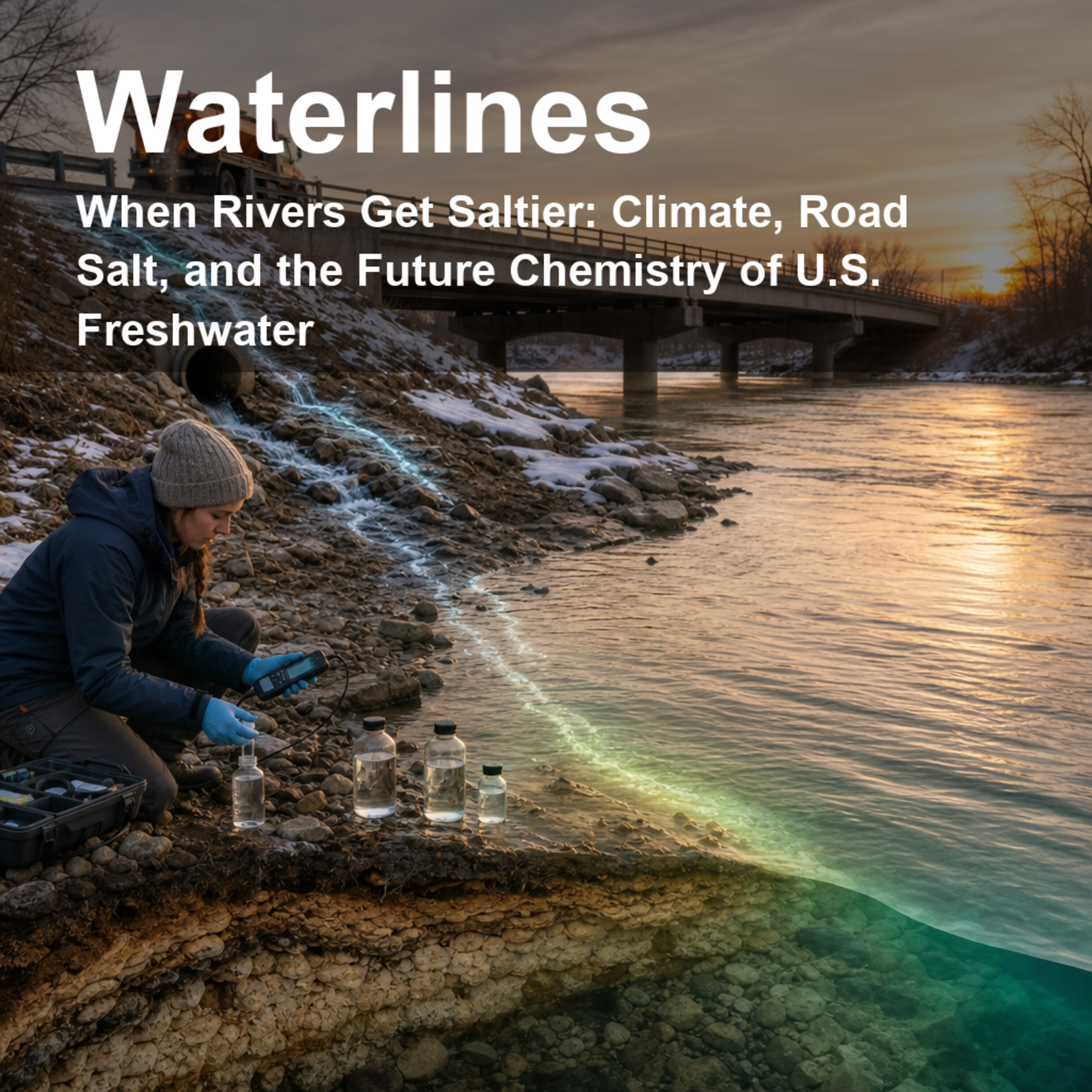
When Rivers Get Saltier: Climate, Road Salt, and the Future Chemistry of U.S. Freshwater episode artwork

EPISODE · May 27, 2026 · 11 MIN

When Rivers Get Saltier: Climate, Road Salt, and the Future Chemistry of U.S. Freshwater

from Waterlines: How Water Shapes Our World · host jaywen

A glass of tap water, a winter road, a farm field, and a trout stream are all connected by river chemistry. This episode asks a practical climate question: as the U.S. warms, will freshwater become saltier, less buffered, or simply different in ways communities need to plan for? We follow a new study that used long-running river records and machine learning to look ahead from 2040 to 2100, linking sodium, alkalinity, road salt, rainfall, population, and bedrock geology across 226 U.S. river sites.Hosts A and B unpack why northern rivers may see lower sodium flux as warmer winters reduce road-salt use, why warmer and drier southern and western regions could still face soil-salinity risks, and why alkalinity behaves differently depending on the rocks beneath a watershed. Along the way, they explain sodium as a salinity signal, alkalinity as water’s acid-buffering capacity, and random forest models as many simple decision trees voting together. The episode also covers what the models do well, where uncertainty remains, and why monitoring stations and open data matter for water managers.Citation: E, Beibei, Shuang Zhang, Elizabeth Carter, Tasmeem Jahan Meem, and Tao Wen. 2025. “Predicting salinity and alkalinity fluxes of U.S. freshwater in a changing climate: Integrating anthropogenic and natural influences using data-driven models.” Applied Geochemistry 180: 106285. https://doi.org/10.1016/j.apgeochem.2025.106285.Disclosure: This Waterlines episode uses AI-generated voices for the host conversation.

A glass of tap water, a winter road, a farm field, and a trout stream are all connected by river chemistry. This episode asks a practical climate question: as the U.S. warms, will freshwater become saltier, less buffered, or simply different in ways communities need to plan for? We follow a new study that used long-running river records and machine learning to look ahead from 2040 to 2100, linking sodium, alkalinity, road salt, rainfall, population, and bedrock geology across 226 U.S. river sites.Hosts A and B unpack why northern rivers may see lower sodium flux as warmer winters reduce road-salt use, why warmer and drier southern and western regions could still face soil-salinity risks, and why alkalinity behaves differently depending on the rocks beneath a watershed. Along the way, they explain sodium as a salinity signal, alkalinity as water’s acid-buffering capacity, and random forest models as many simple decision trees voting together. The episode also covers what the models do well, where uncertainty remains, and why monitoring stations and open data matter for water managers.Citation: E, Beibei, Shuang Zhang, Elizabeth Carter, Tasmeem Jahan Meem, and Tao Wen. 2025. “Predicting salinity and alkalinity fluxes of U.S. freshwater in a changing climate: Integrating anthropogenic and natural influences using data-driven models.” Applied Geochemistry 180: 106285. https://doi.org/10.1016/j.apgeochem.2025.106285.Disclosure: This Waterlines episode uses AI-generated voices for the host conversation.

NOW PLAYING

When Rivers Get Saltier: Climate, Road Salt, and the Future Chemistry of U.S. Freshwater

0:00 11:28

No transcript for this episode yet

We transcribe on demand. Request one and we'll notify you when it's ready — usually under 10 minutes.

Eat to Live Jenna Fuhrman, Dr. Fuhrman Our health is our most precious gift and smart nutrition can change your life. Each month, join Dr. Fuhrman and his daughter, Jenna Fuhrman as they discuss important topics in the world of nutrition. Eat to Live will change the way you eat and think about food. French Your Way Jessica: Native French teacher founder of French Your Way Boost your French listening skills and test your comprehension with this one of a kind series of podcasts. Get the chance to listen to a real conversation between native speakers talking at normal speed AND customise your learning experience through carefully designed sets of questions (2 levels of difficulty) available for download at www.frenchvoicespodcast.com. All interviews also come with the transcript. French teacher Jessica interviews native speakers of French from around the world who share a bit of their life and passion. Where else would you meet in one same place a French yoga teacher based in Melbourne, a soap manufacturer from Provence, or a couple cycling around the world? HOMELAND HOMELAND The Church is a body not a building. It's the bride of Jesus Christ! Jesus is coming back for a mature bride. That means it's time for the church of Jesus Christ to move from milk to meat. This is the hour of maturity!HOMELAND is an announcement that the church is being set free. Only the church has the ability to transform the world. The kingdom's of this world will become the kingdoms of our Lord and Savior!All of creation has been waiting for this moment! Sons and daughters of God are rising up and taking their seat! XXX Tech by SOVRYN Dr. Brian Sovryn The crossroads between technology, sensuality, and metaphysics - and the longest running anarchist podcast in the world! Brought to you by Dr. Brian Sovryn.

Frequently Asked Questions

How long is this episode of Waterlines: How Water Shapes Our World?

This episode is 11 minutes long.

When was this Waterlines: How Water Shapes Our World episode published?

This episode was published on May 27, 2026.

What is this episode about?

A glass of tap water, a winter road, a farm field, and a trout stream are all connected by river chemistry. This episode asks a practical climate question: as the U.S. warms, will freshwater become saltier, less buffered, or simply different in ways...

Can I download this Waterlines: How Water Shapes Our World episode?

Yes, you can download this episode by clicking the download button on the episode player, or subscribe to the podcast in your preferred podcast app for automatic downloads.
URL copied to clipboard!