
EPISODE · Jul 20, 2026 · 41 MIN
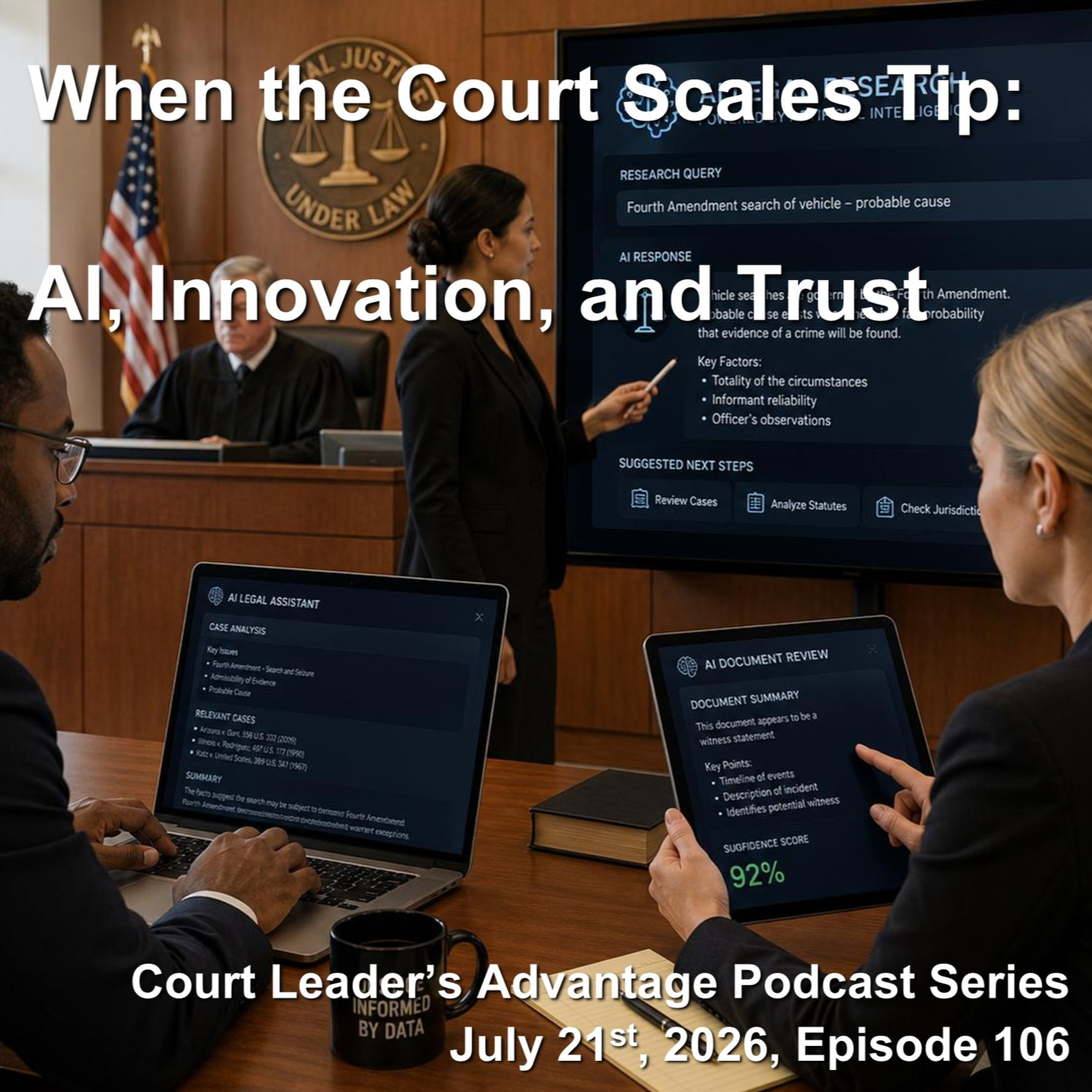
When the Court Scale Tips: AI, Innovation, and Trust
from Court Leader's Advantage · host Peter C. Kiefer
July 21st 2026, Court Leader’s Advantage PodcastEpisode 106AI promises greater efficiency, lower costs, and better public service—but it also raises concerns about privacy, bias, job displacement, and accountability. This panel explores where courts should draw the line.Artificial intelligence is currently having a difficult moment. Hardly a day goes by without headlines highlighting a new AI concern. Consider just a few of the issues currently dominating public conversation: • Corporate leaders are investing billions in AI while simultaneously announcing layoffs, fueling fearsabout job displacement and economic insecurity.• Communities across the country are opposing the construction of new data centers due to concernsabout their massive consumption of water and electricity.• Educators and researchers worry that AI has weakened students’ critical thinking and problem-solving skills by making information and answers available almostinstantaneously.• Privacy advocates warn that AI enables governments, employers, and corporations to monitor individuals more closely than ever before, raising concerns about the emergence of a surveillance society.• Others fear that AI-generated videos, voices, images, and documents have become so convincing that distinguishing fact from fabrication is almost impossible. As a result, AImay undermine trust in elections, journalism, and public institutions. These concerns are real and deserve careful consideration.Yet they often overshadow the remarkable accomplishments AI has already achieved. Consider just three examples:• Google's DeepMind developed an AI system that analyzes mammogram images that, in some cases, detect breast cancer earlier and more accurately than expert radiologists, reducing both false positive and false negative results.•AI-powered wildfire detection systems now analyze live camera feeds, satellite imagery, weather data, and vegetation conditions to identify wildfire smoke within minutes. This saves valuable time for emergency first responders and ends up protecting lives and property.•Arizona State University has implemented AI-powered educational tools that provide personalized learning experiences through conversational tutors, simulated learning environments, and on-demand academic support. AI is also becoming increasingly embedded in courtoperations. It can summarize documents, draft reports, assist with legal research, identify patterns within large datasets, and automate a wide range of administrative tasks. Even courts that have not formally adopted AI are likely employing staff who are already experimenting with these tools in theirday-to-day work. This reality raises a number of difficult questions.As with many technological revolutions, the central challenge is not simply deciding what AI can do. The central challenge may be deciding what AI should do. How much responsibility should be delegated to algorithms? Where must human judgment remain indispensable? And how can courtsstrike the proper balance between innovation, efficiency, fairness, and accountability?Today’s Panel TJ BeMent Court Administrator, 10th Judicial Administrative District in Athens, GeorgiaRick Pierce Judicial Programs Administrator, Administrative Office of the Courts in Mechanicsburg, PennsylvaniaKarl Thoennes Court Administrator, 2nd Judicial Circuit Court, in Sioux Falls, South DakotaCreadell Webb Diversity, Equity, and Inclusion Officer, 1st Judicial District of Pennsylvania, PhiladelphiaWhere should courts draw the line on AI? Email your comments or questions to [email protected]. Selected comments may be featured in a future episode.
Embed this episode
NOW PLAYING
When the Court Scale Tips: AI, Innovation, and Trust
No transcript for this episode yet
Similar Episodes
No similar episodes found.