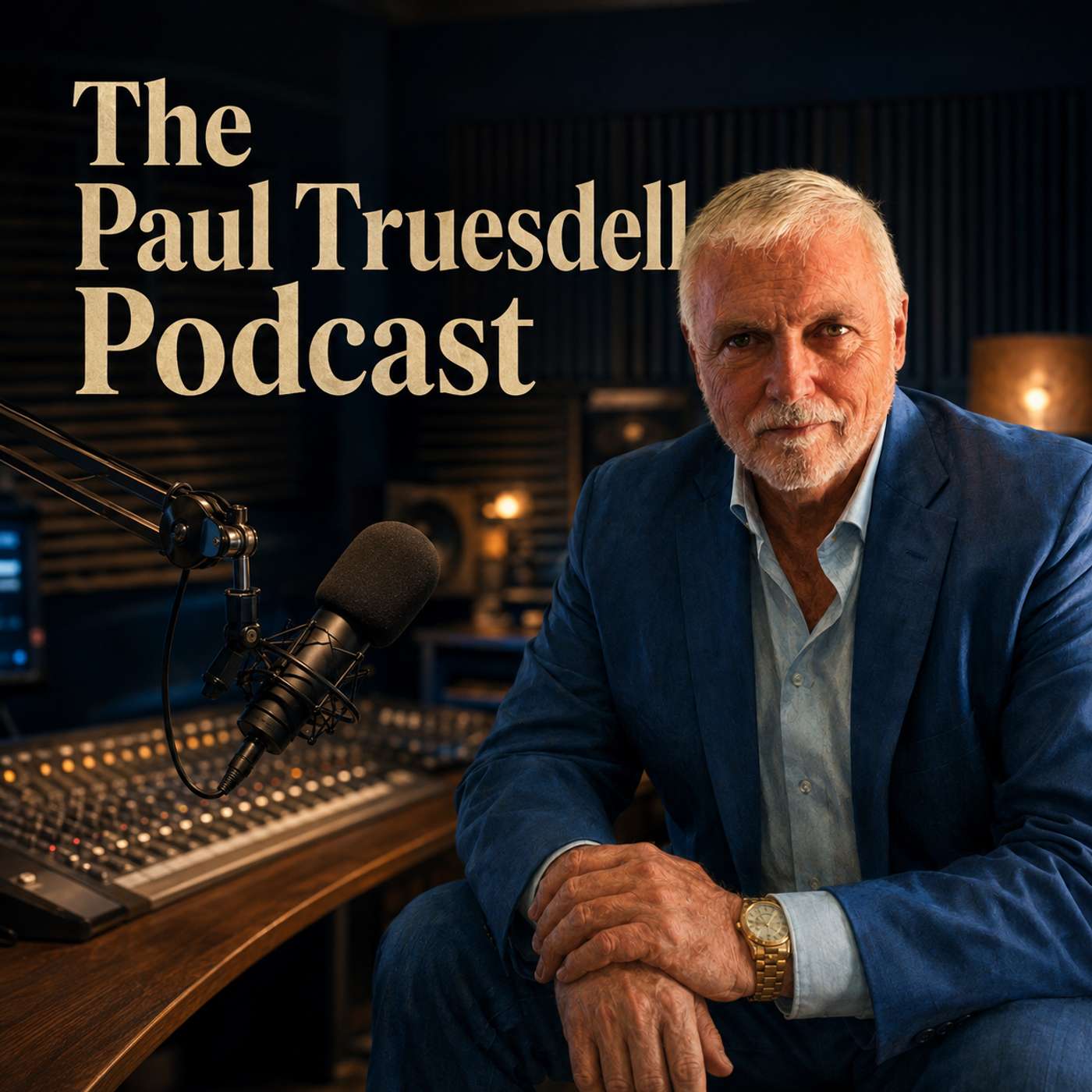
Where Did The Money Go
from The Paul Truesdell Podcast Hosted by Paul Grant Truesdell, JD., AIF, CLU, ChFC
The loss of the House and the Senate on Tuesday will be a massive distraction for the Trump administration, and there is no doubt about that. The Associated Press called both chambers for the Democrats overnight. The blame sits squarely on the RINOs, the Republicans in name only: shortsighted, egotistical, selfish, emotionally charged, knee-jerk Republicans. Enough Republicans stayed home or switched their votes, and now we have a real hootenanny and donnybrook coming. What you are not going to see, if this country turns leftist, is stability in places like Haiti. In my opinion, you will continue to see the kind of money machine we saw around the Clinton initiatives. Do not forget January 2010, when Bill Clinton and George W. Bush stood side by side and President Bush told Americans, "I know a lot of people want to send blankets or water. Just send your cash." When you send money, there is going to be graft involved. Sadly, we have members of the Republican Party, including leaders both local and national, who are corrupt. We also have those who do not understand a fundamental rule of business, which is that people do business with those they know, like, and trust. There are Republicans who find a boogeyman behind every tree. Some exist nationally, and several exist locally. To them, every business relationship is questionable, because they have no business experience at all. They are the epitome of the bureaucratic employee, maneuvering for more benefits. In business, the rule is straightforward. You do business with people you know, you like, who are competent, and whom you trust. It is quid pro quo in the ordinary commercial sense: you do business with each other. Good Republicans do business with fellow Republicans. That is true of Democrats as well, and it is more true among rank-and-file Democrats, because rank-and-file Republicans, who control the majority of the money, oftentimes don't get it. I've seen this continually in my business. Republican businesses are given a shoulder shrug, or a "Well, that's nice, but I have my person." They don't know who their person really is, or that their person is with a heavily Democratic organization or a fair-weather friend of one. From a business perspective, disruption and chaos are not good for stable business. They provide opportunities, but they are not stable. Consider the data center, which is subject to the whims of a small band of people. ABC News reported that Ukraine struck five Russian data centers in October, disrupting banking, payments, online orders, and court records. Kyiv Post reported that more than twenty distribution centers of Wildberries, Russia's largest online marketplace and the closest thing it has to Amazon, have been attacked since mid-July. People in the United States do not understand how good they have it. Those who do understand too often lack appreciation for what we have. Is this election a bellwether? Yes, and here is what it signals. Donald Trump, as a civilian, said things nobody else was willing to say, and he won office as the forty-fifth president. In my opinion, the election of Joe Biden and Kamala Harris was orchestrated by Republicans as well as Democrats. Do not forget Paul Ryan and Mitch McConnell, or the endless attacks on the administration when he was first elected. He returned battle hardened, experienced, and well financed, and he understood how bloodthirsty the game is. That is politics. It has always been that way, and it always will be. In less than two years, things have been done that are amazing, and a large number of those who once gave them lip service no longer appreciate them. That is a danger. There are a hundred million things happening right now that keep our way of life the way it is. Nobody talks about them and few people understand them, but they all work together, and that has fundamentally changed. Here is what is important. From border to border and coast to coast, the Republican National Committee, the Republican Party of each state, including the Republican Party of Florida, every Republican county executive committee, and every club needs a post-election catharsis and evaluation, one that leaves nothing off the table. There are a lot of heads that need to roll, belonging to those who did not do their job to get the message out. There were people who were distracted. There was horrible candidate recruitment. And there was a true abundance of carrot tops, rather than real carrots who stood up as leaders. Some of those discussions were had on the evening of Tuesday, November 3, at various locations, and they will continue, border to border and coast to coast. It is time to take stock. Evaluate, plan, and implement. Paul Grant Truesdell, J.D., AIF, CLU, ChFC, RFC Where Did It All Go Haiti, the billions after the earthquake, and the neighbor paying his own way 1. The Check We All Wrote Most people who have worked for a living and saved some of it have written a check after a disaster and wondered later what it accomplished. Those of us at or near retirement remember January 2010, when the pictures from Port-au-Prince filled the evening news. The Center for Economic and Policy Research, a Washington research group, reported that forty-five percent of American families donated to the relief effort. If your family was one of them, you are entitled to ask what that check bought. This is not a history of Haiti. It is about the last sixteen years and the last three weeks, because the first explains the second. A neighbor in Central America has sent an army into Haiti with President Trump's blessing. 2. The Money After the Earthquake Let's go back to January 12, 2010. A magnitude seven earthquake struck Haiti. Barack Obama was in the White House, and Hillary Clinton was running the State Department. Bill Clinton was the United Nations special envoy to Haiti, and that April he became co-chairman, alongside Haiti's prime minister, of the Interim Haiti Recovery Commission, the body created to coordinate the rebuilding. Less than three months after the earthquake, nearly fifty donors gathered at the United Nations and pledged nearly ten billion dollars, according to NBC News. Total pledges eventually reached about thirteen billion dollars, spread over ten years. To put that in proportion, Fox News reported that Haiti's entire economy was worth around eleven billion dollars at the time. Here's something most people probably haven't seen. The Clinton Foundation did not hold those billions. By its own account it raised about thirty million dollars for earthquake relief, the fund Mr. Clinton ran with former President George W. Bush raised about fifty-four million, and the foundation's Haiti Action Network raised more than five hundred million. The billions moved through governments, the World Bank, contractors, and charities. Mr. Clinton's name was on the commission that was supposed to bring order to all of it, and that is where the questions landed. 3. What the Money Bought The flagship project was the Caracol Industrial Park in northern Haiti, about one hundred ninety miles from the epicenter. The United States Agency for International Development, known as USAID, and the Inter-American Development Bank allocated about three hundred fifty million dollars to support it, and the Clinton Foundation was a partner. The State Department promised sixty-five thousand jobs. The Center for Economic and Policy Research counted about ten thousand as of 2017, roughly one job for every six promised. The American Red Cross raised nearly half a billion dollars. A joint investigation by two news organizations, ProPublica and NPR, reported in 2015 that the number of permanent homes it had built was six. The Red Cross disputed the reporting and said it had repaired thousands of homes. Now let's look at where the dollars landed. The Center for Economic and Po...
Embed this episode
No transcript yet.