
EPISODE · Apr 2, 2026 · 5 MIN
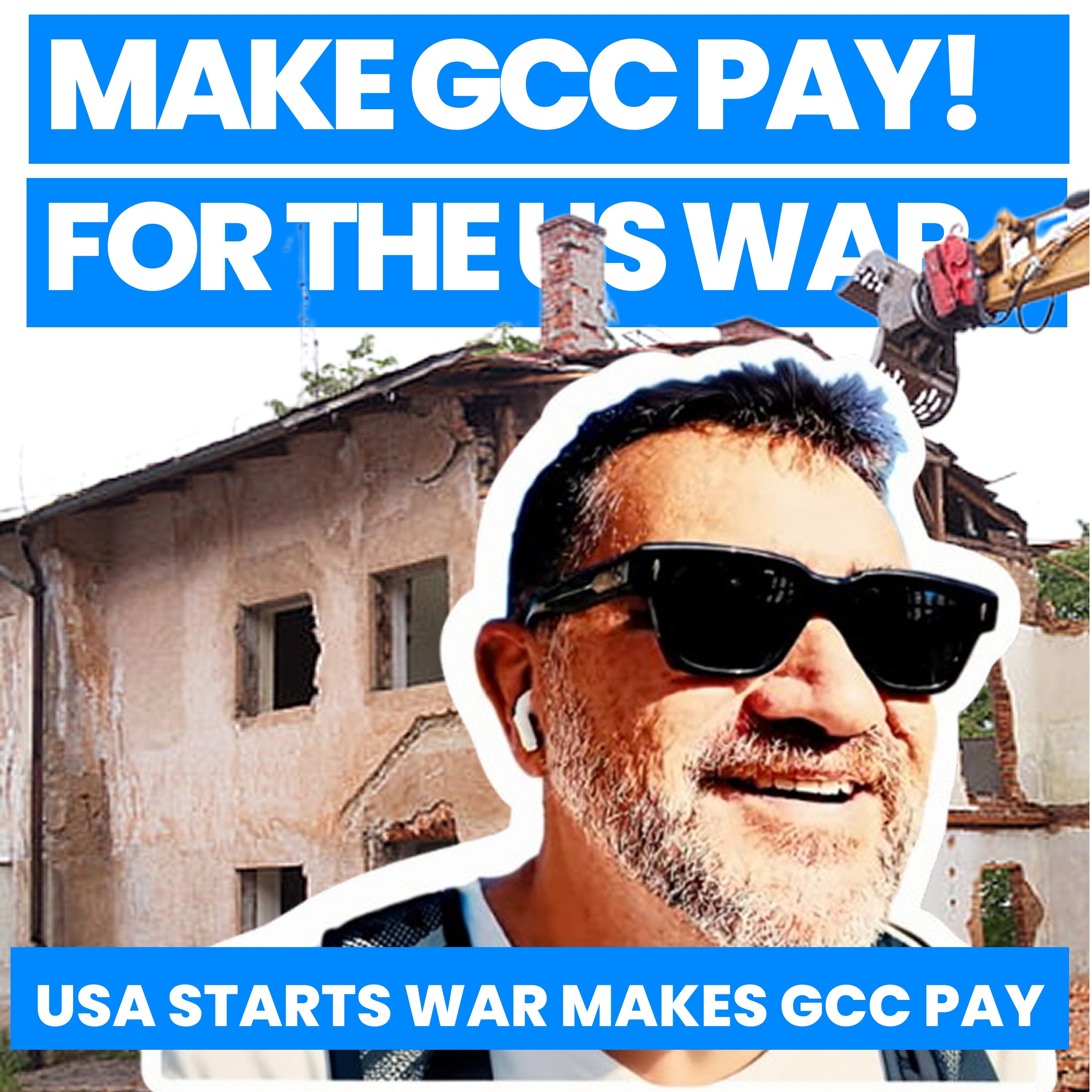
White House Signals Gulf States Should Foot Part of the Bill
from Dave Talks Global Politics Podcast · host Dave Talks: Politics 🌐
Welcome back, team! In this episode of Dave Talks Politics, hi, I’m Dave, and I’ll be talking politics. Today, team, let’s talk about the White House floating the idea that Gulf states should help pay for the costs of the US-Israel war with Iran.**1. White House Signals Gulf States Should Foot Part of the Bill**- White House press secretary Karoline Leavitt said President Trump would be “quite interested” in asking countries like Saudi Arabia, the UAE, and Kuwait to contribute to the war costs.- She was responding to a reporter who noted that Gulf states helped cover most of the costs during the 1990–91 Gulf War against Iraq.- Leavitt added that it is “an idea that I know that he has, and something that I think you’ll hear more from him on.”- The suggestion comes as the US has already conducted strikes on more than 11,000 targets in Iran over the past four weeks.- Team, this is the administration testing the waters on shifting some of the financial burden onto regional allies who are already taking hits.**2. The Historical Parallel to the First Gulf War**- In 1990–91, after Saddam Hussein invaded Kuwait, Gulf states along with Japan, Germany, and South Korea contributed billions to offset the costs of the US-led coalition.- Saudi Arabia and Kuwait in particular wrote large checks because their own security and oil infrastructure were directly threatened.- That war was widely seen as a defensive operation to protect Gulf oil fields from Iraqi aggression.- Today’s situation is different — the US and Israel launched strikes on Iran despite private concerns from Gulf leaders about escalation and economic fallout.- My take: Comparing the two wars ignores a key point — in 1991 the Gulf states asked for help; this time the US started the conflict and now wants them to pay for it.**3. Gulf States Are Already Paying a Heavy Price**- Gulf countries are bearing the brunt of Iranian retaliation — missile and drone strikes have caused damage, disrupted airports, and hit energy infrastructure.- Analysts estimate each Gulf state has already lost millions in revenues and suffered structural damage from Tehran’s responses.- The war has blocked or severely restricted the Strait of Hormuz, through which roughly a fifth of the world’s oil normally flows.- Saudi Arabia and the UAE have reported drone incidents, interceptions, and civilian impacts, including wounded civilians and damaged homes and vehicles.- Team, these countries did not want this war — they warned about the risks — yet they are now absorbing Iranian counter-attacks while the US considers asking them to write cheques.**4. The Arrogance Factor and Regional Reality**- Gulf leaders were concerned from the start that they would suffer the most from any escalation with Iran.- Trump has praised them for “fighting back,” but the White House is now floating the idea that they should also help fund the US effort.- This comes as American gasoline prices have climbed above $4 a gallon and global energy markets remain volatile.- People familiar with administration talks say Trump has not yet directly raised the payment issue with Gulf counterparts.- History shows that when the US asks allies to pay for wars they didn’t ask for, it can strain relationships and fuel resentment — especially when those allies are already taking hits.**5. Political Risks, Strategic Concerns and What Polymarket Is Saying**- With midterms approaching, rising fuel prices at home are already creating political pressure — asking Gulf states to pay could look like an attempt to ease the domestic cost burden.- If Gulf states push back or refuse, it could expose divisions in the anti-Iran coalition and weaken deterrence.- The suggestion also risks reinforcing the perception that the US starts conflicts and then expects others to clean up the financial mess.- Polymarket traders currently give only about 17% chance that Strait of Hormuz traffic returns to normal by the end of April, and around 64–74% chance of a US-Iran ceasefire by December 31 rather than sooner.- Forward realism: Trump’s team may see this as smart burden-sharing, but in practice it could complicate alliances and make future cooperation harder when real threats emerge — traders are betting on a longer, messier timeline.I hope you enjoyed this show today team. The main show, and snack sized supercuts are available on yt, plus apple and Spotify as a podcast and show notes on substack; come join the team it’s free and gets you instantly connected to what’s happening. Help me grow with a like and subscribe and wherever you are team in this wonderful world of ours, I hope, you have, a wonderful day. This is a public episode. If you would like to discuss this with other subscribers or get access to bonus episodes, visit wgowbrics.substack.com
Embed this episode
NOW PLAYING
White House Signals Gulf States Should Foot Part of the Bill
No transcript for this episode yet
Similar Episodes
No similar episodes found.
Similar Podcasts
No similar podcasts found.