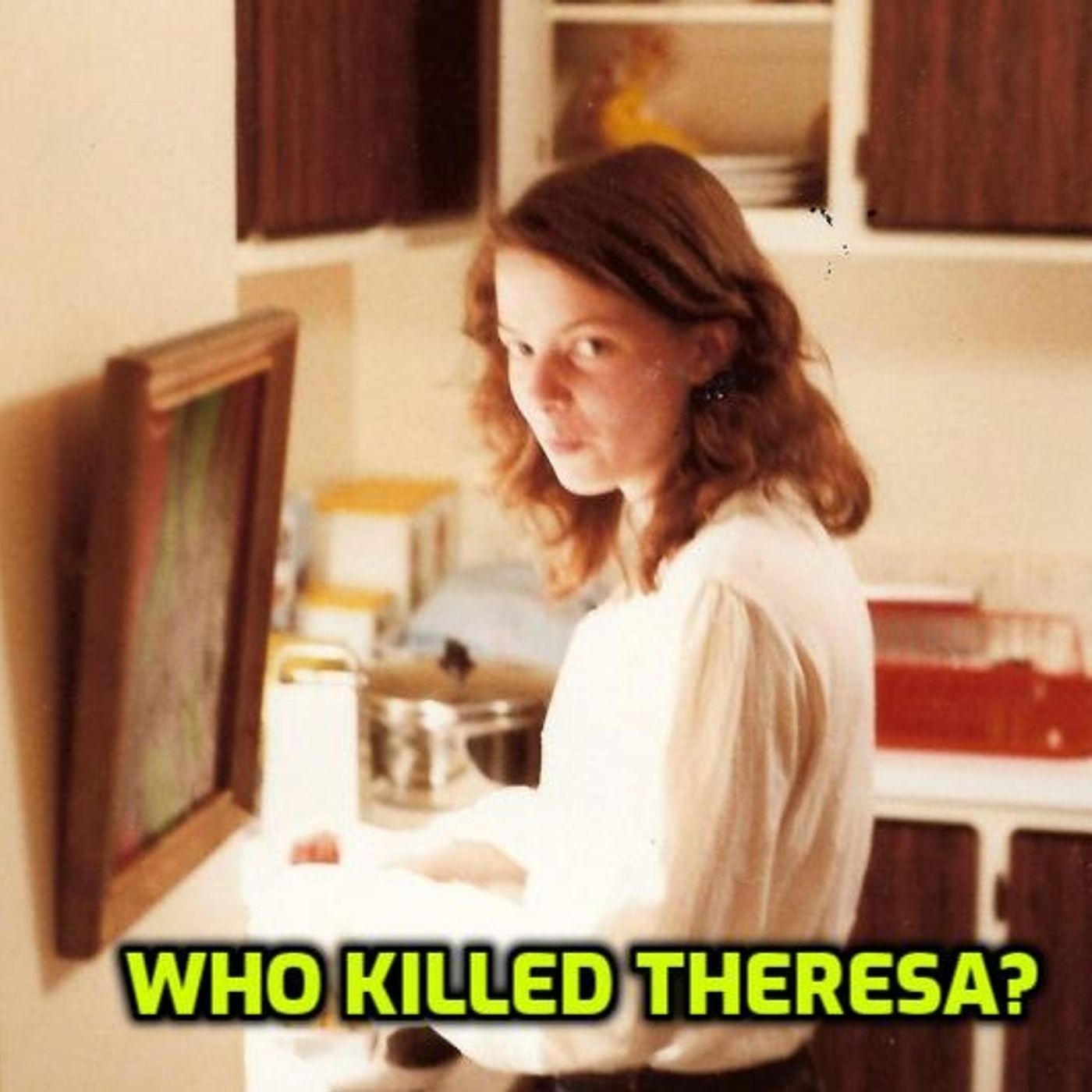
Hello, I'm John Allor. Before you listen to this episode, a couple of things. These are podcasts from the first season of Who Killed Theresa. They haven't been heard in over four years.
They're raw. It took me a while to develop a style. A lot of people like them that way. Unvarnished.
Others commented that it was amateurish. Nonetheless, here they are, I'm edited. I haven't gone back and listened to them. I haven't cleaned them up.
Thanks for listening. And once again, life isn't fair, justice is blind and dysfunctional, and some cops aren't smart and dedicated like on television. This is Who Killed Theresa. Hi, welcome to the show.
This is Who Killed Theresa. I'm your host, John Allor. It's a podcast about missing and murdered persons. A show where life isn't fair, justice is blind and dysfunctional, and some cops aren't smart and dedicated like on TV.
So you may be wondering, God, John, why a podcast? And believe me, I ask myself the same thing. Does the world need another podcast, let alone a true crime podcast? And let's not fool ourselves.
I can call this whatever I want. But it is a true crime podcast. So why? Well, and I don't listen to a lot of these things.
Generally, I listen to them if I'm on road trips, if I drive up to Canada, and it's a 14 hour drive, I'll say that again. A 14 hour drive. So that's how you know, I've been with my kids on serial that way. I've listened to Criminal, I love that.
I like Jordan, a Bonapartis, the nighttime podcast, which is a podcast out of Halifax, Nova Scotia. It's got a simplicity and naivety that I really kind of adore. But beyond that, I don't I'm not aware of too many true crime things. Let alone podcasts.
I think the only other one I've listened to is my brother, my brother and me. And that's not because I'm cool. And in the know, it's because I have kids and they love Griffin, Justin and Travis Mackel right. So that's that's really it.
But but I thought, well, I came to the studying realization that although I have written all this down in triplicate over the past, I guess, 15 years on my website, there is a strata of the population that does not like to read, it kind of hit me one day. Why say it all when you've written it all? Well, John, there are some people who like to just turn on a podcast and have it playing in the background well, they do something else. So I thought, Hey, there's an idea.
Let's try that. Maybe something will come of it. This won't always be me blabbing. I think for the first few, we're going to do it that way.
We're going to start really, really simple. But then I will obviously open it up to other voices as I flex my muscle with this thing and kind of learn some tricks it will grow as I grow. And then of course, the other thing is, you know, if you like binging on these things, I don't think you're going to have to worry. There's lots to talk about.
This is one case that flowers out and touches many up to 20 cases by way of comparison. If you think of the guys who do the Moira Murray podcast, that is one case about a missing person in New Hampshire who has never been sold. And yet they've managed to string that out for I think it's going on five years now. And I believe their frequency is weekly.
That might be a little generous might be monthly, but they have lots to talk about and I have lots of people who follow that case. So I see this very, very similar. We won't always talk about my sister's murder and come back crime. We'll take a break occasionally.
Because it will start to give me a headache. And I'm sure I'll give you a headache. We'll talk about other things. Have some ideas.
I'm not going to talk about them right now. But I thought it would be a good idea. Yes. On the last podcast, I did the first one.
I kind of set the groundwork for the case. Might be a good idea now to go back and kind of get people who are coming in now just a short introduction about what we're talking about here. So here it goes. This is from the Wikipedia page on the death of Teresa Laura.
I can do this because I wrote it. So it's my stuff with the media in the panic. So here it is death of Teresa Laura. Teresa Laura was a 19 year old college student who disappeared on Friday, November 3rd in 1978 from Champlain College, Lennoxville, in the eastern townships of Quebec, Canada.
Five months later on April 13th, 1979, her body was discovered in a small body of water approximately one kilometer from her dormitory residence in Compton, Quebec. Upon her disappearance, police initially suggested she was a runway. When her body was discovered, police then suggested she was the possible victim of a drug overdose, perhaps with the assistance of fellow college students. In the summer of 2002, the family of Teresa Laura enlisted the support of an investigative reporter and friend, Patricia Pearson, who produced a series of articles for Canada's national post newspaper that presented compelling evidence that Teresa Laura was the victim of murder and that her death was possibly linked to two other unsolved local cases.
The death of 10 year old Manon Jubei in March 1978 and the murder of Louise Cammerin in 1977. The theory was supported by a geographic profiler and then FBI consultant Kim Rosmo, who suggested a serial sexual predator may have been operating in the Quebec region in the late 1970s and advise police to investigate the three deaths as a series of murders. Rosmo had gained notoriety when in 1998 he suggested that Vancouver police create a serial killer task force to investigate the multiple cases of missing women from Vancouver's downtown east side. Robert Pichton was eventually arrested and found guilty of six of the murders, though he was accused of and implicated in an additional 26 murders of Vancouver missing women.
The deaths of Teresa Laura, Manon Jubei and Louise Cammerin remain unsolved cold cases. Now when we last discussed this last time we talked about the disappearance and then the discovery of Teresa's body in the spring of 1979 and how quickly authorities latched onto a theory of a potential drug overdose and student involvement and the insinuation really that the victim was to blame and this was not really a problem of the town or the university and how quickly my father frankly bought into that theory. And I think part of the reason for that was we were unfamiliar with the area. We did, we grew up and lived on the West Island of Montreal but between the point where Teresa disappeared and when she was found in the five months we had moved to St.
John New Brunswick. So we were not familiar with the eastern townships. If I'm to guess I think the reason that my brother and sister ended up at Champlain College is when my brother and I were teenagers we attended in the summers the Howie Meeker Hockey School and any Canadian right now when they're hearing that of a certain age is smiling and a bunch of you don't know what the hell I'm talking about. But the Howie Meeker Hockey School was legendary.
Howie Meeker had his own program on Hockey Night in Canada. He was the Don Cherry of his day and he had a hockey school and it was in Stansted Quebec right on the border of Vermont. And to get to Stansted you would need to drive out of Montreal into the eastern townships and you'd have to drive past Lake Memphra Magog because that lake extends right down into the United States. So you can't be on the east side of it or the west side of it.
You have to drive past the east and then you have to hang a right and head down to Stansted and the only way to get to Stansted is to go through Lenoxville. So my guess is on one of the times when my parents dropped myself and my brother off at Hockey Camp they saw this small college and fell in love with it. But they really apart from that we're not familiar with the area. And the authorities tried to sell my parents and everyone in the community on the idea that it must have been a drug overdose because nothing like this had ever happened in that community ever before.
It was so foreign and so unconscionable that such a thing could happen because there was no past history of it. And of course that notion is complete and utter horse shit. In 2002 I wrote extensively about the history of sexual assaults on women in the eastern townships from 1977 to 1980. I was just I haven't looked at it but I was just looking over it.
I was going to summarize it for you. But it's actually pretty good. So I think what I'm going to do is I'm just going to read it to you and you can make of it what you will. One of the first people to contact me was a woman named Carolyn Raoul.
Raoul had been a writer with the Bishops College paper The Campus in 1978. At that time there had been a series of sexual assaults on campus. Raoul had covered these stories. She had been one of the only journalists in the area to repeatedly warn that there was a growing problem of sexual violence against women.
For the most part the mainstream papers like Latribune which was the French paper and the English Sherbrooke record ignored the situation. After speaking with Raoul, Raoul found some of her old writings in her attic and she sent them to me. And the trouble in Lennoxville had started long before the night of November 3, 1978. As early as January 78 Carolyn Raoul had reported of three separate incidents of sexual and verbal assaults on women.
The Lennoxville police force failed to take the situation seriously. When then police chief Kazimir Krisak justified the police as an action by arguing that in the five years since he had been police chief there had only been one reported incident of sexual assault. Raoul did some quick research and discovered that at least eight rapes had occurred in Lennoxville in the course of that one year. Many of the attacks had been quite severe.
One student was dragged to the ground and beaten on the head with a board. In February of 78 the Champlain student paper, the touchstone, picked up the story. Girls were being molested by a short man in jeans and a green parka. Other women described a different short man, a man with beard and black hair.
Girls had complained to officials both at Champlain College and Bishops University. They also had made reports with the police. The girls were scared to walk home at night. Many classes didn't end until after dark.
Lights that were supposed to illuminate the campus had burnt out. Students were scared and anxious. The police and the school did nothing. The Bishops University nurse commented that the situation had all been blown out of proportion.
That's in quotes. A Champlain counselor Melanie Cutting tried to justify the school's lack of response by commenting that one of the stories had been fabricated. By this time, the former police chief, Kajmir Kryshak, was fired by the town of Lennoxville. But his replacement, Leo Hamel, did nothing to improve the situation.
Concerning the attacks, Hamel commented to the touchstone newspaper, quote, everyone was making a mountain out of a mole hill. End quote. For the remainder of the year, the hysteria quieted down on the university campus. But then by the fall of 1978, reports of a sexual predator re-emerged.
In early October 1978, a short man in a ski mask harassed a female student in an empty campus hallway. Then two weeks later, on October 30th, a girl was walking to the university at night when she was confronted by a naked man standing by a tree. Quote, I'm certainly not going to walk after dark anymore. I was scared half to death.
End quote. She said, Chief Hamel brushed off the incident, commenting that such things were to be expected at a university where so many women congregated. Unbelievable. In her editorial on the campus on November 3, 1978, remember that my sister disappeared.
Carolyn Raoul sounded off again protesting that authorities were not taking the situation seriously. Raoul chided Chief Hamel for his comments and reminded students that it was he who made the comment the previous year that sexual assaults on campus were, quote, a mole hill, end quote. Raoul further complained that the campus lighting that had been broken the previous winter still had not been fixed. The campus was neither safe nor secure, and women were being forced to walk about late at night in the dark.
I'm going to stop here and just note, there was an article last month in the local townships paper still complaining. This is, what is this? This is 36, 38 years later, still complaining about the lack of lighting from Champlain College into the town of Lenoxville, and that students, 38 years later, were still complaining about safety concerns regarding lighting. In addition to the articles she kept from her years at Bishop's University, Carolyn Raoul also remembered the names of some women who had suffered attacks.
One woman Raoul recalled was attacked while jogging by a man who tried to force her into his car. Another girl had suffered a large gash to her head when she jumped from a moving car driven by a woodby attacker. Raoul also related her own encounter with a possible predator, and this is Raoul's encounter. One afternoon she was hitchhiking between Sherbrooke and Lenoxville, when a guy in a beat-up car stopped to pick her up.
Raoul got in and they were headed down the road when suddenly the guy turned to two or three times quickly onto some side streets. Alarm Raoul asked where he was going. He replied in French that he had to go someplace to check on something. The man pulled into a vacant lot and stopped.
He then turned to her and stared. A man said nothing. Raoul did nothing. She was determined to stare him down.
After a minute the man started the car and drove her out to the main road. Raoul asked that he let her out of the corner. The man stopped the car. She moved to open the door but couldn't.
The man turned to her and said smiling you can't get out. I have to open the door for you from the outside. He did so and then sped away. While Raoul was left upon her how close she had come to putting her life in jeopardy.
I tracked down one of the other women Carolyn Raoul had mentioned to me. We're going to call her woman A because there's several women here and I'm just going to refer to them alphabetically because they chose not to be identified. Woman A was now living out west. Her assault occurred in October 1980.
Two years after my sister's disappearance. At the time she was a student at Bishops but lived near North Hadley. North Hadley is to just a little bit to the south of Compton where my sister lived and her body was found. So she was living near North Hadley.
Also she was a brunette but not short. She stood about five foot ten. One afternoon and the stuff about height and all that will come into play later. One afternoon she was out jogging on Route 143.
Recall that Route 143 is the same main road that leads south out of Lennoxville. It's the road that Theresa would have hitchhiked on. It is the road to get to Massawippi where men on Zebay's body was found. Woman A was jogging down the highway.
She was at a point about one mile south of McDonald Road. McDonald Road is the road where Theresa's wallet was found. When a man jumped out from behind some bushes and attacked her. The man darted out and grabbed Woman A by the neck.
He then repeatedly beat her on the side of her head with his other hand. Woman A was fit. She had recently run a marathon. She took self-defense classes.
She commented that this training did hurt no good. She felt helpless. He seemed experienced at this kind of thing. A professional, she suggested.
Woman A fought back. She scratched his face and bloodied him. She was amazed that motorists who were passing by did absolutely nothing. Finally the man overpowered her.
Before passing out Woman A spied a big gold car behind the bushes where the man had come from. When she regained consciousness Woman A found she was lying prostrate on her backseat on the backseat of the gold car. She was bleeding badly. She had been stripped down to her brawn panties.
The man was looming over her, preparing to rape her. When she opened her eyes the man began beating her about the head again. Woman A believed she was about to die. She cried out, God save me.
At this point the man stopped. He dragged her out of the car, dressed her and let her go. Out on the road two women stopped their car and drove her to the hospital. Doctors later stated that it was a miracle she was still alive.
She had been so badly beaten. Woman A eventually recovered from her injuries. When she got better she was determined to track down her attacker. She created a composite drawing of the man.
Her brother posted the drawing throughout Lennoxville and Sherbroke. Unlike some victims, Woman A was not intimidated and wanted to find the man and prosecute. Boy by her determination police were initially motivated to find her attacker. The investigator assigned to her case Detective Filion confided to Woman A that there had been quote a wave of such incidents in the area.
Woman A remembered some details of her assailant. A man spoke French. He might have worn black army boots. When police checked the bushes where Woman A was attacked they found a large tool.
Maybe a ice pick or a file. Over time the investigation lost momentum. Police were never able to track down her attacker. A year after the incident a reporter from the Sherbroke record confided to Woman A that there was a rumor going around town that the police chief's son was a sex offender and may have been the one responsible for her attack.
Slowly Woman A became convinced that the incident was swept under the rug for political reasons. I'm going to stop there a little bit and talk about that a little bit. This notion of the police chief's son. That comes up an awful lot as an urban myth.
It came up in the case what we call the Shaddigay full moon murders that happened I believe in 75 that two young women who were murdered for a long time. It was rumored I think it still rumored I still see it on websites like Christian Gravener's Coolopolis which is a fantastic blog about Montreal and Quebec Underground. But often there's always a comment and he talks a lot about the Shaddigay full moon killer and there's always a comment on the police chief's son did it or the mayor's son did it. This seems to be pervasive throughout society.
I don't know if it's true or not. In reading this about Woman A I haven't read it in a long time. It is absolutely horrific. I cannot believe that someone had to suffer through that and if nothing happened nothing was done and nobody learned from it.
But hey we're just beginning. There's more here. I'm going to continue from this piece again if you're just tuning in. This is a piece I wrote in 2002 about history of sexual violence against women in the township area.
Woman A had read our story in the National Post. It's the story that Patricia Pearson had written. She remarked the way you describe the encounter with the girl in the apple orchard. That's it.
That's how this guy had attacked her. Two weeks after talking with woman A I was able to track down Detective Filion, the man who investigated woman A's attack. I asked him to comment on his remark about the wave of attacks that had been reported against township women. Filion stated that he was now retired.
He didn't remember much from his police days. I don't know a police officer who doesn't remember much from their police days. They seem to remember everything. Anyway, besides he said, Rock-a-droll was in charge back then.
If I had questions it would be best to communicate with him. It appeared that all roads led to Rock-a-droll. Some of this I'm skipping ahead. I'm touching on things we haven't talked about yet.
Just bear with me. We'll get to it. Continuing. Carolyn Ryle had mentioned a second-issue student, woman B.
Woman B was the victim who had suffered a gash to the head when she jumped from a moving car she had been forced into. Both myself and Ryle attempted to contact woman B on several occasions. She never returned her calls or emails. All that is known is that she was attacked sometime in 1978.
If I recall correctly, I believe that attack occurred on the road north leading out of Champlain College. She was a small road there that leads up to private school up there. She was attacked on that road. Another email came through my website.
A woman wrote to tell me the anonymous story of Woman C. I'm going to run through the alphabet here. Woman C was a Champlain student who had been violently raped in the fall of 1978. When I tracked her down and asked her to speak with me, Woman C was like Woman B.
She did not wish to revisit the event. The memory of it haunted her. When I told her who I was and I was doing, she then agreed to talk to me. In the fall of 1978, Woman C was a first-year student at Champlain.
She was living in an off-campus housing on Shamanne Bell Horizon just up the street from Champlain Bishops Campus and the lion pub. Bell Horizon would have been at that corner. I talked about it in the last episode. Right?
Students would have hitchhiked from there. You know, crosshairs of the lion pub and Bell Horizon. One day her roommate brought home a young man. She had picked up at a bar.
J.R. as he was known, liked the girls' apartments and decided to invite himself to stay. J.R. turned out to be a brutal, violent man.
For three weeks, he virtually held Woman C hostage. He began to rape her at will. Woman C went to the police. She told them what was happening.
The police explained that if she pressed charges, J.R. would be placed in jail. But there was still a possibility that he would be out on jail. Other than this, the police said there was little that he could do.
In fear that if she prosecuted, J.R. might return and inflect it far worse treatment, Woman C did nothing. There was the police's way or my way, and my way was the alive way. She said, defeated Woman C.
went home and the rapes continued. One day, J.R. brought home a revolver and raped her at gunpoint. Later, J.R.
confided to her that the gun had been used in a local murder. He said that he had to get rid of J.R. forced her to accompany him to the Sherbrooke prison where he conferred with a prisoner about the gun. The prisoner revives J.R.
to dump the gun in the river. To the best of Woman C's knowledge, that's exactly what J.R. did. After three weeks, J.R.
lost interest in Woman C. He stopped coming around the Bell Horizon apartment. Woman C said to me that she had lived in fear all her life, wondering whatever became of J.R. She knew his real name, and she knew this because one day she dared to rifle through his wallet and saw his driver's license.
J.R. stood for junior. Woman C. Said she wanted to help because she knew that other woman had suffered.
Maybe her coming forward could make a positive change. So stop there a little bit. I'm not talking about this to have people chase down these leads or suspects. That's not the point.
This is beyond cold. We're not going to track down J.R. and see if you really did it. That's not the point here.
The point is the history of sexual violence in the area. I seriously doubt J.R. had anything to do with my sister's murder. Again, that's not the point.
The point is to say that this area was unaccustomed to this level of sexual violence is, again, absurd because there were so many doing it. So many. And frankly, when J.R. says that the gun was used in a murder, I think I know which murder he's talking about because gun violence was not as prevalent as it is today or certainly as it is in the United States.
There were very few gun murders in that area. There was one particular note that happened in the fall of the 1960s. I believe J.R. is linked to that case.
I believe I know who the inmate was that he went to talk with. But that's another story that we will get to when we talk a little bit more about the private investigator Robert Buick, who was involved in that case. So to continue, another former student, this time a bishop's alumni, also informed me of harassment problems in 1978. She too lived in an apartment on Bell Horizon.
A man used to stop the hallways late at night whispering, here kitty kitty. You can't make this stuff up. She rented her apartment from a bishop's professor. The professor used to make excuses to come and check her heating system.
She could always tell when he had been there because her panty drawer was disheveled. She lodged a complaint and school asked the professor to stop. You gotta laugh or you'll cry. More emails.
A woman, woman D, wrote about an incident that happened to her in August of 1980. Woman D was followed to a case popular at the corner of Union in Beldedir. The same case popular is a bank, by the way. The same case popular where Men on the Bay had been playing when she disappeared on a night of January 27, 1978.
The man ran after Woman D. In French, he offered her a lift. Woman D stated that she was not interested and moved on. Later, the man cut her off in his car.
He exited the car and stood in her way, ordering her to get in the car. She refused. He began shouting and swearing, demanding her to get in the car. She was defiant and yelled back.
The man turned red with rage, clenching his fist. She thought he'd looked like he was about to punch her. A crowd gathered, seeing the people, the man back down. As he drove away, Woman D noticed a baby seat in the back of his car.
Seven years later, Woman D's sister-in-law had a similar encounter with what she believed was the same man. Again, the man was French. He had a baby seat in the back of his car. This time, the sister-in-law took down the license plate number.
She kept that number on a piece of paper and a drawer for over 15 years. And finally, there's the story of Woman E. Woman E's brother contacted me after reading the story in the National Post. In the summer of 1977, months after Louise Camarone had died, Woman E stood hitchhiking at the corner of Portland and Chartier.
The location was one block north of the corner where Camarone was last seen by the convenience store owner. It was the middle of the day, 12 noon, when a car stopped to pick her up. The man driving was short and French. He said he was an electrician.
Before taking Woman E to her destination, the car for a shopping mall, he explained he needed to stop somewhere to do something. The man headed off course toward the north edge of town. On Beckett Street, he pulled in beside a small electrical house and stopped. The man got out of his car and said he needed to retrieve something from the trunk.
Confused, an apprehensive woman E remained seated and lit a cigarette. She could hear him in the trunk, rummaging through what sounded like a toolbox. Suddenly, he came at her through the driver's door, brandishing a very large screwdriver. Panicked, Woman E stuck the cigarette in his face and kicked him in the groin.
She jumped over him, ran out to the street, and flagged down a passing milk truck. Woman E reported the incident to the police and gave a detailed statement. She referred to her attacker then and now as military stupid. He looked like he might have served in the army.
She stated that the incident related in the National Post about the woman chased on McConnel Road through the apple orchard sounded like the same man that attacked her. So those are the sexual assaults from the townships from that era. But of course, the elephant in the room or the two unsolved murders that had occurred within 17 months of Teresa's disappearance, the murder of Menel to Bay in 78, and the murder of Louise Cameron in 77. And what we have to ask is how did the police not know about these murders and not make a connection with these cases?
We'll go into greater detail in these cases later, but for now, I want to talk to them about them in relation to the private investigator, my father hired Robert Buelac, and talk a little bit about how I learned of these cases. So we're going to start with that with Robert Buelac. Now, as I had mentioned, early in November 78, my parents became quite frustrated with the level of service the job that the police were doing. And so he enlisted the services of a private investigation firm called Metropole, which was run by Robert Buelac and Joel Hart to McGill graduates.
My father was a McGill graduate, and I happened to have a copy from 78 of the McGill magazine that they send to alumni from the fall of 78 in McGill News. And in here is an article on Metropole investigations called Partners Against Crime. I'll put a picture up of it as well. I'm going to read from it a little bit.
It's actually quite amusing. He has been immortalized as Sherlock Holmes and Hercule Poirot, glamorized as Co-Jack and Colombo. But the real life detective knows from experience that crimes are not always solved, and that wearing a trench coat, no matter how rumbled, does not guarantee success. Fiction shows the positive side, explains 31-year-old detective Robert Buelac, founder and director of Montreal-based Metropole Bureau of Investigation.
But there is also the negative image, the shady operator who will do anything for a dollar, to whom illegality and legality are just technicalities. Buelac and Deputy Director Dr. Joel Hart give the lie to both images. Integrity, they maintain, is Metropole's watchword.
Sure, we want to serve the interests of the client, notes Buelac, but our main commitment is to do a thorough investigation and to tell the truth. Under no conditions are we prepared to Dr. Evidence. How did a lawyer and philosopher end up running a private detective agency?
For Buelac and Hart, it was a logical move. During Expo 67, Buelac served on the well-drilled Auxiliary Police Force that provided security for visiting dignitaries. He continued to work in the field of investigation and security while taking his degree at McGill. About a year and a half ago, I decided to start my own business, he recalls.
I contacted John Abbott College's Police Technology Department to try to find new recruits as agents for my firm. I don't know that they really had agents, I always thought it was just the two guys, but anyway. The chairman of the department happened to be, and still is Joel. He was personally interested in getting involved in the organization, so we began operating as a team.
Hart, 38, who heads the only English language police technology program in Quebec's SAGEIP system, earned his doctorate in political and social philosophy from New York University in 1974. There is a close connection between philosophy and detective work, he explains. A lot of philosophers read detective stories to help them with their analytical philosophy. Here is one philosopher who has actually gone into the business.
It goes on and on, but I will, there's one paragraph that I think is interesting. Many of MetroPaul's clients are individuals experiencing stressful family situations. Parents, anxious that their teenager might be heading for trouble with the law, or in need of professional counseling hire youthful MetroPaul agents to find out who the child's friends are, what his lifestyle is, and whether or not he's involved in drugs or crime. Says Hart, most of them would rather know the worst than just not know.
So that's the next, Robert Buelac, who my father hired. Buelac was an imposing figure. He stood six foot five and carried around a like a nickel plated gun, a revolver and a holster. And he, unknown to my father, he had a history with the Sherbrooke police.
Prior to getting involved in Theresa's case, he was involved in a case where, what had happened, and I alluded this earlier to JR, there was an incident in just south of Lennoxville where two police informants, a woman and a man, were taken out into a field and shot execution style through the head. Arrests were made, two young locals were arrested and convicted and sentenced to a 25 year sentence for those murders. Some believe that they were falsely convicted, and Buelac was brought in to represent their interests. And from that he learned that the Cervatate Takeback had done illegal wiretapping.
They had beaten a confession out of one of the young men. They had beat him so hard on the side of his head with a phone book that he lost his hearing in that ear. And so that was Buelac representing that side of the case. On the other side of the case, the prosecution of these two young men, the lead investigator was Rock Goudreau, the Cervatate Takeback detective, who eventually led up the investigation into Theresa's body being discovered.
And although last time I had alluded that Goudreau only became involved when Theresa's body was found, that's not really true. Although Leo Himmel at the point of disappearance was in fact in charge. Goudreau was always lurking in the periphery. Goudreau's the one who famously had said to my father in the winter of 78 when my father had, in frustration, said what's to be done, Goudreau responded, well, there's nothing to do but wait for the snow to melt and then we'll find a body which my father remarked that when Goudreau made that comment to him, it was like a bullet going through his head.
He couldn't believe the insensitivity of the remark. So unbeknownst to my father, there was this history between Buelac and Goudreau and a history of conflict. So you can imagine how that would have played out when Buelac showed up a month later after representing these two guys that that Goudreau was trying to convict and was in the middle of this missing persons case. Undoubtedly it led to conflict, it led to friction, poor communication and frustration and ultimately bad investigation.
So a little background on how did I discover that there were these other cases meant on debate and Louise Cameron? Well, it was easy because they were right in the French newspapers and you might say, well, then, you know, why didn't everybody talk about it? Why didn't everybody know nobody? I can't answer for the police.
I can answer for my parents. It's very, very simple. I mean, in conjunction with the fact that they were physically separated from Quebec, that they were living in New Brunswick at the time, my parents didn't speak French. They had a very rudimentary knowledge of French.
So they wouldn't be reading the French newspapers. They had no reason to. In fact, when my father eventually got treats his autopsy report, he had to pay $100 to a local translator to get translated into English because it didn't mean anything to him. I, on the other hand, well, I mean, I was raised on Anglophone, but I'm a product of the late 70s in Quebec, where by when the party Quebecois came into power, I was forced to attend school in French, which was really good for me.
So my French was better, but not great. I had been living in the States at that point for approximately 15 years. So when I arrived in Schurbrook in March of 2002, I arrived with a La Russi dictionary in hand. Met with the police who gave me a fly box of things.
And when I was pouring over that, I was literally working word for word because many things I didn't know. And now, over time, that improved. I began to learn the words of crime. I certainly knew what rape and murder and sexual assault were in French.
All the buzz words from the case, I picked up really quickly. Wallet, scarf, underwear, earrings, naked, murder, all of these things were the buzz words that I needed to know in order to adapt. And then, of course, you know, now my French is fine. I can read it.
I can understand it. Occasionally I speak it, but if you don't have anyone to speak with it, that becomes a challenge. So, so at this point, in the spring of 2002, you know, I was making a lot of inquiries and trying to figure all of this stuff out. And Boulak, the investigator, had become an ally with me.
I think I got his phone number from my father and we were communicating on several things. And in fact, he eventually bought his dead now, bought a guide of cancer in like 2000s. But before he did, he gave me his file entry, generously. He wrote me this note.
It's from April 2002. Dear John, the finding closed. All the newspaper clippings I could find in our file, including the reference to concerning the photographs taken at the crime scene. If there is any other way that I can be of assistance, do not hesitate to contact me if you prefer to use email, my personal addresses, etc., etc., Robert Boulak.
So, we had become friends and we were talking about things. And one day, doing research, I also know that in addition to going to to to Lennoxville and, you know, meeting with the police and looking at the files, I also went over to the Bishops Library. I was pouring over their archives of newspapers and also on microfiche. They had copies of a low police, the crime journals of their day.
And so I was looking at those things on microfiche. Eventually, I found out that you could have those things. It was amazing. If those things mailed to you, the library will mail them to you.
So I was able to look at the microfiche right here in North Carolina, the local Durham Library. So I was pouring over these things. And one day, I found an article on Theresa's death in a low police from day day May 6, 1979. And I'm going over it and I see this in French.
It says, I'm going over to the Bishops Library. I'm going over it. And I see this in French. It's aZ, please.
I want to ask you the Sherbrook community to speak French. What it's saying is, is the Sherbrooke Serté de Quebec remember the murder of Louise Cameron from the 25th of March in 1977. The violent murder, and it looks like Theresa Allor, is also the victim of a sadistic murder. So that's when I stopped in my tracks.
And at that point, I phoned Robert Boulak, and I said, did you ever hear anything about the case of Louise Cameron, another woman, Louise Cameron? And he said to me, you mean Men on Debate? And I said, no, Louise Cameron. And he said, I'm currently looking at an article about Theresa that references Men on Debate.
And I said, well, I'm looking at an article about Theresa that references Louise Cameron. Like all went off with both of us, we faxed each other the articles, and that began the process of connecting these three cases with each other. Now, you may ask yourself, why was Boulak not aware of this initially? Recall that Boulak also initially thought of a drug overdose theory in which students were involved.
I can't speak for Bob, but I can say that he wasn't from Eastern townships. He was Montreal based. So it's possible he did not know about Louise Cameron from 77. So then why was he aware of Men on, but didn't make the connection?
And I can only guess that if that's the case, he didn't make the connection for the same reason that a lot of people don't make that connection. She was a 10-year-old girl. Theresa was 19, Louise was in her early 20s. For a lot of people, that basic element excludes the connection between the two.
And so that's my idea of why he did not make any connection between them. So that's the landscape in which the case of Theresa Lour kind of fell into in the Eastern townships in Quebec in 1978, 1979. And far from what everyone was saying, that nothing like this had ever happened. It clearly had.
And all parties were aware of it. You had a chief of police, Leo Hummel, who thought that sexual assault was making a mountain out of a molehill. He was in way over his head prior to coming to Lennoxville. He was a security guard at Vanier College.
He did not have the experience for this kind of thing. In addition, you had Rock Goudreau, the lead investigator of the city of Quebec. Now Rock was the lead investigator on the Men on De Bequets and on the Louise Cameron case. So he clearly had knowledge of these things.
And both of it's hard to imagine that when the matter of the clothing appeared in the woods off Chamein Guillain, they clearly would have known the implications of clothing in that location, that Louise Cameron body had been found there 17 or 13 months prior. On top of this, so these were the law enforcement officers who my parents interacted with. But what we're forgetting is that the colleges involved in this fair affair. So their main interface with the college was through the campus director of a fellow named Bill Madsen.
Madsen was the one who was chiefly trying to convince my parents that Theresa was either she had either run away, she had either gone to Florida to visit friends, she had gone to Calgary to visit her boyfriend, she had gone to Montreal back to her apartment, or she was grieving somewhere because she was actually secretly pregnant. She was grieving somewhere because she, as he put it had, and I quote, lesbian tendencies. And so she might have gone somewhere where people, and I quote, people like that go. Madsen's background, Madsen worked counterintelligence for the US Army in Korea.
Madsen was all about subterfuge and hiding things. Clearly, what they wanted is they wanted this problem as far away from them as possible. That's what they wanted. And this goes to the nature of town and gown politics, campus relations.
But it's more emphasized in a Sajept system. The Sajept system, if you don't know, it's kind of like pre-college. After graduating from high school in Quebec, it's only unique for Quebec. And don't ask me what Sajept stands for.
It's an acronym for something. It starts with college, but I don't know what it is. And I don't care. But anyway, it's pre-college.
After you finish high school, you do two months preparing you for college or university. And then you decide what direction you want to go. Do you want to go to college? Do you want to go to university?
Do you want to go to a trade or vocational school? So that's what Champlain College was. It was preparation for college. And typically, you only had two years there.
So you can see it was a revolving door of a problem. People in position of authority must have been very aware of the fact that if they just waited this problem out, it would go away. If you just wait two years, anyone with an institutional knowledge that is a student is going to be gone. And I think that was certainly a systemic problem with the culture in that area at that time.
I think people like Bill Madsen knew this and exploited it. And certainly, I think Leo Hamel would have been sensitive to it as well. Hamel had two daughters who were at the time attending Champlain College. So he was somewhat, there was a bit of a conflict of interest there.
He didn't want to dig too deeply, certainly with his children would be subject to exposure if he, in turn, exposed the college too much. And then, of course, into the mix, you throw this guy, this investigator, Robert Buelac, to stir the pot, who the police in the area loathe. They can't stand them. Nor can he stand them.
Bob once commented to me, I was talking to Bob Buelac, and telling him, I said, my dad mentioned that you had a meeting with him and Rock Goudreau at the Hilton Airport Montreal one time. And he immediately said to me, with Rocky. I said, yeah. And he said, that never happened.
And I said, what do you mean it never happened? He said, if Rocky walked in the door, I would walk out the back door. They hated each other that much. So you can imagine Bob coming in and stirring the pot.
Without invitation, he's showing up on campus. He's interviewing staff and students. And he's digging around. That must have been quite a threat to the community, to have an outsider with a revolver on his side, 6'5", coming in and meddling in their business.
So that kind of paints the picture for you, of the landscape, of crime and the Eastern townships in that era. A couple other things I think that are worth noting. Bob Gulak once commented to me that that area, crime in Quebec in the 70s was like the Wild Wild West. You never quite knew who was wearing the white or the black hat.
And through the years, I've had the great fortune of having some retired officers and investigators befriend me from the serrated Quebec and also from the Langstonville Force, who've confided me in a number of things. And here's some of the things they noted that I think, and informed things a little bit. To begin with, one officer mentioned to me that Leo Hamil, who was the chief of police for Lennoxville, and headed up the Missing Persons investigation, this officer characterized him as a paranoid maniac in his words. He wiretapped and bugged the offices of all of his officers.
He kept grenades in the trunk of his car. Grenades, he said that again, he kept grenades in the trunk of his car. Other things, the police chief before him, Kazmir Kazek, or however you pronounce his name, was this Polish guy. Apparently he was a bare knuckle fighter.
Like fight club. I don't know, he'd unfried at nights and beat the crap out of people without gloves or anything like that. The Lennoxville Force in the late 70s went on strike. For a period, they had no police force because they actually walked out.
And then there was a couple officers who were kind of like rogues, renegades, who were characterized for me that they would carry concealed guns or extra guns, disposable guns, revolvers I'm talking about, and knives and boots and things like that, would not wear the uniform. And one incident that was related to me was, one time, these two officers were chasing a car that was speeding in Lennoxville. And I should mention this. We keep talking about Lennoxville and Champlain and Compton in the Eastern Township, Sherbrooke.
How do we equate that? It's like the size of, I don't know, like where I live, Chapel Hill Durham, well under 300,000 people, very small community. And so anyway, these officers are chasing somebody for speeding and it's just kids in a car. And at one point, the car veers off the road, goes out of control and stops, the kids in the car stop.
And they get out of the car and the officer exits the car with a shotgun and cocks it in the middle of the road. And the kid puts up his hands and goes like, whoa, whoa, whoa, it's just we Francois, it's just we at Fisse de Maurice. And he's like, hey, I'm just a kid. I'm just a local.
Here's a police officer, cocking a shotgun. That kind of characterizes the atmosphere at that time, that things were wide open. And it was crazy. And in many ways, somebody, people who were listening who were experiencing remains crazy in Quebec.
We know this. So the only other thing I'll say in conclusion is I talk a lot about geography here. And geography is very important to me. I have a whole series of maps on my website, if you're interested in that kind of thing.
If you kind of want to get your geographic coordinates and bearings, a post-em here on this podcast, you can go in and take a look. Because there is a lot of information that talks about distance and relations to different places. And it becomes increasingly important. In fact, geography is everything to me.
Time and place are with these investigations. And really the only thing we really have to go on, lacking confessions and testimonials. So that's it for now. That's all I'll say.
If you like this, please repost it or whatever, share it on SoundCloud. As well, I have an email. It's set up for this site. It's TeresaLora at gmail.com.
That's T-H-E-R-E-S-A-L-L-O-R-E, all one word lower case. At gmail.com, you can write to me there with your questions, your comments, your suggestions. Be happy to entertain us. And who knows where we're going from here.
We'll discuss more aspects of this case and other cases as we go forward. Thanks again for listening to Who Killed Teresa. And this is John Lora. And have a great, great day.