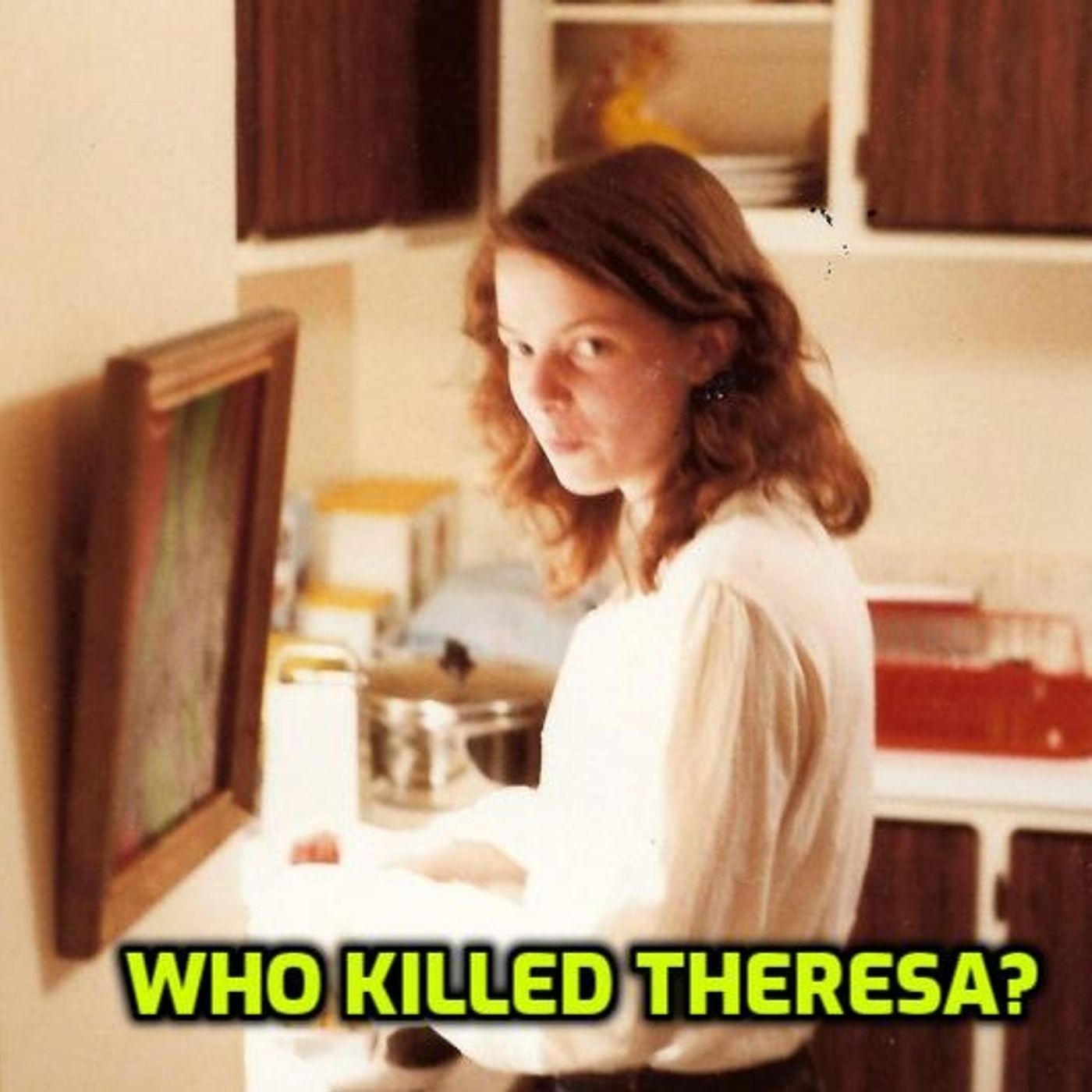
Hello, I'm John Allor. Before you listen to this episode, a couple of things. These are podcasts from the first season of Who Killed Theresa. They haven't been heard in over four years.
They're raw. It took me a while to develop a style. A lot of people like them that way. Unvarnished.
Others commented that it was amateurish. Nonetheless, here they are. I haven't gone back and listened to them. I haven't cleaned them up.
Thanks for listening. And once again, life isn't fair. Justice is blind and dysfunctional. And some cops aren't smart and dedicated, like on television.
This is Who Killed Theresa. Hello. Welcome to the podcast. I am your host, John Allor.
And this is Who Killed Theresa. A program where life isn't fair. Justice is blind and dysfunctional. And some cops aren't smart and dedicated like they are on TV.
So to begin, I would like to, we've covered a lot of ground. I'd like to kind of go back and recap again for some people who may not have been following from the beginning. Theresa Allor was a 19 year old Canadian college student who disappeared on Friday, November 3, 1978, from Champlain College, Lenoxville, in the eastern townships of Quebec. Five months later on April 13, 1979, her body was discovered in a small body of water approximately one kilometer from her dormitory residence in Compton.
Upon her disappearance, police initially suggested she was a runaway. When her body was discovered, police then suggested that she was the possible victim of a drug overdose, perhaps with the assistance of fellow college students. In the summer of 2002, a family of Theresa Allor enlisted the support of an investigative reporter and friend, Patricia Pearson, who produced a series of articles for Canada's National Post newspaper that presented compelling evidence that Theresa Allor was a victim of murder and that her death was possibly linked to two other unsolved local cases, the death of 10 year old Menon Dubey in March 1978 and the murder of Louise Kennera in 1977. The theory was supported by geographic profiler and then FBI consultant Cam Rosmo, who suggested a serial sexual predator may have been operating in the Quebec region in the late 1970s and advised police to investigate the three deaths as a series.
Rosmo had gained notoriety when in 1998, he suggested that Vancouver police create a serial killer task force to investigate the multiple cases of missing women from Vancouver's downtown East Side. Robert Picton was eventually arrested and found guilty of six murders, though he was accused of and implicated in an additional 26 murders of Vancouver missing women. The deaths of Theresa Allor menon Dubey and Louise Kennera remain unsolved cold cases. Since that time since 2002, I have continued this investigation and have geographically identified an additional 16 unsolved murders from the Montreal and Eastern townships region from 1975 to 1981, which may be associated with the original three cases.
So one of the things I like to do is to read some source documents because I find that they kind of get lost in the mix. So at this point, I would like to read the serial profiler, Cam Rosmo's report that he prepared for those national post articles, which were released, I believe August 10th, 11th, and 12th 2002 in the national post. So this is Rosmo's final conclusion. Each of these incidents involve multiple locations that when combined form a persuasive pattern.
Camarun disappeared in Sherbrooke close to where Dubey went missing. She was later found in Maygog near what may have been the location of Theresa Allor's Quothes. Dubey in turn was found a few miles from where Allor's body outside Compton was found, just off of route linking Compton to Maygog. Allor's wallet was found just south of the area where both Camarun and Dubey disappeared.
The last link is that of Allor's wallet, which was recovered near the place where Dubey's body was found by Highway 143, which leads back to Lanesville and Sherbrooke. The locations associated with these three deaths are intertwined, woven together in the landscape south of Sherbrooke. Three murders of low-risk young women in a 19-month period in such a tight geographic cluster is highly suspicious and not likely to be a chance occurrence. These cases should be fed into vie-class, the violent crime linkage analysis system used by Canadian law enforcement, and reexamined as a group of potentially linked sex murders.
Serial murderers typically live closer to the victim and counter-sights than body disposal locations. This offender was most likely based in Lennoxville or south Sherbrooke during the period of 1977 to 1978. So that's the official conclusion of Camarosmo regarding the Camarun, Allor, and Dubey cases. We've spent a lot of time talking about those cases, and now I'd like to summarize a few things.
As a side note, I realize the frequency of these podcasts has been very aggressive and I should explain that. That won't last forever. I have been snowed in down here in North Carolina, and I use that term loosely. We got two to three inches of snow on Friday and then temperatures elbow-low freezing and have stayed that way for four days, which is unusual for North Carolina.
But nevertheless, I have nowhere to go and less to do. I'm trying to avoid my Canadian smogness about snow, but nevertheless, driving the snow doesn't bother me. In fact, it kind of amuses me. And I've certainly experienced in my life some bad incidents.
The worst I ever had, since we're clearly out of tangent now, I was driving back from Montreal one time at a time I'd been living in Toronto, and I'd gone in the winter to visit my brother in Montreal, and I was driving along the Transcathed Highway Highway 401, and it started to snow quite bad. And right around Brockville, Ontario, I had an incident. Anyone who's in the know, and I mentioned Brockville in the winter, you know that that is Black Eyes Central. And sure enough, I was driving this little tiny Toyota, red Toyota Celica that we had.
And I was in the right lane, and the transport truck moved into the left lane and proceeded to pass me. And as it passed me, the wind that it created caused my car to do a 360 degree turn on the Transcathed Highway and then proceeded to dump me in a snowbank on the highway. I managed to back out and to drive up to the nearest service station, you know, those, they're all generic along the Transcathed, those combined service station restaurants. And I just sat there for an hour with a cup of coffee shaking until I could find my composure to proceed to Toronto.
So snow doesn't bother me after that incident. It's had a lot of incense. But the tailing back, yeah, a lot of content right now, this won't continue. I probably will get more to a one month frequency, but I figured well, I had the time I might as well get as much of the same as possible.
So going back to summarizing some things, what do we know? Well, we know for a fact that Louise Cameron was strangled. She had a bootlace literature around her neck. We suspect that Theresa L'Or was strangled.
Although her autopsy was inconclusive, we have a coroner's report that states that marks of strangulation were observed around her neck. And then in the case of Menollum Debate, we don't know how she died. And then we also know we have this nexus location near Meigog along Chamein Guillaire, where Cameron's body was found, where the clothing of Theresa L'Or may have been spotted by hunters. And where over the years after conducting two search parties, one in 2006, one in 2016, items have been recovered.
And those items are a woman's purse, the soles of two women's shoes, a woman's comb, the button off a woman's coat, a woman's shirt, and a necklace. And what to make of all this. So the last thing I'd like to bring up about it is a geographic component. We know that Highway 112 is the way you would get to Chamein Guillaire.
You would take, if you were coming from Sherbrooke, you would take King Street, which is a main drag in Sherbrooke. And King Street intersects Belvedere. Belvedere is on the one hand, if you go south on Belvedere, that's where Menollum Debate was last seen. If you go north on Belvedere, you will hit the residents of the Sherbrooke, Hissars, of which Louise Cameron was a member and would have frequented that location.
So heading west on King slash 112, you would pass Bryant Street, the location where Louise Cameron and then further 112 snakes through Magog and just past Magog, you hit Chamein De Perre. You would turn left on Chamein De Perre and then make almost an immediate right onto Chamein Guillaire and you hit the wooded area where Cameron and all these artifacts are found. And what should be noted about this is there is another, currently there's another access. If you want to get out of Sherbrooke and head west, it's highway 110.
And that's the faster highway. If you want to get out of Sherbrooke on Highway 10 and make it to Montreal, it'll probably take you an hour and a half. If you take Highway 112, which was the old highway, it'll probably take you about two hours. But I think what's important to know here is although Highway 10 existed in 1978-79, it was a toll road.
There were five toll booths along, beginning shortly after Magog and those booths were manned. You would have had to stop. If you were in your vehicle, you would be seen. Anyone else in your vehicle would have been seen.
So if you made the decision to take Highway 10 and you were up to something you didn't want anyone to know about, it was very high risk to do that. So the better option would be to take Highway 112. It would take you longer but you could do it in relative seclusion. And the other thing I will mention is despite the fact that Highway 10 existed, even then it only started at Magog.
And in order to get on it, you still would have had to take 112 and you would be forced to pass Chamonte de Perre. And only a little ways after that is the entrance way to Highway 10. So even if you wanted to take it, you are forced to go past Chamonte de Perre and it's only a couple of miles from there that you reach this nexus point that I'm talking about where all this intriguing activity took place. One final thing of note, the highway system in Quebec is a numerical system.
It's much like the Federal Highway system in the United States for anyone who's following these things. Odd number routes tend to run north south. Even number routes run east west. So 95 is the main corridor north south in the States.
Highway 40 takes you from Wilmington, North Carolina all the way to Santa Monica, California. Well, it's the same thing in Quebec. Highway 10, Highway 20, these lead you across the province to either Ontario or New Brunswick. A 55 leads you from the United States border all the way into the northern interiors of Quebec.
So now I'm going to venture into making my pitch, making my justification for why certain unsolved murders from the eastern townships region should be considered in relation to other unsolved murders from Montreal. And initially anyone would say that's a stretch, John. That's an hour and a half to two hour car journey. These are different locations, different aspects.
What leads you to that conclusion? Well, I'm going to tell you, I'm going to take some time here because whenever I try to explain this, I'm never really given enough time to explain it. Although in some cases, I've had a lot of time. I did the Rob Tripp's podcast and he gave me generously a full hour.
CPC Montreal recorded me for an hour on this subject, but unfortunately was only able to broadcast 15 minutes of it. And even that is extremely generous for broadcast radio. The worst always is CJAD and Montreal. They'll call you and they'll say, can we get an interview and you get on the phone with them?
They'll talk to you for 10 minutes and you think, man, that's great. They're going to put it on the line of five or something like this. And it usually goes like this. Hour at the top of the hour and now we have a case of a young man still grieving for his sister who thinks there's a connection with a serial killer.
Over to John and Lord. Yes, I think there's really a lot of evidence that should be looked at. That's John and Lord. Now, over to Live at Five, we get a weather update.
I mean, it's literally that brief whenever you're on CJAD. And I appreciate them giving us the time, but it's never an in-depth interview to glean anything from it. So now, if you'll indulge me, I'm going to talk about two Montreal cases. The death of Lison Blais on June 4, 1978, and the death of Denise Bazzignet on October 24, 1977.
And we'll start with Lison Blais. So to orient yourselves, Lison Blais dies in the summer of 78 in Montreal, four months after the disappearance of Menont du Bey in Sherbrooke, in five months before the disappearance of Theresa Lour back in the Sherbrooke area. Blais was found murdered the morning of June 4, 1978, a few feet from the entrance of her home, where she lived with her parents at 465 Rue Christophe Colom in Montreal. And it was the back entrance.
If you can imagine sort of townhouses in Montreal, you know, with those, there's an upstairs and a downstairs and those winding staircases. And in the back is where you would park your car. There would be back entrances in which you walk down the alley and then go through like a wooded gate and there'd be a small, a modest backyard and you'd enter from your house through the backyard. That's where Blais was attacked.
The previous evening she had been out with friends, first at a disco tach on Saint Denis, then later at the Filip disco bar on Saint Laurent. She left the bar about 3.25 a.m. Her body was found at 9 a.m. that following morning.
She had been struck on the head. There were choke marks on her neck and she had been raped. Now, police noted that some of her clothing was missing, including Lison's black purse. Writing in a note police on June 18, 1978, reporter Jacques Durand noted the similarity with other murders at that time, including Catherine Hawks, who also was missing a purse.
Louise Cameron strangled missing clothing. Jocelyn Hool, Joanne Doreon, Doreon and Hool were both nursing students and we note that Louise Cameron worked as an assistant at the hospital. Helen Manast strangled missing items and Liz Labadee was one of the planes of Abraham murders, a series of cases from 76 that took place not in these regions but in Quebec City. Now, a particular note was Lison's missing black purse and we have noted that a black purse was found at the dump site of Louise Cameron.
In the composite photo that police released of the purse, the purse looks white. So that's led a lot of people to say, wait a minute, you found a black purse, but the Lison and Blais pays, the purse was white. That's just the nature of the drawing. If they drew it in black, you wouldn't see anything.
It's like a cartoon drawing. But when the article was published, it clearly states that the missing purse was in fact black. At this point, I just haven't said this yet, but I should, if you need photos of any of this, photos of the victims of the purse, of geographic locations, they're all on my website and my website is very easy to search. At the very top of it is a lexicon of all of these cases in French.
You click on the case, it takes you to a page that gives you a full description of the case. Just below that kind of French summary is this exact same summary in English. Again, if you click on any of the cases, it'll take you to the case. That content is sticky, meaning it will always remain at the top of my website.
And then if you want to see anything new that I talk about, for instance, these SoundCloud broadcasts, they're under that. But for me, the most important thing is are those cases. That's the information that is of prime importance, so it's always there. So back to the purse.
So clearly black, the purse that was missing, the purse that was recovered off Chamein Guillaire, clearly the same shape. If you look at the composite, if you look at the photo of the recovered purse, not exactly the same, but similar. But again, you have a composite drawing being made from memory. And then did the did the Blay family positively identify the recovered purses there?
We talked about this a little bit last time. No, they did not. They could not definitively say one way or another. But I don't know how anyone could after so much time, after 36 years say definitively, yes, that was my sister's purse.
If you ask me to identify something of my sister from the 70s era, it would be my recollection would be very prone to bias. So inconclusive. So the first is the first thing that we have that connects Montreal to the Eastern townships and more specifically to this Chamein Guillaire dump site. Now we're going to add another component.
And that's the murder of Denise Bazzignet on October 24, 1977. And what's most important here is that to begin with Denise Bazzignet and Louise, and Louise on Blay were neighbors. They both lived north of Park La Fontaine in the East End of Montreal within blocks of each other. So I'm just going to read to you from a little post I made on my website.
On Monday morning, October 24, 1977, a truck driver spotted the naked body of a young woman lying next to the road along autorude 35 at the Chambalie exit in St. Luc, about a half hour east of Montreal. Police were notified and at approximately 10am detectives Jean-Louis Sivard and Robert Oberten, of the Certé de Quebec's Queens Contre de la Passana unit, arrived at the scene. The victim had been strangled and there were signs of sexual assault.
Clothing was scattered and the victim's wallet was missing. In hopes of identifying the young woman police issued a press release and published photos showing the victim's face, fingers wearing rings, ear wearing earring and wrist wearing a watch. The brother of the victim recognized the Timex watch. He immediately traveled to the SQ Police headquarters on Parfane to identify the body.
23-year-old Denise Bazzignet lived with her parents on 4-2-5-2 who, Rebeuf, in Montreal's East End. The Bazzignet's were a large family. Denise had 10 brothers and sisters. She worked as a cashier at St.
You Bear BBQ. The last time her mother saw her, Denise was going to meet some friends for a drink in a neighborhood bar. She did not come home that Saturday evening, but this was not entirely unusual. As Sunday dragged on with no communication, the Bazzignet's began to worry and cold the police.
Denise was apparently last seen late Sunday evening just hours before her body was discovered and she was last seen at the corner of Mount Royal and Pepino, less than 10 blocks from her house. Police later released a composite photo of the suspect with whom she was last seen and you can see that composite photo on my website. So some things to note about this. Again, like other victims, Bazzignet is strangled.
There happened some accounts that she was a shot, but I've seen the crime scene photos. She has a very clear ligature mark across her neck. So we have strangulation in the case of Camaront, possibly a lure, Lison Blais and now a Denise Bazzignet, so four of the victims. We have scattered clothing which is beginning to become a theme here.
We have a missing wallet which we also have in the case of Theresa. And probably most interesting is that Bazzignet is a neighbor of Lison Blais, but Bazzignet, unlike Blais who was found virtually in her backyard, Bazzignet is found a half hour west, excuse me, east of Montreal in the direction of Sherbrooke back. And you know, for anyone who thinks I'm cherry picking on self crimes, let me just say to you, there were 179 murders in Quebec in 1977. I'm talking about 11 of those cases.
They were all kinds of murders. I'm not talking about domestic violence. I'm not talking about gunshot wounds. You know, I'm talking about a very specific subset of strangulation.
And in outdoor locations, bodies found exterior, often in the woods, often near bodies of water. So it's a very unique subset that I'm talking about. And of note, strangulation was not a mode of murder that was very common this time. It was not unique.
A lot of people, strippers, stabbed to death or shot. Again, as I said, a lot of domestic violence cases. But something like this, what we sometimes call stranger murders or this was, as I say, a very, a very unique subset. So again, if she's last seen in Montreal in her body is found a half hour east in Saint-Gien, so, so how do you get the body out of Montreal?
Well, again, you don't take Highway 10, because you're in risk of those manned toll roads and being seen. So what road do you take? You take Highway 112, the same route that leads out of Sherbrooke is the same route that leads out of Montreal. It would take you through Long Gay.
It would take you through Shumbly. I write around the point of Shumbly. You would head south on 35. And then, of course, she's found a little south of there at the Saint-Luc Shumbly exit.
And keep, as a frame of reference, those towns, Long Gay, Shumbly in your mind, because they're going to play greater significance as we go forward. All right, on second thought, I've thought about it. Why keep you in one's suspense? Long Gay is the location of the brutal murder of Sharon Pryor in 1975.
Shumbly is the location of the strangulation murder of Helen Monast in September 77. And Monast may have been strangled by a shoelace, a ligature, her sister indicated to me that might well be the case when I spoke with her. But not going to go into a great deal of details on those cases just yet, but just to mention them as a frame of reference in relation to this Nexus Highway, Highway 112, which was the old East West Highway across the province of Quebec back in the 70s. Stepping back, I want to reference from a stats can report from 2005, the Canadian Center for Justice Statistics released a report called Homicide in Canada 2005.
And it looked at homicide clearance rates from 1976 to 2005. And in that time period, the province of Quebec had the worst clearance rate of any province in Canada. The national average was a clearance rate of 83.9%. Quebec was 10 points below that at 73.7%.
And then when you looked at the clearance rates of individual police forces, Quebec's scored is one of the lowest. The start to take a back had a clearance rate of 80.3. Jurisdictions well above that. City of Winnipeg at 94.4.
Ottawa at 92.8. The OPP, that's the Ontario Provincial Police at 91.2. The RCMP at 89.0. So even of those, start to take a Quebec almost of well beyond in some cases, 10% below at 80.3.
Should add that Toronto was below the Cervaté Quebec at 78.4. But coming in at the very bottom, and I'm saying the very bottom, the force of Long Gay, 74.1 clearance rate, Vancouver at 69.9. And then bottoming out La Val Police Force at 67.1. And finally Montreal's police force at 65.4.
And I'd simply note that at least on Blais case was a Montreal case. We haven't touched on it yet, but Jocelyn Huul was a La Val case. Sharon Pryor was a Long Gay case. And of course, the Cervaté Quebec cases would have been Louise Cameron, Theresa Lour, Manon Tubei and Benise Baziné.
Because although she disappeared in Montreal, the body was found in Saint-Gienes, which was in the SQ's jurisdiction. Also Helen Monast, Chambalie also would have been the Cervaté Quebec's jurisdiction. So a summary, Helen Monast, Ligerture, possible chuleis, adenise Baziné, Ligerture, Lison Blais, Strangle, Theresa Lour, possible strangulation, Louise Cameron, bootlays, Ligerture. This led me in, I believe it was 2013 to make a post on my website called Who Was the Bootlays Killer.
It's probably the post that gets the most hits on my website. It's led some people to believe that police were actually in that era chasing a bootlays killer. Nothing could be further from the truth. I created that term out of whole cloth.
My apologies, I tried to come up with a sexy serial killer name that would draw interest. It did, but I was by no means suggesting that anyone was diligently pursuing this far from it. It's only me. We'll get to my relationships with Quebec law enforcement at some other time, perhaps.
They are only ever as diligent as I am diligent. If I shake the tree, they'll look at the fruit. If I don't shake the tree, they go back to sleep. That has generally been their modus other than the, in these matters.
But nevertheless, for point of reference, there's no official bootlays killer. That's just me trying to drum up interest and trying to get some form of engagement in these matters. It's simply trying to link this subset of late 1970s murders in Quebec to a mode of execution. That's a lot of information for now.
I'm going to leave that with you for the moment and let it gel. There's a lot there. I noticed I have a little more time, so I'm going to switch gears now a little bit. I'm going to talk about an amusing story.
Well, it turned out I'm using it. It wasn't amusing at the time about the stupidest thing I ever did in investigating these affairs. So I guess it was in the summer of 2003. I had made contact with an Eastern Townships Law Enforcement Officer who I befriended through email but had never really met or talked with.
And he became a sympathetic ally and he agreed to smuggle information from Theresa's case file which at that time I had not seen. Out of the start of the Quebec's offices, which were located on the Gonzalo Street in Sherbrooke and to give me portions of that file. I was thrilled of this, of course. So the meeting was to take place at the Aubert de Guvenaire Hotel which in Sherbrooke is on just off King Street, Highway 112, across the street from Don Bosco where the SQ offices were.
And we agreed to meet one morning in the main dining hall. And I had driven up from North Carolina with my eldest daughter who at that time was approximately four years old. And the trip had a bad omen to begin with. I should have known it.
I left the home with my then wife saying to me, you take care of that girl. And I said, absolutely, of course, who do you think I am? And proceeded up the road and before I got on the highway, I stopped for gas. I got out of the car to put gas in the car.
I shut the door to the van and immediately realized I had locked my four-year-old child with the keys to my car in the van, not 10 miles up the road from my house. I was embarrassed. I was loathe to contact my then spouse and admit I needed help. And if it were not for the good graces of a Mexican day laborer who noticed my plight and came over and immediately had a rig for Jimmy in a walk and did it so swiftly and professionally that I could only be grateful.
I wasn't thinking anything else. He unlocked the door and I was reunited with my four-year-old child. So cut to Sherbrooke where we're in the main dining hall. I'm waiting for my meeting.
And I'm dressed, if I recall, rather formally. And my eldest daughter is sitting next to me having breakfast. It's one of those restaurants. If the kid comes in, you get a little pitcher to draw and they bring you crayons.
So she had that and I'm waiting. And in walks this guy. And from the moment he walks in the room, I realized I played my hand all wrong and I may be in trouble because I've dressed rather formally. And formally by means, I'm wearing a button down and a really ugly ass chinos from that area.
And in walks this guy, he looks like a biker. He's wearing jeans, boot cut, cowboy boots, leather jacket. He's got that short cropped hair like Mom Boucher. He's got an earring.
And I immediately realized I played the status hand wrong and he's already got a leg up on me. And I don't even, I'm beginning to question who he is. He sits down, we talk, he gives me the file. This is great.
He then says, you know, why don't we get in the car? You can show me where your sister's body was found because I've never really known. And I can actually show you where Manon Dubey was found. You show me yours, I'll show you mine.
And I had never seen this location. So I say, yeah, naively, great. So we get out of the parking lot and incidentally, this hotel is O'Barrish to Guvenaire, to Guvenaire's is the hotel where like in the eighties, nineties, the Quebec Hills Angels held a meeting and while they were off partying, there was a Ontario Provincial Police Officer who was conducting surveillance of them. And he let down his guard and he left the room for a bit, but unbeknownst to him, the Hills Angels knew he was there.
And they stole his laptop, which contained all kinds of compromising information about the rock machine and the Hills Angels. So being in this hotel, my senses were already heightened to this and to Hills Angels and to the idea of that good and bad crossed paths that you never knew. Despite you knew who the police were and the Hills Angels were, there were blurred lines. So this was already going on in my head.
So we get out in the parking lot and I'm like, well, should I follow you? And he's like, no, no, we'll take my car. And I'm like, well, why can't we take my car? And he's like, no, we'll take my car.
And so I get in the back of his car with my daughter. And I'm like, oh, shit, you are in so much trouble. And of course, running through my head is, this is some guy who knows I'm in way over his head and doesn't realize what he's touching on in my imagination is getting the best of me. And you know, that still may be the case, but you know, I was letting my worst fears run away from me.
We get in this car, we drive down to Hatley, Ayres Cliff, and he shows me the location where the debate was found. And then we take that short road just out of the Hatley location where you can cross over to Compton. Bear with me, I'm trying to pull it up right now. There it is.
It's highway 208 is where it is. You just kind of go north from where the debate was found. You cross over 208 and you're in Compton, drive up to Shaman del Astacean. I drive down that.
I show him where Theresa was found. And all the time, I think, you know, he's going to pull off on a side road. Me and my daughter are going to be left with a bullet hole in our head in a gravel pit somewhere. Thankfully, this was not the case.
He turned out to be true to his word and has since been a real ally and a great friend to me. But that is the stupidest thing I have ever done investigating these matters. One other idea I'll leave you with, you know, in doing this work every time, you know, I dig things up, but it's never as if I am completely confident in what I'm doing and how could I? Because law enforcement holds the key to all this information.
So every time, even from the original release of the Hookel Theresa stories in the National Post to more recent work, I'm always in the position of being a little fearful that I might be embarrassed that the police will say, you got it all wrong. Didn't you know that case was solved years ago? You know, that's your worst fear, is that you're going to end up looking like a supreme idiot in these things. And you know, with the Camarilla case, it's in the Bay case that never happened.
The police at one point tried to embarrass me in the aspect of things. They came to me one time on a phone call and said, Mr. Alar, we understand that Tricia Pearson, the case, that she once was your girlfriend. It's like, yeah, that seems to be a compromise.
It's not a compromise, buddy. It's a well-known fact. Not an issue here. Well, you know, seems to me that you are, you know, they try to make a big deal out of it when there was really not a big deal out of it.
That was looking into my personal affairs with my first high school crush was really the extent of their investigative work. It was funny. But in other matters, you know, every time I bring this up, adding cases, I'm always fearful that I got something drastically wrong. And so far, I don't.
And I've met a lot of these family members. Of course, I've met Chantel du Bay. And then, you know, adding the other cases, I know the sister of Lise en Blais, Salange. I've met the brother of Denis Mezzieme, of course, know the priors and know very well, and Nicole Monast, the sister of Helene Monast.
You know, most of us are Facebook friends. You know, my friends, I don't mean friends. It's hard to be friends with people like this when you share something that's so horrific. But we stay in contact when we need to.
But each time I meet with one of them, I'm always fearful that, you know, one of them is going to go, you know, my worst fear would be, what the hell are you doing? Why are you dredging this up again? What is your beef with Quebec law enforcement? We've enjoyed a level of service that has been extraordinary.
But that's never been the case. Ever. What is been consistent is a sense of, I never knew someone else felt this way. I felt isolated.
I felt alienated by law enforcement. I never felt I got the answers. Our family deserved. I'm grateful that someone else is doing this.
So I don't feel like I'm doing it alone. I'm reengaged to do it because someone else is doing it. And all of those things are very, very gratifying and confirming. You know, it's just a family.
Certainly if you're an unsolved homicide that is reaching into the decades, it would not be unlikely that you're experiencing frustration with agencies of authority. However, the level of frustration in Quebec and how uniform that frustration is across agencies from long gay police to start taking it back to municipal police of Montreal, to Long Gay, to a La Val police is disturbing. And I think there's a lot to be probed there. It's one of the reasons that we've called for a public inquiry into these matters with specific reference to the matter of evidence destruction.
We've pressed on the Minister of Public Security, Martin Quatier. He initially refused us, but we're patient. And we will choose the time and the place when we decide to move forward as a vanguard to press these matters further. So I think that's it for this time in closing.
I will say again, you can always contact me. Through email, I have a email set up. It's Teresa Lour at gmail.com, T-H-E-R-E-S-A-L-O-R-E at gmail.com. If you write me there, I will entertain your questions, your suggestions.
If there's anyone you'd like me to talk to in future episodes, happy to do it. As I've said before, initially, I kind of want to set the groundwork by just me talking. No theme music, none of that stuff. It's just bare bones, people, an agarilla podcast.
I know the facts. I've known them for years. But I will eventually open it up to a dialogue with certain people of interest in these matters. I think that'll be a lot of fun and I think you'll enjoy it.
So thank you so much for joining me on these wintery days and have a great one. Thanks.