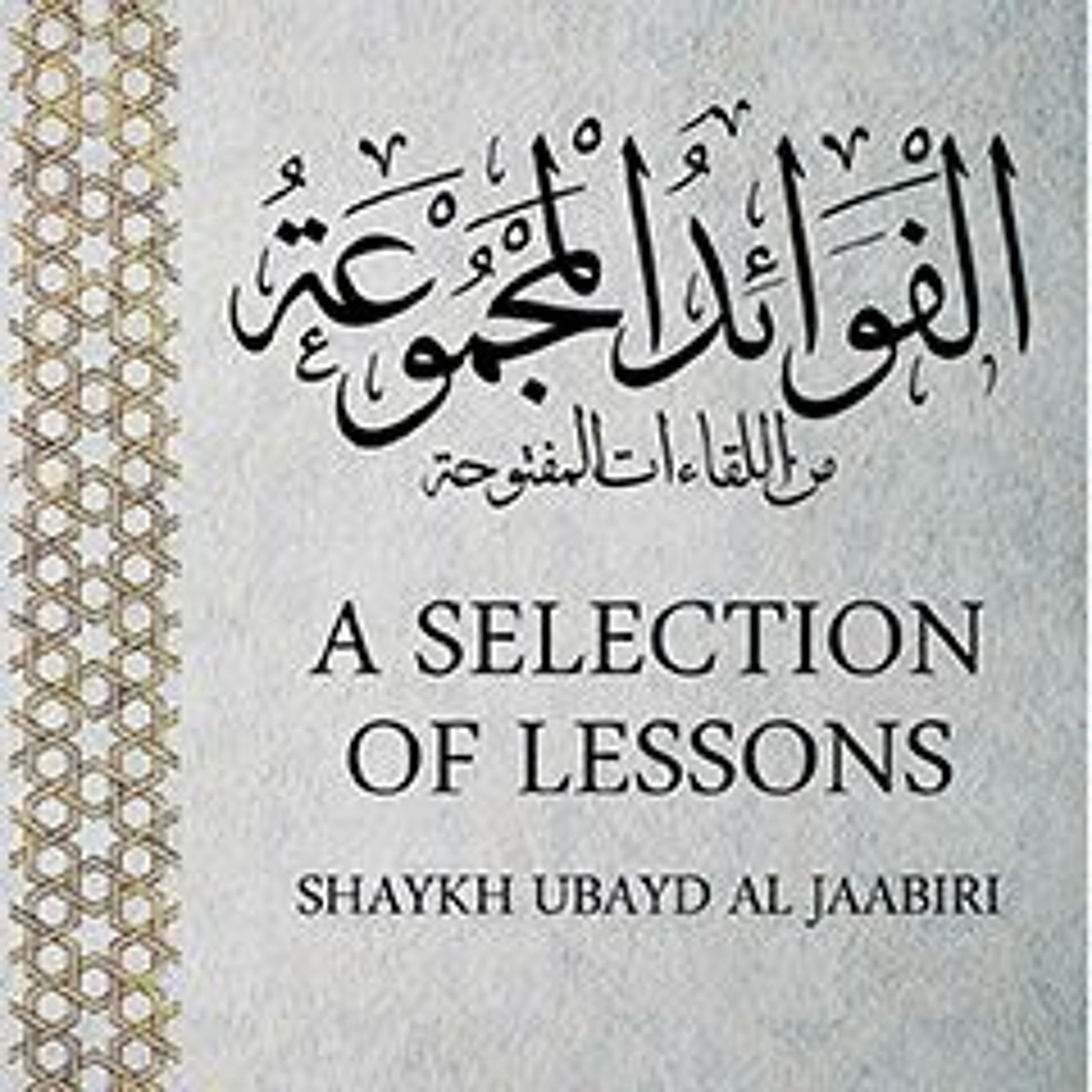
So today we will begin a new series of lessons! And these lessons in China will be taken from this book, Al-Foua'id, Al-Majimua'id, Minali-Pahat, Al-Mothua'id. These are basically lessons that were given by one of the Sheks, Al-Tumadina, one of the Sheks who we used to teach at the Islamic University of Medina, and he is Shek, Obaid, and Jabbi, Havilah, Al-A'al. And these lessons were delivered between 2013 and 2014, in a manuscript called Mascip, Abigua.
And these lessons have been obviously published in a book. And each lesson will take us maybe one lecture, or maybe two lectures, not the most maybe three lectures. We have short topics, maybe on a hadith, the hadith of the messenger of Al-A'al-A'al-A'al, or maybe an al-Yir from the Quran, and to a very short, beneficial, concise lessons in Shad-A'al-A'al-A'al, we want to benefit from. And the first lesson today is a lecture on the hadith, a famous hadith, to whom so ever Allah intends to show goodness, he gives him understanding of the religion.
So we're going to, this is the first lesson, of the first lecture that we're going to go through in Schal in Kitabu-ein, in Kitabu-ein, in the chapter to do with knowledge. And this hadith is narrated by one of the great companions of Allah's Messenger, Sub-Allah Walih, wasalim, and he is wa-aawiya, bin-a-gis-u-kiyan, wa-aawiya wa-aawiya wa-a-gis-u-noor. So this week, we re-detected that hadith in Shalat-aaw, and this hadith is narrated from An-waawiya, A-aawiya wa-a-gis-noor-aawiya, that wa-a-a-gis-noor-a-noor-a-noor, he said, Sub-Allah Walih wa-a-sala-mihul, I heard the Messenger of Allah, Sub-Allah Walih wa-aawiya wa-a-gis-noor-a-sala-mihul, Mayuridir al-Aawidirir al-Aawidir al-Aawidir al-Aawidir al-Aawidir al-Aawidir, to whom, so ever Allah intends to show goodness, he will grant him on the Sunday of comprehension of the religion. And the Messenger of Continues, he then said, wa-in-nawah, an-a-parsim, wa-in-nawah, an-a-parsim, wa-la-awu, yuridir al-a-gis-noor.
He said, Indeed, I am the distributor, I distribute, and Allah is the Giver. So the Messenger of Sun, is the one who discributes the knowledge. Allah is the Giver, wa-in-nawah, an-a-parsim, wa-la-awu, yuridir al-a-dih. And the Messenger of Continues, wa-la-an-tazada, ha-a-di-hid-um-ah, karibat-an, and-a-angri-la, wa-la-yud-r-a-hum, man-kah-a-la-awu, ha-tah-yad-dih-a, and-a-la-lah.
And then continuing and said, this nation, this u-m-ah, will never cease to be upon the command of Allah. And those who oppose them, will not harm them until the affair of the command of Allah arise. So this is the text of the hadith. And it is written by Uqah'i, Uq'i-wil, so what we do in Shal-Qalat, the benefits from Shil-Qal-Bir, what we do is take the benefits from the shir in what he's presented, and also bring some other benefits as when in Shal-Qalat-ah.
So first of all, the shir begins after the praise of Allah, and said, in Salah, the man-hul-Pravit, Muhammad-sall-Allah, wa-yim-sall-a-an-dih-w, and he welcomes those who are listening, thanking them for attending the gathering, and especially to revise knowledge, revise knowledge in a west-state. And so we know the hadith of the messenger of Allah, so that's when he said, man-in-poh-in, it's gonna rule, he has to hu-un-al-wah, he has to be much of his-in, he's gonna have to have to come and let out of you. That there is no people who gather together, no people who gather together, in order to remember Allah, to remember Allah, this means obviously knowledge, knowledge of Allah and his religion. That no people gather together in order to remember Allah in a gathering, except that the angels lower their wings over them, all right?
So in any gathering that we attend, in the west-state, to seek knowledge, and the angels are also present, and they lower their wings, lower their wings, it's around the gathering, and they lower their wings, out of mercy to the people, and also out of humility as well, for the knowledge, because angels, you know, they give honor and respect to knowledge and its gatherings. So this is the nature of these types of gatherings, my dear brothers and sisters, in the massages of Allah, and so we should have glattagings, that when we are in these types of gatherings, the mercy of Allah, so we should gather and we are under mercy of Allah, so we should. The shipment goes on to say, wah la buh bahr kah la bhibon, and the sada, a tama, a la abba, a la tihan hab, a la abba, figun yau, wah rahu, la hazaviram wahrahid, wahu al vihan hofidim, wah la abba, he said, you should know, min a la bhissi, that complete and comprehensive happiness, right? So this is true genuine happiness, which a servant can obtain in the world and the hereafter, it only has one path, it only has one path, right?
So again, see, we remember the previous discussion on the previous lesson that we had on Al-Hailah, we're talking about the good life, we are coming to the same issue here, the same same point, what is the root to happiness? What is the root to general and complete happiness in the life of this world? And the hereafter, well here we are approaching it from, you know, another angle, the shapes is it only has one, wait, one path, if you want to be genuinely happy, you know, the happiness of the heart, and that is, wahu al vihan hofidim, wahu al vihan, simple, it is again comprehension of the religion, to gain an understanding of the religion, and then to act by it, to act upon what you know. This is the only path to genuine happiness.
I don't know if you mentioned the Harif, Manjurid, in Lahore, in Hehir, in Pha'ihu, 15, to whom, so I have Allah intends to show goodness, he will give him understanding of the religion. So before we continue further into the country, I want to focus, first of all, on the narrator of the Hadi, for his narrator, he is Marawiyyah, being Abhisothiyan, from the greatest, from one of the great companions. And I want to speak about Marawiyyah, Oki'lavu Anhul, before we enter into, so that we understand who is the narrator of the Hadi, this is a companion, who has many, many virtues, he has tremendous virtues. Marawiyyah, in Abhisothiyan, he was one of the Muslims who accepted Islam towards the end, towards the end of Prophethood, just before the conquest of Mecca, before the messenger of Asu, before he contacted Mecca, right, this towards the very end.
However, his father was Abhisothiyan, as you know, he was from the staunchest of enemies, against Islam, and the prophets, and the Muslims, Abhisothiyan. So when he accepted Islam, he had to spend a period of time to conceal his Islam, to hide his Islam from his father. As Marawiyyah said, as well as the way he's about even a circuit, I accepted Islam on the day of the affair, his printed events of the Treaty of Pudithya, seven after Hijah. But I conceived my faith out of the fear of my father.
He also participated in some of the data battles, the Battle of Hauden, with the messenger of Allah Sussallah, and certain verses he's included, he's included amongst those people, about whom certain verses in the Quran were revealed, right? So from those verses, it's Aya in Surat, Surat Atova, some of the insul al-Dawu, Saki Nata who Allah was all he, Wa'ala Bhumini, then Allah sent down his sakim and his tranquidity upon the messenger, and upon the believers. As well as the Wa'ala Bhumini comes under verses of the Quran, and also other verses as well, before I prayed. Also, the messenger of the Assum, made Dua'ala from Wa'ala Bhumini.
He said, Oh Allah, make him a guide for others, guided in himself, and guiding others through him. So he's guided himself, and he also guides others as well. Why are we mentioning these things about Wa'ala, Wa'ala Bhumini, because Wa'ala Bhumini holds a very, very special position, as it relates to the rest of the companions. And we want to see what that position is, surely we look at certain directions in Shallat Al-Arah.
But Ma'ala, as you know, he was the person made Dua'ala. And like was also, there was a woman by the name of Um-Hah. And she heard the messenger of the Assum, saying that paradise of forgiveness will become true. Al-Ajib, for the first army of Ma'ala, who makes a sea expedition.
Right? So the first one from Ma'ala, who envelops by an expedition by the sea, then paradise becomes Wa'ala jib upon them. So this woman was listening to the messenger of the Assum, make this application. So she said, Oh, messenger of Allah, am I from them?
Am I from them? And he said, you are from them. You are from them. And then it so happened, after the messenger of the Assum, he passed away in many years afterwards.
And what are we on the Allah who emphold? Was the first one to make a sea expedition to Cyprus? So he went from the Mediterranean across over to Cyprus. And he conquered Cyprus, and this woman called Ha'ala, she was a monster, and she eventually died on the island of Cyprus.
So this is basically a sign of the truthful of the messenger of the Assum, the sign of his prophet as well. So this is Ma'ala jib upon him, holding a tremendous position. Likewise, Ma'ala jib upon him was a writer of Revelation. He wrote the Revelation of Allah's object.
As I became here, I think I mentioned that it has been established through large-scale transmission that the Prophet Islam commanded, Wa'ala jib as he commanded others into writer revelation. And Wa'ala jib had alongside him, and he was trustworthy to the messenger of Allah writing Revelation upon him. And the Prophet Islam did not suspect him at all in anything in writing the Revelation. This is basically a reputation for the rafidah and the shi'a another the nip who like to accuse certain companions of obviously dishonesty, treachery lying in the rest of it.
And specifically they focused upon Wa'ala jib obviously because of what happened with Al-A'ala when Wa'ala jib was a trial for the, for the harp. But they liked to speak in of him. However, the Qur'an, praise him comes to the certain resident of the Qur'an and the messenger of the sith, the Qur'an for him trusted him with revelation, made to art for the one who goes on the sea expedition, which was M'ahawiyyah. All of these are evidence to show that M'ahawiyyah have the Allah's name was a trustworthy upright noble companion.
M'ahawiyyah also is one who narrated 163 hadiths from the messenger of Allah, right? 163 hadiths from the messenger of Allah's as a man. Also he is known as the uncle of the believers. The uncle of the believers.
Why you see the uncle of the believers? It is because he is the brother of Umm Hariba. Umm Hariba is the daughter of Abu Suhyan and the messenger of Suhyan marita. So she is the mother of the believers.
She is the mother of the believers, Ummawiyyah. And Wa'ala jib is her brother. So therefore he is the uncle of the believers. So this is not one another angle.
The tea has a lucky position in Islam. Also it was Ummah bin al-qatab, Wa'ala wanhu who gave Wa'alaiyyah the ruin of a Shah, the advantage of the rule of a Shah. And obviously this is because he trusted him and his capabilities and his knowledge of the deed of Islam and its rulings, he obviously had trust in M'ahawiyyah to appoint him to rule over the whole of Shah. And also he is the first of the kings of Islam.
He was the first king in Islam, right? And this we know from an authentic Khadif as well, an authentic Khadif in which the messenger of Al-Sussam he said, al-Wolohad al-Aunhu, al-Wolohad al-Aunhu, Nubhuwa, Wa'alaiyyah. This is not a message of so he describing the situation of his former. He said, the beginning of this Afehin Islam and its rulership, right?
The first week is going to be Prophet Haud and Mercy. Prophet Haud and Mercy, that will be Prophet Haud and Mercy. From Malayakon, Khilah Vatin, Wa'alaiyyah. Then there will be a Khilah Vat and Mercy, right?
So this would be Abu Bakr and Urahman and Ali, Aaveel Al-Aabhu, Aimeel. And that lasted for 30 years, 30 years. As we see another Afeh, right? That's Khilah Vat for last 30 years.
Then he said, from Malayakon, Mu'lka, Wa'alaiyyah. Then there will be kingship and mercy. Kingship and mercy, right? So then you know the Hadifs, he mentions that later on there will be kingship and hardship and kingship and tyranny that came afterwards.
But the point being here, this is a reference to Wawai'ala, Wa'alaiyyah, Aravi'ala, Wa'ala, and his rule. But he was the first of the kings and his rule was the rule of mercy. And Imam Al-Dahibirah, Mu'alaiyyah, he said that Mu'alaiyyah is the chief of the believers, Aimeel, Mu'alaiyyah, the king of Islam, and he is Abu'ala Rahman, Abu'alaiyyah, Abu'alaiyyah, Abu'alaiyyah, Al-Awe, Al-Makki. And Ibn Abiliz, Ibn Abiliz, Al-Hailafi, Wa'alaiyyah, the author of the Shahra, of the Ha'amis Creed, and he said, So Ibn Abiliz, for him, Wa'alaiyyah, he said that Mu'alaiyyah, Oli'ala, Wa'alaiyyah is the first of the kings of the Muslims.
And he is the best of the kings of the Muslims. And like was in the king, Abu'alaiyyah, he said the scholars are great, that Mu'alaiyyah is the best of the kings of this woman. For the four that were before him, were the caves of the Abu'ala. So they were the full of fat, the caves.
And he was the first of the kings. His kingship was one of mercy, as has come in Hadith, and there was in his kingship such mercy, and gentleness, and benefit for the Muslims, that nothing better was known about the kingship of others beside him. And simply Al-Kadad, he narrates that Mu'alaiyyah, bin imran from amongst the south, he was asked whether Mu'alaiyyah, Mu'alaiyyah, or Oli'al bin Abiliziz, or Mu'ala bin Abiliziz, which of the two was superior? Mu'alaiyyah died in the year 60 Hejra.
He died 60 years after Hejra. And Mu'alaiyyah, as you know, he was a Khadif on front of the right, just Khadifs roughly around the turn of the century, around 95, 100 Hejra. And so the question was asked, which of these two is superior? Is it Mu'alaiyyah?
Obviously it was a companion. Mu'alaiyyah, Mu'alaiyyah, Mu'alaiyyah, Mu'alaiyyah, Mu'alaiyyah, Mu'alaiyyah, Mu'alaiyyah was 600 times the likes of Umar bin Abiliziz, 600 times. And there are other generations as well, which mentioned, for example, that Umar bin Abiliziz, without belittling Umar bin Abiliziziz, of course, because he also has a lovely position, but just to show the status of the companions, that Umar bin Abiliziz was not equal to dust, the dust on the sandal of Mu'alaiyyah, who basically engaged in Jihar, alongside the messenger with us, right? So this is the status of the companion Mu'alaiyyah, Mu'alaiyyah, Mu'alaiyyah, Mu'alaiyyah, and Gu.
Now why is the issue of Mu'alaiyyah is very important? It's because Mu'alaiyyah has, there's a very unique status which he has, and this status is known by a narration from Al-Wavir bin Abil-Hailavik, and from the venture setup. And this statement is the following. He said Mu'alaiyyah, Sithro, as Harid Nabi, he saw the lahu aliyyah, he was saw that.
Mu'alaiyyah is like the cover, he's the cover over the companions. He is the veil over the companions. For Ivar Akashifar Rajul, a sithro, Yjnara-ah, Al-A-Mawarahu. So when a man, he removes the veil, then he will become bold in going to what is beyond it.
Right? What does this mean? It means that if anybody wants to attack the companions, and belittle them, and undermine them, then Mu'alaiyyah is the veil. Right?
So he would go to Mu'alaiyyah. If he goes to Mu'alaiyyah, and starts attacking Mu'alaiyyah, he's now removed the veil. The veil has been lifted. And then naturally he's going to go and proceed to other girls of companions.
Right? So what this means is very clearly, that Mu'alaiyyah basically is a mission, he's a trial, and he says exactly, it's another narration that even Kathi had written, from Al-A-Mawarahu, Al-A-Mawarahu. Al-A-Mawarahu, Al-A-Mawarahu. And he said Mu'alaiyyah, Al-A-Mawarahu, M'ashina-Dun.
Mu'alaiyyah to us is a mission. He is a trial, he is an examination. From an Al-A-Mawarahu, the young girl in the evening, he says, A-Mawarahu, Al-A-Mawarahu. Whoever we see, looking towards Mu'alaiyyah, with a, you know, with a, with a, suspiciously, whether it's Mu'alaiyyah, with a suspicious attitude, then we suspect him in relation to the people who need to companions.
So anyone who's suspected Mu'alaiyyah, we suspect him that this man is suspicious and has even intentions towards the companions of Al-A-Mawaru, Al-A-Mawaru, Al-A-Mawaru, Al-A-Mawaru, Al-A-Mawaru has been made, has been made a trial. And like for us, Mu'alaiyyah, Mu'alaiyyah was asked, who was created by Al-Foggard, who said, I heard Abu-A-Mawarahu, asked about a man who reviled Mu'alaiyyah, and I would be like, asked whether he should be labelled a Raffi, a Raffi, and he said, that this man did not transgress against him, against Mu'alaiyyah, and Abu-A-Mawarah, except that he was secretly harbouring evil. No one ever belittled any other companions except that he has an evil intent. Right?
So not only is Mu'alaiyyah a lofty and mighty companion became active at the Khulafah, but he has been made a trial and a metna, right? He's been made the veil or the cover of the companions. So anyone we see trying to find fault with Mu'alaiyyah, trying to accuse him, or whatever they try to accuse him, we know that this man has evil intentions to the companions as a whole, right? Because if he's lifted that veil, then he's going to transgress over what is, you know, for the rest of them.
And that's why in the modern era, in the modern era, we see, that many of those writers, thinkers and authors who appeared in the 20th century and divided as well, those people were largely responsible for the ideology of revolution, revolution against Muslim rulers, the key of Muslim rulers, expanding Muslim rulers from Islam, because of their sins, because of their alleged mistakes, sometimes their actual mistakes, right? Or because they are sinful, or because they might be tyrannical, right? Those people who came out with that way of thinking in the 20th century and before that as well, such as, for example, Jamal al-Dim, Al-Aqalayhi, Jamal al-Dim al-Aqalayhi, he was a Ravi Dhii, Baddiri pretending to be, you know, pretending to be, uh, al-Aqalayhi when he was a king, he was a Persian, he was from, from that region, he spoke in a phallia. Then along came after him, Said Qatab, Y'Qawani, he spoke very little for A'ariah, and he saw that Usoqian, along came the likes of Naudun, he did the same thing from the subcontinent, right?
Likewise, another Hani, that you didn't have another Hani, right? He said, the founder of his potari, all these people, you see from them, that they spoke ill of M'arabi, of M'arabi, of M'arabi, of M'arabi, of M'arabi, of M'arabi, so we can, you know, so we can, we take the criterion that the son of Lay'an Pharas, that any man who wants to speak about M'arabi, really, he has a problem with other companions as well, but he's just not bold enough and courageous enough to really, you know, write it, or to speak it because then he will be exposed. So, at hand, a lot of the stuff, the game is quite teething, right? We can identify people, because you know, in real life, you know, from experience, a lot of the times people don't reveal what their true intentions are, right?
They conceal their true intentions, and they'll deal with you, like, on the surface, but you don't know that real and true intentions. And if they were to reveal their true intentions, then, you know, they would give the game away, and their objectives couldn't be realized. And so, the same thing, here, with people who bring ideologies, or bring false methodologies, right, the whole thing inside their hearts, what they can't speak with them. So, they use indirect methods, or they use, you know, so that's why, you know, the criteria that the fellow can give us, it allows us to know the realities of people.
So, here, as we've seen, anyone who speaks against M'arabi, straight away, this is a person of evil, a person of innovation, he has evil intentions, he's concealing things like Imam Ahmad said, that he's not bold enough to reveal with his pen, or with his tongue. Now, it's important always, the reason why I mentioned what it's about M'arabi, is that when we come to learn these headies, these are very important foundational headies, right, my Yuri, the love of the king, Kaira, your prophet of the being. We should learn the name of the companion, who narrated that headies. And we should know the biographical, general biographical details of that companion, and his virtues, and his excellence.
And it will help us to remember that headies as well. So, whenever now, the deal is heady, whoever allows intense to show goodness, he gives him understanding the religion, you're going to know out, and he says, why are we going to have a sub-yan? He was the first king of Islam, he was the best of the king of Islam, he conquered Cyprus, right, the person of the Meddua Al-Fawim, and he was the writer of Revelation. And you remember all these things, because you have to tie the headief narrated to the companion who narrated it, and some of his biographical details, right?
So, M'arabi was amongst those people to whom Allah showed goodness, obviously, by virtue of the fact that he was granted rulership of a Shah, and he went to an expedition, and so on and so forth. So, this is the narrator of the headief, Ravi Surhyan, Avila Al-Lavu-Aikal, and so, then, the shapes, shall obey, have his whole life continues, and then he explains to us, he says, for man, he died, he died, I said, he was here, I said, if you come who will have a sub-yan, a father, a father, a father, a father, will have a sub-yan, will have a sub-yan, he died, he died, he died, he died, he died, he died, he died, he died, he died, he died, he died, he died, he died. Allah, Allah, Allah, Allah, Shiva. So, then, the shape makes the point, is that once you understood, that you must have comprehension of the religion, you have to start with this, not just going, start speaking about the religion from ignorance, from opinions, you have to, it has to be upon comprehension in the religion, you've actually understood the various aspects of the religion.
So the ship says there is no one who is a caller to Allah, one who calls to Allah upon inside of Anoy, who is concerned with the state of the Muslims and who devotes himself to teach them the Halaam, meaning how to know the Halaam and the Halaam, that the team must have a methodology in knowledge, there must be a methodology in knowledge. So the point being that if you are someone who is going to call others to Islam and teach others and you are going to be treated like the Halaam, the Truth from the Balsal and Sunnah from the Balsal and the Balsal, then there must be a clear methodology you must have to proceed on that path. What is that methodology? And the ship explains it very clearly, it is Allah, Allah, that you say, Allah says such and such and his message just says such and such.
This is how we speak about the religion, like you say Allah said and his message just said, this is our way, not my opinion is, my feeling is or my belief is or I think or whatever my beat is Allah said and the message just said, however on top of that there is a third thing as well, what you have to do is, you have to say, I don't know, I don't know, I don't know, I just want to say. I don't know how else I want to do that, but I don't know. I don't know, I don't know. Because I know that even if I don't know, I don't know, I don't know what it means.
He says like he says, he is very eager to follow in the footsteps or the tracks of the foremost among the righteous fellow, right, we need the companions and there follows the Tabine and those who came after them, the Tabine, and so they are, they are, they are, that is a reference to everybody who came after the messenger of the Sabalah, who followed in the footsteps of his companions and the web will follow them in goodness in every age, in every era from the leading scholars of knowledge and the religion. In other words, we say Allah said, and the messenger said, and in that we follow the companions and also follow them, the tag'e'in and then also follow after them, and we stick to them. This is the methodology in knowledge. After this, the chef then goes on to explain that we proceed upon seeking knowledge and learning knowledge by going through a book.
For example, then we complete the book, then we move to another book, then we complete that book, then go to another book, and step by step we increase our knowledge and we, basically we acquire knowledge in a step by step gradual fashion. This is the way that you take knowledge. This is what the chef is mentioning, the alluding to, right? So knowledge isn't, you take knowledge all in one go, because as the seller said, whoever takes knowledge all in one go, he will lose it all in one go, right?
Knowledge is something like, you take a pebble, and you collect that pebble, and you collect another one, and you collect that pebble, and you collect another one. And you keep collecting in small pieces, step by step. And eventually you have the whole small mountain of pebbles which you built over lifetime. But you take it step by step.
You don't try to, if you try to, if you try to conquer knowledge, you can't conquer all of the knowledge, because it's too much, right? It's too much. The knowledge will be the one who will be donated. So you have to take knowledge piecemeal by piecemeal, step by step, like the companions used to do, as we mentioned in the predecessor, that the companions will take ten verses of the Quran, ten verses of the Quran if you memorized them, and then they will not see what is in these verses?
Is there any action? Is there any adam, in these verses? Are there any, there are any luenies in these verses, and they will derive the fit? They will take the understanding out of these verses, they will take the admonishment out of these verses, and then they would act upon whatever was in these verses if there was any action.
Then after they have mastered those ten verses, they move to the next ten verses. In this manner, the companions became scholars of the religion. They did so over 23 years of revelation coming back. Remember the revelation didn't come down long ago.
It came down piecemeal, so they took knowledge piecemeal. So this is how knowledge is set. We shouldn't be deceiving the thinking that we can become scholars in 3 years or 5 years, or whatever it might be. Knowledge is just about memorized.
It's comprehension. It's the kind of the de-level as of a joke. So as the Shakespeare says, all the passing of years, if we follow this basic methodology, then there will be many students of knowledge that will be created, they will be generated, they will understand the sardines, they will go and they will spread, and they will benefit people. So anyway, moving to the Hadith and how the Shakespeare goes on to remove the second part of the Shakespeare lesson.
This lesson was in two separate lessons. So the following week, the Shakespeare continued with his thus, and he then goes on to give us a basic explanation of the essentials of the Hadith. So he says, this hadith basically teaches us that there are two groups of people. There are two groups of people, Wohal hadith, Ithadam and A'walen, and Nās, Sintran, La Thāritha, Agma.
This hadith comprises the benefits that people are only of two groups, there is no third of them. You mentioned the first group, Asaqa'l-Avel, A'l-Avel. The first group are those to whom Allah Zawajan, Mayutih, Hila, Sohran-Tara, Al-Bassira, and Ustanir, Al-Bassira, Al-Bassira. We also call him Al-Avel, Mayut-Mai, U-Mai, Yum-A-Yum-Avel, He is U-Hih, Mayut-Mai-Hila, Hila, Hila, Hila, Hila, Mās-A-D-Avel, The first group of people are those to whom Allah gives this illuminating insight.
It gives him knowledge, this knowledge gives him comprehension, that comprehension allows him to basically, it gives him illumination, he has a light, right? This becomes a light for him. He shines in dark places so he can see it clearly. And he gives him certain knowledge by which he can distinguish between truth and follow, also, between what is guidance and what is mis-guidance, between what is sona and what is vida, and other such things.
And, you know, from those things which are opposites, and things which might become confusing for people of ignorance, right? People are ignorant, they can be very confused between what is truth and follow, what is sona and what is vida, what is guidance, what is mis-guidance, right? They don't have this hidden, they don't have this comprehension of the religion. So when they enter into the field of life that religion and people come along, and one person says one thing, another person says another thing, another person says another thing, another thing, another person says another thing, another person says another thing, another person says another thing, another person says another thing, another person says another thing, another thing about some of the topic, he's very confused.
He can't see who, who is speaking the truth, who is speaking falsehood, right? So this ability, this is knowledge that Allah gives to an individual, by which he can remove confusion from himself. And so, as the show continues, Walmana and Alaha Yomzokhu, Gedawika and Malifa, Al-Habimah, as Sahiha. So Allah gives that person sound authentic knowledge, and so he knows that whatever Allah is meant to command it in with, he knows that that is the truth, and he knows what to keep away from, and he knows what to believe in, what are the things that he should be believing in as part of his belief, from the narrations and the reports that come to him, about knowledge of him, about the affairs of him seeing, for example, Allah's attributes and what will happen on the advertisement, and the reward and the punishment and all of these things that they are true and they are real, and how he ought to believe in them right.
So basically, a person now has comprehension, has the knowledge, he knows what is true, what is false, the creed, what is true, the creed, what is what is false, and he can proceed in this way. The shape that mentions the mind that the person who is among this path will Allah gives, this understanding of his comprehension, he must always be sincere, he must have sincerity. And he must know that this knowledge that he is acquiring Allah, his name, his attributes, his religion, the Haldal and the Hanah, everything else, the Allah is worthy of worship, but he must be constantly bringing to mind the Aqlas, which is sincerity, to be sincere. It is not to show off, it is not to astound and amaze the people with knowledge, it is not to acquire knowledge, just to argue with people, some people have quite knowledge because they wanted to debate and argue with arguments, some people have quite knowledge because they want to be seen to be knowledgeable, this is insincerity, some people have to acknowledge because they want to become a teacher, so the knowledge is not to add upon the knowledge, it is in order to earn the living.
This also is not for sincerity, this knowledge is too lofty and too important to be tarnished by these other motives and intentions, right? Knowledge is sought to worship Allah with Aqlas with sincerity, likewise, one must also make Uda'a'a, which is to follow and imitate the guidance of the messenger of Allah's name, when he basically proceeds a artifact, acting upon this knowledge, he must follow, the guidance of the messenger of the sous. If it is lacking sincerity, then it is either shirk or riyah. If it is shirk or yah, it is shirk, setting up pounds of a lot, or it is showing off.
And if action is devoid of following the messenger of Allah, meaning that you do this action of the suntan, then it becomes a bidah. When he combines that in action, sincerity to Allah and imitating and following the messenger, then this is the action of Allah. So all of this is the first category of people. In this study, Manyunididna ubhi, where you have got people with you, there are actually two groups of people that have been mentioned.
Even though on the surface it seems there is only one. There are two groups being mentioned. The first group is clearly what we understand from the wording of the hadith. The whom, so how Allah intends to show goodness, and we give it on the standing of the original.
This is very clear. Allah gives him knowledge, gives him insight about creed, of the hala, of the haran and son tepoth, and he proceeds upon this with sincerity, and he acts upon his knowledge, and so he is guided. Allah has intended goodness for him. But then there is also a second group of people.
And this is understood from the Mahfum, Mahfum of the hadith. So the shiksis, that the reverse is also true as well. The reverse is also true as well. If the messengers said Manyunididna ubhi, you have got people with me, the whom, so Allah intends to show goodness, and we will give him understanding of the religion.
The reverse is also true. The whom, so Allah does not intend to show goodness. He will not give him understanding of the religion. So the opposite is also true.
And as the shiksis, Mahfum will have the hadith and manyunidna ubhi, the Allah is of 15. Allah will prevent him from gaining understanding of the religion. Why? Because Allah already knows in his private knowledge, and he knows in what the pen brought down in the lower back forth, that there are certain people who don't want guidance.
They will not pursue guidance. They are too interested in the world, or in occupation, or in chasing money, or in pastimes, or pleasures, or whatever it might be, the two preoccupied, to be spending that time wanting to learn comprehension in religion. So therefore Allah does not intend goodness for that. So these are the people who don't gain understanding in the religion.
And they, you know, so the belief they are abandoned, and obviously as it relates to the believers, then, you know, there are some to whom Allah intends goodness and they have a great deal of goodness. So others whom Allah might give understanding in some aspects of religion as opposed to others. So they lose a large part of goodness. So it's not like, yes or no, that Allah treats every servant in accordance with what he wants.
Right? So if you are a person, as we find many of the Muslims, that they just are preoccupied in, for example, a profession, a career, earning money, trying to develop a status in the, in the community, in the society, you know, our children to be doctors or lawyers, so that they're overlooked. That needs very attention to people to live in and out of money. Right?
And these whole preoccupation is to do this, right? And it sleeps in the night, the beach in the morning, all you're thinking is making money to, you know, for that people that purpose, Allah will not give that person understanding the religion. He will leave him because that's what you perceive, that's what you want. Right?
And other people who want, who want comprehension in Allah's religion, they perceive it, they seek it, they take all the means for it, which is to attend the lectures, attend the lessons, attend the massages, what Allah's name has been mentioned, what Allah's religion has been taught, then Allah will be slow then with understanding the religion. And they will have the goodness of this life and the next. Right? So anyway, so this is the first benefit that we take about this study.
What is the benefit? First benefit is that there are two categories of people in relation to this study. Those who allow intense to show goodness and those who allow does not intend to show goodness. There is no third category.
You're either here or you're either here. Right? So inshaAllah will stop at this point and we'll conclude inshaAllah, the remainder of the explanation from the sheriff inshaAllah in the next session. So we conclude here 100 love, it says, Adiqah wa'am, you're going to be soqyanq, all the from the greatest of companions.
So you should remember the details about Mu'abi'a and obviously the explanation of the ha'ilif we started and we conclude next week with Adiqah wa'am, al-qam, al-qam, al-qam, al-qam, al-qam. Al-qam, al-qam, al-qam, al-qam. Al-qam. Al-qam.
Al-qam. Al-qam. Al-qam. Al-qam.
Al-qam. Al-qam. Al-qam. Al-qam.
Al-qam. Al-qam.