Why AI systems don’t learn and what to do about it
from Best AI papers explained Hosted by Enoch H. Kang
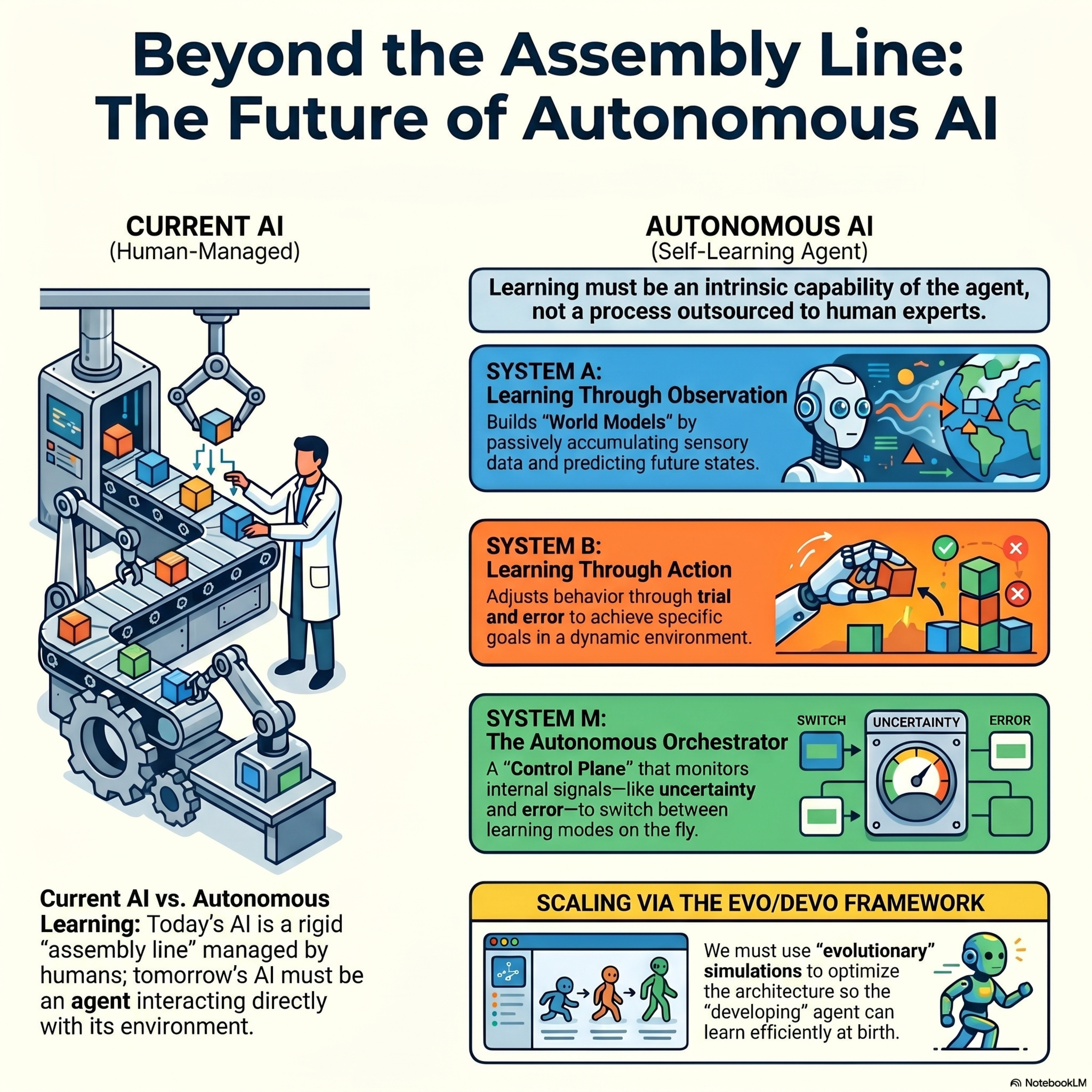
This paper explores the critical limitations of current artificial intelligence, noting that existing models fail to learn autonomously from their environment like humans and animals. To address this, the authors propose a cognitive architecture called the A-B-M framework, which integrates learning through observation, active behavior, and an internal meta-control system. This meta-controller mimics biological processes by automatically managing data selection and switching between different learning modes, tasks previously handled by human engineers. The researchers argue that building adaptable AI requires an evolutionary-developmental framework where systems are trained in complex, simulated environments to refine their own internal learning recipes. Ultimately, the goal is to create robust agents capable of open-ended improvement, grounding their knowledge in real-world interactions rather than static datasets. Such advancements could bridge the gap between machine learning and the flexible, multi-modal intelligence seen in biological organisms.
Embed this episode
No transcript yet.