
EPISODE · Jul 2, 2026 · 1H 11M
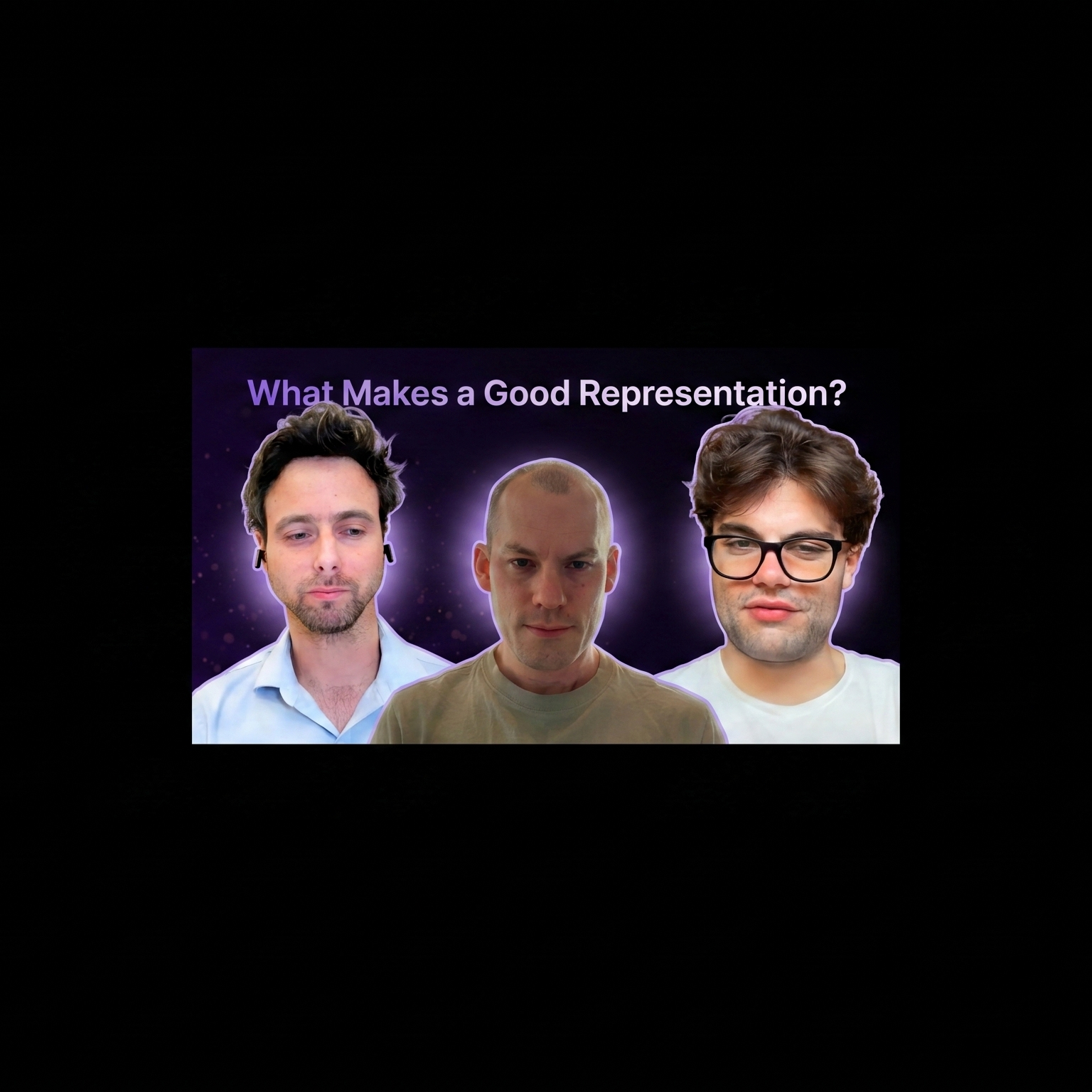
Why All Models Learn the Same Thing with Phillip Isola (MIT)
from The Information Bottleneck · host Ravid Shwartz-Ziv & Allen Roush
Phillip Isola, professor at MIT, joins us to talk about representation learning: what makes a representation good, why different models seem to converge on similar representations, and whether pre-training is really over.We discuss the platonic representation hypothesis and its limits, why clustering structure matters more than global geometry, and Phillip's new neural thickets paper arguing that post-training is easier than people think because pre-trained weights already sit near solutions to downstream tasks. Phillip also explains why he thinks LLMs are already world models, why he's betting on RNNs making a comeback, and why his most exciting current direction is artificial life: putting LLM agents in open environments with no fixed task and studying them like new organisms.Timeline:00:00 Intro song00:13 Intro01:05 What is representation learning and why it matters04:09 What makes a representation good: minimality and sufficiency10:03 How cross entropy and contrastive learning shape representations14:35 Dimensionality reduction and why dimension isn't the right complexity measure16:35 Compression and geometric clustering during training19:27 The platonic representation hypothesis and what actually converges22:53 Local neighborhoods vs global structure: the Aristotelian follow-up24:33 When convergence is strong: truth vs the space of possibility28:09 Is there true similarity in the world? The Bouba-Kiki effect30:56 World models vs autoregressive LLMs32:14 Diffusion LLMs as a special case of autoregressive models33:42 What architectures win in five years: the case for RNNs36:11 Grad student descent, or do we actually have principles?40:51 Feathers and wings: what to take from biology43:17 How close are we to brain-like models? Marr's three levels47:01 Are better models becoming less human-like?49:38 Is pre-training all you need? The neural thickets paper54:18 LoRA, low rank fine-tuning, and why post-training is easier than we thought56:01 RL environments and what our benchmarks actually test1:01:11 Artificial life: LLM agents as new organisms1:07:20 What's overlooked in AI research right now1:08:36 Why stay in academia, and doing science in the age of OpusMusic:"Kid Kodi" - Blue Dot Sessions - via Free Music Archive - CC BY-NC 4.0.About: The Information Bottleneck is hosted by Ravid Shwartz-Ziv and Allen Roush, featuring in-depth conversations with leading AI researchers about the ideas shaping the future of machine learning.
Embed this episode
NOW PLAYING
Why All Models Learn the Same Thing with Phillip Isola (MIT)
No transcript for this episode yet
Similar Episodes
No similar episodes found.
Similar Podcasts
No similar podcasts found.