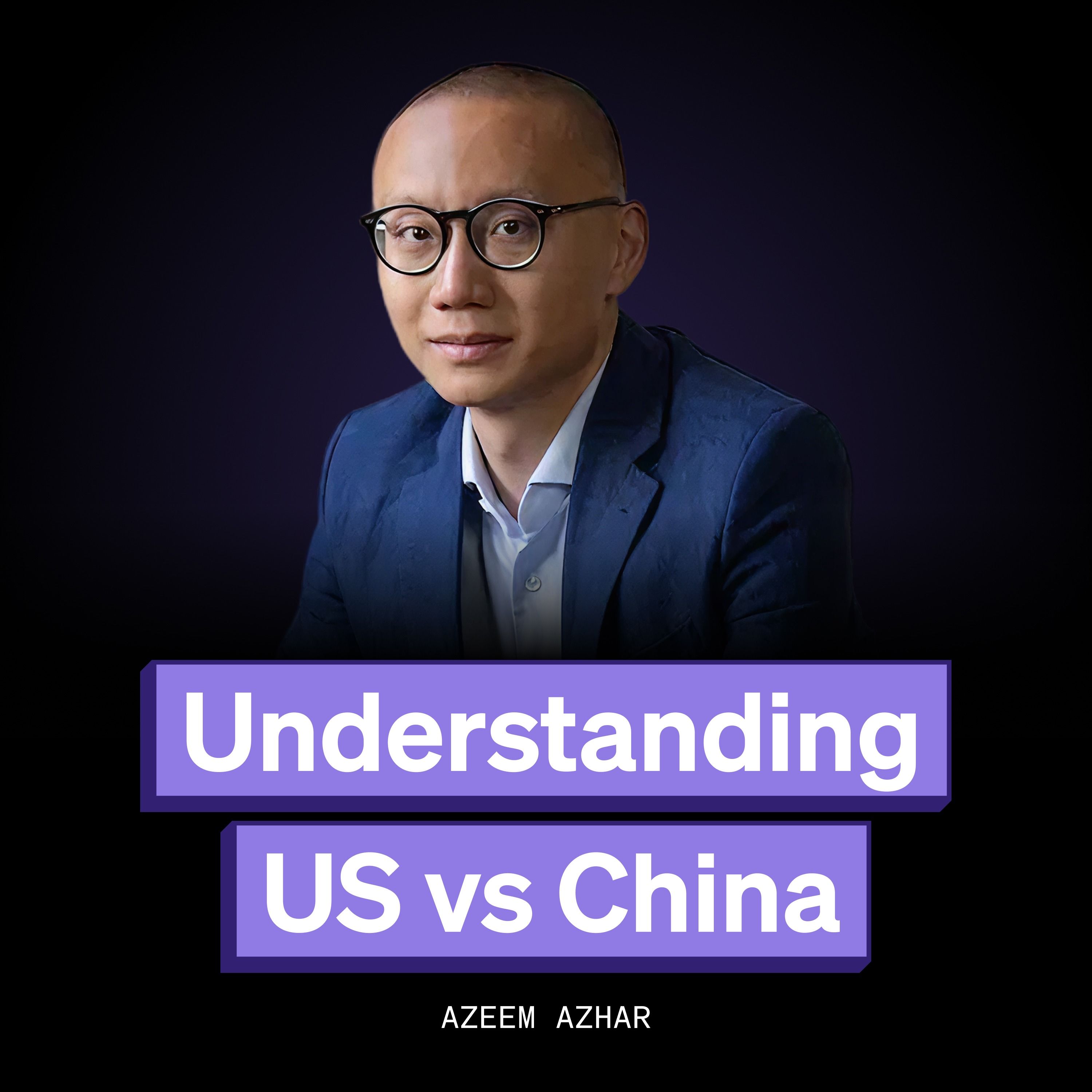
So today, I'm really excited to have Dan Wong on the show. Many of you will be familiar with his work on technology, in particular, the angle from China. I've been reading his essays on his beautifully designed blog for a number of years. And Dan has just published a new book, Breakneck, over here, which I strongly recommend. It's just been shortlisted as one of the best books in the year for the FT business book of the year. So much, much deserved, Dan. And it's great to have you here. Thank you very much, Rosie. The core idea in your book is that China is an engineering state led by engineers and the US is led by...
lawyers. What in practice does it mean to say that China is an engineering state? In practice, what it means is that China is very intent on engineering the environment. I spent a lot of time living through some of the successes and the not-so-great successes of the engineering state. Some of the successes can be represented through the city of Shanghai, which has beautiful subway systems, very well-functioning, excellent infrastructure of all sorts. And you can debate whether this is also a success, but I've also cycled through China's fourth poorest province far in the southwest and mountainous Guicho.
which has a high-speed rail, which has 11 airports, which has 45 of the world's tallest bridges. And so this is where the province is really saddled by all sorts of debt. It is pouring a lot of cement into the ground. And I think this is giving people a sense of some degree of optimism for the future, even if it creates some problems. Engineers also are very intent to engineer the economy. So as I was living in China between 2017 to 2023, one of the centerpieces of my time there was Xi Jinping's effort to smash a lot of consumer internet companies, a lot of cryptocurrency companies to say, we need young people to work on strategic technologies instead.
And one final thing to say is that the engineering state also treats society as if it were just another engineering exercise, as if people were just another building material not to be torn down and remolded as they wish. And so I spent a lot of time also thinking through another big centerpiece of my time in China, which was zero COVID. I was in China throughout all three years of zero COVID, really felt like the state was simply moving people around as if we were a series of chess pieces. So environment, economy, society, they engineer it all. I mean, it's a remarkable thread that you've drawn between those different dynamics. I think one of the really helpful things is it gives us a frame to...
try to make sense of things that may feel a little bit disconnected, but in a sense, there is something that pulls it all together. I suppose one of my questions around all of this is, why does it work in China? I mean, people have tried technocratic engineering in the past. Of course, the Soviet Union was a good example, you know, the five-year plans, Goss plan, all these other things. What is it about the intersection between Chinese leadership, Chinese society, Chinese culture, that has meant that it has this momentum that we can observe when we see you land in Beijing and the airport is...
pretty phenomenal. You walk around a clean city, you go on high-speed rail, you see the numbers of BYD cars that are now driving around the streets of London, you see what's happened with the exports of solar panels. Why does it work when it didn't work previously? I'm not sure if it fully works. I agree that a lot of it does work. Beijing airports, the solar, the BYDs, which is becoming more of an international success. There are also, if we wanted to poke at the dark underbelly of the engineering state, maybe we should go to Guizhou and take a look at these really tall bridges that cannot pay their meet their bond payments that very few people use. We can go to the northern city of Tianjin, which you happen to, Azim.
which is one of China's most overbuilt cities. They try to build something like China's Manhattan and it's not functioning super well. What I would say is that the engineering state mostly works pretty well. It has mostly worked pretty well in terms of producing manufacturing leaders, producing excellent infrastructure, and that is a real achievement. And I think what really distinguishes China from, let's say, the Soviet Union is that the Soviets were much, much more state-controlled in a lot of ways relative to the Chinese. The gas plan really was real. The five-year plans really were real. Whereas I think the Chinese five-year plans are kind of an interesting exercise. It has taken...
more seriously rather than literally. And what China has is this incredibly dynamic, vast consumer economy, which the Soviets never were able to produce. There is a lot more entrepreneurial dynamism in China that I think a lot of these successes, when you say something like BYD, which is an entrepreneurial firm, this did not grow out of the plan. Now, when we think about something like solar, that is, again, predominantly entrepreneurial firms, some of them maybe state-owned. But I think there is something, call it Chinese characteristics, that reflects a lot of the engineering state that does make it much more successful. There is something that's relatively distinct, which appears to be the transition between engineered outcomes that we might have seen.
Before 1979, or before the opening up of capitalism with Chinese characteristics, where there were engineering efforts under the leadership of Mao, and many of those didn't really work well. The attack on the four pests, for example, is a great example. But I think the thing that struck me about reading about China in my recent trip was that there's also a degree of competition in this engineering, that in a way, city mayors and regional leaders compete with each other in a way that we didn't really see in the era of the centrally planned engineering state. Can you just characterize that? Tell me whether you think that competition is relevant or important. The important thing to say about China is that there is a lot of competition. There is a lot of competition between the firms. There's a lot of competition between regional governments. Everybody has their favorite EV maker, where the Shenzhen EV makers, the Shenzhen government doesn't really buy from the Shanghai EV makers. It has to buy from itself. And so I think there is this level of competition that is pretty endemic, mostly because China is just so big, it cannot possibly be controlled, not even by a ruler as ambitious as Xi Jinping. But I think there is also a sense of which I feel like, you know, part of the problem is that the engineering state could be too successful.
Did the wiping out the four pests in the Great Leap Forward, was that a success? Well, in the narrow terms, destroying all the sparrows really was something that's mounted. I think the estimates are that. China destroyed something like 30% of sparrows, which triggered all sorts of ecological disasters. Part of the consequence was the destruction of the sparrows. So that was an effort in which they succeeded, but they failed. And this is where I also think about other engineering projects. Something like the one-child policy, something like zero COVID, which the number's right there in the name. There's no ambiguity about what these sort of things mean. You know, they were able to achieve one child per couple for a lot of folks, and they were able to tamp down on the growth of zero COVID for quite a long time.
But this is also where success actually is a harbinger of failure. And maybe you don't want so much engineering-led state capacity here. Let's dig into zero COVID because I think for many of us who are not in China, we lived through the lockdowns that you had in the UK and certain parts of the US and parts of Europe, but it was very, very different as it played out in China. And you describe this in your book as well, but just for people who are listening, what was it really like and what did zero COVID actually mean to live through? I think the way I reflect about the three years of zero COVID are...
Kind of a drama in three acts. The first act of zero COVID, I was in Beijing at the start of 2020. We heard about the Shanghai lockdown. We were all quite nervous about the new respiratory virus. And one of the broader reactions among myself as well as a lot of my friends was, oh man, not again. This is the second respiratory virus to erupt from China in 20 years. The first was SARS in about 2002. And we were upset because it seemed to erupt in exactly the same way, which a lot of local political officials were uninterested in bad news because they wanted to maintain a facade of serenity. And that was one of the reasons that zero COVID spread pretty extensively.
And this was a time when a lot of Western commentators were saying, well, could COVID be something like China's Chernobyl moment, which a natural disaster triggers the collapse of a political regime? And then there was a longer second act in which China was able to control the virus through pretty restrictive means, much better than other countries could. So China essentially sealed the borders. Only Chinese could enter. If you landed in China, you would be put into a two-star hotel where you couldn't really leave for two to three weeks. You'd be given hotel food for quite a while. And anyone to test a positive for the virus would be dragged away from their home to be sent to a convention center or stadium.
such that they don't affect the rest of the household. These sort of restrictive measures, plus a contact tracing regime that was kind of inconvenient, but we all learned to live through it. This proved that the Chinese were able to have much lower rates of transmission and get back to normal life in a way that the Americans could not. So I was pretty struck that between March and April, a lot of Beijing was coming back to life when the U.S. was really shutting down. And so more Chinese felt that the zero COVID system was working.
But then there was a third act in which people had been stuck with the virus. The government seemed to have no strategy for exiting zero COVID. People wondered whether they would just have to be dealing with the virus all the time for years or perhaps decades. And when the virus evolved to be much more transmissible, namely through the Omicron variant, Shanghai lockdown. This was, I described, the most ambitious lockdown ever attempted in the history of humanity, in which 25 million people were unable to step foot outside of their apartment compounds over the course of 10 weeks in the spring of 2022. And this caused a lot of anger and a lot of distress among ordinary people because they did not want to have random shutdowns through a super transmissible virus all the time.
The new month of this zero COVID strategy was at the end of the year in December, essentially Beijing threw up its hands inside everyone on their own now and COVID spread throughout the country in which they removed all of these controls in one of the coldest months of the year. And so this is where I think that the engineers tend to be really fixated on delivering one policy. When it becomes untenable, they can swerve really quickly and do something completely different. Is this a feature or a bug? Hard to say, but that is just how engineers operate. You're right. I mean, engineers, it's a bit unfair. I'm going to generalize, but nuance is complicated, complex to engineer four and second and third order effects.
complicated to engineer for a priori. But I have a quick question about the lockdown. Do you think the lockdown is a function of an engineering mindset or could it have been a function of a authoritarian regime that doesn't have to worry about popular consent for a little while, a bit longer than a democratic regime, but the engineering mindset allows you to execute on that intent far better than a different class of mindset? I think there is no contradiction between a role by autocrats and a role by engineers in which I feel like it is called a role by Leninists or a role by communists. These all apply.
So I think that what I want to offer is that the engineering state is not a replacement to any of these other important terms. Part of why I wrote this book is that I thought we were reasoning through this 21st century competition between the U.S. and China, mostly through these political science terms from the 19th century. And it doesn't mean that these political science terms are wrong. I think that they are just incomplete. And I think that we should definitely understand China as being authoritarian, engineering-led, somewhat socialist, somewhat capitalist, kind of neoliberal as well, and also very state-driven. But once we start adding up all of these sort of things, I think it is more useful to have simple frameworks like engineers really to try to understand them.
would they have been better off as a loyally state? You know, you describe the US as a loyally state and it has very different dynamics that emerge from it. What are the characteristics of that that make it a loyally state? The loyally society moves much more slowly. It doesn't really tend to commit to big projects all at once and then go really hard and go all out towards achieving some of these projects. So the loyally society is much more deliberative. And what we can tell is that the loyally society, whether that's in the US or arguably also the UK, is also a loyally society.
They are also much worse at building. They're much worse at building HS2. They're still talking about the Heathrow runway. It's been talked about for, what, two decades now. Kind of incredible. And so I think that what I would love to see is for the U.S. to be, let's say, 20% more engineering because the U.S. has a desperate need to build its way out of the housing shortage, build its way out of the rusting manufacturing industrial base, and then also resuscitate the defense industrial base and all of this before the infrastructure that we need to decarbonize the economy. I dare say that the U.K., which is actually more substantially de-industrialized than the U.S., maybe let's make it 30% more engineering.
And I would love for the Chinese to be 50% more lawyerly because I think it would be wonderful for the Chinese people to actually enjoy individual rights, to have a state that respects a lot of their creative impulses. And I wish that, and I think that China would be a stronger power if the state could just sometimes learn to leave its people alone for a little bit so that they can individually flourish. Watching the numbers around China between 1995 going from very small economy, maybe one of the top 10 in the world to 2014, the size of the US on a purchasing parity basis and... seeing what they are, that nation and its industries is capable of doing in scaling out advanced technologies. And hearing you say, well, you know, China could be an even more powerful state with a little bit more loyalness really tells us something about what the capacity of that nation is. Now, you know, this moment in history, it's sort of inescapable that a lot of the language that comes out of the US is couched in similar terms to the great power competition that we had seen with the Soviet Union, certainly since 1947 and until the turn of the 90s. What are the things that Americans don't understand about China? You know, you've come back here, you're talking to people.
You're hearing what people say on the East Coast and on the West Coast. The rhetoric from the politicians, but also the way in which technology firms talk about this, must land on your ears and you're thinking, I'm not sure they've interpreted this quite right. So what are the biggest misunderstandings? First of all, I think we're all wrong about everything all the time. I think that is a rough starting framework. I'd be the last person to put on my hand to say I know anything about China. And I frankly don't understand anything about America either. And I think both of these countries are too big and too difficult to really try to grasp. And so I think there is an East Coast flavor of getting China wrong, which is that China is successful in technology.
mostly because of industrial subsidies. And so if they're cheating in all sorts of ways and we need to raise the cost of their production through tariffs, but if it weren't for all of these industrial subsidies, China wouldn't be very far ahead. And I think there is also a West Coast misunderstanding of China, which is that China's ahead only because it has stolen a lot of American technologies. And I think both of these perspectives are true to some extent, but radically incomplete. You know, I do see part of my task as really pushing back against some of these views. I think there are other views that we can push back against, that China is somehow this wonderful global socialist utopia, which has solved poverty and it's just some sort of leftist paradise, I think.
This is a country that detains union organizers, that has a pretty threat-bare social safety net, and that is enforcing pretty traditional gender roles upon the people. And I think that a lot of what I'm trying to do is to say that China has been technologically successful. It is growing more and more technologically successful. And also, the political regime is getting more and more repressive in new and novel ways. And so I think that what we see in China is some sort of technological progress as well as some sort of institutional political regress. And I think we can keep both of these facts in mind. I think that is simply true. And try to interpret the world in a little bit of a smarter way.
We don't have to say that this is some sort of an amazing political paradise. At the same time, we don't have to say that they are failing all the time in technology. There's a deep sense of rivalry between when I talk to American entrepreneurs or certainly when I listen to the statements that are public, a sense that they are in a race against China, particularly around AI. And that's a lot of the language that is infused with what the big AI companies have said. It's behind a lot of the language around export controls on chips. But when I talk to Chinese entrepreneurs, I've not talked to many, probably 20 to 30 in AI and advanced materials and batteries and so on. I don't get a sense from their language that they see themselves in a race against the US. And that could be a language barrier. It could be that I've not spent enough time with them.
and they're not going to be candid with me. What is your interpretation about how the people in these two different countries in those roles see each other? It is certainly striking that Washington, D.C. in particular conceptualizes the U.S. and China technological competition as a race. We saw this with the AI action plan announced by the White House a few months ago in which they explicitly said AI is a race. Now, in which dimension is it a race? You know, it's not always very clear to me. I think that this is much more of a long-term competition. But I think what you're hearing a lot of is kind of more the East Coast perspective of Washington, D.C. saying, well, we need to get ahead of the Chinese and we need to build a lot more. And I think if you are speaking to more West Coast entrepreneurs as you do all the time.
I think people have a much better sense that, you know, it's not so much a race. Nobody gets to hit the win button. There is no referee that comes out at the end to give gold, silver, and bronze. This is kind of just a long-term competition. And I think you're picking up on something very true, which is that the Chinese kind of conceptualize themselves as being a little bit apart. Every Chinese company understands that American suppliers can be pretty unreliable because you never know when the Department of Commerce is going to completely cut off your chip access. And so they understand that there is kind of this bully out there that is denying them essential technologies for reasons that are sometimes valid, which they don't always understand.
And so they are trying to escape from under the thumb, but maybe they are also thinking mostly about their own products for their own sake rather than, oh, well, how do we get better than the Americans? But I think there is also a pretty clear sense among Chinese entrepreneurs that it is the U.S. that has invented a lot of great things. You know, Chachi PT was absolutely noticed in China. MRNA has been noticed. And so maybe the Chinese themselves don't conceptualize it as a race. But, you know, one point that I'll offer is that it seems like the Americans have a much poorer understanding of China relative to the Chinese who have a much better sense of America because, you know, it is kind of this global Twitter marketplace. Everybody is reading American stuff.
where he has the Americans don't spend that much time thinking about what's actually going on in China. A quick note, if you want to support us in bringing more of these conversations to the world, please consider subscribing to the show. Well, I think American information is easier to access because we've built a layer of decades of journalism and reporting and analysts who filter it and take it across. And I would guess that the level of English speaking amongst Chinese entrepreneurs is higher than the level of Mandarin speaking amongst American entrepreneurs. So there is that sense. But you raised an interesting point about the mRNA vaccine when we could add the smartphone or...
or GPS. These are things that have emerged from, you know, the American innovation stack running from human capital development from the education sector through to the way government has funded things early through to venture capital. Has a Chinese stack produced anything that is comparable? And are the conditions perhaps getting better to do that if they haven't? Yes. And I think one quick thing to say about the American cultural stack is that it seems like all the British are much more familiar with American politicians than they are with their own politicians. And so there is something kind of really globally dominant about the American discourse that gets absolutely everywhere.
I think you're right that China has not produced a lot of these really core technologies that other people want to build on. Most of the time, Chinese firms are fast followers. So it was Apple that invented the first real smartphone, Samsung followed, and then Huawei, Xiaomi, Oppo Vivo nipped at Samsung's heels. And again and again, I think it is slightly difficult to find real Chinese innovations. Perhaps you can label the consumer drone as a Chinese innovation. But I think what I would try to encourage listeners to think about is that I think that there is a little bit of an overstatement of the general view that quote-unquote innovation is the most important thing.
First, it's really difficult to define what is innovation. I would say that a lot of the improvements in electric vehicles as well as their batteries, though they're not a new category of products created by the Chinese, you know, this sort of incremental bit of innovation, that is absolutely an improvement over the product that the Chinese are delivering and the rest of the world are not. And I think China's real strength here is to be a very good, fast follower. It doesn't matter that China was unable to invent the first solar cell. The first solar photovoltaic cell was invented by Bell Labs in 1954.
The Americans treated this mostly as a science project, and that is all good and fine, but the Chinese were able to completely overrun this industry such that they're making about 80% of the solar value chain in the world. So my view is that science is for the most part a public good. It does not matter whether the innovation comes from Zhejiang University in Hangzhou or Stanford University in California. It's whoever can make the most use of it, and the American firms have not made very good use of it, and the Chinese have done a much better job. So maybe this process of innovation is less important. Maybe what matters the most is just...
having most of the industry and being able to iterate upon it. There's something in that, the notion that the value really accrues at the point of diffusion, right? And one's ability to diffuse it in the economy. And if it's something that has protocols or standards, you want to diffuse those protocols and standards as well as the Americans did with IP and other internet protocols back in the late 80s through the last 30 years or so. And it's the diffusion that actually impacts the prosperity and the welfare and security of your people more than the early invention. I think that's something that we can think about when it comes to AI, because when we look at what's happening in artificial intelligence, I see very, very distinct etiologies in the US.
compared to China. In the US, if I interpret it, it's a all hands to the pump race to build better and better, bigger and bigger models that are more generally capable, that might reach something that some people call AGI. And what I see perhaps in China is a broader, more distributed approach towards, I mean, this is not about not producing the best model or better models, but it's more about saying, we can diffuse this across our economy, we can find ways to use it more quickly, and it's not dependent on these bigger and bigger models. So I see this distinction. I was thinking back to just how important open source became in China. You know, it's been something that's been important for 20 years. It was certainly part of a recent five-year plan or something to anchor around. And it seems to be one of the distinctions between what's happening in the US, where I do think we see some genuine efforts at really hardcore innovation, and what's happening in China, where I think we're not seeing exclusively fast following. I think we are seeing very rapid iterations bouncing between these other labs, the Kimi's, DeepSeek, and Alibaba, and so on. And through that, seeing an accelerating cycle of innovation. And the paths seem to be quite different at this point.
I think the other big difference between the U.S. and China is that maybe the U.S. has a lead in reasoning models right now, but there are other big advantages that China can bring to the table, which involve much bigger aspects of hardware, which the Chinese are significantly better. So I'm thinking about something like power production. AI requires a lot of power to both train and to actually run. And China right now is producing, by the end of this year, it will produce 500 gigawatts of new solar installed. The U.S. will have about 50 gigawatts, so just one order of magnitude difference. China right now has 33 nuclear plants under construction. The U.S. has zero.
And so, you know, this is where, you know, the Chinese are thinking a little bit ahead of, well, what are the constraints going to be? How many years is it going to take? And then they're actually building a little bit more towards that future. China also has a lot of talent. China has different sorts of data. The U.S. economy is mostly services and healthcare. Maybe what the Americans will get is the automation of the Baines and the McKinseys of the world, where, yes, China is going to have a lot more manufacturing data to work with so China can actually automate Foxconn. And so this is where, you know, if AI is going to strengthen each country's specialties, which is, again, services and healthcare for the U.S. and manufacturing in China.
Well, I would much rather have, I think, a more robust manufacturing base able to build things, not least of all ships, drones, and munitions, which are military goods, than to have, you know, more efficient consultants. Well, I think you're being a bit unkind on PowerPoint there, Dan, but I think the point about power is really, really critical. I mean, we've seen the tremendous, tremendous demands that AI data centers of 2025 are already putting on not just the U.S. grid, but the supply chain and the regulations that slow things down. And I wrote an op-ed in the New York Times at the end of last year about this 19th century technology, which is, of course, electricity.
and how it's so fundamental if you want to reach an AI future. And what we see in China, as you say, the ability to deliver nuclear power, solar batteries, and high voltage direct connections. And the numbers are quite staggering. I was trying to figure out the theory as to why this had happened. And part of it is that energy is prosperity. And any society that is moving from poverty to prosperity, from an agrarian society to an urban society, just needs lots of energy, right? You need energy to put up skyscrapers and to build sanitation systems and to light people's homes. And so it becomes part of the mindset of people in the ruling elite, in the national and regional governments, within business.
that you need that. And I think when you track what's happened to the US and the US's attitude to energy until about two or three years ago, I do think you get this angle of your loyally state emerging, right? So in the 1970s with Ralph Nader and the growth of those types of regulations, emphasizing efficiency, which is a great thing to have, in a way, the response to oil shocks. And then we find ourselves in this funny place by 1990, where for 30 years, the US doesn't increase its energy density per capita. I mean, it's a really bold secular bet to make that after a million years of humans linking prosperity to energy use, you decide you don't need to do that. It actually plays quite well to your analysis of the loyally state and the engineering state, because I do think that a lot of what gets in the way now of Americans building more energy is actually things that are ultimately dealt with by lawyers. You know, it's kind of regulation and permitting. Yes, that's right. And I think the big shift in the U.S. is that the lawyers used to build. The U.S. has been in a lawyerly society forever. The first 16 presidents from Washington to Lincoln, 13 of them were lawyers. Most of the Democratic nominees to president in the 20th century have been trained in law.
And I think what really matters is that lawyers have shifted themselves in character over the past 100 years. About 100 years ago, all the way through the early 1950s, lawyers were much more interested in being handmaidens of other builders. So there were Wall Street lawyers, there were railroad lawyers, it was mostly lawyers implementing the new deal for FDR. But after Ralph Nader had his way, many more of these lawyers turned away from creative dealmaking and into regulation and litigation. And that has been a meaningfully different stamp on American power, especially power production. And I'm still pretty struck that it was Meta that tried to build a new nuclear facility about two years ago.
and a rare species of bee swatted a lot of these sort of plants. Now, I think maybe for the average citizen, it does not matter very much whether Mark Zuckerberg gets another hyperscaler, but I think it should matter to civilization that, you know, we should be able to generate more energy cleanly. I think we should emphasize that. But more solar and wind, let's have more of that because that really enables us to live better lives. Well, it's very true. And I just think we should take a moment to think back to FDR and the New Deal because, of course, they did build the Hoover Dam, the federal highway interstate system, the grand rural electrification projects, all built at that time, bringing a lot of Americans out of poverty, improving prosperity.
and building long-lasting infrastructure. So we know, we have evidence proof that it can be done culturally, historically, it has been done. And with great, great consequence as a result. If we just come back to this question around that Chinese economy and AI, you know, you raise this point that China has lots of, within its industries, has lots of really, really interesting data. Data around manufacturing, data around materials, data around processes. And I remember years ago reading one of your essays before Breakneck, it was a great essay about process knowledge, this notion that the Chinese are really, really good at process.
knowledge. And it's not necessarily something that shows up in the patents or when you weigh the intellectual property of a nation. How important really is process knowledge and why is Chinese industry so good at it? I would argue it is by far the most important component of technology. Technology isn't simply the tools and the equipment that we can physically feel and poke out and use. Technology isn't simply written instruction on blueprints and patents and recipes, all of these sort of things that we can write down and examine. Most of what technology is are the sort of things that cannot possibly be written down because it is almost silly to write down a lot of these processes that all of us know how to do.
And to make a defense of even the PowerPointers, for a consultant who is really good at PowerPoint, even that, you know, how to construct a great PowerPoint, it can't just simply teach someone how to do that very easily. It involves a lot more work to actually train. And what China has is a great deal of this training. It is the center of manufacturing for all sorts of goods, not least consumer drones and electrical batteries, but also lower-end goods like refrigerators and guitars and whatever else. When you have a workforce that is endlessly just working through all of these different products, producing new knowledge, training each other, that is a lot of what the U.S. as well as the U.K. have lost, in which the U.S. manufacturing employment keeps going down. Right now, it stands at about 12 million people. For China, it's about 70 million people.
I think that really places the U.S. at a disadvantage when the stock of process knowledge is unwinding such that people are not really able to invent the next great product after the iPhone. And I just want to imagine that if we're able to achieve this fantastic scenario of assembling iPhones in Pennsylvania or Michigan or Wisconsin, many more of the follow-on innovations of the iPhone, something like drones and other consumer electronics, electric vehicle batteries, that has a shot at being produced in the U.S. Now, it was never really going to happen that Apple wasn't going to put iPhone production in this much lower-wage place, but I think the U.S. shouldn't be accepting of losing again and again the process knowledge that it requires to create whole new products.
Doesn't the arc of process knowledge within a society naturally reach a point where it starts to decay? Because, you know, Chinese people, especially if they're, I mean, to be a second generation from the bigger cities, may not want to work for Foxconn and they may have other things to do. There are other opportunities in the economy. To what extent are we seeing a blip, maybe it's a couple of decades long, where China's process knowledge continues to grow before the economy moves on? We've already seen manufacturing move to certain types, move to Cambodia and Vietnam, and the people themselves don't want to do it. That is in part inevitable. I think that fewer and fewer Chinese really do want to work in manufacturing.
Absolutely true. I would offer that still there are plenty of Chinese people living in rural areas who would still gladly take a factory job. And I think the Chinese are getting better at a lot of the robots and some of the AI in order to replace some of this workforce. Now, a couple of decades might seem like a short time, but in the long run, we're all dead. And a couple of decades seems pretty important to me. Just compare, let's say, the UK today to the UK 30 years ago. The other point that I wonder about is one can have a commitment to maintaining process knowledge. And this is why one of my favorite parts of writing this book was to write a little bit about the Issei Grand Shrine, which is one of them.
most holy shrines in Japanese Shinto faith, in which every 20 years or every 25 years, over the past six centuries, essentially, the Japanese have torn down a simple wooden temple and reconstructed it next to its place because they believe in renewal. They believe that wood joinery is an important craft, that they are really intent on making, you know, preserving all of this craft knowledge. And, you know, there's something that I think maybe the Japanese are the best at this and even they have lost a lot, but still, their manufacturing is a pretty big part of their economy. And maybe we should all be a little bit more like the Japanese. That's a cultural, like a deep, deep cultural.
trait. I mean, when you walk around Tokyo or Kyoto, as I did earlier this year, you absolutely do notice behaviors that make sense when you think about the Issei shrine that you don't notice when you walk around other cities, cities in Europe, cities in the UK, cities in the US. There's something about the deliberateness of the culture. You know, cultures have these different attributes. Can one really lift and replace culture? You know, America has been so successful with different attributes for the last 250 years. And so I think the question is, could that happen? Or do we need to end up relying on our old deus ex machina, which is, well, we'll have AI systems that will somehow learn the process knowledge and they will...
that will reduce China's advantage on process knowledge and it will allow the US and Europe to embed this within AI systems. My sense is that if the present dais isn't working, let's get a new dais. So the East Grand Shrine is not only a cultural project, it is also a religious project. And if the Shinto faith is going to be what allows America to build better ships and better chips and better munitions, I say we should all be Shinto, more like Shinto people. And I think that you're right that parts of this may be difficult and America broadly is successful. But I will always come back to the view that...
Every culture has something to teach other cultures. The U.S. doesn't have to copy China, but the U.S. should definitely study China. And the U.S. will never copy China and China will never copy the U.S. But let's study other cultures a little bit more. I think that the U.S. could maybe at least copy something like Japan or France or Denmark or Spain, in which they're actually building a lot more public infrastructure, mass transit in particular, at very reasonable costs and delivering it roughly at budget. I think we could learn, we could recognize that the U.S. has gone deeply off track in quite a few ways, namely around manufacturing and infrastructure and housing. And that doesn't mean that we can change nothing. Let's change a few things.
You know, it struck me that things like the CHIPS Act and the IRA under the Biden administration were perhaps creating the policy space and the financial space for there to be more engineering in the US. And then the new administration has obviously changed the shape of those policies. But still, you know, within various executive orders and other things that are being done in the president's own style appear to be rather pro-engineering. You know, whether it is persuading semiconductor manufacturers to build factories, whether it is constructing space for businesses to get what they need done, whether it is the promise of fast-tracking. The build-out of energy infrastructure, all of these things look like they are pro-engineering, pro-building policies, different in cost and color to the Biden era policies, but are they pro-engineering policies or are they just dressed up like that? I think there is a little bit of a real seed of something in both the Biden administration as well as the Trump administration. Both have been deformed in various ways. I think that is absolutely the case that Biden achieved these legislative successes in terms of building more infrastructure, building more chip fabs, and building more clean technology deployment as well. The problem was that this was industrial policy as run by lawyers, and Biden was plotting a proceduralist throughout his term.
which never really became a priority to actually build these sort of things. It's mostly about how to disperse the money and how to create these processes in order to build this very well, such that when Trump is now in office, he can either cancel all of these projects or have a lot of new bridges to be able to be named after himself. And I think there is something, a kernel of engineering in the Trump administration. I think Elon Musk is definitely one of the preeminent engineers in the United States, but Elon is now fired as co-president. And it is not all that clear that Elon had really the right priorities. He was mostly focused on reducing headcounts within the government.
as if it weren't entitlements that were creating most of the problems for the U.S. fiscal situation. And so I wish that Elon Musk could have been somewhat more like a Hyman Rickover, say, who deployed his talents inside the government, created a lot of grand new projects inside it, rather than trying to shear off essential functions of government. And right now, I'm not sure that I see that the Trump administration is really going to be all that successful in building out a lot more chip fabs, building out a lot more wind turbines at solar. In fact, he's been tweeting against these scams of the century. And so I'm not really sure whether, you know, between the tariffs and the funding cuts that the U.S. actually will build a lot.
That's something that we can test, which is great. But you raised Elon Musk, and of course, he's one of the preeminent engineers anywhere in the world. One of his emphases, I think his unique characteristics amongst American engineers is that he does span the bits in terms of X.com and through to the atoms in terms of his robots, his robots on wheels, the cars and what he's building with Optimus. But it does feel to me, and I think you've interpreted this a few times, that it's where code meets atoms. It's Chinese entrepreneurs who are largely leading. I mean, within autonomous vehicles, we talk a lot about Waymo and its successes.
But of course, Apollo, which was incubated in Wuhan, is doing incredibly well with much, much lower cost vehicles. We know what's happening with the surge of electric vehicles coming out of China, right across not just Europe, but across Africa, you know, the BYDs and the others. And these are great vehicles. You haven't been in them. I was in a few luxury EVs when I was in China and I was blown away. And one of them had a marble floor, which I've never seen in a car before. And then, of course, we're seeing this naturally with drones, right? We know that the drones are produced essentially in China. Is that code meets atoms, right? As a layperson who knows less about these countries than you do, I would say, well, this is something that...
speaks very well to the engineering culture, and it's no surprise therefore that Chinese entrepreneurs are leading this. Is there a different interpretation to that? I think that is mostly my interpretation, that the Chinese used to be behind on code and software for quite a while, and they have made substantial strides to become a lot better over the last few years, call it the last decade. Where yes, the Americans have always been strong on code and software, much weaker on manufacturing and all sorts of process knowledge, and the Chinese have improved their deficiencies at a much faster rate than the Americans have been able to improve their own deficiencies. And this is, again, I think part of the...
Part of the urgency I'd like to raise to people that America is weak. America is strong in all sorts of ways, but it is weak in a few crucial ways. And let's patch up a lot of these pretty big, hard manufacturing-driven deficiencies. I think one of the challenges is going to be about that intersection between process knowledge, which I think is very closely related to the learning curve and right-hand learning, which essentially means that the more you make of a complex engineered product, the cheaper it is per unit, independent of the scale costs, right? That is what drives these exponential curves. And the way that subsidies now land for things like EVs in China, it's really marginal.
So when BYD ships a car for 40,000 euros in Europe, there's just not a ton of Chinese government subsidy, if any, in that. And they have that advantage higher up the chip curve. It's almost as if you try to compete with Intel 30 years into Moore's law having started. So you're behind that curve, and you're certainly behind that curve around things like solar panels and almost certainly around batteries. So what does it actually take to be able to compete? Because at some point, political considerations aside, and I may not care where I buy my battery from, price is going to be a determining factor.
Yes, absolutely. And this is where I think we didn't buy, my family didn't buy a new electric vehicle recently, but we did buy a new, much more boring product, a new stove. And our salesperson in Michigan told us that, well, you could buy this GE stove or you can buy this LG South Korean stove. And the South Korean stove is essentially the same functionalities for half the price. And I'm wondering, I'm a reasonably patriotic person, but I am not so willing to pay twice the price for something that is American made. And I think that, you know, unless the tariff barriers are really high, unless the European governments make it much more difficult for Chinese firms to compete in all sorts of ways, then I think, you know, if they're not going to do that, then they have to.
work a lot harder to make sure that European companies and American companies can be much more competitive against the cheaper priced Chinese products, which may well be better in all sorts of dimensions. Well, you know what? The thing is, it's not so much necessarily that they're Chinese. It is that they've marched so far down the learning curve. There's so much embedded knowledge that the product that is produced is going to be of a higher quality. You know, it's why the chips being produced by Intel were better than the chips being produced by other companies in the late 90s and not so true today. And I guess the question that I have is, is it possible to, you know, what are the ways in which you leap over that? Otherwise, as a government or an economy...
you put yourself in this really difficult position, which is you're buying capital equipment, machines, consumer spending that are key factors to welfare, but you're essentially paying more for getting less, which is a path to relative immiseration, right? So that feels to me like quite a gnarly problem to tackle. And the US can do it because, you know, in the sense, the US car market has been much more heavily skewed domestically anyway. But, you know, these emerging car markets, whether it's across Africa or elsewhere, that calculus doesn't exist. And all that does is serve to expand the market, right? And expand the opportunities for...
for learning. So I can't, I haven't in my head been thinking about this. I'm not sure how one ends up squaring that circle, but I'm not a fatalist. I'm a possibilist. So I'm hoping you have a possibility. I think I would love to be a possibilist, but I agree that the problem is very, very gnarly indeed. And I think the challenge is we cannot say that China has been marching down all of these learning curves and therefore we don't even try to do anything. I think that is probably the wrong attitude. On the other hand, competition with a country and its firms that really have marched down so many learning curves, that is indeed pretty difficult. You know, maybe there is no doctrine error. Maybe there is no right or wrong answer in every case here. Maybe what is most important is
figuring out a few learning curves that are really important to master. Maybe that is something like stoves. Maybe that is something like electric vehicles. Maybe that is something like munitions. And then being much more intent on actually climbing down these curves. There is another way to get down these curves. So during the industrial revolution and the early mechanization revolution really in England, mill owners and loom manufacturers really put very, very tight contracts around the engineers who were making these first looms because the know-how was in their heads. We would call it process knowledge now. And if they walked out of the factory, went to a competitor, they would exchange that. And the U.S. mechanization industry around...
cotton and textiles in the 19th century really started because somebody whose nickname amongst British historians is Slater the traitor left England with this know-how and went over to the US and bootstrapped the Americans. And one of the things that strikes me is that that revolving door around knowledge is really easy if there's more free movements of people. And of course, the view has been, well, it's been people coming from China, going to the US and then going back to China who've taken the knowledge. But there's a whole series of domains now where perhaps that knowledge flow would move the other way if the people could. Well, I think it is absolutely important to bring up Samuel Slater, who's known as Slater the traitor in the UK and father of the American Industrial Revolution in the US.
And my view is that technology tends to move around. People tend to move around. We have the trader as eight that did move around. And it is really difficult to try to stop the technology from being monopolized by any key country. But here, maybe there is a point to trying to get brain drain a lot more Chinese into the U.S. and trying to have them build on the American shores rather than on the Chinese side. Dan, there's so much to discuss. Thank you for your time today. As a reminder, there's your book, Breakneck, shortlisted for the FT and Schroeder's Business Book of the Year this year. So many, many congratulations. Really glad to have had you in this discussion. And what I would say to...
To listeners, this is all the time we have for today. And thank you so much for showing up. Best of luck with winning the competition for the best business book of the year with EFT. We'll find out in a few months, I'm sure. Thank you very much, Azine. Thanks for listening all the way to the end. If you want to know when the next conversation is released, just hit subscribe wherever you're listening. That's all for now. And I'll catch you next time.