Why Cystoscopy Matters Before Your Bladder Gets Worse S2E25
from BPH360 Hosted by Man vs Prostate
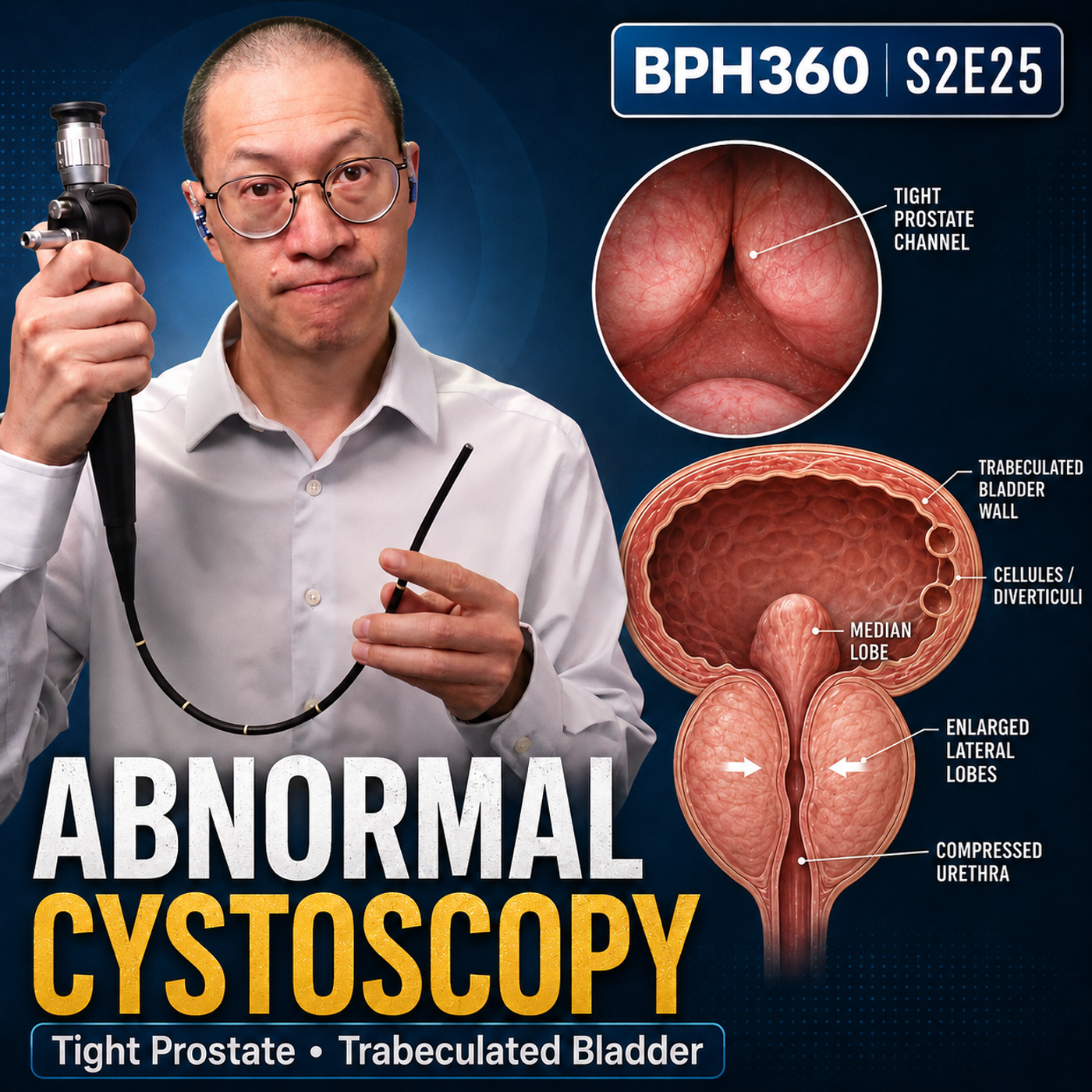
Measure Your Urine Flow Rate Qmax: https://proudp-soundable.app.link/w5rhpKoU7Wb Learn more: https://www.manvsprostate.com/ What does a normal cystoscopy look like—and what changes when the prostate and bladder have been fighting each other for years or even decades? In Part 2 of our cystoscopy series, we go inside the urinary tract to compare relatively normal anatomy with the abnormal findings that can develop with BPH / prostatic bladder obstruction. First, we establish the reference point: an open urethra without scar tissue, relatively open prostate channel, straight pathway into the bladder, and a smooth bladder without significant trabeculations, cellules, or diverticuli. Then we examine a very different cystoscopy in a 75-year-old man with BPH. You’ll see: • Lateral prostate lobes compressing the prostate channel • A longer, tighter pathway through the prostate • Changes in the angle between the prostate and bladder • Prostate tissue growing up into the bladder • Severe bladder trabeculation • Cellules and diverticuli suggesting years of bladder remodeling This is why prostate size alone does not tell the whole story. Two men can have prostates of similar volume but completely different anatomy and geometry. Same size does not mean same shape—and shape can matter more than you think. Cystoscopy can also help reduce diagnostic uncertainty by looking for competing explanations for urinary symptoms, including urethral strictures, bladder stones, and bladder tumors. But there is an important scientific guardrail: Cystoscopy shows anatomy. It does not prove physiology. A tight-looking prostate does not by itself prove the degree of obstruction. A severely trabeculated bladder does not tell us whether the detrusor muscle is still strong or beginning to fail. That is why cystoscopy is only one part of the Man vs Prostate Trifecta: Size + Shape + Bladder Function. Combine what we see with your symptoms, IBPSS, Qmax, PVR, bladder/detrusor wall thickness, and—when needed—more advanced testing. The better question is not simply: “Do I need prostate surgery?” It is: “What do my prostate AND my bladder need together?” CHAPTERS 00:00 Video Opener 00:28 Intro 00:30 Overview 01:15 "Normal" Cystoscopy 05:10 Cystoscopy in Young Healthy Man 08:12 Cystoscopy: "Normal" Prostate Anatomy 14:23 Cystoscopy in BPH: "Abnormal" Big and Tight Prostate 18:20 Understanding Prostate Growth and Bladder Dynamics 21:43 The Importance of Cystoscopy in Bladder Health 23:14 The Five Stages of Bladder Health 23:54 Cystoscopy: A Tool for Understanding Prostate and Bladder Health 25:56 The Manverse Prostate Trifecta: Size, Shape, and Function 26:57 How to Tackle Your BPH 27:49 Conclusion: The Need for Comprehensive Bladder Assessment Next in Part 3: active cystoscopy during urination. Instead of looking at a static picture, we’ll watch the prostate channel behave in real time. ✋ Educational content only; not medical advice. Discuss your individual symptoms, testing, and treatment options with your healthcare professional. #WhatAboutMyBladder #BladderHealthMatters #ManVsProstate Let’s go… save more bladders… together!
Embed this episode
No transcript yet.