
EPISODE · Jun 29, 2026 · 2 MIN
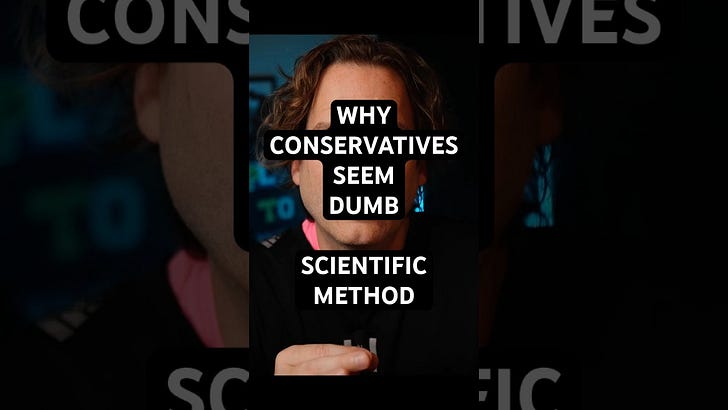
Why Does the Right Seem So Stupid?
from The Lucas Bean Show · host Lucas Bean
This is not a rhetorical question. It has a scientific answer.And once you understand it, a lot of things that have seemed baffling about American politics for the last decade start to make sense.Not infuriating. Not inexplicable. Predictable.The “I Did My Own Research” ProblemYou’ve seen it. A family member shares a conspiracy theory on Facebook. A coworker explains that vaccines contain microchips. Someone on Twitter insists the earth is flat and they’ve “done their own research.”When you push back, they don’t engage with your sources. They question your sources. They call yours mainstream, corporate, controlled. They call theirs independent, authentic, brave.The argument collapses not because they ran out of information, but because you and they are playing completely different games.They think research means finding things that confirm what they already believe. You think research means designing a test that could prove you wrong.These are not two versions of the same process. They are opposites. And the gap between them is what this piece is actually about.What the Scientific Method Actually IsMost people think science is a body of facts. It isn’t. It’s a method for producing facts that can be trusted.Here is how it works.You observe something in the world that you don’t understand. You form a hypothesis, which is a specific, testable guess about why that thing is happening. Then you design experiments to test whether your hypothesis holds up. You run those experiments repeatedly. You let other scientists run their own independent tests. If the results consistently support your hypothesis across multiple tests, in multiple labs, by researchers who have no stake in your being right, your hypothesis becomes a scientific theory.In science, a theory is not a guess. A theory is the strongest form of conclusion that science produces. Gravity is a theory. Evolution is a theory. Germ theory is why antibiotics work. These are not educated hunches. They are the most rigorously tested explanations we have for how the world works.The whole system is designed around one idea: what you believe doesn’t matter. What matters is whether reality cooperates when you test it.The scientific method is the only reliable process humans have ever developed for separating what is true from what merely feels true.Here is what it is not: watching a YouTube video, reading a Substack by someone with no credentials, scanning Facebook posts that agree with your prior beliefs, and then announcing that you’ve done your research.That’s not research. That’s confirmation. And there is a profound difference.Most Americans Don’t Know the DifferenceIn 2019, Pew Research found that only 28 percent of Americans can be classified as scientifically literate, meaning they have enough working knowledge of science to understand and evaluate scientific information as it is communicated in mainstream public discourse.72 percent cannot.That means nearly three quarters of Americans cannot read a science article in the New York Times and properly evaluate what it is saying. Not because they’re unintelligent. Because they were never given the tools.Pew also found that only 52 percent of Americans can correctly identify what a hypothesis is. According to the NSF’s Science and Engineering Indicators, 66 percent of Americans do not understand the scientific method well enough to apply it as a framework for evaluating claims.This is not a fringe problem. This is the median American.And it has consequences that go far beyond science class.Education Is the Dividing LinePew’s 2019 survey broke down understanding of the scientific method by education level, and the results were stark.85 percent of Americans with postgraduate degrees understand that the scientific method is designed to produce results that are continuously tested and updated over time. 76 percent of college graduates understand this. Among Americans whose highest level of education is high school or less, that number drops to 56 percent.Read that again. Among Americans who did not go to college, nearly half do not understand the fundamental logic of how we verify what is true.The NSF data shows a similar pattern. Americans who never completed high school answered an average of 43 percent of basic science knowledge questions correctly. Those with a bachelor’s degree averaged 74 percent. The difference is not marginal. It is the difference between understanding how knowledge is produced and not understanding it.This matters because when you do not understand the process by which reliable information is created, you have no framework for distinguishing a peer-reviewed study from a tweet. You have no way to evaluate why one source is more credible than another. You can’t assess what “multiple independent replications” means or why it should change your mind.In that vacuum, you fall back on what every human brain defaults to when it lacks better tools: familiarity, tribe, emotional resonance, and the people who tell you what you already suspected was true.This is not stupidity. This is the predictable result of not being taught otherwise.Who Did Not Get Taught Otherwise62 percent of American adults do not have a college degree.Among voters without a college degree, 54 percent voted Republican in the 2024 presidential election, compared to 41 percent of college graduates, according to NBC News exit polls. The gap has been widening for a decade. In 2016 it was 9 points. In 2020 it was 7 points. In 2024 it was 13 points and still growing.Among white voters specifically, the numbers are sharper. Two-thirds of white voters without college degrees voted Republican in 2024. White women without a college degree backed Trump by 28 percentage points.This is not a coincidence that happens to overlap with science literacy data. It is the same population, described two different ways.The voters who are least likely to understand how evidence is evaluated are becoming, in increasing numbers, the base of one political party. And that party has spent the last decade systematically attacking the institutions that produce and communicate reliable evidence: universities, scientific agencies, mainstream media, public health authorities.This is not an accident. It is a strategy.Trump Said It Out LoudIn February 2016, after winning the Nevada Republican caucuses, Donald Trump stood on a stage and said: “We won with young. We won with old. We won with highly educated. We won with poorly educated. I love the poorly educated.”The crowd cheered.Exit polls from that night showed Trump had won 57 percent of Nevada voters with a high school education or less, compared to 20 percent for his nearest rival. He was not exaggerating his appeal to that demographic. He was accurately describing it.The political press treated the moment as an odd gaffe, a boast that inadvertently revealed something embarrassing about his coalition. But looked at through the lens of what we know about scientific literacy, it was something more precise than that. Trump had found a population of voters who were never taught how to evaluate evidence. Who had no framework for fact-checking claims. Who had been told by their information environment that their gut was more reliable than expert consensus.And he was telling them exactly what their gut wanted to hear.Why Facts Don’t Work on ThisHere is the part that confuses people who believe in evidence-based argument.When you cite a study to a committed conservative voter, they don’t engage with the methodology. They attack the source. When you reference mainstream scientific consensus, they call it an elite narrative. When you point to data from a government agency, they say the government is lying.This looks like stubbornness. It is not stubbornness. It is the logical output of a worldview in which the verification process itself cannot be trusted.If you believe that peer review is corrupt, that universities are indoctrination centers, that the CDC lies, and that mainstream journalism is propaganda, you have not just rejected a set of facts. You have rejected the system by which facts are produced and validated. At that point, there is no fact you can present that will carry weight, because the weight of facts depends on the credibility of the process that produced them.Conservative media spent decades building exactly this outcome. Not by arguing that specific facts were wrong. By arguing that the people and institutions capable of producing reliable facts could not be trusted.Once that argument succeeds, the playing field is permanently tilted. Every piece of evidence becomes a point of dispute. Every expert becomes a suspect. Every inconvenient study becomes evidence of the conspiracy.Political psychologist Dan Kahan at Yale calls this identity protective cognition. His research found that more educated and scientifically literate conservatives are actually better at constructing arguments against scientific consensus on politically charged topics like climate change, because they have more cognitive tools available to rationalize their tribal commitments. Scientific literacy, in other words, does not automatically translate into accepting science. It can just as easily be turned toward more sophisticated rejection.But for the majority of conservative voters who do not have that level of education or scientific literacy, the barrier to rejecting expert consensus is even lower. They don’t need sophisticated rationalizations. They were never taught to trust the process in the first place.What “I Did My Own Research” Actually MeansWhen someone tells you they did their own research, they are almost always describing something that looks like this:They felt uncertain about an official claim. They searched for content that matched their uncertainty. They found YouTube videos, Facebook posts, or podcasts from people who shared their skepticism. They processed that content. They emerged more certain that the official claim was wrong.At no point in that process was there a test that could have proved them wrong. At no point were they looking for disconfirming evidence. At no point was anyone checking whether the sources were credible, whether the methodology was sound, or whether the conclusion had been independently replicated.What they did was not research. It was selective information consumption that confirmed a prior belief. And because they do not have a framework for understanding why that is different from research, they cannot see the difference.This is not an insult. It is a description of what happens when you are never taught that a hypothesis has to be falsifiable to be meaningful, that a sample of one is not a study, that a YouTube video with citations is not the same as a peer-reviewed paper, or that the existence of disagreement does not mean all positions are equally valid.Science does not work by accumulating agreeable opinions. It works by subjecting ideas to the most rigorous attempts to destroy them, and updating based on what survives.Most Americans were never taught this. Most of them do not know they weren’t taught this.This Is a Structural Problem, Not a Character ProblemThe easiest thing to do with all of this is conclude that conservative voters are simply less intelligent than everyone else. That conclusion is wrong, and it matters that it is wrong.Scientific literacy is not innate intelligence. It is a skill that has to be taught. In a country where 62 percent of adults do not complete college, and where high school science education has for decades prioritized facts over methodology, it should not be surprising that 72 percent of Americans cannot properly evaluate scientific claims.What should be surprising, and what is not discussed nearly enough, is that one political party has chosen to build its coalition around exactly those voters while simultaneously dismantling the educational and institutional infrastructure that could change that situation.Defund public universities. Attack the credibility of scientists. Call teachers ideologues. Eliminate the Department of Education. Cut funding for public broadcasting. Celebrate the person who questions the expert over the expert who spent a decade earning the knowledge.This is not an accident of where Republican voters happen to be concentrated. It is a self-reinforcing system. Keep voters from developing the tools to evaluate evidence. Tell them those tools are weapons of the elite. Provide an alternative information ecosystem that validates every prior belief. Win elections.“I love the poorly educated,” Trump said.He should. They are the structural foundation of the entire project.The Real QuestionThe question “why does the right seem so stupid” is not actually a question about intelligence. It is a question about epistemology.Epistemology is the branch of philosophy concerned with how we know what we know. How we determine what is true. What standards of evidence we accept. Whose claims we trust and why.The right does not have worse epistemology because its voters are less intelligent. It has worse epistemology because its voters were given worse tools and were then, systematically, taught to distrust anyone who offered better ones.When you argue with a conservative who rejects your sources, you are not encountering a failure of intelligence. You are encountering someone who was never given the framework that would allow them to evaluate what you’re saying, and who has since been trained to treat that framework as a threat.The next time someone tells you they did their own research, ask them to walk you through their methodology. Ask them how they controlled for confirmation bias. Ask them what evidence would have changed their conclusion.If they cannot answer, they did not do research.They did what all of us do when we lack better tools.They went looking for what they already believed.Sources:Pew Research Center. (2019). What Americans Know About Science. pewresearch.orgMiller, J.D. (2010). Adult Science Learning in the Internet Era. Curator: The Museum Journal, 53(2).National Science Foundation. (2022). Science and Engineering Indicators: Public Attitudes and Understanding. ncses.nsf.govPew Research Center. (2019). What Americans Know About Science: Scientific Method Understanding by Education Level. pewresearch.orgNBC News / Edison Research. (2024). Presidential Election Exit Polls by Education.Pew Research Center. (2024). Party Affiliation of U.S. Voters by Race, Ethnicity, and Education. pewresearch.orgKahan, D.M. et al. (2012). The Polarizing Impact of Science Literacy and Numeracy on Perceived Climate Change Risks. Nature Climate Change, 2, 732-735.Trump Nevada Caucus Victory Speech. February 23, 2016. C-SPAN / Politico / Snopes (verified). This is a public episode. If you'd like to discuss this with other subscribers or get access to bonus episodes, visit lucasbean.substack.com/subscribe
Embed this episode
Ready to play
Why Does the Right Seem So Stupid?
No transcript for this episode yet
Similar Episodes
No similar episodes found.
Similar Podcasts
No similar podcasts found.