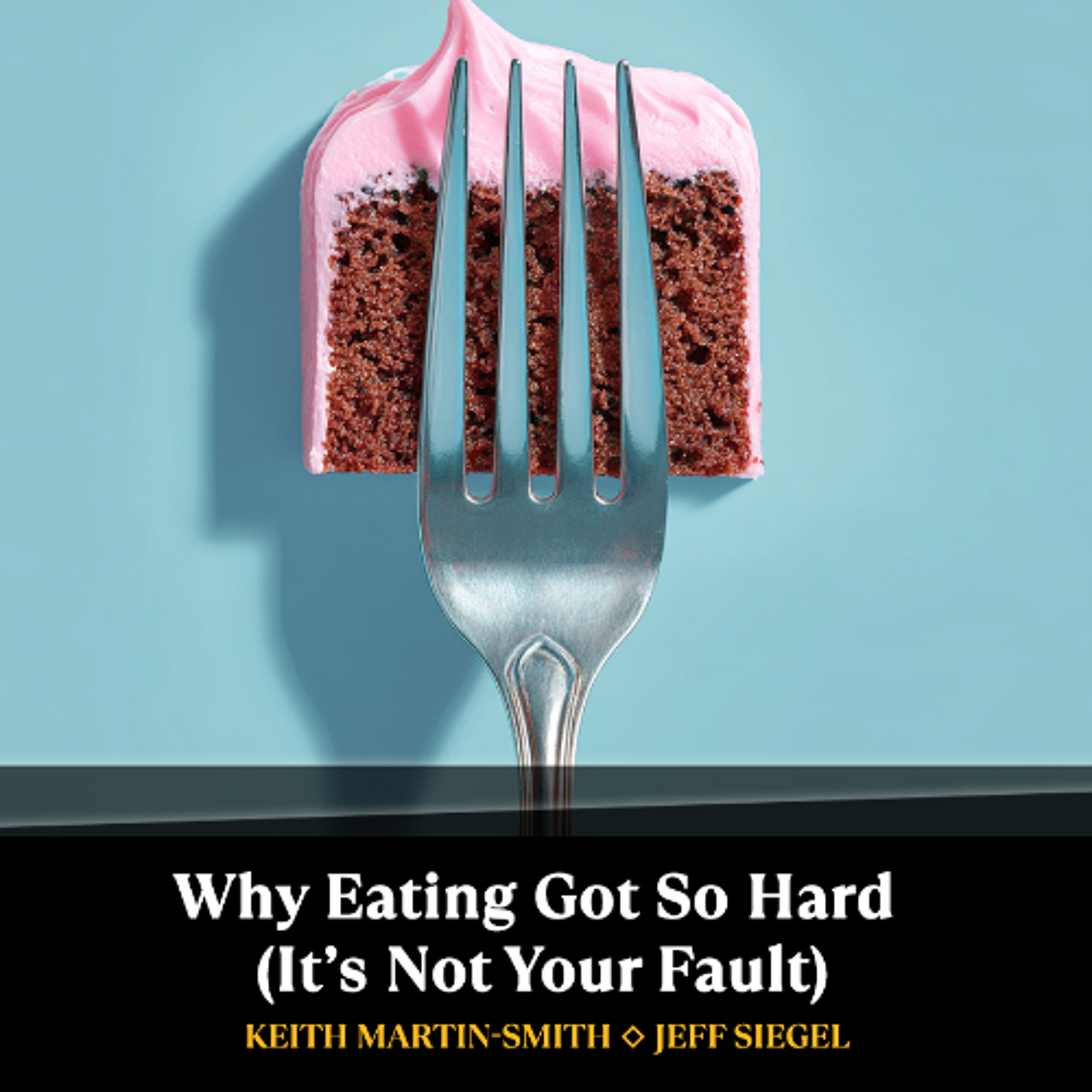
Why Eating Got So Hard (It’s Not Your Fault) episode artwork

EPISODE · Jan 30, 2026 · 1H 14M

Why Eating Got So Hard (It’s Not Your Fault)

from Everyone Is Right · host Integral Life

This episode explores what it means to eat sanely and joyfully in an age of ultra-processed food, GLP-1 drugs, and endless conflicting nutrition advice — through the lens of Jeff Siegel’s “Eating 2.0” and Integral theory. Jeff begins with his own origin story: as a teenager he developed severe anorexia, dropping to a dangerously low weight while locked in a “civil war” between his mind and body. That crisis sent him on a long journey through neuroscience, behavioral biology, Eastern philosophy, and eventually Integral theory as he tried to understand what had gone so wrong in his relationship with food—and how to help others avoid the same fate. Out of this comes a view of eating that is biological and psychological, personal and cultural, individual and systemic all at once. Using the four-quadrant map (inner/outer, individual/collective), Jeff and Keith reframe eating as a fundamentally integral affair. There’s the chemistry of food and metabolism (UR), our inner stories and emotions around eating and body image (UL), the cultures and microcultures that tell us what’s “normal” or desirable (LL), and the wider food system of industrial agriculture, subsidies, marketing, and access (LR). Any real change, they argue, has to acknowledge all four, rather than reducing the problem to “just your macros,” “just diet culture,” or “just Big Food.” At the heart of the conversation is Jeff’s “inner eaters” model: a cast of five parts—Survival, Pleasure, Social, Strategic, and Ecological eaters—each corresponding to different developmental needs and values. The survival eater wants basic nourishment and regulation; the pleasure eater craves enjoyment and immediacy; the social eater longs for belonging and ritual; the strategic eater optimizes for performance and control; and the ecological eater cares about ethics, animals, and the planet. Most of us over-identify with one or two of these and pathologize the rest, which leads to predictable distortions—rigidity, bingeing, moralizing, or burnout. Integral eating means recognizing who’s “holding the fork” in any given moment and learning to coordinate these voices under a wiser inner leadership. The episode then locates these inner dynamics inside what Jeff calls “Food 2.0”: a radically novel, engineered food environment built to be irresistible, effortless, and endless. Ultra-processed products, omnipresent snacking, and algorithmic food media are not neutral—they are designed to capture our pleasure eater and overwhelm our survival eater’s signals. Against this backdrop, the usual moralizing about “willpower” looks naïve. Instead, Jeff emphasizes designing environments, habits, and inner agreements that make it easier to stay centered in a world of superabundance. GLP-1 drugs (Ozempic, Wegovy, etc.) enter as both a genuine breakthrough and a test of our maturity. For some, these medications finally quiet a lifetime of intrusive food noise; for others, they risk becoming another one-dimensional fix that ignores deeper psychological, cultural, and systemic factors. Jeff walks through how GLP-1s interact with each inner eater, and argues that the real opportunity is to use the pharmacological breathing room to re-educate taste, renegotiate social patterns, and embed tech within a broader upgrade in sleep, stress, movement, and meaning—rather than outsourcing the entire project of eating to pharma.

This episode explores what it means to eat sanely and joyfully in an age of ultra-processed food, GLP-1 drugs, and endless conflicting nutrition advice — through the lens of Jeff Siegel’s “Eating 2.0” and Integral theory. Jeff begins with his own origin story: as a teenager he developed severe anorexia, dropping to a dangerously low weight while locked in a “civil war” between his mind and body. That crisis sent him on a long journey through neuroscience, behavioral biology, Eastern philosophy, and eventually Integral theory as he tried to understand what had gone so wrong in his relationship with food—and how to help others avoid the same fate. Out of this comes a view of eating that is biological and psychological, personal and cultural, individual and systemic all at once. Using the four-quadrant map (inner/outer, individual/collective), Jeff and Keith reframe eating as a fundamentally integral affair. There’s the chemistry of food and metabolism (UR), our inner stories and emotions around eating and body image (UL), the cultures and microcultures that tell us what’s “normal” or desirable (LL), and the wider food system of industrial agriculture, subsidies, marketing, and access (LR). Any real change, they argue, has to acknowledge all four, rather than reducing the problem to “just your macros,” “just diet culture,” or “just Big Food.” At the heart of the conversation is Jeff’s “inner eaters” model: a cast of five parts—Survival, Pleasure, Social, Strategic, and Ecological eaters—each corresponding to different developmental needs and values. The survival eater wants basic nourishment and regulation; the pleasure eater craves enjoyment and immediacy; the social eater longs for belonging and ritual; the strategic eater optimizes for performance and control; and the ecological eater cares about ethics, animals, and the planet. Most of us over-identify with one or two of these and pathologize the rest, which leads to predictable distortions—rigidity, bingeing, moralizing, or burnout. Integral eating means recognizing who’s “holding the fork” in any given moment and learning to coordinate these voices under a wiser inner leadership. The episode then locates these inner dynamics inside what Jeff calls “Food 2.0”: a radically novel, engineered food environment built to be irresistible, effortless, and endless. Ultra-processed products, omnipresent snacking, and algorithmic food media are not neutral—they are designed to capture our pleasure eater and overwhelm our survival eater’s signals. Against this backdrop, the usual moralizing about “willpower” looks naïve. Instead, Jeff emphasizes designing environments, habits, and inner agreements that make it easier to stay centered in a world of superabundance. GLP-1 drugs (Ozempic, Wegovy, etc.) enter as both a genuine breakthrough and a test of our maturity. For some, these medications finally quiet a lifetime of intrusive food noise; for others, they risk becoming another one-dimensional fix that ignores deeper psychological, cultural, and systemic factors. Jeff walks through how GLP-1s interact with each inner eater, and argues that the real opportunity is to use the pharmacological breathing room to re-educate taste, renegotiate social patterns, and embed tech within a broader upgrade in sleep, stress, movement, and meaning—rather than outsourcing the entire project of eating to pharma.

NOW PLAYING

Why Eating Got So Hard (It’s Not Your Fault)

0:00 1:14:59

No transcript for this episode yet

We transcribe on demand. Request one and we'll notify you when it's ready — usually under 10 minutes.

MG Show MG Show The MG Show, hosted by Jeffrey Pedersen and Shannon Townsend, is a leading alternative media platform dedicated to uncovering the truth behind today’s most pressing political issues. Launched in 2019, the show has grown exponentially, offering unfiltered insights, comprehensive research, and real-time analysis. With a commitment to independent journalism and factual integrity, the MG Show empowers its audience with knowledge and encourages active participation in the political discourse. Breaking News Show | eTurboNews Juergen Thomas Steinmetz News is relevant to the global travel and tourism industry, human rights and global issues.Breaking news when it happens and only from the source. Eat to Live Jenna Fuhrman, Dr. Fuhrman Our health is our most precious gift and smart nutrition can change your life. Each month, join Dr. Fuhrman and his daughter, Jenna Fuhrman as they discuss important topics in the world of nutrition. Eat to Live will change the way you eat and think about food. That Hoarder: Overcome Compulsive Hoarding That Hoarder Hoarding disorder is stigmatised and people who hoard feel vast amounts of shame. This podcast began life as an audio diary, an anonymous outlet for somebody with this weird condition. That Hoarder speaks about her experiences living with compulsive hoarding, she interviews therapists, academics, researchers, children of hoarders, professional organisers and influencers, and she shares insight and tips for others with the problem. Listened to by people who hoard as well as those who love them and those who work with them, Overcome Compulsive Hoarding with That Hoarder aims to shatter the stigma, share the truth and speak openly and honestly to improve lives.

Frequently Asked Questions

How long is this episode of Everyone Is Right?

This episode is 1 hour and 14 minutes long.

When was this Everyone Is Right episode published?

This episode was published on January 30, 2026.

What is this episode about?

This episode explores what it means to eat sanely and joyfully in an age of ultra-processed food, GLP-1 drugs, and endless conflicting nutrition advice — through the lens of Jeff Siegel’s “Eating 2.0” and Integral theory. Jeff begins with his own...

Can I download this Everyone Is Right episode?

Yes, you can download this episode by clicking the download button on the episode player, or subscribe to the podcast in your preferred podcast app for automatic downloads.
URL copied to clipboard!