
EPISODE · Oct 1, 2026 · 15 MIN
Why LinkedIn Networking Fails Working Professionals
from The Innovation Attorney Podcast · host The Innovation Attorney
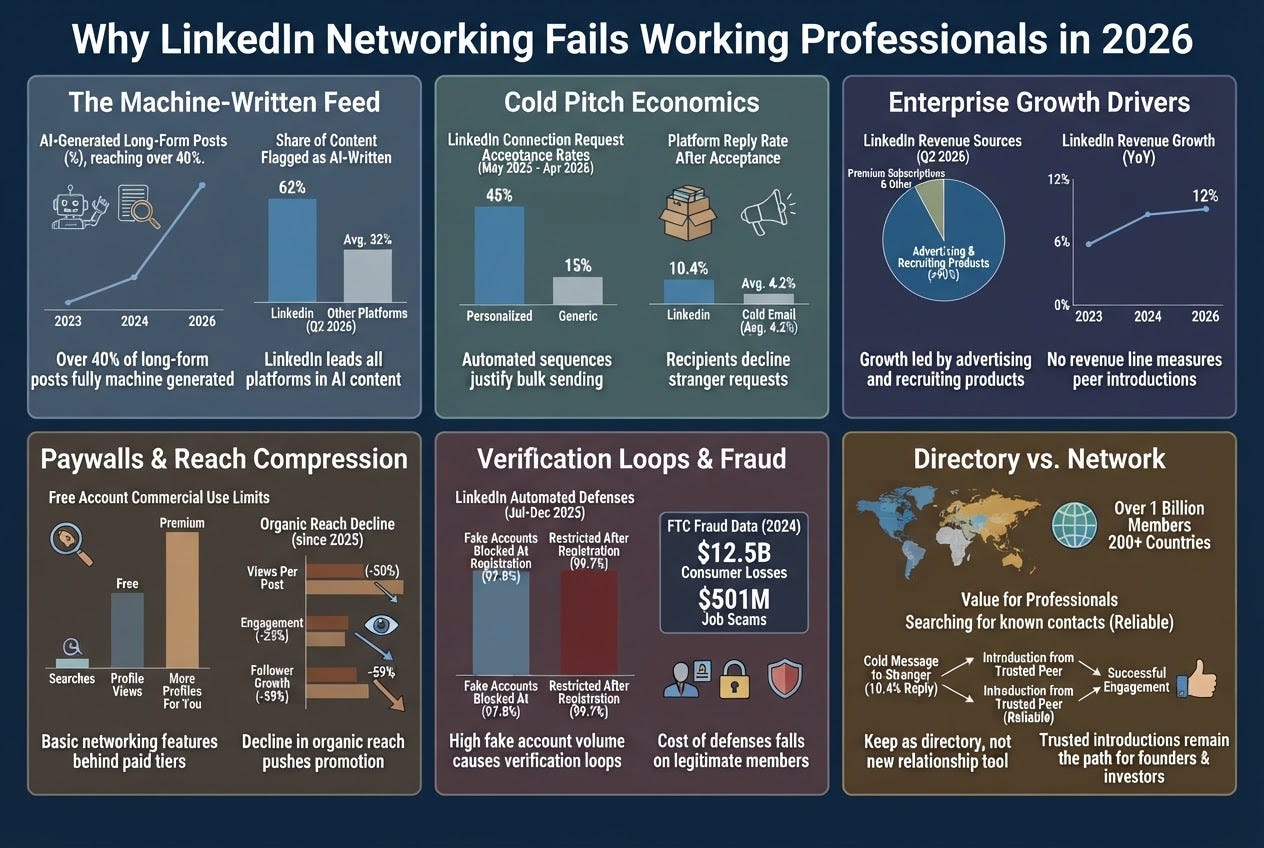
LinkedIn networking in 2026 fails working professionals because over 40 percent of long posts are machine generated, cold pitches fill inboxes, and Microsoft’s growth is led by advertising. A July 2026 analysis of 1,002,627 posts found that LinkedIn supplied about one third of the content scanned and 62 percent of everything flagged as AI written. Outreach data covering 13.2 million connection requests shows that 28 to 30 percent are accepted and that 10.4 percent of messages sent after acceptance receive a reply. LinkedIn’s parent company reported 12 percent revenue growth for the quarter ended June 30, 2026. This report examines ten reasons professionals give for abandoning LinkedIn as a networking tool: engagement bait, AI generated content, automated sales pitches, paid feature limits, humblebragging, message filters, an algorithm that favors frequency, identity verification loops, member lock in, and the weight of advertising and recruiting products in the business. Verified figures support the findings on AI content, outreach results, humblebragging, fraud, and revenue. The findings on message filters, reach changes, and verification burdens rest on practitioner reports, and the report labels each one that way. LinkedIn keeps a place as a directory for checking people already met or introduced. Founders and investors seeking new relationships will find that introductions from people who know their work remain the reliable path. Detailed Findings Why do engagement bait posts dominate the LinkedIn feed? Engagement bait dominates the feed because LinkedIn’s distribution rewards early reactions and comments, so authors write to produce them. Practitioner analyses of the ranking system describe the first 60 to 90 minutes after posting as the period that decides how far a post travels, and they describe dwell time as a weighted input. That mechanism pays an author for a poll that asks the reader to agree, or for an instruction to comment a single word in exchange for a guide delivered by direct message. LinkedIn changed its ranking in 2025 to suppress engagement pods and generic comments, according to the same analyses, and a large language model began matching posts to member interests in August 2025. The reward for writing to the metric remained. A founder who wants a peer with experience in a Delaware preferred stock financing finds motivational stories ahead of that peer’s work. LinkedIn has not published its ranking weights, so every description of them comes from practitioners who test posts and compare results. How much LinkedIn content is AI generated, and why does it matter? Over 40 percent of long form LinkedIn posts in spring 2026 were classified as fully machine generated, roughly double the average across the other platforms examined. The analysis covered 1,002,627 posts of more than 50 words collected from April 24 through June 30, 2026, and it defined long form as posts above 250 words. LinkedIn represented about one third of the scanned content and 62 percent of the material flagged as AI written. An earlier analysis of 8,795 public posts from January 2018 through October 2024 estimated that more than 54 percent of long English posts were likely AI written, and it found a 189 percent jump at the start of 2023, after the late 2022 release of ChatGPT. The two figures differ because the detectors and the definitions differ: one counted posts likely written by AI, and the other counted posts classified as fully machine generated. Both place the share near half. The 2026 analysis points to LinkedIn’s own Enhance Post feature and Microsoft Copilot integration, which place machine writing inside the composer. When any member can produce a polished 300 word analysis in seconds, polish stops indicating knowledge. A reader must spend time to learn whether the author has done the work, and most readers decline to spend it. Why do cold sales pitches fill the LinkedIn inbox? Cold pitches fill the inbox because automated sequences return enough replies to justify sending them in bulk. An analysis of 13.2 million connection requests sent from May 2025 through April 2026 found a 28 to 30 percent acceptance rate, about 45 percent for personalized requests and about 15 percent for generic ones, and a 10.4 percent reply rate to messages sent after acceptance. Cold email replies in the same comparison ran from 3.4 to 5.1 percent, so a sender gains by choosing LinkedIn. LinkedIn caps connection requests at roughly 100 to 200 per week per account, which sets the ceiling each sender faces. Recipients learn the pattern. A new connection that arrives with a pitch within hours teaches the recipient to decline requests from strangers, which shrinks the pool of reachable people for every sender, including those with a real reason to connect. This is the report’s analysis of the incentive. No audited figure exists for the share of accepted requests followed by an automated message. Does LinkedIn place basic networking features behind paid subscriptions? Yes. LinkedIn limits searches and profile views on free accounts and sells higher limits through paid tiers. The limit, called the commercial use limit, counts searches and profile views from sources such as the “More profiles for you” section and the People tab of a company page, and it does not count name searches or views of first degree connections. These details come from user reports compiled in October 2025, and this research located no LinkedIn document that states them. Price guides list individual paid tiers from about $40 per month for a career tier to about $170 per month for a recruiter tier, with annual billing lowering the cost by roughly 20 to 25 percent. Prices vary by guide and region. Reach shows the same pressure. One practitioner analysis reports that views per post fell about 50 percent, engagement about 25 percent, and follower growth about 59 percent. LinkedIn has published no reach figures to confirm those numbers, and the report treats them as an indicator of direction. A decline in organic reach gives a brand a reason to buy promotion, and that is the interaction between the free feed and the paid products. Why do corporate conformity and humblebragging erode trust on LinkedIn? Peer reviewed research published in 2018 found that humblebraggers are liked less and judged less competent than people who brag directly. The research, published in a peer reviewed psychology journal, tested the behavior across several studies, including a field experiment in which people complied with requests less often when the requester humblebragged. Perceived insincerity explained the result: readers treat a disguised brag as a misstatement of the author’s motive. The feed format supplies the behavior in volume: the announcement framed as gratitude and the credential framed as a lesson. A reader looking for a candid peer finds posts that the research predicts will lower the author’s standing with that very reader. The study examined individual interactions, so the link to the platform is the report’s inference from the format. Do LinkedIn’s communication filters block legitimate outreach? LinkedIn publishes no list of the rules that trigger a message or connection restriction, which leaves a legitimate sender unable to predict what will be blocked. The verified fact is the weekly cap of roughly 100 to 200 connection requests per account, reported by outreach vendors. Claims that words such as “opportunity” or “partnership” trigger restrictions could not be confirmed in any public LinkedIn documentation, and this report treats them as unverified. The evidence here is the weakest in the report. An attorney who writes a first message to a prospective client has no way to learn the filter’s thresholds before sending, and has no public statistic on how many restrictions are lifted after review. Does LinkedIn’s algorithm reward expertise or posting frequency? No published evidence shows that LinkedIn’s ranking rewards technical depth over posting frequency, and the inputs practitioners describe favor early engagement and consistency. They describe consistent niche focus as a rewarded behavior since the August 2025 model change, and they describe weak performance in the first hour as a trigger for reduced distribution. A careful analysis of a Section 409A valuation or an export license determination draws fewer quick reactions than a personal story. Under those inputs, the specialist’s post stops circulating first. This is the report’s analysis of the described inputs, and it remains untested because LinkedIn has not disclosed the weights. Why do LinkedIn members face identity verification loops and lockouts? LinkedIn imposes verification and restrictions because fake account volume is high. Its automated defenses stopped 97.8 percent of the fake accounts it blocked from July through December 2025, and 99.7 percent were stopped before any member report. In the first half of 2022, LinkedIn stopped 16.4 million fake accounts at registration, restricted 5.4 million after registration but before any member report, and restricted 190,000 after member reports. The harm those accounts cause is documented elsewhere. The Federal Trade Commission reported that consumers lost more than $12.5 billion to fraud in 2024, a 25 percent increase from 2023, including $501 million to job and employment agency scams, with reports in that category tripling from 2020 to 2024. The Commission’s release does not attribute those losses to LinkedIn and names email as the most common contact method. The cost of the defenses falls on legitimate members. Practitioners describe repeated verification requests, sudden lockouts, and difficulty reaching a person at support. LinkedIn publishes no count of wrongly restricted accounts, so the size of that cost cannot be measured from public data. Why do professionals stay on LinkedIn when they dislike it? Professionals stay because recruiters, clients, and counterparties search there. LinkedIn states that it has more than 1 billion members in more than 200 countries and territories, and absence from a directory of that size has a cost that an individual cannot offset alone. This is a network effect, and it is the report’s analysis. This research located no survey that measures how many members dislike the platform and remain on it. A member base that stays regardless of feed quality gives the owner room to place revenue products ahead of member experience, as the figures in the next section show. Has LinkedIn shifted from peer networking to B2B advertising and recruiting products? LinkedIn’s growth is reported through advertising, recruiting, subscription, and sales products, and no line in the reporting measures peer introductions. For the quarter ended June 30, 2026, LinkedIn revenue rose 12 percent, or 10 percent in constant currency. LinkedIn sits inside Microsoft’s Productivity and Business Processes segment, which produced $37.8 billion in revenue, up 14 percent, on total Microsoft revenue of $90.0 billion, up 18 percent. A trade report identified advertising as the primary driver of LinkedIn’s growth. Microsoft did not disclose separate figures for advertising, recruiting products, premium subscriptions, or sales tools. A business that grows 12 percent by selling reach to advertisers and search to recruiters measures success by those products. Peer introductions appear nowhere among the revenue lines. Where does LinkedIn still deliver value to professionals? LinkedIn still works as a directory for verifying people a professional has already met or been introduced to. A profile confirms an employer and a work history in a minute, and more than 1 billion members means nearly any counterparty appears there. In my own practice, a review of a profile is the first step I take before a first call with an unfamiliar founder or investor, and the introductions that become engagements arrive through a former client or another lawyer who knows my work. I cannot point to an engagement that began as a cold message on the platform. That pattern matches the outreach data above: a 10.4 percent reply rate rewards the sender who messages thousands of strangers, and a lawyer who accepts referrals from people with a reputation to protect never needs to join that contest. What laws and regulations apply to conduct on networking platforms? Several federal rules reach the conduct described in this report, and none of them regulate the quality of a feed. Section 5 of the Federal Trade Commission Act, 15 U.S.C. § 45, prohibits unfair or deceptive acts or practices and supports Commission action against deceptive recruiting schemes. The Commission’s Trade Regulation Rule on Impersonation of Government and Businesses, 16 C.F.R. Part 461, in force since April 1, 2024, prohibits impersonating a business, which reaches a fake recruiter who claims to represent a named company. The CAN-SPAM Act of 2003, 15 U.S.C. § 7701 and following sections, regulates commercial email, and its definitions in 15 U.S.C. § 7702 refer to email addresses, so a message sent inside a platform inbox does not fall plainly within its text. The Ninth Circuit held in hiQ Labs, Inc. v. LinkedIn Corp., 31 F.4th 1180 (9th Cir. 2022), that the Computer Fraud and Abuse Act likely does not bar scraping of public profile data, and the dispute ended later in 2022 with judgment for LinkedIn on its contract claims. No statute requires LinkedIn to preserve organic reach or to publish its ranking weights. Open Questions What share of accepted connection requests receives an automated pitch within 24 hours? No audited figure exists, and the answer determines how much of the inbox problem comes from automation as opposed to individual salespeople. What triggers LinkedIn’s message and connection restrictions, and how often are they wrong? The platform has published no thresholds and no reversal rate, which leaves attorneys and other professionals who write first messages for a living without a basis for compliance. Will LinkedIn’s built in writing tools raise the machine written share above the 40 percent measured in spring 2026? The tools sit inside the composer, and LinkedIn also tries to suppress machine written content, so the two efforts work against each other. How far will advertising growth reduce organic reach? LinkedIn has published no reach figures, and the 50 percent decline in views comes from practitioner analysis alone. Do verification requirements reduce losses to fake recruiters? The Federal Trade Commission does not report losses by platform, so the effect of LinkedIn’s defenses on member losses cannot be measured. My next report examines the contract and privacy terms that govern what LinkedIn may do with member data to train its AI models, including the opt out mechanics in each jurisdiction and the questions a general counsel should ask before a company page posts anything proprietary. Source List 1. LinkedIn Corporation, “Our Community Report,” LinkedIn Transparency Center, https://about.linkedin.com/transparency/community-report. Reporting period July through December 2025. Supplies the 97.8 percent and 99.7 percent fake account figures and the 2022 registration blocking counts. 2. Microsoft Corporation, “FY26 Q4 Press Release and Webcast,” Investor Relations, https://www.microsoft.com/en-us/investor/earnings/fy-2026-q4/press-release-webcast. July 29, 2026. Supplies the 12 percent LinkedIn revenue growth and the segment and company revenue totals. 3. LinkedIn Corporation, “About LinkedIn,” https://about.linkedin.com/. Accessed September 30, 2026. Source of LinkedIn’s statement of more than 1 billion members in more than 200 countries and territories. 4. Federal Trade Commission, “New FTC Data Show a Big Jump in Reported Losses to Fraud to $12.5 Billion in 2024,” press release, https://www.ftc.gov/news-events/news/press-releases/2025/03/new-ftc-data-show-big-jump-reported-losses-fraud-125-billion-2024. March 2025. Supplies the $12.5 billion fraud total and the $501 million job and employment agency scam figure. 5. Federal Trade Commission, Trade Regulation Rule on Impersonation of Government and Businesses, 16 C.F.R. Part 461, https://www.federalregister.gov/documents/2024/03/01/2024-04335/trade-regulation-rule-on-impersonation-of-government-and-businesses. March 1, 2024. Primary text of the rule that reaches fake recruiters who claim to represent a business. 6. hiQ Labs, Inc. v. LinkedIn Corp., 31 F.4th 1180 (9th Cir. 2022), https://www.eff.org/cases/hiq-v-linkedin. April 18, 2022. Controlling Ninth Circuit authority on scraping of public profile data under the Computer Fraud and Abuse Act. 7. Sezer, Ovul, Francesca Gino, and Michael I. Norton, “Humblebragging: A Distinct and Ineffective Self Presentation Strategy,” Journal of Personality and Social Psychology, https://www.hbs.edu/faculty/Pages/item.aspx?num=52825. 2018. Peer reviewed finding that humblebraggers are liked less and judged less competent than direct braggers. 8. Tech Times, “LinkedIn Leads All Platforms in AI Written Posts, Study of a Million Feeds Confirms,” reporting an analysis by Pangram Labs, https://www.techtimes.com/articles/320534/20260715/linkedin-leads-all-platforms-ai-written-posts-study-million-feeds-confirms.htm. July 15, 2026. Supplies the 1,002,627 post sample, the 40 percent figure, and the 62 percent share of flagged material. 9. eWeek, “Study Reveals Over 50% of LinkedIn Posts Now Machine Generated,” reporting an analysis by Originality.ai, https://www.eweek.com/news/ai-generated-posts-flood-linkedin/. November 2024. Supplies the 8,795 post sample, the 54 percent estimate, and the 189 percent jump at the start of 2023. 10. Overloop, “LinkedIn Outreach Benchmarks 2026: Acceptance and Reply Rates,” summarizing a dataset from Expandi, https://overloop.com/blog/linkedin-outreach-benchmarks. 2026. Supplies the 13.2 million request dataset, the acceptance rates, and the 10.4 percent reply rate. 11. PhantomBuster, “LinkedIn Commercial Use Limit,” https://phantombuster.com/blog/social-selling/linkedin-commercial-use-limit/. October 2025 user reports. Describes what counts toward the commercial use limit on free accounts. 12. LA Growth Machine, “LinkedIn Premium Cost 2026: All Plans Explained,” https://lagrowthmachine.com/linkedin-premium-cost/. 2026. Lists published monthly prices for individual paid tiers and the annual billing discount. 13. Cook, Jodie, “9 Recent LinkedIn Changes Affecting Your Reach Right Now,” Forbes, https://www.forbes.com/sites/jodiecook/2026/05/06/9-recent-linkedin-changes-affecting-your-reach-right-now/. May 6, 2026. Practitioner description of ranking changes in 2025 and 2026 and reported reach declines. 14. Ivris Tech, “LinkedIn Revenue Rises 12%, Led by Marketing Solutions,” https://ivristech.com/linkedin-revenue-growth-2026/. July 2026. Trade report identifying advertising as the primary driver and noting that no separate figure was disclosed. Bibliography Cook, Jodie. “9 Recent LinkedIn Changes Affecting Your Reach Right Now.” Forbes, May 6, 2026. https://www.forbes.com/sites/jodiecook/2026/05/06/9-recent-linkedin-changes-affecting-your-reach-right-now/. Federal Trade Commission. “New FTC Data Show a Big Jump in Reported Losses to Fraud to $12.5 Billion in 2024.” Press release, March 2025. https://www.ftc.gov/news-events/news/press-releases/2025/03/new-ftc-data-show-big-jump-reported-losses-fraud-125-billion-2024. Federal Trade Commission. Trade Regulation Rule on Impersonation of Government and Businesses. 16 C.F.R. Part 461. Federal Register, vol. 89, no. 42, March 1, 2024. https://www.federalregister.gov/documents/2024/03/01/2024-04335/trade-regulation-rule-on-impersonation-of-government-and-businesses. hiQ Labs, Inc. v. LinkedIn Corp. 31 F.4th 1180 (9th Cir. 2022). https://www.eff.org/cases/hiq-v-linkedin. Ivris Tech. “LinkedIn Revenue Rises 12%, Led by Marketing Solutions.” July 2026. https://ivristech.com/linkedin-revenue-growth-2026/. LA Growth Machine. “LinkedIn Premium Cost 2026: All Plans Explained.” 2026. https://lagrowthmachine.com/linkedin-premium-cost/. LinkedIn Corporation. “Our Community Report.” LinkedIn Transparency Center. Accessed September 30, 2026. https://about.linkedin.com/transparency/community-report. LinkedIn Corporation. “About LinkedIn.” Accessed September 30, 2026. https://about.linkedin.com/. Microsoft Corporation. “FY26 Q4 Press Release and Webcast.” Investor Relations. July 29, 2026. https://www.microsoft.com/en-us/investor/earnings/fy-2026-q4/press-release-webcast. eWeek. “Study Reveals Over 50% of LinkedIn Posts Now Machine Generated.” November 2024. https://www.eweek.com/news/ai-generated-posts-flood-linkedin/. Overloop. “LinkedIn Outreach Benchmarks 2026: Acceptance and Reply Rates.” 2026. https://overloop.com/blog/linkedin-outreach-benchmarks. Tech Times. “LinkedIn Leads All Platforms in AI Written Posts, Study of a Million Feeds Confirms.” July 15, 2026. https://www.techtimes.com/articles/320534/20260715/linkedin-leads-all-platforms-ai-written-posts-study-million-feeds-confirms.htm. PhantomBuster. “LinkedIn Commercial Use Limit.” Based on user reports from October 2025. https://phantombuster.com/blog/social-selling/linkedin-commercial-use-limit/. Sezer, Ovul, Francesca Gino, and Michael I. Norton. “Humblebragging: A Distinct and Ineffective Self Presentation Strategy.” Journal of Personality and Social Psychology 114, no. 1 (2018). https://www.hbs.edu/faculty/Pages/item.aspx?num=52825. Interested in analysis about the intersection of tech, policy and the law? Check out my Substack channel. https://theinnovationattorney.substack.com/ This is a public episode. If you'd like to discuss this with other subscribers or get access to bonus episodes, visit theinnovationattorney.substack.com/subscribe
Embed this episode
Ready to play
Why LinkedIn Networking Fails Working Professionals
No transcript for this episode yet
Similar Episodes
No similar episodes found.
Similar Podcasts
No similar podcasts found.