
EPISODE · Aug 12, 2026 · 1 MIN
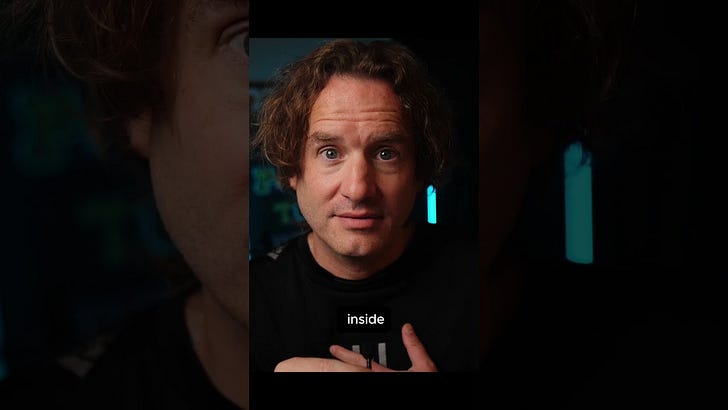
Why MAGA Lose Their Minds Over Facts
from The Lucas Bean Show · host Lucas Bean
You have been in this argument before.You came prepared. You had the sources. You had the data. You had the court documents, the direct quotes, the video evidence. You laid it all out clearly, calmly, step by step.And the person you were talking to looked at everything you presented and said fake news.Not because your evidence was weak. Not because your argument had a flaw. Not because they had better information.Because their brain physically would not let them hear you.That is not a metaphor. A neuroscientist put people in a brain scanner and proved it.The Brain Scanner StudyIn 2016, neuroscientist Jonas Kaplan at the University of Southern California’s Brain and Creativity Institute published a study that fundamentally changed how we understand political disagreement. The study was published in the journal Scientific Reports by Nature.Kaplan and his colleagues put 40 participants inside a functional MRI scanner. Then they challenged those participants’ beliefs with counter-evidence. But they did it in two categories. They challenged political beliefs and they challenged non-political beliefs.When they challenged non-political beliefs, the brain did what a healthy brain is supposed to do. It processed the new information. It updated. Participants adjusted their positions. The system worked.When they challenged political beliefs, something completely different happened.The brain activated the default mode network.The default mode network is a set of interconnected structures in the brain associated with self-representation. It is the part of the brain that processes who you are. Your identity. Your sense of self. Your ego.The brain did not process the political challenge as new information. It processed it as an attack on the self.Kaplan described it this way. Political beliefs are like religious beliefs. Both are part of who you are and important for the social circle to which you belong. To consider an alternative view, you would have to consider an alternative version of yourself.Read that again. The brain does not treat a political challenge as a factual dispute. It treats it as an existential threat. A challenge to a political belief does not activate the reasoning centers of the brain. It activates the identity centers.The Fear ResponseThe study did not stop there. Kaplan and his team also measured which specific brain regions showed the most activity in the participants who were most resistant to changing their minds.Two areas lit up the most. The amygdala and the insular cortex.The amygdala is the brain’s threat detection center. It processes fear, anxiety, and the fight-or-flight response. It is the part of the brain that tells you a predator is nearby. It is the alarm system that evolved to keep you alive.The insular cortex processes feelings from the body and is critical for detecting emotional significance. It helps the brain determine whether something matters enough to react to.Together, these two regions tell the same story. The brain of a person whose political beliefs are being challenged with facts is experiencing the same neurological response as a person who is facing a physical threat. The fear and disgust centers of the brain are firing. The body is responding as if it is in danger.Their brain literally treated a fact as a threat to their survival.This is why presenting evidence to a Trump supporter does not lead to a productive conversation. You think you are sharing information. Their brain thinks you are trying to destroy them. The evidence never reaches the part of the brain that evaluates evidence. The threat response intercepts it first.The Backfire EffectIn 2010, political scientists Brendan Nyhan at Dartmouth and Jason Reifler at the University of Exeter published research that identified a pattern consistent with what Kaplan later found in the brain scanner.They tested what happens when you give people factual corrections to political misinformation they already believe. In several of their experiments, they found something that should have been impossible. The correction did not just fail to change people’s minds. It made the misperception stronger.Nyhan and Reifler called this the backfire effect. Presenting counter-evidence to a strongly held political belief does not reduce the belief. It reinforces it.To be clear about the full picture: later replication studies found the backfire effect is not as universal as originally reported. Nyhan himself has acknowledged this. In many cases, factual corrections do improve accuracy. The backfire effect appears to be strongest when the belief being challenged is deeply tied to a person’s identity and group membership.Which brings us back to Kaplan’s brain scanner. The backfire effect may not happen every time. But the neurological mechanism Kaplan documented always happens. When a political belief is challenged, the default mode network activates. The brain treats the challenge as an identity threat. Whether that threat causes the person to dig in deeper or simply ignore the information, the result is the same. The evidence does not get processed on its merits.Identity-Protective CognitionThe mechanism Kaplan found in the brain scanner has a name in the psychology literature. Dan Kahan, professor of law and psychology at Yale University, has spent years studying it.Kahan calls it identity-protective cognition. The tendency of individuals to unconsciously dismiss evidence that does not reflect the beliefs that predominate in their group.But Kahan’s most important finding is the one that breaks everyone’s assumption about how this works. Most people believe that education and intelligence protect against this effect. That smarter people are more likely to follow the evidence wherever it leads.The opposite is true.Kahan’s research shows that the most scientifically literate, most cognitively proficient people are the most polarized. Not the least. Intelligence does not protect against identity-protective cognition. Intelligence makes it worse. Because smarter people are better at finding sophisticated reasons to dismiss evidence that threatens their identity.This means you cannot fix this problem with education. You cannot fix it with better arguments. You cannot fix it with more data. The problem is not a lack of information. The problem is that the brain has a built-in defense system that prioritizes identity over accuracy. And the smarter the person, the more effective that defense system becomes.The Echo Chamber Feedback LoopNow layer Kaplan’s finding on top of the media environment that most conservatives live inside.Every single day, Fox News, Newsmax, Truth Social, and right-wing podcasts reinforce the same political identities. The same group boundaries. The same us-versus-them framework. Every day, the identity gets stronger. Every day, the default mode network’s association between political belief and personal identity gets reinforced.Kaplan’s study showed what happens in a single moment when a political belief is challenged. But that single moment is happening inside a brain that has been soaking in identity-reinforcing media for years. The political belief is no longer just an opinion the person holds. It is fused into their sense of self. It is woven into their relationships, their social media feeds, their daily rituals, their vocabulary.At that point, the brain cannot tell the difference between “you are wrong about immigration” and “you are worthless.” Both register as attacks on the self. Both trigger the amygdala. Both activate the default mode network. Both get shut down before they ever reach the reasoning centers of the brain.This is what Kaplan meant when he said that to consider an alternative political view, a person would have to consider an alternative version of themselves. For a Trump supporter whose entire social world, entire information diet, and entire sense of purpose is organized around MAGA, considering an alternative view does not mean changing a policy position. It means dismantling who they are.The brain will not allow that. It will protect the identity at all costs. Even at the cost of reality.What This Actually MeansThis research does not mean that Trump supporters are biologically incapable of changing their minds. It means the conditions required for change are far more extreme than most people realize.Facts alone will never do it. The brain has already classified facts as threats. Better arguments will never do it. The identity defense system is specifically designed to neutralize arguments. Even firsthand experience may not do it, because identity-protective cognition can override what a person sees with their own eyes.The only thing that consistently breaks through is the collapse of the social structure that maintains the identity. When the group falls apart. When the media ecosystem loses credibility. When the leader fails so visibly that the identity becomes more painful to maintain than to abandon.That is not a conversation. That is a rupture.And until that rupture happens, you are not arguing with a person. You are arguing with a brain that has already decided, before you opened your mouth, that everything you are about to say is a threat to its survival.That is not a political party. That is a neurological hostage situation.SourcesKaplan, J. T., Gimbel, S. I., & Harris, S. (2016). Neural Correlates of Maintaining One’s Political Beliefs in the Face of Counterevidence. Scientific Reports, 6, 39589.Nyhan, B., & Reifler, J. (2010). When Corrections Fail: The Persistence of Political Misperceptions. Political Behavior, 32(2), 303-330.Nyhan, B. (2020). Why the Backfire Effect Does Not Explain the Durability of Political Misperceptions. Proceedings of the National Academy of Sciences, 117(24), 13549-13556.Kahan, D. M. (2017). Misconceptions, Misinformation, and the Logic of Identity-Protective Cognition. Yale Law School, Public Law Research Paper No. 605.Kahan, D. M., Peters, E., Dawson, E. C., & Slovic, P. (2017). Motivated Numeracy and Enlightened Self-Government. Behavioural Public Policy, 1(1), 54-86.Kahan, D. M., Braman, D., Slovic, P., Gastil, J., & Mertz, C. K. (2007). Culture and Identity-Protective Cognition: Explaining the White Male Effect in Risk Perception. Journal of Empirical Legal Studies, 4(3), 465-505. This is a public episode. If you'd like to discuss this with other subscribers or get access to bonus episodes, visit lucasbean.substack.com/subscribe
Embed this episode
Ready to play
Why MAGA Lose Their Minds Over Facts
No transcript for this episode yet
Similar Episodes
No similar episodes found.
Similar Podcasts
No similar podcasts found.