
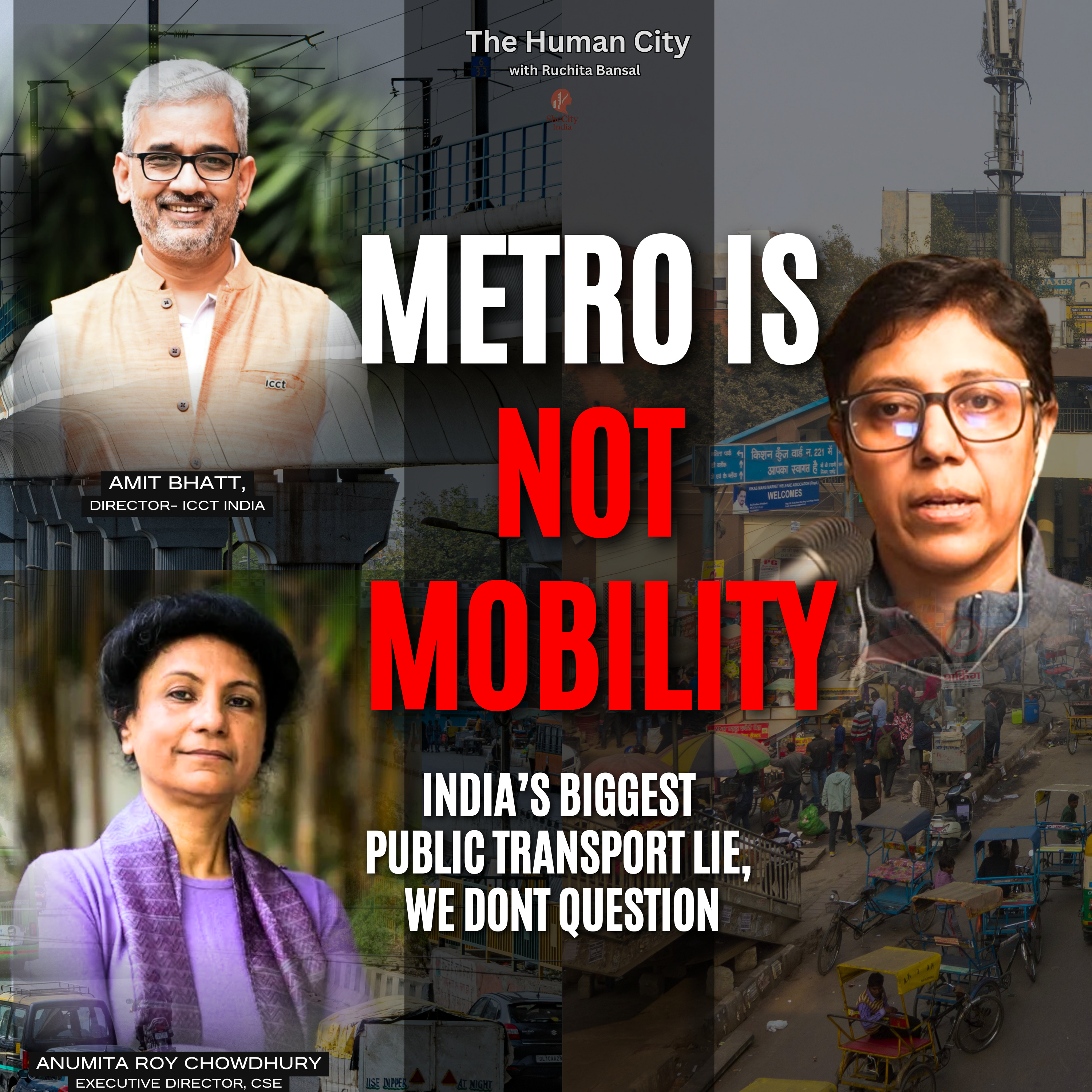
EPISODE · Dec 15, 2025 · 34 MIN
Why Metro Became a Substitute for Real Public Transport | HC E15| Anumita Roy Chowdhury, CSE | Amit Bhatt, ICCT, India | Ruchita Bansal
from The Human City · host Ruchita Bansal
About the Episode: Indian cities are building metros, announcing clean air targets, and celebrating infrastructure milestones.Yet for most people, everyday mobility is getting worse — unsafe streets, overcrowded buses, polluted air, and long exhausting commutes.In this episode of The HumanCity Podcast, host Ruchita Bansal is joined by Anumita Roychowdhury (CSE) and Amit Bhatt (ICCT India) to dismantle one of India’s most accepted urban myths: that metro equals mobility.We discuss:Why India has only 40,000 urban buses — the same number as one city: BeijingWhy metro projects receive national backing while buses are left to struggleThe absence of any Public Transport Act in Indian citiesWhy we measure vehicle registrations but not how people actually moveHow footpath capacity is ignored while road capacity is endlessly expandedWhy EVs without public transport reform won’t solve congestion or pollutionThis is a candid, data-backed conversation about power, politics, and priorities — and why Indian cities must stop confusing infrastructure with mobility.If we truly want human-centered cities, we must ask harder questions about who our transport systems are really designed for.About the Guest: Anumita Roychowdhury is the Executive Director of the Centre for Science and Environment. For over three decades, she has been at the forefront of India’s clean air movement — shaping policies on vehicle emissions, fuel standards, public transport, and air quality management. From the CNG transition in Delhi to national emission norms, her work has directly influenced how India understands pollution, mobility, and public health.Connect with her on Linkedin: / anumita-roychowdhury-6204a3164 Amit Bhatt leads the India program at the International Council on Clean Transportation. For more than two decades, he has worked closely with cities and governments on public transport reform, vehicle electrification, road safety, and air quality. His work focuses on one central question: how do we move people, not just vehicles in Indian cities.Connect with him on Linkedin: / amit-bhatt-transport ------------------------About the Host:The Human City Podcast is hosted by Ruchita Bansal, an accomplished urban planner and project management professional with 15+ years of experience. She has led multi-billion-dollar development projects and sustainable mobility programs across India, including her leadership role at the Ayodhya Development Authority.Ruchita is also the founder of SheCity India, a platform for gender-inclusive urban planning, storytelling, and data-driven advocacy.--------------------------About The Human City Podcast:This podcast brings together global voices and local insights to explore how cities can be made more inclusive, sustainable, and human-centered. Each episode uncovers what it takes to design cities that truly work for people.“The Human City Podcast is an initiative of SheCity India — building gender-inclusive, human-centered cities.”
Embed this episode
NOW PLAYING
Why Metro Became a Substitute for Real Public Transport | HC E15| Anumita Roy Chowdhury, CSE | Amit Bhatt, ICCT, India | Ruchita Bansal
No transcript for this episode yet
Similar Episodes
No similar episodes found.
Similar Podcasts
No similar podcasts found.