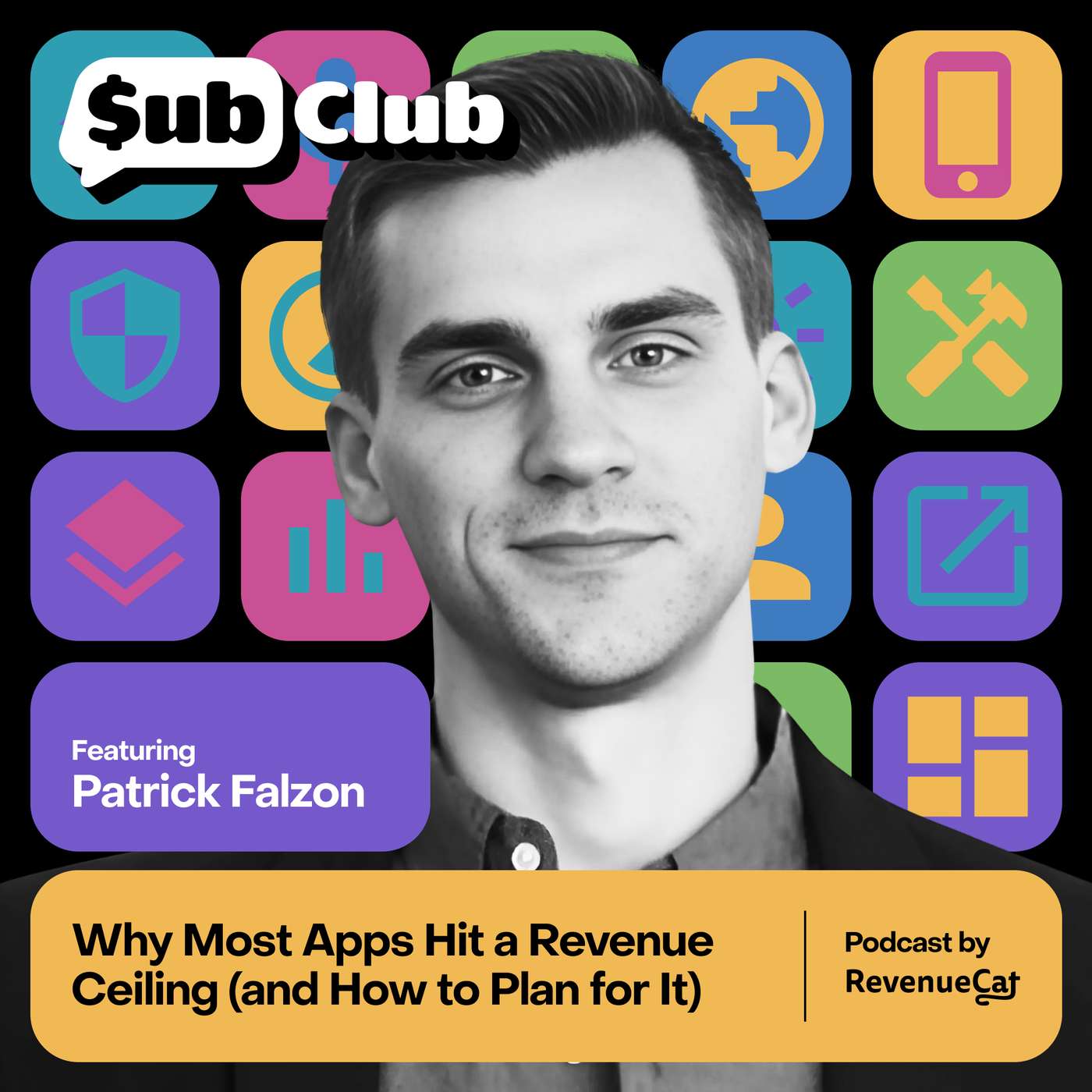
Why Most Apps Hit a Revenue Ceiling (and How to Plan for It) — Patrick Falzon, The App Shop episode artwork

EPISODE · Dec 11, 2024 · 1H 13M

Why Most Apps Hit a Revenue Ceiling (and How to Plan for It) — Patrick Falzon, The App Shop

from Sub Club by RevenueCat · host David Barnard, Jacob Eiting

On the podcast: estimating the revenue potential of an app, crafting an exit strategy, and why LTV is such a terrible metric.Top Takeaways:🎯 Finding the right market fit – Not all apps have billion-dollar potential, and chasing massive markets often means competing with big players. Instead, focus on markets where your app has room to stand out. By positioning yourself in a "Goldilocks zone"—big enough to scale but niche enough to avoid overcrowding—you’ll lay the groundwork for sustainable growth.📈 Portfolios over all-in strategies – Instead of putting all your effort into scaling one app, building a portfolio of smaller, successful apps can diversify risk and drive steady revenue. Portfolios give you the flexibility to test new ideas and spread your earnings across multiple use cases, avoiding the pitfalls of over-concentrating on one product.🔍 When to expand features or create a new app – Apps with focused, singular value propositions tend to attract and retain users better than those overloaded with features. Before adding more functionality, ask: Does this align with the app’s core mission? If not, consider launching a complementary app to avoid cluttering your existing product.🧪 Price testing without regrets – Effective price testing requires patience and precision. Run small tests, and use early retention patterns—such as trial-to-paid or monthly renewal rates—to model the impact on long-term subscribers. Always prepare for possible retention dips by planning worst-case scenarios to protect your bottom line.✍🏻 Set up for a strategic exit – If acquisition is your goal, build your app to be buyer-ready. Private equity and strategic acquirers look for apps with clean operations, predictable revenue, and scalable systems. Crafting a clear differentiation and avoiding operational mess increases your chances of attracting high-value offers and makes the process smoother.About Patrick Falzon👨‍💼 Co-founder of The App Shop, Patrick helps app developers build sustainable portfolios, optimize monetization, and prepare for strategic exits.📈 With extensive experience in app monetization and growth strategies, Patrick is focused on creating streamlined user experiences while identifying opportunities for sustainable scaling and market differentiation.💡 “A big market is great only if you can take a substantial or specific share of that market. If it’s so competitive that you can’t garner any market share, it’s not actually valuable to you."👋 Patrick on LinkedInResourcesThe App Shop websiteFollow Us:• David Barnard: https://twitter.com/drbarnard• Jacob Eiting: https://twitter.com/jeiting• RevenueCat: https://twitter.com/RevenueCat• Sub Club: https://twitter.com/SubClubHQEpisode Highlights[1:41] The story begins: Patrick’s career evolution — from investing in to operating at Mosaic Group.[7:59] A stand-out app: Why RoboKiller, an app for blocking spam calls and texts, stood out in Mosaic’s portfolio.[9:07] Evaluating market size: Mosaic’s framework for assessing an app’s revenue potential balances market depth with competition and user demand.[14:20] Tough markets to crack: Mosaic avoided saturated app categories (like VPNs and personal finance), due to high acquisition costs and competitive pressure.[19:36] Depth vs. breadth: How Mosaic decided whether to enhance existing apps or create new ones.[25:52] Portfolio strategies: Building a diverse portfolio of smaller apps, instead of scaling a single app, can reduce risk and increase sustainable revenue.[32:14] LTV pitfalls: Patrick stresses the importance of capping LTV projections and focusing on shorter payback periods to make realistic growth decisions.[39:20] Exit strategy: Aligning operational processes, profitability, and a clean setup improves the chances of a successful app exit.[49:12] Retain to sustain: Why user retention metrics are key to building durable, long-term revenue.[1:01:05] Good press: How Mosaic leveraged proprietary data to secure media coverage, boosting RoboKiller’s organic growth and user trust.

Episode metadata supplied by the publisher feed · Published Dec 11, 2024

On the podcast: estimating the revenue potential of an app, crafting an exit strategy, and why LTV is such a terrible metric.Top Takeaways:🎯 Finding the right market fit – Not all apps have billion-dollar potential, and chasing massive markets often means competing with big players. Instead, focus on markets where your app has room to stand out. By positioning yourself in a "Goldilocks zone"—big enough to scale but niche enough to avoid overcrowding—you’ll lay the groundwork for sustainable growth.📈 Portfolios over all-in strategies – Instead of putting all your effort into scaling one app, building a portfolio of smaller, successful apps can diversify risk and drive steady revenue. Portfolios give you the flexibility to test new ideas and spread your earnings across multiple use cases, avoiding the pitfalls of over-concentrating on one product.🔍 When to expand features or create a new app – Apps with focused, singular value propositions tend to attract and retain users better than those overloaded with features. Before adding more functionality, ask: Does this align with the app’s core mission? If not, consider launching a complementary app to avoid cluttering your existing product.🧪 Price testing without regrets – Effective price testing requires patience and precision. Run small tests, and use early retention patterns—such as trial-to-paid or monthly renewal rates—to model the impact on long-term subscribers. Always prepare for possible retention dips by planning worst-case scenarios to protect your bottom line.✍🏻 Set up for a strategic exit – If acquisition is your goal, build your app to be buyer-ready. Private equity and strategic acquirers look for apps with clean operations, predictable revenue, and scalable systems. Crafting a clear differentiation and avoiding operational mess increases your chances of attracting high-value offers and makes the process smoother.About Patrick Falzon👨‍💼 Co-founder of The App Shop, Patrick helps app developers build sustainable portfolios, optimize monetization, and prepare for strategic exits.📈 With extensive experience in app monetization and growth strategies, Patrick is focused on creating streamlined user experiences while identifying opportunities for sustainable scaling and market differentiation.💡 “A big market is great only if you can take a substantial or specific share of that market. If it’s so competitive that you can’t garner any market share, it’s not actually valuable to you."👋 Patrick on LinkedInResourcesThe App Shop websiteFollow Us:• David Barnard: https://twitter.com/drbarnard• Jacob Eiting: https://twitter.com/jeiting• RevenueCat: https://twitter.com/RevenueCat• Sub Club: https://twitter.com/SubClubHQEpisode Highlights[1:41] The story begins: Patrick’s career evolution — from investing in to operating at Mosaic Group.[7:59] A stand-out app: Why RoboKiller, an app for blocking spam calls and texts, stood out in Mosaic’s portfolio.[9:07] Evaluating market size: Mosaic’s framework for assessing an app’s revenue potential balances market depth with competition and user demand.[14:20] Tough markets to crack: Mosaic avoided saturated app categories (like VPNs and personal finance), due to high acquisition costs and competitive pressure.[19:36] Depth vs. breadth: How Mosaic decided whether to enhance existing apps or create new ones.[25:52] Portfolio strategies: Building a diverse portfolio of smaller apps, instead of scaling a single app, can reduce risk and increase sustainable revenue.[32:14] LTV pitfalls: Patrick stresses the importance of capping LTV projections and focusing on shorter payback periods to make realistic growth decisions.[39:20] Exit strategy: Aligning operational processes, profitability, and a clean setup improves the chances of a successful app exit.[49:12] Retain to sustain: Why user retention metrics are key to building durable, long-term revenue.[1:01:05] Good press: How Mosaic leveraged proprietary data to secure media coverage, boosting RoboKiller’s organic growth and user trust.

PodParley-generated summary based on available episode metadata and transcript content.

NOW PLAYING

Why Most Apps Hit a Revenue Ceiling (and How to Plan for It) — Patrick Falzon, The App Shop

0:00 1:13:13

No transcript for this episode yet

We transcribe on demand. Request one and we'll notify you when it's ready — usually under 10 minutes.

MG Show MG Show The MG Show, hosted by Jeffrey Pedersen and Shannon Townsend, is a leading alternative media platform dedicated to uncovering the truth behind today’s most pressing political issues. Launched in 2019, the show has grown exponentially, offering unfiltered insights, comprehensive research, and real-time analysis. With a commitment to independent journalism and factual integrity, the MG Show empowers its audience with knowledge and encourages active participation in the political discourse. That Hoarder: Overcome Compulsive Hoarding That Hoarder Hoarding disorder is stigmatised and people who hoard feel vast amounts of shame. This podcast began life as an audio diary, an anonymous outlet for somebody with this weird condition. That Hoarder speaks about her experiences living with compulsive hoarding, she interviews therapists, academics, researchers, children of hoarders, professional organisers and influencers, and she shares insight and tips for others with the problem. Listened to by people who hoard as well as those who love them and those who work with them, Overcome Compulsive Hoarding with That Hoarder aims to shatter the stigma, share the truth and speak openly and honestly to improve lives. Flottengeflüster ALD Automotive Österreich | LeasePlan Beim Flottengeflüster powered by ALD Automotive | LeasePlan präsentieren Jörg Janik und Peter Gutenbrunner alle zwei Wochen spannende Informationen rund um das Thema nachhaltige Mobilität. Beide beschäftigen sich schon lange mit der Thematik und bringen umfangreiches Fachwissen mit. Sollten sie aber doch einmal nicht weiter wissen, werden unsere Expert*innen hinzugezogen, die ihnen gerne mit Rat und Tat zur Seite stehen. The Small Business Startup School – Business Notes | Financial Literacy | Retail Psychology – For Professionals & Entrepreneurs The Small Business Startup School Inc. Starting or buying a small business? While personal circumstances may vary, business patterns remain timeless. On The Small Business Startup School, we explore strategies, insights, and practical solutions to help entrepreneurs confidently navigate their journey.Hosted by Ola Williams—a retail entrepreneur, fintech founder, and financial coach with over two decades of experience—this podcast marries financial awareness and retail psychology with optimism to deliver actionable takeaways.Join us to learn, grow, and connect as we uncover the keys to business success.Let’s continue to learn together and be encouraged to keep on connecting!

Frequently Asked Questions

How long is this episode of Sub Club by RevenueCat?

This episode is 1 hour and 13 minutes long.

When was this Sub Club by RevenueCat episode published?

This episode was published on December 11, 2024.

What is this episode about?

On the podcast: estimating the revenue potential of an app, crafting an exit strategy, and why LTV is such a terrible metric.Top Takeaways:🎯 Finding the right market fit – Not all apps have billion-dollar potential, and chasing massive markets...

Can I download this Sub Club by RevenueCat episode?

Yes, you can download this episode by clicking the download button on the episode player, or subscribe to the podcast in your preferred podcast app for automatic downloads.
URL copied to clipboard!