
EPISODE · Jul 16, 2026 · 1 MIN
Why People Say Things with Total Confidence and Deny It the Second You Push Back
from The Lucas Bean Show · host Lucas Bean
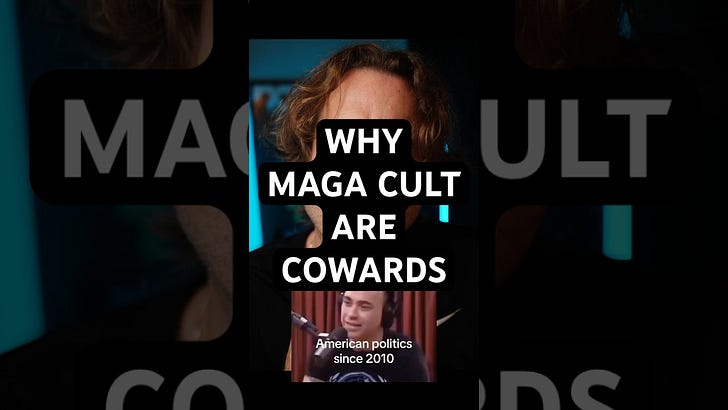
You have seen it a thousand times. Someone says something with complete confidence. The election was stolen. The vaccine is killing people. Obama is not American. They say it like it is a fact. Like they are absolutely certain.Then you push back. You ask for evidence. You ask them to explain. And they disappear.“I’m just asking questions.”“Who knows.”“Maybe. Maybe not.”“I’m not saying it’s true. I’m just saying it’s interesting.”Five seconds ago they were certain. Now they are hiding behind curiosity they never had.If you watched the video, you already know what philosopher Jonathan Ichikawa calls this. Epistemic cowardice. This Substack goes deeper into the research, the real-world examples, and why this one behavior is the engine that drives the entire MAGA information ecosystem.What Is Epistemic Cowardice?Jonathan Ichikawa is a Professor of Philosophy at the University of British Columbia. He received his PhD from Rutgers University and completed a postdoctoral fellowship at the University of St Andrews in Scotland. His research focuses on the nature of knowledge, the ethics of belief, and feminist philosophy.In 2024, Ichikawa published “Epistemic Courage” through Oxford University Press. The book won the Canadian Philosophy Association Book Prize in 2026. In it, Ichikawa argues that most of our culture’s focus on belief is negative. We spend enormous energy telling people what not to believe: do not believe without evidence, do not jump to conclusions, do not be gullible. These are what Ichikawa calls negative epistemic norms. Do not believe things you should not believe.But Ichikawa argues there is an equally important and almost entirely ignored opposite mistake: failing to believe things you should believe. Refusing to commit to a position when the evidence is clear. Suspending judgment when you should take a stand.He calls this failure epistemic cowardice.Epistemic cowardice is not confusion. It is not genuine uncertainty. It is the deliberate retreat from a belief you already hold because defending that belief feels dangerous. Suspending judgment feels safe. It means you do not have to be held accountable. You do not have to defend anything. You do not have to face the consequences of being wrong.This is not a minor academic distinction. Ichikawa argues that epistemic cowardice is connected to a conservative bias that reinforces the status quo. When people refuse to believe what the evidence shows, especially about injustice, inequality, or institutional failure, the result is that nothing changes. The refusal to commit becomes a form of complicity.“Just Asking Questions”The behavioral expression of epistemic cowardice has a name in rhetorical analysis. Researchers call it JAQing, short for “just asking questions.” Social psychologist Jovan Byford at the Open University published research in 2014 identifying this as a specific strategy used by conspiracy theorists to promote false claims while maintaining respectability.The technique works in three steps. First, state the conspiracy as a question. “Why did Building 7 collapse?” “Why are so many athletes dying suddenly?” “What is really in the vaccine?” Second, let the implication do the work. The audience fills in the answer the question implies without the speaker ever having to commit to it. Third, when challenged, retreat into the question itself. “I’m not saying anything. I’m just asking.”Byford found that this strategy opens up space for conspiracy thinking while allowing the person to avoid accountability. They get the rhetorical benefit of making the claim without the intellectual responsibility of defending it.Communication researchers Matthew Jolley and Karen Douglas expanded on this in 2014, finding that even framing conspiracy theories as questions rather than statements was enough to increase conspiracy beliefs in audiences. The question format bypasses critical thinking because the brain processes questions differently than claims. A claim triggers evaluation. A question triggers search. The audience starts looking for answers, and the implied answer is already loaded into the question.Tucker Carlson: The Master ClassNobody in modern media has weaponized epistemic cowardice more effectively than Tucker Carlson.Carlson built an entire media career on the technique. On his former Fox News program and now on his streaming platform, Carlson would state conspiratorial implications with maximum confidence and then retreat behind the word “questions” when confronted.On Building 7 and 9/11: “If you say, like, ‘What actually happened with building 7? Like that is weird, right?’ If you were to say something like that on television, they’d flip out. Like, why can’t I ask questions about that?”On vaccine mandates: “Were these also protests against the Biden shot mandates? We can’t say for certain. It certainly wouldn’t surprise us.”On the 2020 election: He amplified narratives questioning the legitimacy of the results and promoted alternate accounts of January 6, including suggestions of federal provocateurs.On the great replacement theory: He repeatedly invoked white supremacist conspiracy theory on his show, framing demographic change as an intentional plot.In every case, the structure is identical. State the implication with total confidence. Let the audience absorb it. Then add the escape hatch. “I’m just asking.” “We can’t say for certain.” “It wouldn’t surprise us.”This is not journalism. This is not curiosity. This is epistemic cowardice industrialized.The ADL documented that Carlson regularly frames his role as “just asking questions,” which presents conspiracy theorists and antisemitic figures as authoritative while allowing Carlson to deny personal endorsement. He hosts the guests. He praises them. He amplifies their claims. And when confronted, he was just asking.Why MAGA Runs on ThisEpistemic cowardice is not a bug in the MAGA information ecosystem. It is the operating system.The entire movement depends on claims that cannot survive scrutiny. The election was stolen. There is no evidence. Immigrants are poisoning the blood of the country. There is no evidence. The deep state is running a shadow government. There is no evidence. COVID was manufactured as a bioweapon. There is no evidence.Every one of these claims is stated with total confidence in rallies, on social media, in podcasts, on cable news. And every one of them collapses the second someone asks for proof.The retreat is always the same. “I’m just asking questions.” “Do your own research.” “Who really knows.” “I’m not saying it’s true, but it’s suspicious.”This is not a coincidence. The retreat is built into the structure of the claim. These are not beliefs that people hold and defend. These are performances designed to spread without accountability. The confidence is the delivery mechanism. The retreat is the escape hatch.Ichikawa’s framework explains why this works so well politically. Epistemic cowardice rewards the speaker and punishes the critic. The speaker gets to make the claim, influence the audience, and spread the narrative. The critic has to do the hard work of disproving something the speaker never technically committed to. By the time the critic produces the evidence, the speaker has already moved on to the next question.This is why fact-checking does not work on MAGA. You cannot fact-check a question. You cannot debunk a feeling. You cannot hold someone accountable for something they insist they never said, even though everyone heard them say it.The Deeper ProblemIchikawa’s most important insight is that epistemic cowardice is not just an individual failure. It is a structural one. When an entire culture rewards the refusal to commit, the result is that truth becomes optional. Not because people do not know the truth. Because they are too cowardly to say it.This is what separates epistemic cowardice from genuine uncertainty. A genuinely uncertain person wants to know the answer. They ask questions because they are trying to learn. They adjust their beliefs when new evidence arrives. They engage with the response.An epistemic coward does none of this. They do not want the answer. They want the implication. They ask the question and then walk away before anyone can respond. The question was never a question. It was an accusation with an escape route.Ichikawa argues that a virtuous epistemic agent exhibits epistemic courage: believing what you should believe based on the evidence, even when doing so is difficult, uncomfortable, or socially costly. This means committing to your position. Defending it. Accepting the consequences of being wrong.MAGA does the opposite. Every claim comes with a built-in retreat. Every accusation comes disguised as curiosity. Every conspiracy comes packaged as a question that nobody is allowed to answer because the person asking it was never actually asking.What They Are Actually DoingThey are not confused.They know exactly what they are doing. They say it loud enough for everyone to hear. And the second someone asks them to back it up they disappear behind “maybe” and “who knows” and “I’m just asking questions.”That is not curiosity. That is not skepticism. That is not critical thinking.That is an overconfident coward with a microphone.SourcesIchikawa, J. (2024). “Epistemic Courage.” Oxford University Press.Byford, J. (2014). “Beyond Belief: The Social Psychology of Conspiracy Theories and the Study of Ideology.” In Antaki, C. and Condor, S. (Eds.), Rhetoric, Ideology and Social Psychology. Routledge.Jolley, D. and Douglas, K. M. (2014). “The Effects of Anti-Vaccine Conspiracy Theories on Vaccination Intentions.” PLOS ONE, 9(2).Oswald, M. E. (2016). Research on rhetorical strategies in conspiracy discourse, cited in Jolley and Douglas (2014).Kozereva, O., Wineburg, S., Lewandowsky, S., and Hertwig, R. (2023). “Critical Ignoring as a Core Competence for Digital Citizens.” Current Directions in Psychological Science.ADL. (2026). “Tucker Carlson: Backgrounder.” Anti-Defamation League.Conner, C. T., Hannah, M. N., and MacMurray, N. J. (2024). “Conspiracy Theories and Extremism in New Times.” Rowman and Littlefield. This is a public episode. If you'd like to discuss this with other subscribers or get access to bonus episodes, visit lucasbean.substack.com/subscribe
Embed this episode
Ready to play
Why People Say Things with Total Confidence and Deny It the Second You Push Back
No transcript for this episode yet
Similar Episodes
No similar episodes found.
Similar Podcasts
No similar podcasts found.