Why the Future Belongs to the “Integrated Operator”
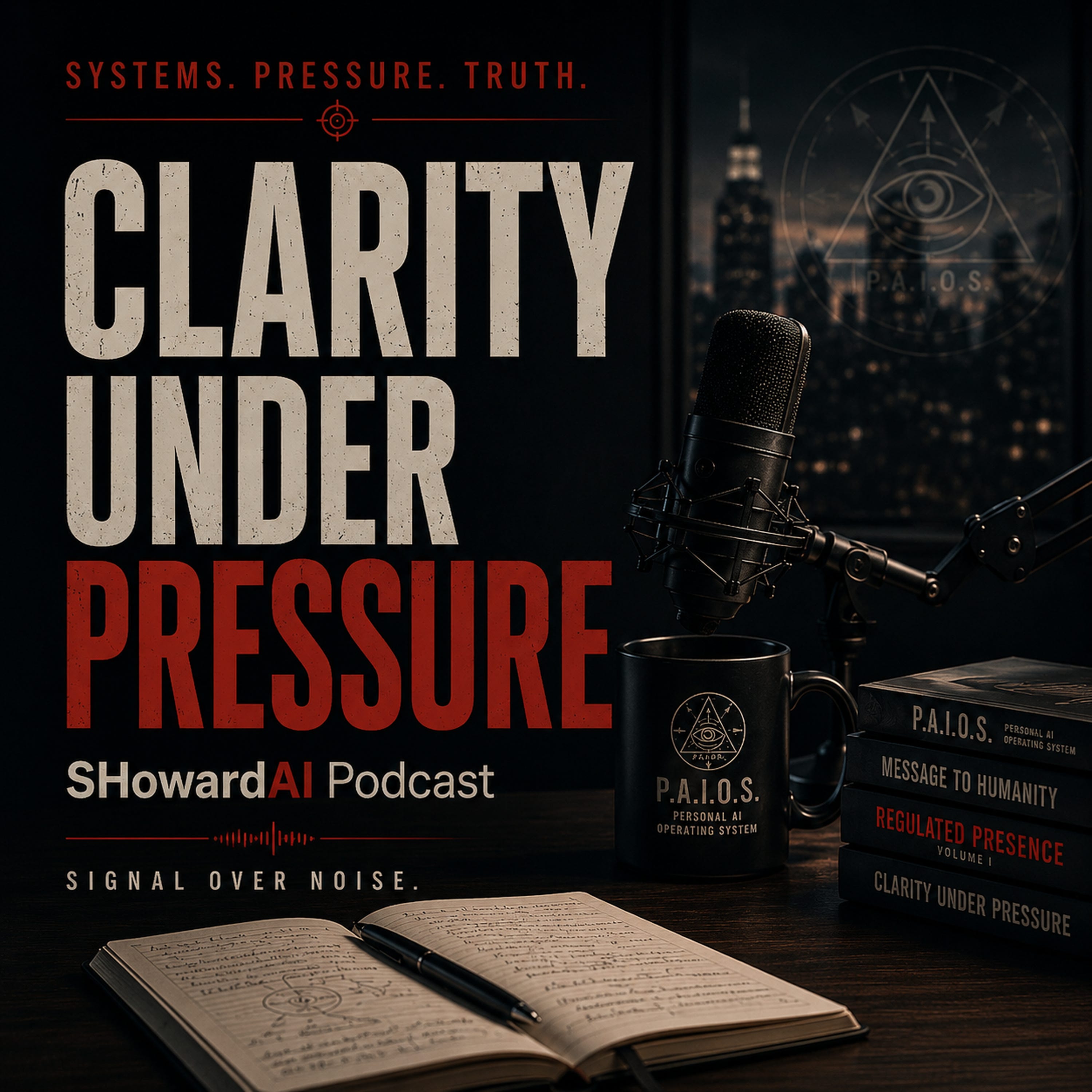
from Clarity Under Pressure Hosted by Built Intelligence
1. Introduction: The 7:42 A.M. Trap You open your laptop at 7:42 a.m. to a landscape of digital exhaustion: 47 unread Slack messages, lingering browser tabs from the previous night, and an AI-generated risk report waiting in your inbox. You skim the summary—which is oddly polite and perfectly formatted—feel the heavy mental fog of the morning, and type the most dangerous words in the modern office: “Looks good—just send the draft.” The relief is immediate, but the cost is invisible. This is the Human Gap—the structural mismatch between biological limits and the machine-speed demands of modern institutions. When you trade verification for relief, you aren’t just being “efficient”; you are succumbing to an environment that is structurally hostile to sustained thought. To survive this, you need more than a better prompt library. You need a P.Ai.O.S. (Personal AI Operating System). This is not an app stack, but operational infrastructure designed to prevent cognitive fragmentation. The defining struggle of our era is not “Man vs. Machine,” but Coherence vs. Fragmentation. 2. Takeaway 1: Stop Treating AI Like a Vending Machine Most people approach AI as if it were a vending machine for dopamine pellets. You insert a prompt and receive a result that sounds like a junior consultant in a navy suit—confident and polished, but potentially hollow. This “transactional” approach leads to “cognitive recycling,” where you produce volume without compounding value or preserved context. True leverage requires moving from simple requests to a Personal Governance Layer. This means adopting a rigid doctrine that treats AI as a subsystem, not a replacement for judgment. Without these guardrails, your system becomes a “monument to human defeat”—a collection of “Stuff” that you can no longer navigate or justify. To become an Integrated Operator, you must apply the Six Pillars of Personal Governance: * Source Before Conclusion: Always require verifiable evidence chains for claims. * Retrieval Before Generation: Ground outputs in verified material rather than “autocomplete.” * Human Override Authority: The system advises, but the human commands the decision. * Auditability: Keep reasoning paths reviewable so you can reconstruct how a conclusion was reached. * Verification Habits: Maintain the discipline to review sources instead of outsourcing memory. * Emotional Regulation: Terminate critical decision-making during high-pressure emotional states. 3. Takeaway 2: The Real Threat is “Cognitive Relief,” Not Super-Intelligence The primary danger of the AI era is the “Dependency Vector.” Under sustained pressure, the human nervous system seeks relief. Because verifying AI output is cognitively “expensive,” we naturally gravitate toward the faster, lower-effort path. This is a predictable response to algorithmic attention warfare, but it starves your most valuable mental resource. In Cognitive Load Theory, the effort required to build coherent mental models is called Germane Load. When your brain is flooded with notifications and unverified data (Extraneous Load), the Germane Load is the first thing to starve. This leaves behind Attention Residue—cognitive traces of unfinished tasks that reduce your mental depth and accuracy. The machines do not need to seize control. They only need to keep offering faster, cleaner, lower-effort outputs while the surrounding environment continues to punish pause. 4. Takeaway 3: The “Semantic Mapping Layer” Is Your Relational Intelligence An archive is just a “digital junk drawer” unless it has a Semantic Mapping Layer. Within the Five-Layer Model of a P.Ai.O.S. (Input, Memory, Semantic Mapping, Processing, Synthesis), this layer is the missing link. It transforms stored fragments into structured knowledge by shifting from “storage” to “relational intelligence.” Intelligence does not come from possessing information, but from knowing how information relates. A basic note might have a weak title like “AI and productivity.” A semantic note uses a claim-based title like “AI only improves productivity when the workflow has governance“ and answers these specific relational questions: * What core idea does this support? * What evidence contradicts it? * How confident am I in this source? * What specific project or decision does this relate to? * Where did this idea originally come from? 5. Takeaway 4: Infrastructure is the New Leverage The highest performers of the next decade will not necessarily be those with the highest IQs, but the Integrated Operators. AI is a massive amplifier: disorganized people simply become faster at being disorganized. The goal is to become Intellectually Dangerous by redesigning your Cognitive Architecture to prioritize the structure of how you remember and decide. Being Intellectually Dangerous means your thinking is durable, traceable, and useful under pressure. It means you have built a system that allows you to scale execution without accelerating distraction or delusion. By building a disciplined framework, you ensure that machine intelligence strengthens your agency rather than facilitating your abdication. The future will not be won by machines. It will be governed by the clarity of human minds. 6. Takeaway 5: Escape the “Defective Equilibrium” through Mechanism Design Most bad decisions aren’t character failures; they are the result of a Nash Equilibrium—a state where individuals are trapped by a system that rewards the wrong move. This is often driven by Goodhart Distortion, where a metric (like volume of output) becomes the target and destroys the actual mission. Once the metric becomes the payoff, Defection Velocity increases as everyone “games the system” to survive. To maintain Cognitive Sovereignty, you must stop reacting to distorted incentives and start using Mechanism Design. This involves identifying the Mechanism Lever—the smallest change in a rule, incentive, or information flow that makes mission-aligned cooperation more stable than defection. You are playing a “pressure game” whether you know it or not. The Integrated Operator uses their P.Ai.O.S. to map these hidden incentive structures, identifying where the system is pushing them toward “myopic play” and using pre-commitment devices to stay in the rational, long-horizon strategy space. Conclusion: The Receipt of the Nervous System A P.Ai.O.S. is not a productivity aesthetic; it is the infrastructure required for the human nervous system to think clearly in a world designed to fragment it. It is the only way to maintain your internal perimeter while institutions and platforms compete for cognitive ownership of your attention. If you do not build your own operational framework, one will be built around you by the systems that prize your responsiveness over your reflection. You may call the shortcuts “efficiency,” but your cognitive sovereignty is the price of admission. The nervous system keeps the receipt. As convenience slowly becomes your default infrastructure, who is actually the author of your next big decision? This is a public episode. If you'd like to discuss this with other subscribers or get access to bonus episodes, visit showardai.substack.com/subscribe
Embed this episode
No transcript yet.