
EPISODE · Jul 17, 2026 · 10 MIN
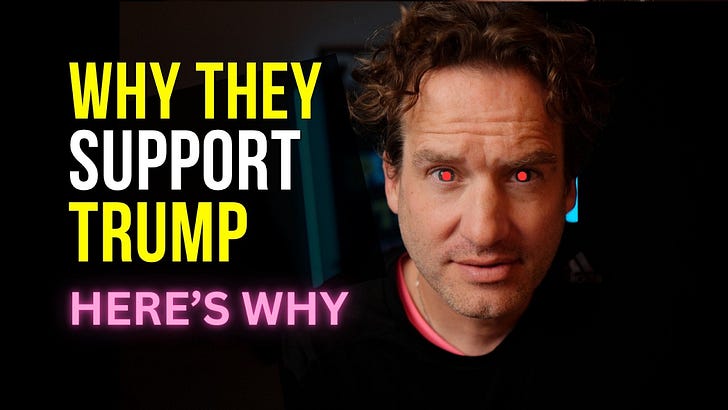
Why They Love Trump
from The Lucas Bean Show · host Lucas Bean
I have been wondering for years why millions of Americans look at Donald Trump and see themselves in him.Why are we able to see so clearly that Trump is a narcissistic, abusive, mediocre criminal and his followers love him for it?So I decided to do some research on presidential symbolism to understand what is actually going on here.Donald Trump mocked a disabled reporter on camera in front of thousands of people. He attacked a Gold Star family on national television. He became the first convicted felon to be elected president in American history. His approval among his base did not move. Not after any of it.Presidents do not just change policy. They change who the country believes deserves power. Barack Obama broke a barrier that should have been broken centuries ago when he became president. Trump also broke a barrier. But it is not the flex you think it is. He opened a door to hate, racism, open crimes, and bigotry that should have remained shut forever.And yet here we are.Here are the five psychological reasons Trump’s base sees themselves in him.1. The Psychological Wage of WhitenessFor over two hundred years, every American president was white. Every inauguration confirmed the same assumption. The highest office in the country belonged to one racial group.In 1935, sociologist W. E. B. Du Bois studied why poor white workers in the American South sided with wealthy white landowners instead of with Black workers who shared their economic struggles. He found that whiteness itself worked as a form of compensation. White workers were given access to public spaces, respect, and social standing that Black workers were denied. The pay was not money. It was status.Du Bois called this the psychological wage of whiteness. The unearned social status white Americans received simply for being white. It kept them loyal to a racial hierarchy that did not serve their economic interests. They were still just as poor as their Black and Hispanic neighbors. Yet somehow they thought they were superior for just existing.The American presidency reinforced that wage every four years for over two centuries.Then in 2008, Barack Obama won the presidency. He shattered a symbolic barrier that had stood since the founding of the United States. His election told Black Americans and other excluded groups that the presidency was no longer reserved for one race. The assumption that had been quietly reinforced for centuries was broken in a single night.A status payment people collected just for being white was gone.When that status floor breaks, people do not quietly adjust. They backlash. Obama did not just win an election. He took something they did not even know they were depending on. They did not earn it. But they thought that status was stolen when Obama got elected. And now they have been trying to take it back however they can.2. Participation AwardsTrump supporters do not just support him. They become him. They wear his clothes. They fly his flags on their trucks. They try to talk like him. They mimic his hand gestures. They adopt his insults as their own vocabulary.In the 1970s, psychologists Henri Tajfel and John Turner studied how people build their sense of self through the groups they belong to. They found that when a group member achieves high status, other members of that group experience a boost in their own self-worth. The success of one becomes the validation of all.Tajfel and Turner called this social identity theory. The psychological process by which an individual’s self-esteem rises or falls based on the status of the group they identify with.When the leader is like you, his status becomes your status. His legitimacy becomes your legitimacy. His power becomes your power. You do not have to accomplish anything yourself. You do not have to earn anything. You just have to belong to his group. And his victories become yours.Trump supporters do not admire him from a distance. They absorb his identity because it validates their own. They are exactly the same person Trump is. And they love the permission that gives them. To be the toxic person they have always wanted to be in public.3. Mass DelusionTrump supporters do not just love America. They need the world to admit America is superior. And when they feel that recognition is being withheld, they respond with hostility, resentment, and aggression.In the early 2000s, psychologist Agnieszka Golec de Zavala studied people whose attachment to their group is driven not by pride but by a deep insecurity that their group’s greatness is not being recognized. These individuals do not just love their country. They need constant external validation that their country is the best. And when they do not get it, they lash out.Golec de Zavala called this collective narcissism. The belief that your group is exceptional combined with the feeling that the rest of the world refuses to acknowledge it. We are the best. Now recognize we are the best. Or else.Normal people watch someone humiliate another person in public and feel that it is wrong. They see cruelty and they know it is wrong. But people who carry narcissistic traits see something different. They see someone getting away with it. They see someone being rewarded for the same behavior that has cost them relationships, jobs, and the respect of the people around them in their own personal lives. And they feel validated because their president is just like them.Trump did not attract his base despite the cruelty. He attracted them because of the cruelty.His supporters are not loyal because he is good. They are loyal because he proves you do not have to be good or kind to be president. Just like the psychological wage of whiteness was broken because Obama got elected, Trump validated to a lot of losers in this country that it was cool to not be educated or go to college. That you can be a narcissistic horrible person to people and somehow it is okay now. That even if you are a mediocre narcissistic person, maybe you could be president too. That narcissistic mediocre bullies and how they behave to other people is not wrong anymore.4. Conspiracy TheoristsAnti-vaxxers. False flag believers. QAnon followers. Moon landing deniers. Bigfoot hunters. People who reject basic verifiable facts.Before Trump, these people were a cagey group who kept to themselves. Society had a word for them. Fringe. They were not taken seriously. They were not given platforms. They were not treated as credible voices in any room that mattered.In 2014, political scientists Joseph Uscinski and Joseph Parent studied why certain populations are drawn to conspiracy theories. They found that conspiratorial thinking is not about intelligence. It is about powerlessness. People who feel excluded from institutions, dismissed by experts, and left behind by the culture are far more likely to reject mainstream knowledge entirely and replace it with narratives that cast themselves as the ones who truly understand what is going on.I call this the conspiracy theory psyche. The psychological tendency of people who feel powerless and excluded to reject expert knowledge and adopt conspiratorial narratives that restore a sense of control and superiority.Trump did not just tolerate conspiracy thinking. He validated it from the most powerful office on earth. He amplified fringe theories on national television. He told people who rejected medical science that they were right to be suspicious. He told people who distrusted every institution that their distrust was justified. He made ignorance feel like insight.Before Trump these people were called fringe. Now they run the country. Anti-intellectualism is alive and well in America under Donald Trump.5. The Narcissist Next DoorTrump’s base is not made up of people who were excluded from power by centuries of structural oppression. It is made up of bullies. Abusers. People convicted of crimes. People who treat the people around them like garbage and resent being told to stop. People who have spent their entire lives being told the way they act is not acceptable.In 2013, psychologist Mitja Back at the University of Münster studied the relationship between grandiose narcissism and political preferences. He found that individuals who score high in narcissistic traits are significantly more drawn to leaders who display dominance, self-promotion, and contempt for norms.The connection is not ideological. It is psychological. Narcissistic individuals are attracted to leaders who mirror their own traits because those leaders validate the way these people move through the world.Back called this narcissistic admiration and rivalry. The tendency of narcissistic individuals to seek out and attach to leaders who exhibit the same grandiose, domineering, and norm-violating behavior they use themselves.Trump proved that you can be a racist, hate-filled person and still hold the highest office in the land. You can break the law and still get elected. You can be a mean, cruel bully who abuses the people around you and still get elected. You can reject science, spread conspiracy theories, and mock the disabled and still get elected. You can be all of it at the same time, in public, on camera, and still get elected.That is not a message that appeals to normal people. That is a message that appeals to narcissistic mediocre people.If you read this and recognized every one of these patterns, you are not the problem. You see Trump’s base for what it is. Broken people who found a broken leader and called it strength.But if something in this made you angry, if one of these sections felt like a personal attack, you are the problem. Normal people do not see themselves in an abuser. Normal people do not celebrate cruelty. Normal people do not feel validated when a convicted felon holds the highest office in the country.Obama broke a barrier that should have been broken centuries ago. Trump broke every barrier that should have never been broken. And the people who celebrated Trump’s behavior in the last ten years were never good kind people. They are the broken abusers they have always been.SourcesDu Bois, W. E. B. (1935). Black Reconstruction in America. Harcourt, Brace and Company.Tajfel, H. & Turner, J. C. (1979). An Integrative Theory of Intergroup Conflict. In W. G. Austin & S. Worchel (Eds.), The Social Psychology of Intergroup Relations. Brooks/Cole.Golec de Zavala, A., Cichocka, A., Eidelson, R., & Jayawickreme, N. (2009). Collective Narcissism and Its Social Consequences. Journal of Personality and Social Psychology, 97(6), 1074-1096.Uscinski, J. E. & Parent, J. M. (2014). American Conspiracy Theories. Oxford University Press.Back, M. D., Küfner, A. C. P., Dufner, M., Gerlach, T. M., Rauthmann, J. F., & Denissen, J. J. A. (2013). Narcissistic Admiration and Rivalry: Disentangling the Bright and Dark Sides of Narcissism. Journal of Personality and Social Psychology, 105(6), 1013-1037. This is a public episode. If you'd like to discuss this with other subscribers or get access to bonus episodes, visit lucasbean.substack.com/subscribe
Embed this episode
Ready to play
Why They Love Trump
No transcript for this episode yet
Similar Episodes
No similar episodes found.
Similar Podcasts
No similar podcasts found.