
EPISODE · Jul 1, 2026 · 5 MIN
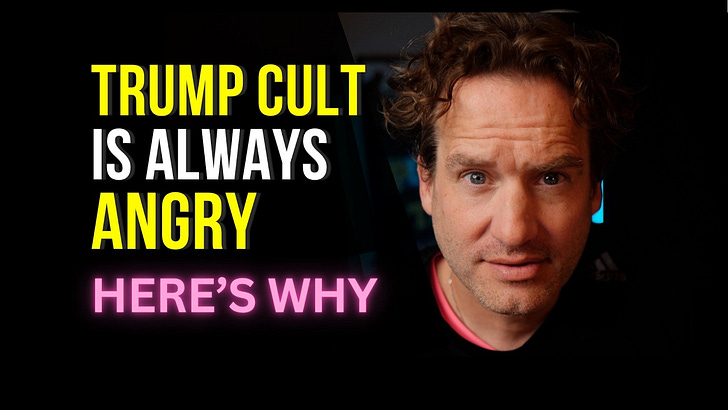
Why Trump Supporters Are Always Angry
from The Lucas Bean Show · host Lucas Bean
There is something you notice if you spend any time around MAGA supporters.They are always angry.Not just politically frustrated. Not just disappointed. Genuinely, constantly, exhaustingly angry.And the anger never resolves. It does not matter how many elections they win, how many policies get passed, or how many enemies get punished. The rage is always there, always at the same pitch, always looking for a new target.There is a reason for that. Actually there are four.And none of them have anything to do with politics.1. Their Brains Are Literally Running On FearIn 2011, neuroscientist Geraint Rees at University College London published a landmark study in Current Biology. He scanned the brains of 90 young adults and cross-referenced the results with their political beliefs.The finding was uncomfortable for a lot of people.Conservative brains had a measurably larger, more reactive amygdala. The amygdala is the part of your brain that detects threats. It evolved to keep us alive in dangerous environments. When a predator appeared, the amygdala fired and you ran.The problem is that the amygdala cannot distinguish between a lion and a Mexican family moving in down the street. It just fires. And in a conservative brain it fires constantly, at everything unfamiliar, everything changing, everything new.At the same time, Rees found that the anterior cingulate cortex, the part of the brain that regulates emotional response and applies rational thinking to fear signals, is smaller in conservative brains. That is the part that says slow down, evaluate, this is not actually dangerous.Conservative brains are running with an oversensitive alarm system and a broken off switch.This is not an insult. It is neuroscience. But it does explain something important.When you try to reason with a Trump supporter using facts and evidence, you are not losing a debate. You are trying to have a rational conversation with a brain that is currently in a low-level state of panic. The amygdala does not respond to logic. It responds to threat. And to a reactive amygdala, your facts feel like an attack.This is why MAGA supporters do not update their beliefs when shown evidence. It is not stubbornness. It is neurology.2. What Rage Actually IsPsychiatrist James Gilligan spent decades working inside maximum security prisons in America. He was not a researcher observing from a distance. He sat with the most violent men in the country, year after year, and asked them one question in as many ways as he could.Why did you do it.The answer was the same every single time.Not anger. Not hatred. Not ideology.Shame.Gilligan published his findings in his 1996 book Violence: Our Deadly Epidemic and Its Causes. His conclusion was that shame is the primary driver of violence in human behavior. Not the anger you can see. The shame underneath it that nobody is allowed to look at.Here is how it works.Shame is different from guilt. Guilt says I did something bad. Shame says I am something bad. Guilt is about behavior. Shame is about identity. And shame at the level of identity is almost impossible to sit with consciously. So it goes somewhere else.It becomes rage.Most Trump supporters grew up being told they were going to be something. That if they worked hard and played by the rules the American Dream was theirs. And then the economy shifted. The jobs automated. The wages stagnated. The life they were promised never arrived.That gap between who they thought they would become and who they actually are produces shame so deep they cannot name it. They cannot even feel it directly. They just feel the rage it turns into.That is what you are looking at when a Trump supporter loses their mind over a transgender athlete or a Black Lives Matter protest. Not genuine outrage about the issue. Decades of unprocessed shame looking for somewhere to land.Trump did not give them solutions. He gave them targets. And for people drowning in shame, having a target feels like relief.3. Why They Cannot Be Wrong For Even One SecondIn 1996 Roy Baumeister at Harvard University published research that upended the conventional wisdom about violence and aggression.For decades, psychologists assumed that low self-esteem was the root cause of violent and aggressive behavior. The thinking was that people who felt bad about themselves acted out.Baumeister found the opposite.The most dangerous people are not the ones with low self-esteem. They are the ones with high but fragile self-esteem. People who have constructed an inflated image of themselves that has no real foundation underneath it. No genuine achievement. No real competence. Just a story they tell themselves about being smarter, stronger, and more deserving than everyone around them.He called this threatened egotism.The second that story gets challenged, they do not update the story. They attack the person who challenged it.This is why correcting a Trump supporter on a single fact produces a disproportionate explosion. It is not about the fact. It is about the entire self-image that fact is threatening. Admitting they were wrong about one thing means cracking the whole construction. And that construction is all they have.Trump is the perfect leader for these people for one specific reason. He models the behavior they need to survive psychologically. He never apologizes. He never admits he was wrong. He always finds someone else to blame. To a person held together by threatened egotism that is not a character flaw. It is a survival strategy they recognize in their bones.4. Why They Would Burn The Country Down For A Man Who Does Not Know Their NamePsychologist Henri Tajfel at the University of Bristol spent his career studying group identity. Tajfel survived the Holocaust and came out of it with one driving question. How do ordinary people come to define themselves entirely through a group to the point where they will do anything to defend it.His answer was social identity theory.When people lack a strong individual identity, they substitute group identity. The group becomes the self. And when the group is threatened, the threat feels existential. Not political. Not ideological. Existential.People who already feel like failures, who carry the shame Gilligan described and the fragile ego Baumeister documented, are the most vulnerable to this dynamic. They have no individual achievements to anchor their self-worth to. So they borrow it from the group.That is why a Trump supporter in rural Ohio feels personally attacked when someone criticizes Trump in New York City. That is why they describe opposing politicians as existential threats to their way of life. That is why they will repeat things they know are false, defend things they know are wrong, and excuse things they know are inexcusable.Because the alternative is having nothing.Trump understood this with an almost predatory precision. He told them they were not failures. They were victims. He told them the life they were promised had been stolen from them, by immigrants, by elites, by liberals, by the deep state. He gave their shame a story that turned it into righteousness.And he gave them each other.The MAGA community is not a political coalition. It is a substitute family for people who feel abandoned by the actual structures of American life. The rallies, the merch, the online communities, the shared enemies, all of it serves the same function. It makes people who feel like nothing feel like they are part of something.Trump does not know their names. He never will. But they would set fire to the Capitol for him anyway.Because without him, they go back to being who they were before.And they cannot survive that.The VerdictFour psychological mechanisms. All of them operating simultaneously. All of them real and documented and peer-reviewed.A brain wired to see threats everywhere.A lifetime of shame with nowhere to go.A fragile self-image that cannot tolerate being wrong.An identity so empty that a reality television host became their entire reason for existing.This is not a political movement.It is what happens when an entire generation of people feel left behind by their country and a predator shows up and tells them it was not their fault.The rage will not stop when Trump is gone.The shame will still be there. The fear will still be there. The emptiness will still be there.Someone else will find them.They always do.Watch on YouTubeSourcesKanai, R., Feilden, T., Firth, C., & Rees, G. (2011). Political orientations are correlated with brain structure in young adults. Current Biology, 21(8), 677–680.Gilligan, J. (1996). Violence: Our Deadly Epidemic and Its Causes. Putnam.Baumeister, R.F., Smart, L., & Boden, J.M. (1996). Relation of threatened egotism to violence and aggression: The dark side of high self-esteem. Psychological Review, 103(1), 5–33.Tajfel, H., & Turner, J.C. (1979). An integrative theory of intergroup conflict. In W.G. Austin & S. Worchel (Eds.), The Social Psychology of Intergroup Relations (pp. 33–47). Brooks/Cole. This is a public episode. If you'd like to discuss this with other subscribers or get access to bonus episodes, visit lucasbean.substack.com/subscribe
Embed this episode
Ready to play
Why Trump Supporters Are Always Angry
No transcript for this episode yet
Similar Episodes
No similar episodes found.
Similar Podcasts
No similar podcasts found.