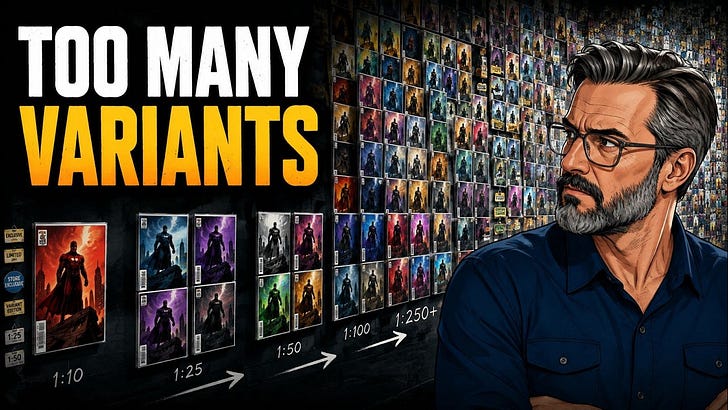
Why Variant Covers Keep Making the Comic Market More Fragile
from Comical Opinions: Comics Reviews for Image, Dynamite, Zenescope, And More Hosted by Gabriel Hernandez
Variant covers now make up 78% of DC's SKUs and 79% of Marvel's. That's not a collector fad, it's a business model. And it might be the same mistake the comic book industry made in the 1990s, just running a more sophisticated version of it. In this Pattern & Post-Mortem deep dive, I break down the real mechanism behind comic book variant cover inflation. Not "there are too many covers," but the feedback loop where publishers, retailers, and collectors all have a short-term reason to keep the machine running until demand breaks. We trace it from the variants that started it all, through the 1990s speculator boom that crashed the direct market, to the 2026 ICv2 retailer data showing variants generating 33–43% of dollar sales despite being "only" a slice of unit sales. Then we get into the ratio-incentive system (1:25, 1:50, 1:100) that quietly turns a collectible into a hidden order requirement — and who actually eats the risk when a hot book cools off. This is a comic book investing and comic collecting conversation as much as a comic book news one: if you've ever wondered why your local shop's pull list is drowning in variants, or whether that cgc-graded 1:100 you're chasing represents real demand or manufactured scarcity, this is the video. What we cover: 🔴Why variant covers weren't the original problem (they solved a real one) 🔴The 1990s warning: mistaking collector enthusiasm for durable readership 🔴How the ratio-incentive system shifts risk from publisher to retailer 🔴The 2026 ICv2 numbers that prove the industry can't just walk away from variants 🔴Marvel's Midnight experiment and what "curated" variants might look like 🔴The real test: what happens when the next hot book stops being hot ⏱️ Timestamps 00:00 – Hook: The variant contradiction 00:26 – Why this matters even if you never buy a variant 02:12 – Stage 1: The original idea wasn't bad 04:04 – Stage 2: The 1990s warning 05:55 – Stage 3: The ratio incentive changes the game 07:53 – Stage 4: The feedback loop (SKU, ratio, price & attention inflation) 09:35 – Stage 5: The 2026 evidence — dependency, not domination 11:29 – Nuance & counterpoints (variants make money, collectors aren't the enemy) 14:32 – Forward implications: what to watch for next 18:08 – The Judge's ruling + final questions Drop a comment: do variant covers make you more likely to buy a comic — or more likely to skip it?Join the Comic Shop Survivor membership ($4.99/mo) for early access, deeper data breakdowns, and the discussion threads behind every ruling. Link: https://www.youtube.com/channel/UCMXGnS8aCd_WXackzDVJpHA/join #VariantCovers #ComicBooks #MarvelComics #DCComics #ComicBookIndustry #ComicCollecting #ComicBookInvesting #DirectMarket #CGC #ComicBookSpeculation #ComicalOpinions This is a public episode. If you would like to discuss this with other subscribers or get access to bonus episodes, visit comicalopinions.substack.com
Embed this episode
No transcript yet.