
EPISODE · Jun 3, 2026 · 7 MIN
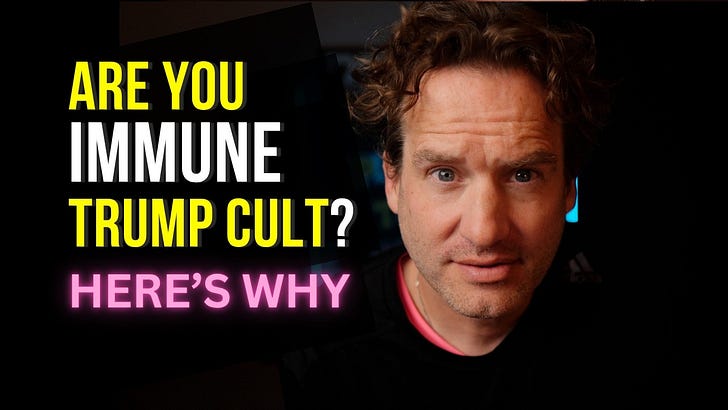
Why You Are Immune to Trump Cult
from The Lucas Bean Show · host Lucas Bean
There are four psychological reasons. You probably have at least one of them.I have been trying to understand this for years.Why can I see so clearly what Trump is and yet 30 - 40 million Americans have fallen under his spell?So I went back into the research on cults, authoritarian psychology, and con artistry to find out why certain people are completely immune to the Trump cult and to political propaganda in general.Right now roughly 70% of Americans reject Trump. The other 30% still follow him blindly.There is a psychological reason for that.Here are the four psychological reasons certain people are immune.1. Education and ExposureThe largest group of people who are immune got there through education and meaningful exposure to people who are not like them.When you are educated, you learn how to evaluate evidence. You learn the scientific method. You learn how to spot logical fallacies. You learn from experts how to solve problems using facts, data, and peer-reviewed research.You also learn that being wrong is not a catastrophe. If you do not study hard enough, you get a bad grade. You fix it and move on. Being wrong is part of learning. Admitting you are wrong is a strength, not a weakness.But education alone is not enough.You also need exposure to people who are different from you. Different races, different religions, different backgrounds.In 1954, psychologist Gordon Allport published a theory that became one of the most tested ideas in all of social science. He called it intergroup contact theory.The idea is simple. When you have real, meaningful personal contact with people who are different from you, it becomes much harder to dehumanize them.Pettigrew and Tropp confirmed this in a 2006 meta-analysis covering 515 independent studies, 38 countries, and more than 250,000 participants. Greater contact with outgroups reliably reduced prejudice across virtually every demographic studied.School is where most people get both. You learn how to think. You work alongside people from different backgrounds on group projects, in sports, at dinner. You realize they have the exact same problems you do. The same fears. The same basic needs.So when Trump shows up claiming immigrants are the problem, or that he alone can fix it, you recognize those as lies immediately. You have actually sat across a table from the people he is talking about. You know them.2. A Strong Moral Foundation from a Healthy FamilyThis group is immune because they grew up in families that actually lived their values. Not performative religion. Actual compassion, empathy, and integrity.Their parents taught them to treat people with kindness and modeled that behavior themselves.Research on moral development shows that children raised with warmth and consistency develop an internalized moral compass. These children learn to consider other people’s perspectives. They develop moral reasoning built on care and fairness, not fear and compliance.They know cruelty is wrong. They know lying is wrong. They know humiliating people is wrong.So when Trump mocked a disabled reporter on live television, when he calls people names, when he calls for violence at his rallies, this group was disgusted. Not because of bad policy. Because it violated something wired into them at a foundational level.Once you know what good looks like, you tend to reject bad when it comes along.3. Being the Scapegoat in an Authoritarian HouseholdThis group is immune because they have seen abusive behavior before. Up close. From someone they were supposed to be able to trust.If you grew up in a toxic household as the black sheep, you were targeted by the authoritarian parent. You were the one who was always wrong. Always too sensitive. Always the problem.The authoritarian parent taught the rest of the family one thing: it is acceptable to hurt the scapegoat if the scapegoat does not comply.Your refusal to fall in line exposed the central lie everyone had agreed to live by. The lie that the parent was always right. That made you dangerous.Research on narcissistic and authoritarian family systems consistently finds that the scapegoat is typically the most empathetic and perceptive child in the family. They were not chosen randomly. They were targeted precisely because their empathy, curiosity, and willingness to question things threatened the authoritarian parent’s control.To survive, they developed something psychologists call hypervigilance. Their nervous system learned to scan constantly for threats and manipulation. For patterns of control. For the gap between what someone says and what they actually do.When Trump showed up, this group recognized him immediately. Not as a politician. As their abusive parent. The gaslighting. The cruelty. The demand for total loyalty. The punishment for any dissent.But their siblings, the ones who learned that obedience meant safety, see something different. They see power. They recognize Trump as the authority figure they have been conditioned to submit to. And for once, they are on the side doing the forcing instead of being forced.The scapegoat knows exactly how that feels and how wrong it is. They are not falling for it again.4. Professional Experience With Con ArtistsThis group is immune because they have already been in the room with people like Trump. They have dealt with con artists professionally.If you have built businesses, negotiated deals, or worked in sales long enough, you have seen every manipulation tactic there is. You know what it looks like when someone overpromises and underdelivers. When someone blames everyone else for their own failures. When someone takes credit for work they did not do.Research by Luka Koning at the University of Twente, published in 2024, identified fraud knowledge as one of the strongest predictors of fraud avoidance. People who understood how con artists operate were significantly less likely to be victimized. The mechanism was direct: you cannot recognize a pattern you have never seen.So when Trump showed up claiming to be a brilliant businessman while bankrupting casinos, promising to make America great again while manufacturing his own products in China, pledging to hire the best people while surrounding himself with criminals and yes-men, this group saw through it immediately.They have professional experience spotting fake promises. They are not falling for it again.What This MeansIf you are one of the 70% who reject Trump, you probably fall into at least one of these four categories.You are not crazy. You learned how to evaluate evidence. You have had meaningful exposure to people different from yourself. You were raised with a moral compass that actually works. Or you survived an authoritarian environment and came out the other side with a finely tuned radar for abuse.Trump’s supporters do not see the abuse. They see an authoritarian parent whose power they have been conditioned to submit to.And this is the part that is hardest to accept.His supporters are not going to wake up. Not because they cannot. Because they do not want to.The siblings who submitted to authority in childhood learned that obedience meant safety. That compliance was the only path to belonging. They have been looking for that authority figure ever since. Trump gave it to them.For them, watching protesters get beaten is not disturbing. It is a relief. For once they are on the side doing the forcing instead of being forced. If you resist and win, it means they were cowards. So they need you to comply. They need everyone to comply.The scapegoat refuses. The educated person refuses. The person with the working moral compass refuses. The person who has seen a con artist up close refuses.That refusal is not just political disagreement.It is a psychological immune response.You were built for exactly this moment. And whether you know it or not, that is exactly what you are doing.Holding the line.Watch on YouTube Here.Sources* Allport, G. W. (1954). The Nature of Prejudice. Addison-Wesley.* Pettigrew, T. F., & Tropp, L. R. (2006). A meta-analytic test of intergroup contact theory. Journal of Personality and Social Psychology, 90(5), 751-783. [515 studies, 38 countries, 250,493 participants]* Kohlberg, L. (1984). The Psychology of Moral Development: The Nature and Validity of Moral Stages. Harper & Row. [foundational research on moral development in children]* Baumrind, D. (1991). The influence of parenting style on adolescent competence and substance use. Journal of Early Adolescence, 11(1), 56-95. [research on authoritarian vs. authoritative parenting and child outcomes]* Gemmill, G. (1989). The dynamics of scapegoating in small groups. Small Group Research, 20(4), 406-418.* Rothschild, Z. R., Landau, M. J., et al. (2012). A dual motive model of scapegoating: Displacing blame to reduce guilt or increase control. Journal of Personality and Social Psychology, 102(6), 1148-1161.* Mandeville, R. (2020). Rejected, Shamed, and Blamed: Help and Hope for Adults in the Family Scapegoat Role. [clinical research on family scapegoating abuse and hypervigilance in scapegoated children]* Koning, L. (2024). Fraud: Studies into Victimization and Prevention [PhD Thesis]. University of Twente. https://doi.org/10.3990/1.9789036563093 [identifies fraud knowledge as a key predictor of fraud avoidance] This is a public episode. If you'd like to discuss this with other subscribers or get access to bonus episodes, visit lucasbean.substack.com/subscribe
Embed this episode
Ready to play
Why You Are Immune to Trump Cult
No transcript for this episode yet
Similar Episodes
No similar episodes found.
Similar Podcasts
No similar podcasts found.