
EPISODE · Aug 9, 2026 · 13 MIN
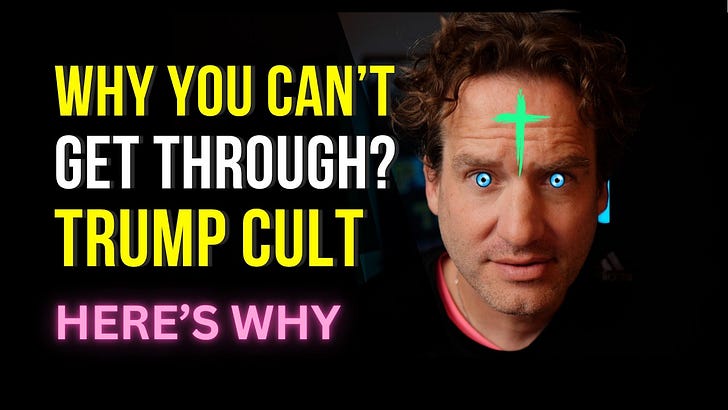
Why You Can’t Get Through to a Trump Supporter
from The Lucas Bean Show · host Lucas Bean
You have tried everything.You showed them evidence. They dismissed it. You showed them video. They said it was fake. You showed them court documents. They said the courts were corrupt. You showed them the conspiracy theory falling apart and they found another one to replace it.Nothing works.And it is not because you are doing it wrong. It is because what you are up against is not a difference of opinion. It is a psychological architecture that was built, layer by layer, to make sure the truth never gets in.Here are the seven psychological reasons it does not work, and the research behind each one.1. The Word BlockYou have seen this happen in real time. You make a point. A good one. Sourced. Specific. Undeniable. And the person you are talking to just stops listening. Their eyes glaze. A phrase comes out of their mouth before your sentence even finishes landing.Fake news. Witch hunt. Deep state. TDS.This is not a rebuttal. This is a reflex.In 1961, psychiatrist Robert Lifton published one of the most important studies ever conducted on psychological control. He had spent years interviewing survivors of Chinese Communist thought reform programs. What he documented was not just political indoctrination. It was a systematic method for shutting down the human capacity to think.Lifton identified eight criteria of thought reform. One of them was what he called thought-terminating cliches. These are short, emotionally loaded phrases that a person learns to deploy the instant an uncomfortable thought begins to form. The phrase fires before the thought can complete itself. The brain shuts down the process and the person moves on, never having engaged with the idea at all.The mechanism works through repetition. A leader says the phrase over and over. He attaches it to fear and anger. He ties it to the group’s identity. Eventually the phrase becomes automatic. The follower does not choose to say it. The follower’s brain produces it the way your hand pulls back from a hot stove. It is a trained response, not a decision.Trump said “fake news” over 2,000 times in his first term alone. That was not because he believed it every time. It was because repetition is how you install a thought-terminating cliche. Say it enough times, in enough emotional contexts, and the phrase becomes a wall that activates the moment threatening information appears.This is why a Trump supporter can kill hours of careful argument with two words. The argument never reaches the part of the brain that evaluates it. The wall goes up first.Lifton documented this same technique in every cult he studied. It works because the person using it has no idea it is happening. A Trump supporter who says “fake news” genuinely believes they are thinking. They are not. They are running a program someone else installed.Thought-terminating cliches did not create hateful people. They turned off the part of the brain that used to feel guilty about being hateful.2. The Significance QuestBefore Trump, a large number of these people were invisible.Their towns were losing population. Their industries were gone. Their communities were hollowing out. Nobody in media talked to them. Nobody in politics visited them. They did not matter to anyone and they knew it.Then a man showed up on a golden escalator and said: I see you. You matter. You are the real Americans.He was lying, of course. But the lie filled a void that nothing else was filling.In 2014, psychologist Arie Kruglanski at the University of Maryland published a study on why ordinary people join extremist movements. His research spanned multiple countries and included interviews with former terrorists, political radicals, and members of violent groups. What he found surprised nearly everyone in the field.The primary driver of radicalization was not ideology. It was not hatred. It was not even politics.The primary driver was the need to feel like your life matters.Kruglanski called this significance quest theory. The theory identifies three ingredients that push a person toward extremism: a need for personal significance that is not being met, a narrative that tells the person how to earn that significance, and a network of people who reinforce both the need and the narrative.When someone feels that their life has no meaning, they become vulnerable to anyone who offers them a mission. The content of the mission is almost secondary. What matters is the feeling of purpose it provides.Trump gave millions of people that feeling. He told them they were not just voters. They were patriots fighting a secret war against forces trying to destroy the country. Conspiracy thinking amplified the feeling even further. They were not just supporters. They were the ones who could see what everyone else was too blind to see.A person working a dead-end job with no direction gets handed a red hat and told he is saving America from a global conspiracy. That is not politics. That is the first time that person has ever felt like his life had a purpose.When you try to get through to a Trump supporter, you are not asking them to change a political opinion. You are asking them to become a nobody again. You are asking them to go back to the emptiness that existed before Trump filled it.They would rather believe the lie than go back to being invisible.3. The Need to BelongAs a person goes deeper into MAGA, something else starts to happen. They lose people.Friends stop calling. Family members pull away. Coworkers avoid them at lunch. Holiday dinners become arguments. Relationships that took decades to build collapse in a single conversation.And every one of those people gets replaced by another Trump supporter.In 1995, psychologists Roy Baumeister at Case Western Reserve University and Mark Leary at Wake Forest University published one of the most cited papers in social psychology. They reviewed decades of research on human connection and concluded that the need to belong is one of the most powerful drives in the human brain. It is not a preference. It is a requirement. People will tolerate almost anything, including abuse, deception, and the destruction of their own interests, to maintain the feeling of belonging to a group.Baumeister and Leary showed that when belonging is threatened, the psychological consequences are severe. Anxiety. Depression. Physical health decline. The brain processes social exclusion using the same neural pathways it uses to process physical pain. Being cut off from a group does not just feel bad. It registers in the body as an injury.Now think about what this means for someone whose entire social world has been reorganized around MAGA. Their friends are MAGA. Their family members who still talk to them are MAGA. Their social media is MAGA. Their news is MAGA. Their sense of humor, their language, their daily rituals are all organized around the group.The shared secret is the glue. Conspiracy thinking is not a bug of this community. It is the bonding mechanism. They share the same theories. They repeat the same phrases. They tell each other they are the smart ones, the awake ones, the ones who figured out what everyone else cannot see.That bond is stronger than friendship. It has to be, because for most of these people it is the only bond they have left.You are not asking a Trump supporter to reconsider a belief. You are asking that person to lose every friend they have. And the research says the human brain will choose the lie over loneliness almost every time.4. The Sunk Cost of ShameA Trump supporter does not just defend Trump. They defend every single thing they have ever said and done in Trump’s name.Every argument. Every Thanksgiving dinner they ruined. Every friendship they blew up. Every post they made. Every yard sign they planted. Every dollar they donated.Admitting Trump is wrong does not just mean changing a vote. It means admitting the last ten years of their life were wrong. That they were the problem. That everyone who tried to warn them was right.And they cannot handle that.In the 1970s, psychologist Barry Staw at UC Berkeley studied what happens when people invest heavily in a failing course of action. He gave research subjects the choice to either cut their losses or double down after receiving clear evidence that their initial decision was failing. The rational choice was to stop. Almost nobody stopped.Staw found that when people have invested significant resources, time, emotion, money, or reputation into a decision, they do not pull back when the decision starts to fail. They escalate. They put in more. They commit harder. Because stopping would mean the original investment was wasted. And admitting waste triggers a psychological pain that most people will do almost anything to avoid.Staw called this escalation of commitment.Applied to MAGA, the mechanism is devastating. Every act a Trump supporter has committed in service of the movement becomes a weight that holds them in place. The more they have sacrificed, the harder it becomes to leave. Not because the movement is getting better. Because leaving would force them to confront the full cost of what they have already done.They cut off a sister over a political argument. They screamed at their kids for questioning Trump. They posted things online that are now permanently attached to their name. They donated money they could not afford. They repeated lies that hurt people they claimed to love.If they stop now, every one of those acts stands alone. Unjustified. Unforgivable.But if they keep going, the original acts become necessary steps in a larger mission. The mission is not over yet. There is still a chance to be right. As long as they never stop, they never have to look back.The truth does not set these people free. The truth makes them a fool. And their ego cannot survive that.5. Mutual DestructionCults do not just make you believe. Cults make you participate.This is a design feature, not an accident. The deeper a person’s participation, the harder it becomes to leave. Because leaving does not just mean walking away from a belief. It means turning on yourself.In 2009, psychologist William Swann at the University of Texas published a study on what happens when people share extreme experiences with a group. Swann found that once people go through something intense together, their personal identity fuses with the group identity. The boundary between who they are as an individual and who they are as a member of the group disappears.Swann called this identity fusion. Once fusion happens, an attack on the group feels like an attack on the self. Leaving the group feels like losing yourself.MAGA engineered this on January 6th. Thousands of people committed federal crimes together in a failed insurrection at the Capitol. Some of them streamed it live while they were doing it. They implicated themselves and each other in crimes that carry years in prison.That is not an accident. That is how shared complicity works. Once everyone has blood on their hands, nobody can leave without exposing themselves.But January 6th was just the most visible moment. The fusion started much earlier. First they supported Trump. Then they defended his lies. Then they excused his cruelty. Then they attacked anyone who questioned him. Then they spread conspiracy theories that got people killed. Each step bonded them deeper into the group.They go down, you go down. That is the arrangement.And where was the leader on the day of the failed insurrection? Watching it on television.6. The Propaganda MachineEvery single day, Fox News, Newsmax, Truth Social, and right-wing podcasts tell Trump supporters the same story with the same villains.The media is corrupt. The courts are rigged. The Democrats are evil. Republicans who turn on Trump are traitors.The same message. Every day. From every source they trust.In the 1960s, communications researcher George Gerbner at the University of Pennsylvania began studying what happens when people hear the same message over and over again from every source they consume. Gerbner spent decades on this research. What he found was that repeated exposure to a consistent narrative does not just inform people. It replaces what people believe is real.Gerbner called this cultivation theory. The theory shows that when every source a person trusts tells the same story, the story stops being a story. It becomes reality. The person’s own experience stops mattering. The message itself becomes their lived truth.This is why real news reporting something bad about Trump registers as “fake news” to his supporters. Their entire information environment has already told them the media is the enemy. When courts rule against Trump, those are corrupt judges. When Republicans break with Trump, those are traitors. There is no outside source they trust anymore.Every piece of evidence that proves them wrong just proves the conspiracy is bigger than they thought.Right-wing media is the machine that keeps the cult alive. It is the delivery system for the thought-terminating phrases. It reinforces the conspiracy theories. It feeds the feeling of significance. It keeps every single psychological lock on this door sealed shut, every single day.Without right-wing media, the whole thing falls apart.7. The Dunning-Kruger EffectThe least informed Trump supporters are always the most confident.They have never read a court filing. They have never read the Constitution. They have never studied history, psychology, or political science. But they will tell you with absolute certainty that they understand what is really going on better than every expert in the country.In 1999, psychologists David Dunning at Cornell University and Justin Kruger at the University of Illinois ran a series of experiments testing people on logic, grammar, and humor. They found a pattern that has become one of the most referenced findings in modern psychology.The people who scored the lowest rated their own abilities the highest. The people who scored the highest rated themselves average.The reason is almost elegant in how simple it is. Recognizing incompetence requires the same skills as competence. If you do not know enough about a subject to evaluate the subject, you also do not know enough to evaluate yourself. You do not know what you do not know. And because you do not know what you do not know, you assume you know everything.This is the Dunning-Kruger Effect. And it shows up everywhere in conservative politics.Doctors spend twelve years studying medicine. A Trump supporter spent twenty minutes on Facebook and now they have “done their own research.” Climate scientists have decades of data. A Trump supporter saw snow yesterday and thinks that settles the debate. Virologists devoted their careers to studying pandemics. A Trump supporter watched a YouTube video and decided COVID was a hoax.Real experts doubt themselves constantly. They know how complex things are. They understand the limits of what they know. When they speak, they use careful language. They say things like “the data suggests” or “based on current evidence.” Trump supporters hear that measured language and interpret it as weakness. If the expert is not 100% certain, then it is not true.Meanwhile, the person who knows the least speaks with the most confidence. And right-wing media keeps giving them a platform to do it.Why None of This Has WorkedIf you have been trying to get through to someone you love and nothing has worked, it is not because you failed. It is because you are fighting against seven psychological barriers that were designed, whether intentionally or not, to keep that person inside the system.You are not asking a Trump supporter to change their mind about politics. You are asking them to lose their sense of importance, their purpose, their community, their identity, and their certainty about things they have staked their entire social life on.None of these people are strong enough to survive that. So they choose to believe the lie. And they will keep choosing the lie until the lie collapses under its own weight and brings them back to reality.And when it does collapse, they will not admit they were wrong. They will not apologize. They will not take responsibility for the damage they caused. They will do what they have always done. They will quietly take the hat off. Delete the posts. Try to walk back into polite society like none of it ever happened.They think we will just let them back in with no accountability.They are wrong.SourcesLifton, R. J. (1961). Thought Reform and the Psychology of Totalism: A Study of “Brainwashing” in China. W. W. Norton.Kruglanski, A. W., Gelfand, M. J., Belanger, J. J., Sheveland, A., Hetiarachchi, M., & Gunaratna, R. (2014). The Psychology of Radicalization and Deradicalization: How Significance Quest Impacts Violent Extremism. Political Psychology, 35(Suppl. 1), 69-93.Baumeister, R. F., & Leary, M. R. (1995). The Need to Belong: Desire for Interpersonal Attachments as a Fundamental Human Motivation. Psychological Bulletin, 117(3), 497-529.Staw, B. M. (1976). Knee-Deep in the Big Muddy: A Study of Escalating Commitment to a Chosen Course of Action. Organizational Behavior and Human Performance, 16(1), 27-44.Swann, W. B., Gomez, A., Seyle, D. C., Morales, J. F., & Huici, C. (2009). Identity Fusion: The Interplay of Personal and Social Identities in Extreme Group Behavior. Journal of Personality and Social Psychology, 96(5), 995-1011.Gerbner, G., Gross, L., Morgan, M., & Signorielli, N. (1986). Living with Television: The Dynamics of the Cultivation Process. In J. Bryant & D. Zillmann (Eds.), Perspectives on Media Effects. Lawrence Erlbaum Associates.Dunning, D., & Kruger, J. (1999). Unskilled and Unaware of It: How Difficulties in Recognizing One’s Own Incompetence Lead to Inflated Self-Assessments. Journal of Personality and Social Psychology, 77(6), 1121-1134. This is a public episode. If you'd like to discuss this with other subscribers or get access to bonus episodes, visit lucasbean.substack.com/subscribe
Embed this episode
Ready to play
Why You Can’t Get Through to a Trump Supporter
No transcript for this episode yet
Similar Episodes
No similar episodes found.
Similar Podcasts
No similar podcasts found.