
Oh, wait, you're listening. All right. All right. You are listening to Radiolab.
Radiolab. Sure. From WNYC. And NPR.
Hey, I'm Jan Abumran. I'm Robert Kroler. This is Radiolab, the podcast. And in this podcast, how would you describe this one?
My sense is that you walk into a wild place and you hear the wind and trees and you hear these chirps and sounds and calls. And they're just part of the, they're part of the wild. They're wildlife. But there's now a group of scientists who listen much more closely and who are reducing wildlife to wild talk.
It's, it's, uh, there are words in there. When you find the words, as the people we will meet do in these stories, you end up not just understanding but actually entering that wild space in a very cool way. So we're going to tell you two tales here. Two different places.
The first, a jungle. And the second, a prairie. Right. Jungle gets it started.
And then the prairie later. This is the story, this first one, that we heard about. Yeah, yeah. From Ari.
I'm Ari Daniel Shapiro. I'm a public radio producer in Boston. And Ari recently met a guy. He's a German.
He's, uh, he's Swiss. No, his name's Klaus Zuberbuehler. Hey, Ari, it's Klaus. And he's a professor of psychology.
At the University of St. Andrews. Which is in Scotland. And where does the story actually take place?
Where's the jungle? Yeah. Well, maybe the best place to start is to kind of describe the scene where we are. Which is in the Thai Forest.
Thai Forest? Which is in the Ivory Coast in Africa. So it's not in Thailand? No, it's not.
It's T-A-I. T-A-I. Okay. And Klaus describes the jungle as this thick sensory world.
Very dark, very moist, and very, very green. And you can't really see for more than 15 to 20 feet. And, I mean, sometimes you feel like you walk through, you know, a big cathedral of dark trees and you don't see very much because all the animals, obviously very shy and run away. I mean, is it still?
No, it is very, very noisy. It's again, it's just this kind of sonic chaos. All these insects and birds and bats and mammals, it is almost as if they compete for acoustic space. So it is very, very loud.
I mean, the main sensation you have in the beginning really is that you're just completely lost. So, it's 1991, and they figured he had to start somewhere. So he focuses attention on a kind of monkey. Very beautiful monkey, I think.
Called the Diana Monkey. There's a mix of black, white, and sort of reddish. Diana Monkeys live up in the treetops, which can be as high as 100 feet off the ground. Wow.
They eat fruits and they eat insects, and they're chattering. Cacophony of calls. Which to him, of course, as a newcomer to the forest, was all just noise. Just a little bit, I imagine, like a child trying to learn a language, which initially must just sound like a string of sounds that you can't really understand, and then, you know, what?
So what did he do? Well, he started provoking the monkeys into making different kinds of noises. For instance, he'd walk out into the forest with a boombox and play the sound of the Diana Monkey's most feared predator, the leper. He would just play the sound into the trees, and all of a sudden, they start leaping around the branches, hopping around, and they make this one particular call.
You know, there's very loud alarm calls. This one here. Meaning what? Yeah, are they just saying, like, run?
Or is it something more specific? Well, here's where it gets a little bit more interesting. Next step, he brought that same cassette player out, pointed at the trees to play, and all that. Yep, but this time, he plays the shrieks of a clown's eagle.
Eagles eat monkeys? Yeah, they do. They're packed from a ball. I've heard about them.
They're very scary. They come flying in with their talons or their beaks, and they hit you in the head sharply and kill you instantly. Oof, and then you fall to the ground. Yeah, and so what do the monkeys do when they hear this?
They make that sound. Same one. Well, that's what he thought, but when he went back to the lab and started looking at the sounds on the computer, comparing one to the other, eagle, leopard, eagle, leopard, he realized that they're actually slightly different. In the acoustic details of the calls.
And it's something that's very difficult to hear when you really only see it in the spectrogram, which is kind of a visual representation of these calls. It's on the computer? Yeah. But interestingly, once you've seen that, and once you know what to pay attention to, you go out into the forest and suddenly you do hear these differences which you haven't heard before.
So you're saying when they hear a call leopard coming, they go up the tree, but when they hear an eagle coming, they run down the tree? Exactly. Exactly. It's really kind of like a word.
They, like a word. That's kind of amazing. Let's pull out for a second because this guy actually got us thinking, honestly, how much language actually is out there in the wild? What do we know?
What's the state of what we know right now? And that question led us out of the forest just for a second and to a place and a creature we just didn't think would be a part of this conversation at all. And that creature is the prairie dog. Prairie dogs.
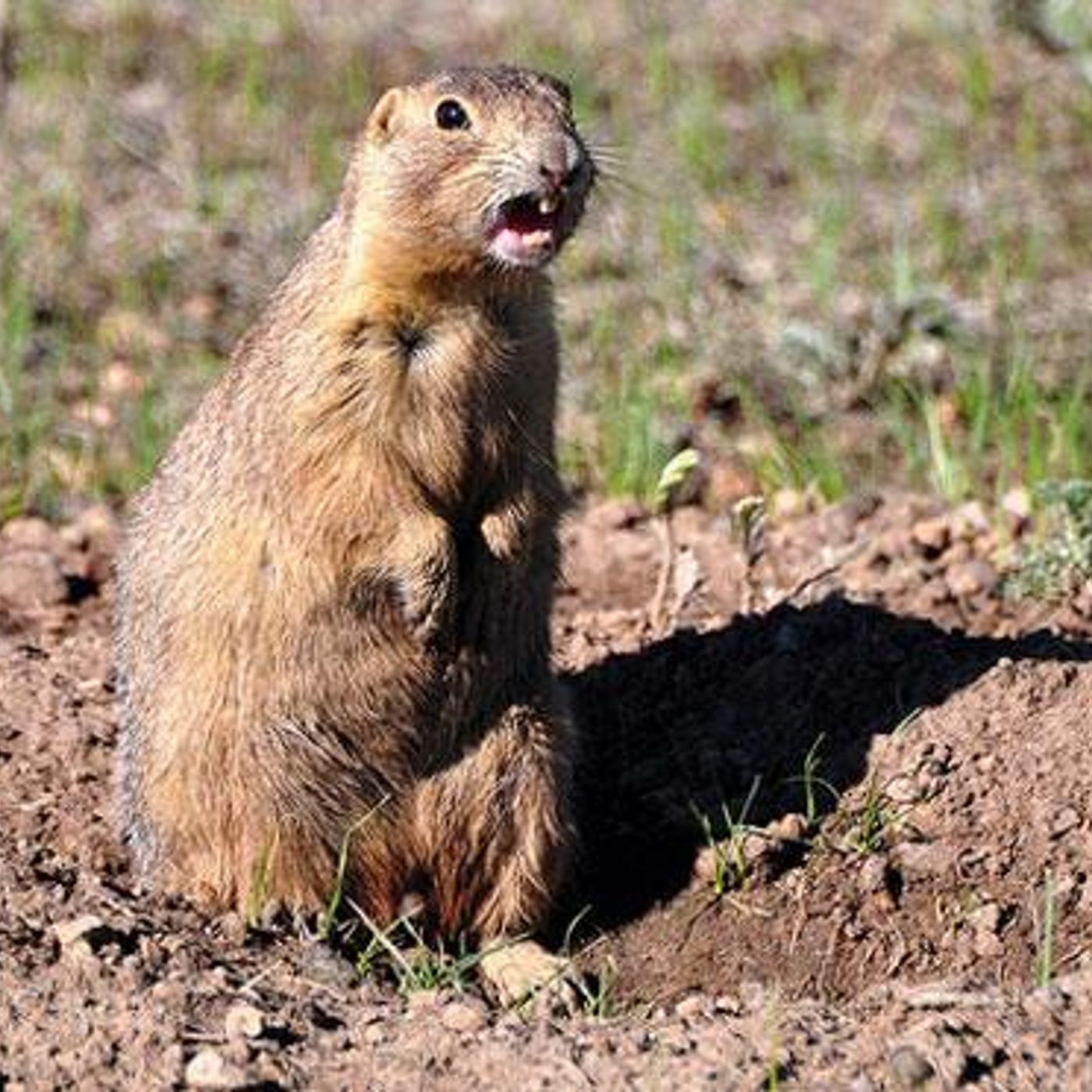
So here's the thing. Prairie dogs are these little rodent-like animals that live under the ground in burrows. And when their community is invaded, they pop out of the burrows. Oh, here comes the whatever.
Sounds kind of like chi-chi-chi-chi. Chi-chi-chi-chi. So we spoke with this guy. My name is Kanslabachikov, professor emeritus at Northern Arizona University who spent a whole lot of time sitting out in the colonies recording prairie dog calls.
And he now believes that these simple little rodents are like nature's wordsmiths. Well, the thing is that initially I recorded... For instance, he began by telling us that the prairie dogs have different kinds of cheese for different kinds of predators. For example, humans, coyotes, and ducks.
Right. Is this the kind of thing that we would actually be able to hear the difference between the calls? I'm guessing that you could hear the difference. Want to try that?
Yeah. So can you just play those samples? All right, so here's one. This is another one.
All right. Here you go. This is the third. Those represent different predators?
Yep. I can't tell the difference. Can you? Do you know what they are?
My guess is human dog coyote. Conradite. Conradite. Wow.
Well, naturally, we wondered how... How did he do that? He told us that at first, he couldn't figure out how to distinguish between these sounds. But he took the sound back to the lab where we had a machine that allowed us to measure a series of frequency and time elements in the call.
And what this computer does is it takes the sound that the prairie dogs make and it essentially looks inside for the ingredients inside the sound. Yeah, like, uh... Well, it's kind of hard to hear with a chirp because it's just hard. So let me demonstrate crudely with this other sound.
I left this around in my library so this is kind of like a buzz. Okay. Okay? Let me see a little bit so we can hear better.
So here you've got this buzz which just sounds to us like a solid piece of noise but get an EQ and take away all the highs. So now you've got just the bass. Yep. Now, you'll notice if you add the highs back in real slowly these little hidden overtones will pop out like, uh...
There's one. Yep. There's another. Uh-huh.
Third. Yep. Fourth. Uh-huh.
So in other words, this sound is filled with little ghost notes that we can't hear and certainly the same is true with this sound. Except in the case of the prairie dogs it seems their ears are tuned to hear all the different sounds within the chirp. Probably sounds to them like this whole layer cake of tones. And Con's computer noticed that the noise they made when a human walked through their village was different in tone from the noise they made when a coyote walked through their village.
It was consistently different. But there was a problem. When he zoomed in on the... Uh-oh, here come the human calls.
Did you hear? What if they could be describing the individual humans? Oh. Now, at that time, no one suspected that this might even be a possibility.
But I thought, well, let's try it and see what happens. So, Con recruited four humans. And he had them dress exactly the same. Same boots, same blue jeans, same sunglasses, everything the same except the color of their shirts.
We had a person in a blue t-shirt, person in a green t-shirt, person in a yellow shirt, person in a gray shirt. Then he asked each one to walk through the prairie dog village. One by one. Prairie dogs made their trips.
And when we analyzed the results, there were significant differences. Like what kind? They essentially clustered around the colors. Does that mean you think you can hear them saying here comes the human in blue versus here comes the human in yellow?
Right. Really? Oh, I was astounded. I was astounded.
I was like, oh, wait a second. These humans, they're not just different in their shirt colors. They're different in all kinds of ways. Some of the humans were taller, some of the humans were shorter.
So we went back and reanalyzed the chirps, looked a little more closely, and we realized we could tease out the prairie dogs were also commenting about the general size of the human. Essentially, they were saying here comes the tall human in the blue versus here comes the short human in the yellow. Wow. And then he made another reason.
And it was just, you know, since he's on a roll. Off the wall idea at that time. He went back into the prairie dog field and he built two large wooden boxes sitting on stilts. A good distance from each other.
150 feet. And we strung wires between the two towers. His team then made cardboard cutouts of three different shapes. A circle, a square, and a triangle.
And then they ran them out along the wire, kind of like a laundry fluttering above you in the breeze. Each shape would emerge from one of the tower blinds and fly something like about three feet over the prairie dog town. So literally you would just kind of go and out would come a triangle or a circle or a square? Correct.
And what we found was that the prairie dogs could tell the triangle from the circle very easily. But they could not seem to tell the difference between a square and a circle. Huh. Why not?
Well, my guess is that triangles kind of look like hawks. Circles and squares kind of look like terrestrial predators. Nonetheless, what you've got here is a little rodent with a remarkably big vocabulary including, but probably not limited to, short, fat, skinny, tall, blue, green, yellow, gray, coyote, human, hawk, triangle, and a square. Yay!
It's not bad. Is the next step that you're going to perform a scene from The Winter's Tale and see whether the prairie dogs laugh at the right moments? What do you do next? Well, we just are scratching the surface of looking at this.
For example, prairie dogs have a lot of calls which we call social chatters. One prairie dog will be feeding and suddenly lift up its head and go chitter, chitter, chitter, chitter. And another prairie dog somewhere across the colony will lift up its head and go chitter, chitter, chitter, chitter. But what does it mean?
We have no way of getting at it. It could be just simply chitter, chitter, chitter. Or it could be do you know where Sam was last night? Now, here's an interesting question.
I mean, if a French couple were sitting next to me on the subway and they were saying do you know where Sam was last night? In French. If I don't speak French, I'm outside of that conversation. But a lot of people do speak French and they can listen to French people talking.
The question then is if you live in the forest and you speak chimp or you speak eagle or you speak snake would you ever be able to overhear or learn something from a neighborly species? In other words, is there an equivalent of listening to the other person talking French in the wild? Good question. And that brings us back to Klaus.
You remember Klaus? Yeah, the monkey guy. Yeah, the monkey guy. Well, Klaus was wondering the same thing.
And that's Ari Daniel Spiro again who introduces to Klaus. So take those alarm calls, for instance. He wanted to know whether different species of monkeys could understand each other. And luckily for Klaus, there's like at least ten different primate species living inside that Thai forest.
So there's one, allibus monkeys, two, spot-nosed monkeys, three, chimpanzees, four, gallagos, five, six, putty-nosed monkeys, seven, mangabee species, eight, prosimians, Campbell's monkeys, and then the dianas, ten. Yeah, so it's a very rich primate fauna. So Klaus's question was could diana monkeys understand the alarm calls of another one of these monkeys, the Campbell's monkey? Oh, could they go across monkey lines, so to speak?
Exactly. So he used that same setup from before. It's a good thing where he plays the sound into the trees. Yeah, and he played the eagle and leopard alarm calls from the Campbell's monkeys to the dianas to see if they'd react.
And what we found there to our great surprise was that the diana monkeys they understand it. Really? Yeah. They take the baby seriously and respond to it very strongly.
So a diana monkey hearing a Campbell's eagle alarm call will respond as though there were an eagle and will respond to the leopard alarm call as though there were a leopard. And vice versa. And it doesn't stop there. Klaus started playing the monkey calls the birds.
Such as hornbills? Yellow-casked hornbills? It turns out that they understand it. The birds?
Yeah, these hornbills are capable of discriminating these different monkey alarm calls. Wow. So it's a pretty substantial web species basically eavesdropping on each other's calls in these forests. But Klaus himself?
He was still on the outside of it all. It is that general sense of perhaps not really belonging there. But then... He told me about this one day.
I was working in the forest. He had gone out for the day and he'd gone out alone. And I was very far away from camp. And it was in the late afternoon and he realized that he should probably be heading back to camp.
Because I still had to walk for something like 15, 20 kilometers to go back to camp. And he was walking past it up in the valley. And then I heard on the other side of the valley a monkey group giving leopard alarm calls which doesn't happen that often. It was the first time that he wasn't actively listening but he heard these monkeys make this call and recognized it.
He was absolutely striking. And he was actually quite excited by this. Because I was suddenly able to understand what the monkey's trying to say so to speak. Those monkeys had picked up a leopard.
Right beneath that sound there the leopard would be. Right. But you know those monkeys were way across the valley. So I didn't really think that much and walked on perhaps you know half a mile further down the road.
And the next group of diana monkeys still across the valley started giving leopard alarm calls as well. And he kind of took notice of that. And then it happened a third time a few minutes later. What became clear to me very rapidly is that a leopard was tracking him.
Of course I couldn't see it because he was in a dance force but I assumed that the leopard saw me. Of course it's just one of these moments where you're totally alone far far away from camp. What does he do? He kept walking.
It happened. The fourth group called leopard. Fifth group called leopard. And then the group stopped calling.
The only thing I could think of is to pick up a large branch. I shouldn't laugh. This is terrifying. Would that stick have done anything for you?
I doubt I really would have been able to do very much with a stick. But as he's standing there sick in hand he realizes he's just entered the forest. He's become the 11th primate. The 11th primate.
Because there were those 10 other species of primate and now me. Suddenly I shifted from being the objective observer to being part of that whole crowd in there. Even though we're separated by 20-30 millions of years of evolutionary history these humble creatures were able to teach me something about what was going on in the forest. Of course it wasn't intentional they weren't trying to inform me or anything like that but it was a very emotional experience.
So what happened? I was eating Beneden. What happened? Well he made it back to camp and he's not sure what happened to the leopard.
The leopard must have slinked off into the forest. In the end it became just another story to pet each other over beers in the evening I suppose. Yeah. Yeah.
Yeah. Thanks for that story to Ari Daniel Shapiro our correspondent. And also thanks to Klaus Zuberbuehler and Kanslavachkov. I'm Dan Abumrad.
I'm Robert Goldberg. Thanks for listening.