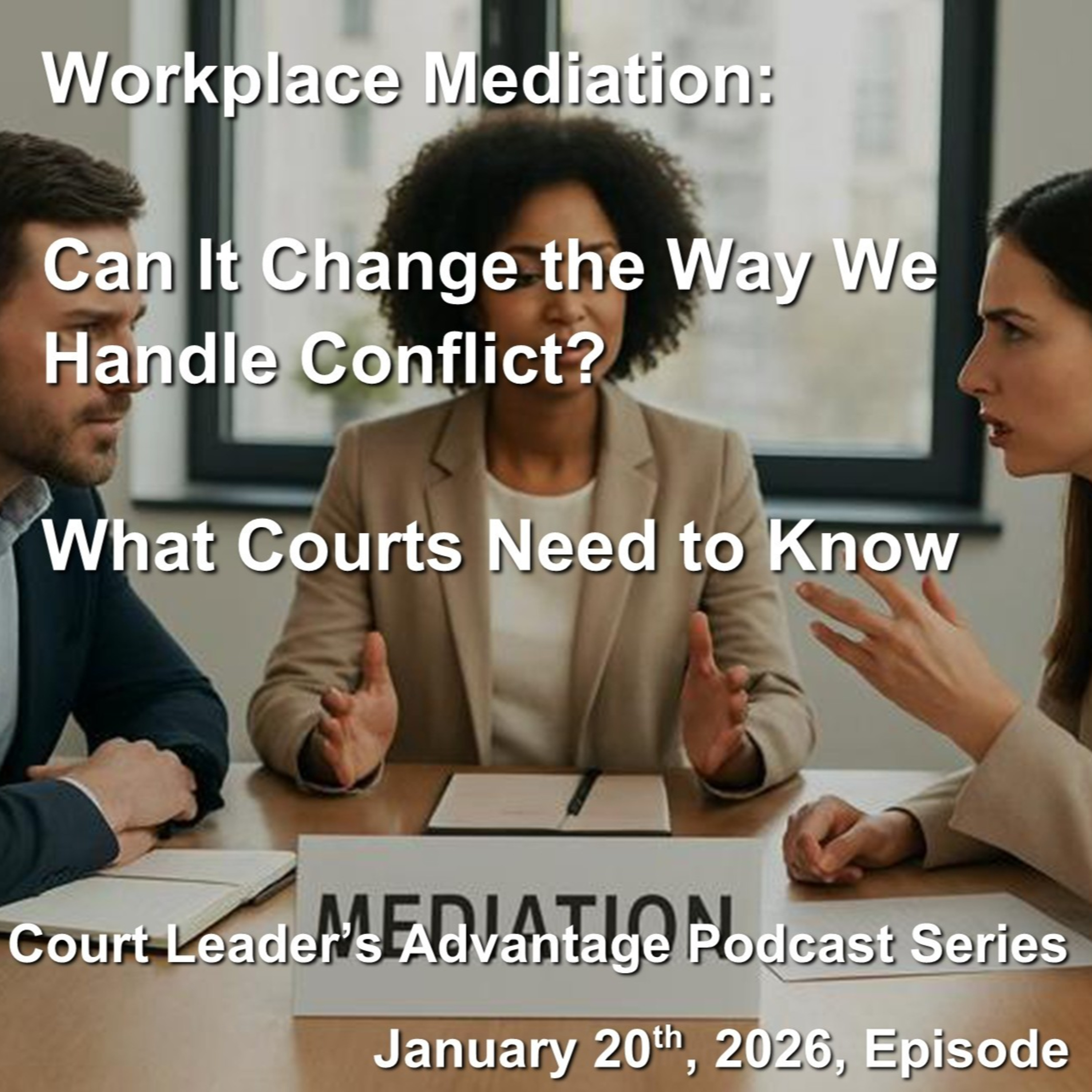
Workplace Mediation: Can It Change the Way We Handle Conflict? What Courts Need to Know episode artwork

EPISODE · Jan 19, 2026 · 30 MIN

Workplace Mediation: Can It Change the Way We Handle Conflict? What Courts Need to Know

from Court Leader's Advantage · host Peter C. Kiefer

Court Leader’s Advantage Podcast Episode ReleaseDate: January 20th, 2026Workplace mediation is rapidly becoming an accepted management tool across the U.S. Organizations facing rising conflict, legal exposure, and employee burnout are increasingly turning to mediation to resolve disputes and restore working relationships. In fiscal year 2024, the U.S. Equal Employment Opportunity Commission received more than 88,000 new discrimination and retaliation charges, a 9 percent increase from the prior year. At the same time, analysts project that the workplace mediation and conflict-resolution market will grow by more than 7 percent annually through 2030. These trends point to a simple reality: workplace conflict is increasing, and organizations are searching for better ways to manage it. The modern workplace itself is driving this change. Hybrid work, remote teams, generational turnover, and a more diverse workforce are creating new kinds of misunderstandings and tensions, many of which do not fit neatly into traditional HR investigations or disciplinary systems. Mediation offers a different model: one that emphasizes dialogue, accountability, and problem-solving rather than blame and punishment. Several forces are fueling the growth of workplace mediation. Employers are placing greater emphasis on employee well-being and mental health. They are alsorecognizing that mediation is typically faster, less expensive, and less disruptive than formal complaints, litigation, or turnover. At the same time, technology has made mediation more accessible, allowing parties to meet virtually and resolve disputes before they escalate. Yet mediation is not a cure-all. It requires both parties to engage in good faith. Some conflicts—particularly those involving serious misconduct or power imbalances—may not be appropriate for mediation. And when mediation is poorlydesigned or inadequately facilitated, it can do more harm than good. This month, we are taking a closer look at workplace mediation. Is resolving disputes through trained, neutral facilitators more effective than the traditional tools organizations rely on? And, most importantly for ouraudience, can this model be adapted to work inside the courts themselves?Today’s Moderator: Erika Schmid Judicial Clerk Supervisor at the Multnomah County Circuit Court in Portland, Oregon Today’s Panel: Teshrie (Tess) Kalicharan ADR Director for the Ninth Judicial Circuit Court in Orlando, FloridaBeth Moss Human Resources Director for the Alaska Court System, Jamie Giani founder of Third Branch Solutions in Wesley Chapel, Florida  Become Part of the Conversation Submit your comments and questions to: [email protected] Please take a moment to share this episode on your Facebook or LinkedIn pages. The more people we bring into this dialogue, the stronger our collective understanding of courts and court administration becomes.

Court Leader’s Advantage Podcast Episode ReleaseDate: January 20th, 2026Workplace mediation is rapidly becoming an accepted management tool across the U.S. Organizations facing rising conflict, legal exposure, and employee burnout are increasingly turning to mediation to resolve disputes and restore working relationships. In fiscal year 2024, the U.S. Equal Employment Opportunity Commission received more than 88,000 new discrimination and retaliation charges, a 9 percent increase from the prior year. At the same time, analysts project that the workplace mediation and conflict-resolution market will grow by more than 7 percent annually through 2030. These trends point to a simple reality: workplace conflict is increasing, and organizations are searching for better ways to manage it. The modern workplace itself is driving this change. Hybrid work, remote teams, generational turnover, and a more diverse workforce are creating new kinds of misunderstandings and tensions, many of which do not fit neatly into traditional HR investigations or disciplinary systems. Mediation offers a different model: one that emphasizes dialogue, accountability, and problem-solving rather than blame and punishment. Several forces are fueling the growth of workplace mediation. Employers are placing greater emphasis on employee well-being and mental health. They are alsorecognizing that mediation is typically faster, less expensive, and less disruptive than formal complaints, litigation, or turnover. At the same time, technology has made mediation more accessible, allowing parties to meet virtually and resolve disputes before they escalate. Yet mediation is not a cure-all. It requires both parties to engage in good faith. Some conflicts—particularly those involving serious misconduct or power imbalances—may not be appropriate for mediation. And when mediation is poorlydesigned or inadequately facilitated, it can do more harm than good. This month, we are taking a closer look at workplace mediation. Is resolving disputes through trained, neutral facilitators more effective than the traditional tools organizations rely on? And, most importantly for ouraudience, can this model be adapted to work inside the courts themselves?Today’s Moderator: Erika Schmid Judicial Clerk Supervisor at the Multnomah County Circuit Court in Portland, Oregon Today’s Panel: Teshrie (Tess) Kalicharan ADR Director for the Ninth Judicial Circuit Court in Orlando, FloridaBeth Moss Human Resources Director for the Alaska Court System, Jamie Giani founder of Third Branch Solutions in Wesley Chapel, Florida  Become Part of the Conversation Submit your comments and questions to: [email protected] Please take a moment to share this episode on your Facebook or LinkedIn pages. The more people we bring into this dialogue, the stronger our collective understanding of courts and court administration becomes.

NOW PLAYING

Workplace Mediation: Can It Change the Way We Handle Conflict? What Courts Need to Know

0:00 30:04

No transcript for this episode yet

We transcribe on demand. Request one and we'll notify you when it's ready — usually under 10 minutes.

TV 2 - Veien til EM TV 2 og Moderne Media Velkommen til TV 2's EM podkast. Dette er tidenes første EM-podkast fra TV 2. I dagene før kamper skal Jesper Mathisen, Jan-Henrik Børslid og Espen Solbakken m/gjester lade opp. God fornøyelse! For annonsering: [email protected] booking: [email protected] The Laura Ingraham Show Laura Ingraham The most-watched woman in the history of cable news brings her no-holds-barred political and cultural commentary to podcasting with The Laura Ingraham Show. A bestselling author, breast cancer survivor, and mother of three internationally adopted children, Laura was the most listened-to woman in talk radio before launching her own podcast. A trailblazer across media platforms, she brings a unique perspective to this twice-weekly show, drawing on her experience as a white-collar criminal defense litigator and a Supreme Court law clerk.New episodes drop twice a week—delivering the clarity, courage, and common sense America needs. Generally American (A Journey in American English) Christopher M. Chandler, Kris Schauer Hello, Hola, Guten Tag, Bonjour, こんにちは !Welcome everyone, this is a podcast for those wanting to learn about U.S. culture through Standard American English, also known as General American. We talk about various different topics related to the U.S. and the U.S.'s relations with other countries. My co-host and I would like to think of this as more of a journey because you never know where it’ll take us. Plus, since the journey’s more important than the end or the start, we hope that you’ll be willing to join us! Let’s see where it takes us! Rethinking Youth Ministry | A podcast for youth ministry leaders, pastors, volunteers, and anyone who cares about students OrangeStudents.com The Rethinking Youth Ministry Podcast is for youth ministry leaders, pastors, volunteers, workers, and anyone who cares about middle school and high school students. Each episode, we hope to raise the bar for youth ministry by asking questions, interviewing thinkers, and having real, honest conversations about what it looks like to lead the next generation. Rethinking Youth Ministry is a podcast from the Orange Students team. Our mission is to help you, the youth leader, influence the next generation. We do that through this podcast, other resources, and our weekly curriculum, XP3. If you'd like to learn more, check out OrangeStudents.com.

Frequently Asked Questions

How long is this episode of Court Leader's Advantage?

This episode is 30 minutes long.

When was this Court Leader's Advantage episode published?

This episode was published on January 19, 2026.

What is this episode about?

Court Leader’s Advantage Podcast Episode ReleaseDate: January 20th, 2026Workplace mediation is rapidly becoming an accepted management tool across the U.S. Organizations facing rising conflict, legal exposure, and employee burnout are increasingly...

Can I download this Court Leader's Advantage episode?

Yes, you can download this episode by clicking the download button on the episode player, or subscribe to the podcast in your preferred podcast app for automatic downloads.
URL copied to clipboard!