World Action Verifier: Self-Improving World Models via Forward-Inverse Asymmetry
from Best AI papers explained Hosted by Enoch H. Kang
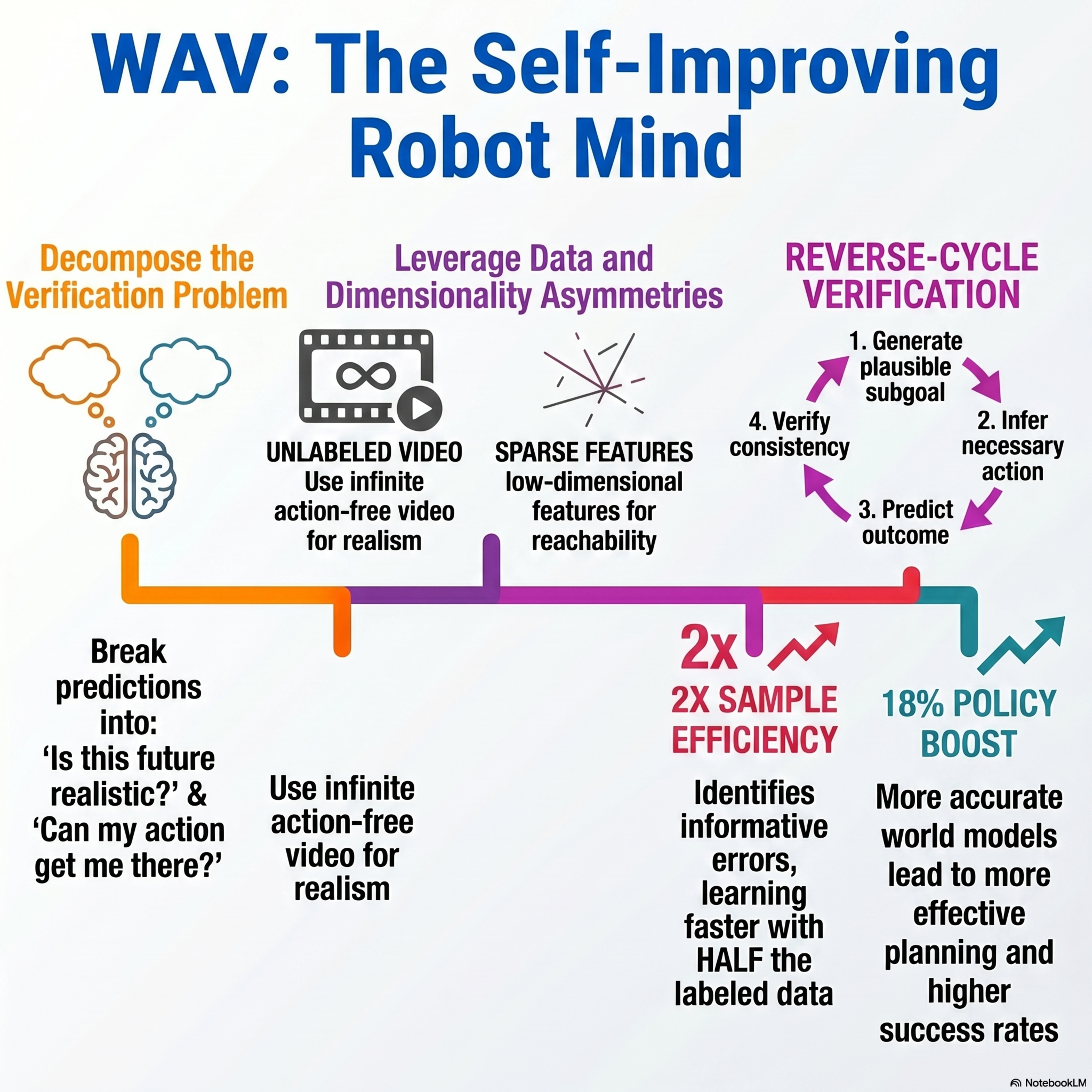
We discuss World Action Verifier (WAV), a novel framework designed to enhance the reliability and efficiency of action-conditioned world models in robotics. The authors address the difficulty of training models to follow actions accurately, especially when labeled interaction data is scarce. By exploiting asymmetries between forward and inverse dynamics, WAV decomposes the prediction process into state plausibility and action reachability. The system utilizes a subgoal generator trained on abundant action-free video data and a sparse inverse model to verify if predicted transitions match intended actions. Theoretical analysis and experiments across nine tasks demonstrate that this approach identifies prediction errors more effectively than standard methods. Consequently, WAV doubles sample efficiency and improves the performance of downstream robotic policies by 18%.
Embed this episode
No transcript yet.