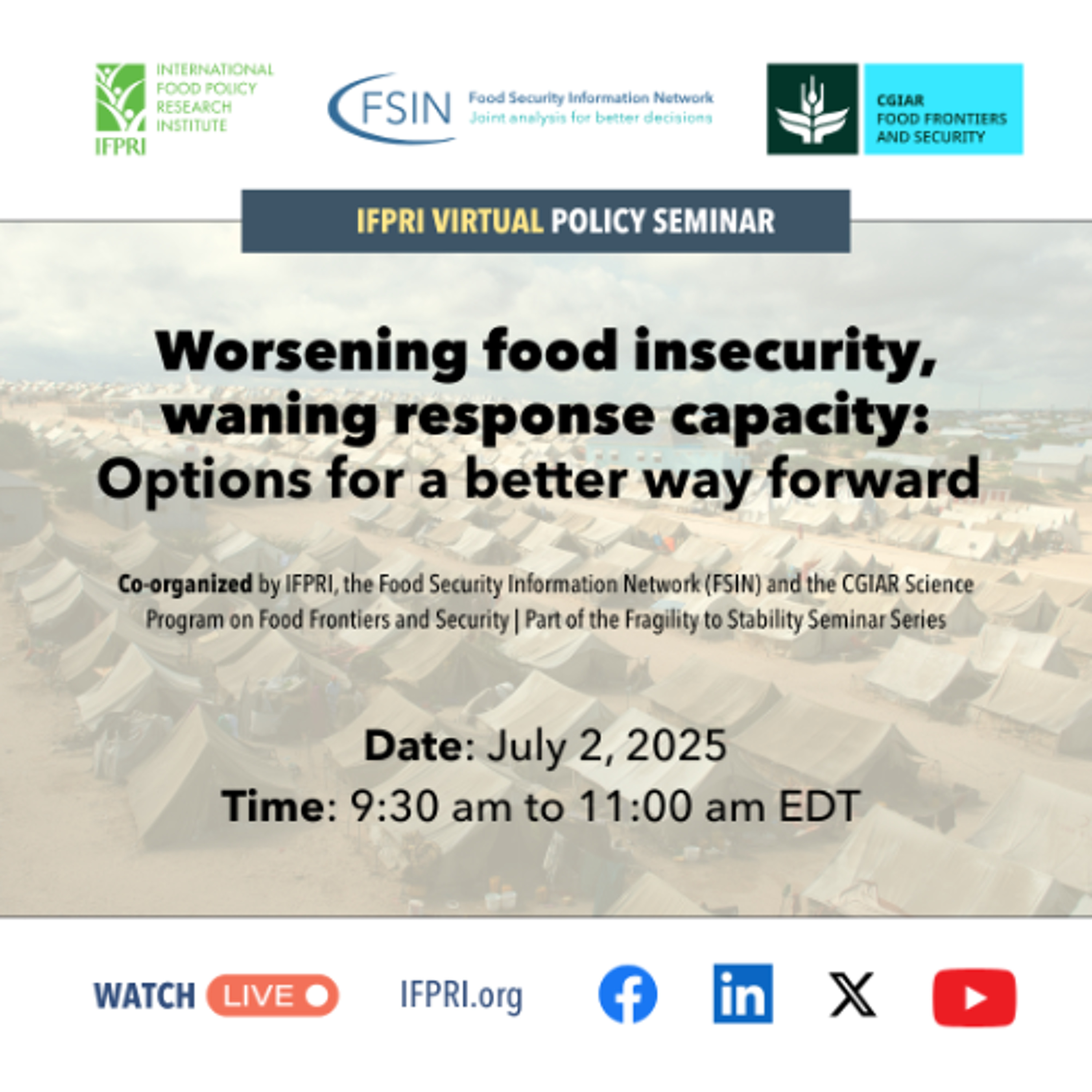
Worsening food insecurity, waning response capacity: Options for a better way forward episode artwork

EPISODE · Jul 2, 2025 · 1H 33M

Worsening food insecurity, waning response capacity: Options for a better way forward

from IFPRI Podcast · host International Food Policy Research Institute

Policy Seminar | IFPRI Policy Seminar Worsening food insecurity, waning response capacity: Options for a better way forward Co-organized by IFPRI, the Food Security Information Network (FSIN) and the CGIAR Science Program on Food Frontiers and Security | Part of the Fragility to Stability Seminar Series July 2, 2025 Food crises arise from the complex interplay of conflict, poverty, climate variability, and economic shocks, resulting in acute food insecurity among vulnerable populations. According to the latest Global Report on Food Crises (2025), the number of people facing severe levels of acute food insecurity has tripled over the past decade, rising from around 100 million in 2016 to nearly 300 million people in 2024. The report warns that intensifying conflict in areas prone to food crises could worsen these conditions, policy uncertainty in major economies could slow income growth around the world, and budget cuts could erode humanitarian assistance, as well as capacities to monitor and anticipate drivers of acute food insecurity. This seminar will assess these prospects and discuss ways to counteract them. Speakers will discuss: • Trends in acute food insecurity and major drivers • Challenges posed by budget cuts by major aid donors and impacts on food crisis response capacities • Obstacles faced by early warning, early action systems in collecting adequate data to monitor and anticipate food crises and address drivers • Insights from AI-driven predictive modeling approaches to overcome select data challenges and better inform anticipatory and preventive action Opening Remarks Johan Swinnen, Director General, IFPRI Global food crises, fragility, and prospects: Trends and drivers Presentation of the key findings of the 2025 Global Report on Food Crises Sara McHattie, Global Coordinator, Food Security Information Network (FSIN) What are the consequences for food insecurity risks of waning international humanitarian and development assistance? EC perspectives and responses Simona Bortolotti, Policy Officer, Sustainable Agrifood Systems and Fisheries Unit, Directorate General for International Partnerships, European Union Implications of foreign aid cuts for climate resilience and food insecurity Kalle Hirvonen, Research Fellow, UNU-WIDER and Senior Research Fellow, IFPRI Challenges to humanitarian assistance and anticipatory action amid Sudan’s worsening food crisis Nigist Abebe, Regional Representative, Chemonics International; Vulnerability Analysis and Mapping National Officer, World Food Programme (WFP) Sudan A new approach to assess food insecurity trends and drivers to better inform early action systems Luca Russo, Independent consultant and co-lead of study on trends and drivers of acute food insecurity commissioned by the Global Network Against Food Crises (GNAFC) Using AI-informed modeling to overcome challenges to data collection and predict food crises Yanyan Liu, Senior Research Fellow, IFPRI Concluding Remarks Rob Vos, Senior Research Fellow, IFPRI Moderator Katrina Kosec, Interim Deputy Director, CGIAR Science Program on Food Frontiers and Security; Senior Research Fellow, IFPRI Links: More about this Event: https://www.ifpri.org/event/worsening-food-insecurity-waning-response-capacity-options-for-a-better-way-forward/ Subscribe IFPRI Insights newsletter and event announcements at www.ifpri.org/content/newsletter-subscription

Policy Seminar | IFPRI Policy Seminar Worsening food insecurity, waning response capacity: Options for a better way forward Co-organized by IFPRI, the Food Security Information Network (FSIN) and the CGIAR Science Program on Food Frontiers and Security | Part of the Fragility to Stability Seminar Series July 2, 2025 Food crises arise from the complex interplay of conflict, poverty, climate variability, and economic shocks, resulting in acute food insecurity among vulnerable populations. According to the latest Global Report on Food Crises (2025), the number of people facing severe levels of acute food insecurity has tripled over the past decade, rising from around 100 million in 2016 to nearly 300 million people in 2024. The report warns that intensifying conflict in areas prone to food crises could worsen these conditions, policy uncertainty in major economies could slow income growth around the world, and budget cuts could erode humanitarian assistance, as well as capacities to monitor and anticipate drivers of acute food insecurity. This seminar will assess these prospects and discuss ways to counteract them. Speakers will discuss: • Trends in acute food insecurity and major drivers • Challenges posed by budget cuts by major aid donors and impacts on food crisis response capacities • Obstacles faced by early warning, early action systems in collecting adequate data to monitor and anticipate food crises and address drivers • Insights from AI-driven predictive modeling approaches to overcome select data challenges and better inform anticipatory and preventive action Opening Remarks Johan Swinnen, Director General, IFPRI Global food crises, fragility, and prospects: Trends and drivers Presentation of the key findings of the 2025 Global Report on Food Crises Sara McHattie, Global Coordinator, Food Security Information Network (FSIN) What are the consequences for food insecurity risks of waning international humanitarian and development assistance? EC perspectives and responses Simona Bortolotti, Policy Officer, Sustainable Agrifood Systems and Fisheries Unit, Directorate General for International Partnerships, European Union Implications of foreign aid cuts for climate resilience and food insecurity Kalle Hirvonen, Research Fellow, UNU-WIDER and Senior Research Fellow, IFPRI Challenges to humanitarian assistance and anticipatory action amid Sudan’s worsening food crisis Nigist Abebe, Regional Representative, Chemonics International; Vulnerability Analysis and Mapping National Officer, World Food Programme (WFP) Sudan A new approach to assess food insecurity trends and drivers to better inform early action systems Luca Russo, Independent consultant and co-lead of study on trends and drivers of acute food insecurity commissioned by the Global Network Against Food Crises (GNAFC) Using AI-informed modeling to overcome challenges to data collection and predict food crises Yanyan Liu, Senior Research Fellow, IFPRI Concluding Remarks Rob Vos, Senior Research Fellow, IFPRI Moderator Katrina Kosec, Interim Deputy Director, CGIAR Science Program on Food Frontiers and Security; Senior Research Fellow, IFPRI Links: More about this Event: https://www.ifpri.org/event/worsening-food-insecurity-waning-response-capacity-options-for-a-better-way-forward/ Subscribe IFPRI Insights newsletter and event announcements at www.ifpri.org/content/newsletter-subscription

NOW PLAYING

Worsening food insecurity, waning response capacity: Options for a better way forward

0:00 1:33:47

No transcript for this episode yet

We transcribe on demand. Request one and we'll notify you when it's ready — usually under 10 minutes.

That Hoarder: Overcome Compulsive Hoarding That Hoarder Hoarding disorder is stigmatised and people who hoard feel vast amounts of shame. This podcast began life as an audio diary, an anonymous outlet for somebody with this weird condition. That Hoarder speaks about her experiences living with compulsive hoarding, she interviews therapists, academics, researchers, children of hoarders, professional organisers and influencers, and she shares insight and tips for others with the problem. Listened to by people who hoard as well as those who love them and those who work with them, Overcome Compulsive Hoarding with That Hoarder aims to shatter the stigma, share the truth and speak openly and honestly to improve lives. The Small Business Startup School – Business Notes | Financial Literacy | Retail Psychology – For Professionals & Entrepreneurs The Small Business Startup School Inc. Starting or buying a small business? While personal circumstances may vary, business patterns remain timeless. On The Small Business Startup School, we explore strategies, insights, and practical solutions to help entrepreneurs confidently navigate their journey.Hosted by Ola Williams—a retail entrepreneur, fintech founder, and financial coach with over two decades of experience—this podcast marries financial awareness and retail psychology with optimism to deliver actionable takeaways.Join us to learn, grow, and connect as we uncover the keys to business success.Let’s continue to learn together and be encouraged to keep on connecting! DIOSA. Carolina Sanper This podcast is a sacred space created by Carolina Sanper where you connect with your inner wisdom and embody your magnetic feminine power.It is the realization that the mystical realm is where you plant the seeds of your desired reality.It is a portal to your true essence: awareness, presence, and receiving with ease. Welcome home, DIOSA. 🖤 XXX Tech by SOVRYN Dr. Brian Sovryn The crossroads between technology, sensuality, and metaphysics - and the longest running anarchist podcast in the world! Brought to you by Dr. Brian Sovryn.

Frequently Asked Questions

How long is this episode of IFPRI Podcast?

This episode is 1 hour and 33 minutes long.

When was this IFPRI Podcast episode published?

This episode was published on July 2, 2025.

What is this episode about?

Policy Seminar | IFPRI Policy Seminar Worsening food insecurity, waning response capacity: Options for a better way forward Co-organized by IFPRI, the Food Security Information Network (FSIN) and the CGIAR Science Program on Food Frontiers and...

Can I download this IFPRI Podcast episode?

Yes, you can download this episode by clicking the download button on the episode player, or subscribe to the podcast in your preferred podcast app for automatic downloads.
URL copied to clipboard!