
EPISODE · Sep 8, 2026 · 34 MIN
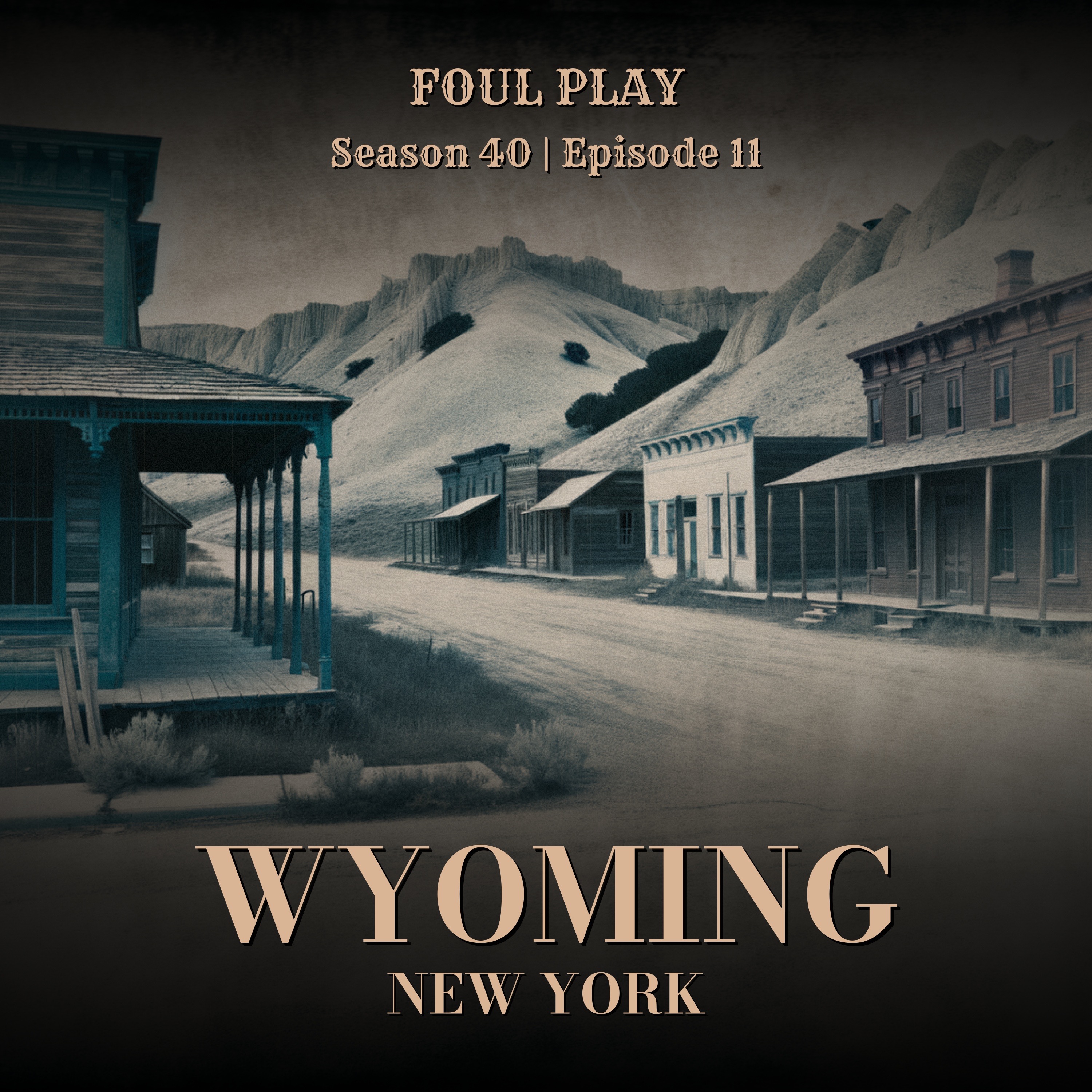
Wyoming and New York: Children in the Dock, 1892
from Foul Play: A Historical True Crime Podcast · host Shane L. Waters, Wendy Cee, Gemma Hoskins
Season 40: America's 250th Anniversary — fifty true crime stories from fifty states. Wyoming, 1892. A fiftee-n-year-old orphan train rider murders two young men in a boxcar and becomes the first person executed bythe state. New York, 1906. A seventeen-year-old immigrant kills the uncle who abused her and walks free froma packed Manhattan courtroom. Two teenagers. Two states. Two verdicts that split the question of whether achild's history belongs to them or to the law.In this historical true crime double feature, Foul Play examines the execution of Charles "Kansas Charley" Millerand the acquittal of Josephine Terranova — two cases that reveal how gender, geography, and political timingdetermined which children America chose to protect and which it chose to destroy.The VictimsWaldo Emerson and Ross Fishbaugh** were eighteen and twenty years old, from St. Joseph, Missouri. Theywere not vagrants. They had outfitted themselves for a tramping adventure on the Union Pacific line with newclothes, spending money, and arms. On the night of September 27, 1890, they were shot in the head while theyslept in a boxcar somewhere between Pine Bluff and Hillsdale, Wyoming, by a fifteen-year-old boy they had beentraveling with. Fishbaugh was found alive but died without recovering.**Gaetano and Concetta Riggio** were killed in their home at 110 East 220th Street in the Bronx by their nieceand goddaughter, Josephine Terranova, in 1906. Gaetano had been Josephine's legal guardian and godfathersince her arrival from Sicily. Trial testimony established that he had subjected her to years of forced labor andsustained sexual abuse behind closed doors.The CrimesCharles Miller — known as Kansas Charley — was born in a Manhattan tenement in 1874. Orphaned by age six, hewas placed into the Children's Aid Society orphan train system founded by Charles Loring Brace in 1853. Roughlytwo hundred thousand children rode those trains between 1854 and 1929. Charley was beaten by his foster familyfor bedwetting and abandoned at a train depot at thirteen. He was gang-raped in a boxcar in Omaha. He boughta pistol. On September 27, 1890, he killed Emerson and Fishbaugh in their sleep and took their belongings.Josephine Pullare arrived at Ellis Island from San Stefano, Sicily, around 1903. Within a year, her aunt and unclehad turned her into a domestic servant working from four in the morning until midday, seven days a week.The sexual abuse began sometime after. Following her husband's departure, Josephine experienced a ten-daypsychological collapse involving auditory hallucinations she believed were the voice of God commanding her tokill her uncle. She traveled to Park Row in lower Manhattan, purchased a revolver and a long potato knife, andreturned to the Bronx to kill both Gaetano and Concetta Riggio.The Investigation and TrialsMiller turned himself in through his brother Fred's foster family in Manhattan, Kansas. His court-appointeddefender, Frank Taggart, had never handled a capital case and was not yet admitted to the Wyoming bar.Taggart's defense included the humiliating strategy of having Charley testify to chronic masturbation — anineteenth-century theory linking the practice to moral derangement. The jury convicted. First-degree murder.Death by hanging. An eighteen-month petition campaign involving senators, congressmen, and the son of EstherHobart Morris — the first woman to hold judicial office in the United States — failed to persuade Acting GovernorAmos Barber to commute the sentence. On April 22, 1892, Charles Miller became the first person executed bythe state of Wyoming, killed by a hydraulic gallows mechanism designed by James Julien that had never beenused on a person before.Josephine Terranova's trial opened May 14, 1906, in Justice Francis M. Scott's courtroom on Franklin Street inManhattan. Several hundred people packed inside, including more than forty women from the Italian-Americancommunity. Defense attorney ex-Judge Palmieri argued temporary madness. Prosecutor James R. Ely argueddeliberate calculation. Competing alienists — the 1906 term for forensic psychiatrists — reached irreconcilableconclusions. The jury delivered a swift verdict: not guilty. Scholars have called it jury nullification. Josephine wasseventeen years old.Historical ContextThese two cases, separated by fourteen years, mark a fault line in American juvenile justice during the historicaltrue crime era of the late nineteenth and early twentieth centuries. Wyoming in 1892 was less than three monthspast statehood, assembling its legal institutions while the Johnson County War between cattle barons andhomesteaders demanded hard enforcement. New York in 1906 had a legal tradition that sometimes extendeda margin of leniency to female defendants — the so-called "unwritten law" — though it was not applied equallyacross race, class, or ethnicity.Cornell historian Joan Jacobs Brumberg brought Charley's story back to public attention in a 2003 book,discovered while researching juvenile male violence after the 1998 Jonesboro school shooting. In 2005, theSupreme Court ruled in Roper v. Simmons that executing people for crimes committed before age eighteen wasunconstitutional. Josephine relocated to California — reportedly with financial assistance from William RandolphHearst — and settled in Marin County. She died on July 16, 1981, at ninety-two years old, outliving her uncle byseventy-five years.Our Sponsors:* Check out Kensington Publishing: https://www.kensingtonbooks.comAdvertising Inquiries: https://redcircle.com/brandsPrivacy & Opt-Out: https://redcircle.com/privacy
Embed this episode
Ready to play
Wyoming and New York: Children in the Dock, 1892
No transcript for this episode yet
Similar Episodes
No similar episodes found.
Similar Podcasts
No similar podcasts found.