Xous: A Pure-Rust Rethink of the Embedded Operating System (39c3) episode artwork

EPISODE · Dec 28, 2025 · 39 MIN

Xous: A Pure-Rust Rethink of the Embedded Operating System (39c3)

from Chaos Computer Club - recent events feed (high quality) · host bunnie, Sean "xobs" Cross

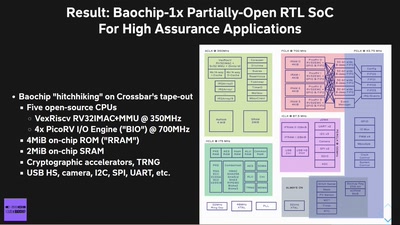
Xous is a message-passing microkernel implemented in pure Rust, targeting secure embedded applications. This talk covers three novel aspects of the OS: hardware MMU support (and why we had to make our own chip to get this feature), how and why we implemented the Rust standard library in Rust (instead of calling the C standard library, like most other Rust platforms), and how we combine the power of Rust semantics with virtual memory to create safe yet efficient asynchronous messaging primitives. We conclude with a short demo of the OS running on a new chip, the "Baochip-1x", which is an affordable, mostly-open RTL SoC built in 22nm TSMC, configured expressly for running Xous. The world is full of small, Internet-of-Things (IoT) gadgets running embedded operating systems. These devices generally fall into two categories: larger devices running a full operating system using an MMU which generally means Linux, or smaller devices running without an MMU using operating systems like Zephyr, chibios, or rt-thread, or run with no operating system at all. The software that underpins these projects is written in C with coarse hardware memory protection at best. As a result, these embedded OSes lack the security guarantees and/or ergonomics offered by modern languages and best practices. The Xous microkernel borrows concepts from heavier operating systems to modernize the embedded space. The open source OS is written in pure Rust with minimal dependencies and an emphasis on modularity and simplicity, such that a technically-savvy individual can audit the code base in a reasonable period of time. This talk covers three novel aspects of the OS: its incorporation of hardware memory virtualization, its pure-Rust standard library, and its message passing architecture. Desktop OSes such as Linux require a hardware MMU to virtualize memory. We explain how ARM has tricked us into accepting that MMUs are hardware-intensive features only to be found on more expensive “application” CPUs, thus creating a vicious cycle where cheaper devices are forced to be less safe. Thanks to the open nature of RISC-V, we are able to break ARM’s yoke and incorporate well-established MMU-based memory protection into embedded hardware, giving us security-first features such as process isolation and encrypted swap memory. In order to make Xous on real hardware more accessible, we introduce the Baochip-1x, an affordable, mostly-open RTL 22nm SoC configured expressly for the purpose of running Xous. The Baochip-1x features a Vexriscv CPU running at 400MHz, 2MiB of SRAM, 4MiB of nonvolatile RRAM, and a quad-core RV32E-derivative I/O accelerator called the “BIO”, based on the PicoRV clocked at 800MHz. Most Rust targets delegate crucial tasks such as memory allocation, networking, and threading to the underlying operating system’s C standard library. We want strong memory safety guarantees all the way down to the memory allocator and task scheduler, so for Xous we implemented our standard library in pure Rust. Adhering to pure Rust also makes cross-compilation and cross-platform development a breeze, since there are no special compiler or linker concerns. We will show you how to raise the standard for “Pure Rust” by implementing a custom libstd. Xous combines the power of page-based virtual memory and Rust’s strong borrow-checker semantics to create a safe and efficient method for asynchronous message passing between processes. This inter-process communication model allows for easy separation of different tasks while keeping the core kernel small. This process maps well onto the Rust "Borrow / Mutable Borrow / Move" concept and treats object passing as an IPC primitive. We will demonstrate how this works natively and give examples of how to map common programming algorithms to shuttle data safely between processes, as well as give examples of how we implement features such as scheduling and synchronization primitive entirely in user space. We conclude with a short demo of Xous running on the Baochip-1x, bringing Xous from the realm of emulation and FPGAs into everyday-user accessible physical silicon. Licensed to the public under http://creativecommons.org/licenses/by/4.0 about this event: https://events.ccc.de/congress/2025/hub/event/detail/xous-a-pure-rust-rethink-of-the-embedded-operating-system

Xous is a message-passing microkernel implemented in pure Rust, targeting secure embedded applications. This talk covers three novel aspects of the OS: hardware MMU support (and why we had to make our own chip to get this feature), how and why we implemented the Rust standard library in Rust (instead of calling the C standard library, like most other Rust platforms), and how we combine the power of Rust semantics with virtual memory to create safe yet efficient asynchronous messaging primitives. We conclude with a short demo of the OS running on a new chip, the "Baochip-1x", which is an affordable, mostly-open RTL SoC built in 22nm TSMC, configured expressly for running Xous. The world is full of small, Internet-of-Things (IoT) gadgets running embedded operating systems. These devices generally fall into two categories: larger devices running a full operating system using an MMU which generally means Linux, or smaller devices running without an MMU using operating systems like Zephyr, chibios, or rt-thread, or run with no operating system at all. The software that underpins these projects is written in C with coarse hardware memory protection at best. As a result, these embedded OSes lack the security guarantees and/or ergonomics offered by modern languages and best practices. The Xous microkernel borrows concepts from heavier operating systems to modernize the embedded space. The open source OS is written in pure Rust with minimal dependencies and an emphasis on modularity and simplicity, such that a technically-savvy individual can audit the code base in a reasonable period of time. This talk covers three novel aspects of the OS: its incorporation of hardware memory virtualization, its pure-Rust standard library, and its message passing architecture. Desktop OSes such as Linux require a hardware MMU to virtualize memory. We explain how ARM has tricked us into accepting that MMUs are hardware-intensive features only to be found on more expensive “application” CPUs, thus creating a vicious cycle where cheaper devices are forced to be less safe. Thanks to the open nature of RISC-V, we are able to break ARM’s yoke and incorporate well-established MMU-based memory protection into embedded hardware, giving us security-first features such as process isolation and encrypted swap memory. In order to make Xous on real hardware more accessible, we introduce the Baochip-1x, an affordable, mostly-open RTL 22nm SoC configured expressly for the purpose of running Xous. The Baochip-1x features a Vexriscv CPU running at 400MHz, 2MiB of SRAM, 4MiB of nonvolatile RRAM, and a quad-core RV32E-derivative I/O accelerator called the “BIO”, based on the PicoRV clocked at 800MHz. Most Rust targets delegate crucial tasks such as memory allocation, networking, and threading to the underlying operating system’s C standard library. We want strong memory safety guarantees all the way down to the memory allocator and task scheduler, so for Xous we implemented our standard library in pure Rust. Adhering to pure Rust also makes cross-compilation and cross-platform development a breeze, since there are no special compiler or linker concerns. We will show you how to raise the standard for “Pure Rust” by implementing a custom libstd. Xous combines the power of page-based virtual memory and Rust’s strong borrow-checker semantics to create a safe and efficient method for asynchronous message passing between processes. This inter-process communication model allows for easy separation of different tasks while keeping the core kernel small. This process maps well onto the Rust "Borrow / Mutable Borrow / Move" concept and treats object passing as an IPC primitive. We will demonstrate how this works natively and give examples of how to map common programming algorithms to shuttle data safely between processes, as well as give examples of how we implement features such as scheduling and synchronization primitive entirely in user space. We conclude with a short demo of Xous running on the Baochip-1x, bringing Xous from the realm of emulation and FPGAs into everyday-user accessible physical silicon. Licensed to the public under http://creativecommons.org/licenses/by/4.0 about this event: https://events.ccc.de/congress/2025/hub/event/detail/xous-a-pure-rust-rethink-of-the-embedded-operating-system

NOW PLAYING

Xous: A Pure-Rust Rethink of the Embedded Operating System (39c3)

0:00 39:24

No transcript for this episode yet

We transcribe on demand. Request one and we'll notify you when it's ready — usually under 10 minutes.

No similar episodes found.

LIGHTS, CAMERA, SMILE! Creatives Club Media Lights, Camera, Smile, is a podcast for anyone with a dream to share something with the world, out of the overflow of themselves - be it their mind, their heart, their personalities, and much more. Each of us are alive in this moment in time, with an innate ability to have ideas and create various things to benefit both ourselves and the people around us for a reason, and here, you will find the encouragement, the inspiration, and the motivation to do just that. Hosted by Cicily, founder of Creatives Club, she dives into various topics surrounding creativity and business. Exploring entrepreneurship for creatives in a corporate reality, sharing tips and tricks in a media centered company, answering questions regarding what a creative actually is are just a few of the things discussed on this podcast. Be encouraged to create for yourself as Cicily gets vulnerable by pivoting the camera to herself for the first time.To submit questions for Cicily to answer, or have her address certain t Chewing the Fat with WorkForge WorkForge Bite-Sized Conversations for Building a Stronger Workforce Welcome to Chewing the Fat, a podcast delving deep into the world of food manufacturing. Dive into real conversations around critical topics like staffing, retention, onboarding, and career development in this essential industry. Subscribe now to gain insights from your peers, subject matter experts and more on the biggest issues facing food manufacturers today: -Hiring and retaining employees -Addressing the challenges of the Silver Tsunami -Improving time to productivity of new employees -Engaging employees from hire to retire And more... Tune in to Chewing the Fat, a WorkForge podcast, and join the conversation on how to build and sustain a resilient, high-performing workforce in food manufacturing. Sermons | Countryside Bible Church Countryside Bible Church At Countryside Bible Church, we equip believers to joyfully live holy lives, to serve one another, and to share the gospel of Jesus Christ, all to the glory of God. We are committed to a high view of God, and a high view of Scripture. The PFN Cincinnati Bengals Podcast Pro Football Network The PFN Cincinnati Bengals Podcast is where you can stay up-to-date with the latest news and analysis on the Cincinnati Bengals! Our hosts, industry experts Jay Morrison and Dallas Robinson, provide weekly coverage of all the latest rumors and updates about the Bengals. Don’t forget to follow the show to receive new episodes directly in your podcast feed and leave a rating and review to let us know your thoughts.

Frequently Asked Questions

How long is this episode of Chaos Computer Club - recent events feed (high quality)?

This episode is 39 minutes long.

When was this Chaos Computer Club - recent events feed (high quality) episode published?

This episode was published on December 28, 2025.

What is this episode about?

Xous is a message-passing microkernel implemented in pure Rust, targeting secure embedded applications. This talk covers three novel aspects of the OS: hardware MMU support (and why we had to make our own chip to get this feature), how and why we...

Can I download this Chaos Computer Club - recent events feed (high quality) episode?

Yes, you can download this episode by clicking the download button on the episode player, or subscribe to the podcast in your preferred podcast app for automatic downloads.
URL copied to clipboard!