
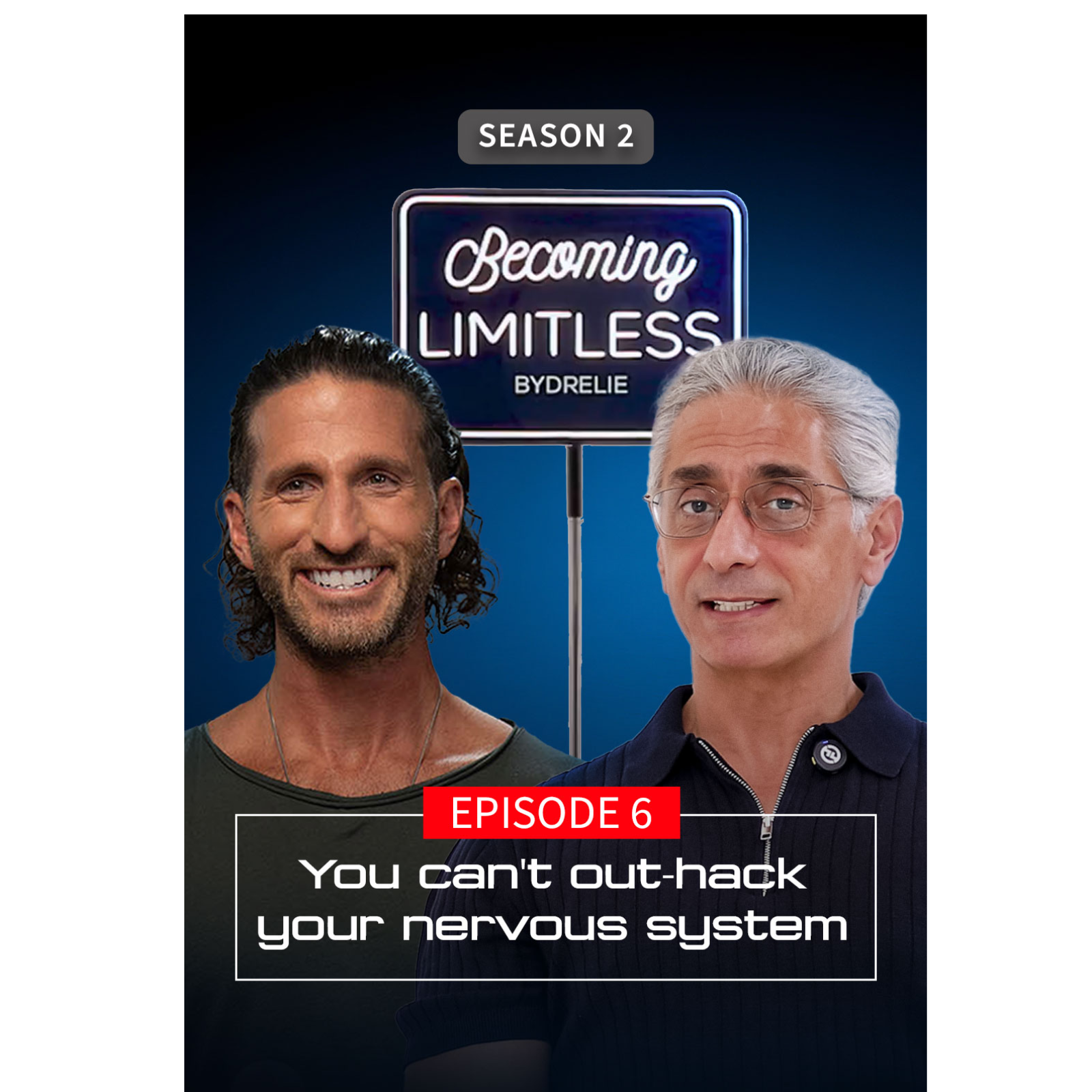
EPISODE · Mar 30, 2026 · 36 MIN
You Can’t Out-hack Your Nervous System | Salim Najjar
from Becoming Limitless
.What if one of the most powerful indicators of your health isn’t how fast your heart beats but the space between each beat?In this episode of Becoming Limitless, Dr. Elie sits down with Salim Najjar, widely known as “that HRV guy” and creator of The Art of the Heart, to explore how heart rate variability (HRV) offers a deeper window into the nervous system, stress, and overall human performance.The conversation begins with Salim’s personal journey, from high-performing engineer and biohacker to someone forced to slow down after his body broke down under chronic stress. Despite optimizing every metric: sleep, fitness, productivity, he discovered that true health wasn’t about doing more, but about understanding how the body responds to stress.At the core of the discussion is a powerful idea: HRV is not just a number, but a reflection of how we perceive and respond to our environment. It reveals the dynamic balance between the sympathetic (fight-or-flight) and parasympathetic (rest-and-digest) systems, and how chronic stress can quietly drive inflammation, fatigue, and long-term disease.Dr. Elie and Salim challenge a common misconception, stress itself is not the enemy. Instead, it is the inability to recover from stress that creates dysfunction. The episode reframes stress as a tool for growth, while highlighting the importance of learning how to consciously shift back into recovery.The discussion dives deeper into why high performers often struggle with low HRV despite excelling in other health metrics. Constant stimulation, lack of true recovery, and difficulty being present with oneself create an “always-on” nervous system that limits resilience and long-term performance.Salim introduces his Art of the Heart framework, outlining five key pathways to improving HRV: sleep, hormetic stress, reframing mindset, intentional living, and community. Together, these form a holistic approach to building nervous system sovereignty, the ability to consciously choose how to respond to life, rather than reacting automatically.The episode also challenges the obsession with numbers. HRV is deeply individualized, and rather than chasing a “perfect score,” listeners are encouraged to understand their own baseline and learn the language of their body.Looking ahead, the conversation points toward a broader shift in health and performance, one that moves away from constant optimization and toward awareness, alignment, and internal regulation.In this episode, we explore:• What heart rate variability (HRV) actually measures• Why chronic stress is the root of cellular inflammation• The difference between stress and recovery• Why high achievers often have low HRV• How constant stimulation impacts the nervous system• The concept of nervous system sovereignty vs regulation• The five key pathways to improving HRV• Why HRV is a personal language, not a universal score• How mindset and perception directly affect physiologyA powerful conversation that reveals that true performance isn’t about pushing harder but about learning how to listen to the body and respond with awareness.Explore moreHuman performance and longevity: limitlesshuman.aeFollowSalim Najar – Instagram: @that.hrv.guyDr. Elie – Instagram: @elie.truthhttps://linktr.ee/limitlesshuman
Embed this episode
NOW PLAYING
You Can’t Out-hack Your Nervous System | Salim Najjar
No transcript for this episode yet
Similar Episodes
No similar episodes found.