
EPISODE · Jul 14, 2026 · 1H 21M
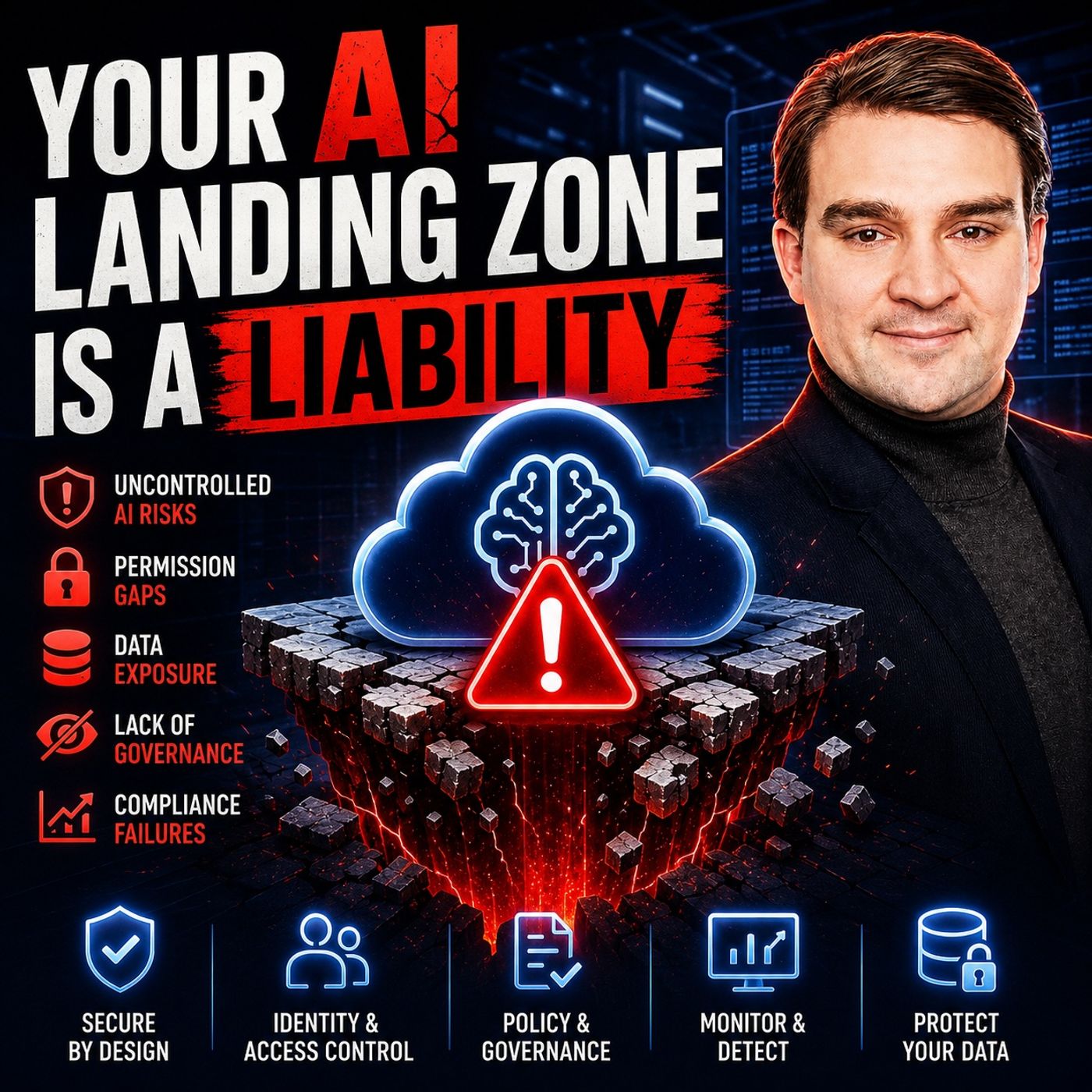
Your AI Landing Zone Is A Liability
from M365.FM - Modern work, security, and productivity with Microsoft 365 · host Mirko Peters - Founder of m365.fm, m365.show and m365con.net
Most organizations believe deploying Azure OpenAI is as simple as provisioning another Azure resource. Create an endpoint, generate an API key, connect your application, and start building AI experiences. While this approach may work for prototypes, it quickly becomes a serious liability in enterprise environments. In this episode of the M365 FM Podcast, host Mirko Peters explains why traditional Azure Landing Zones were never designed for modern AI workloads and why every successful enterprise AI platform needs a hardened governance perimeter built from day one. This episode explores the architectural shift from manual deployments to fully governed AI platforms powered by Azure Bicep, Azure AI Foundry, Azure Policy, Managed Identities, Private Endpoints, API Management, and Infrastructure as Code. You'll discover why Enterprise AI isn't about deploying large language models—it's about controlling identity, networking, governance, observability, and reasoning across every AI workload before technical debt turns into security debt.WHY TRADITIONAL LANDING ZONES BREAK WITH AI Azure Landing Zones were designed for predictable workloads with stable infrastructure patterns. AI changes everything. Large Language Models interact with multiple data sources, external APIs, retrieval systems, vector databases, and orchestration layers that continuously evolve. Traditional governance models simply weren't built for this level of complexity. Topics include:Azure Landing ZonesAI workloadsConfiguration driftShadow AIGovernance gapsEnterprise architectureCloud securityInfrastructure evolutionAI platformsOperational complexityYou'll learn why manually deploying Azure OpenAI resources creates inconsistent environments that become nearly impossible to audit and secure.THE HIDDEN COST OF MANUAL AI DEPLOYMENTS Many organizations deploy their first AI solution through the Azure Portal. The first deployment succeeds. The second team copies the approach. The third team makes slight modifications. Months later, nobody knows which deployment uses Managed Identities, which relies on API keys, which workloads expose public endpoints, or where sensitive business data actually flows. The episode explains why configuration drift, inconsistent security controls, and invisible token consumption create financial, operational, and compliance risks that grow exponentially over time. BUILDING THE HARDENED AI PERIMETER Enterprise AI requires more than secure infrastructure. It requires an integrated perimeter where identity, networking, governance, reasoning, and monitoring work together as one architecture. Topics include:Managed IdentitiesPrivate EndpointsAzure PolicyAzure AI FoundryAPI ManagementAzure BicepRBACKey VaultZero TrustGovernance as CodeRather than treating security as an afterthought, you'll discover how Infrastructure as Code makes secure deployments the default deployment model.BICEP AS THE CONTROL PLANE FOR AI Azure Bicep is far more than a replacement for ARM Templates. It becomes the architectural language that defines identity, networking, monitoring, AI services, governance, and compliance as reusable modules. The discussion explores how reusable Bicep modules eliminate configuration drift while creating repeatable deployments that can be audited, versioned, and deployed consistently across hundreds of Azure subscriptions. Infrastructure stops being manually configured and becomes automatically governed. AZURE AI FOUNDRY, RAG & MODERN AI ARCHITECTURE Modern AI applications depend on Retrieval Augmented Generation (RAG), Azure AI Search, vector databases, and intelligent orchestration. The episode explains how Azure AI Foundry becomes the governance boundary for enterprise AI by controlling approved models, connected knowledge sources, managed identities, and agent orchestration. You'll also discover why AI governance isn't limited to infrastructure—it extends directly into reasoning chains, retrieval pipelines, grounding strategies, and model lifecycle management. OBSERVABILITY, FINOPS & TOKEN GOVERNANCE Enterprise AI success depends on visibility. Organizations must understand where tokens are consumed, which teams generate costs, how models are used, and whether AI systems remain compliant over time. Topics include:Azure MonitorApplication InsightsLog AnalyticsToken trackingFinOpsCost attributionChargebackAPI ManagementMonitoringAI telemetryYou'll learn why token-level observability becomes one of the most important governance capabilities for modern AI platforms.WHO SHOULD LISTEN? This episode is ideal for:Azure ArchitectsCloud ArchitectsPlatform EngineersAI EngineersDevOps EngineersInfrastructure EngineersSecurity ArchitectsEnterprise ArchitectsIT Decision MakersMicrosoft MVPsAnyone building enterprise AI platformsWhether you're deploying Azure OpenAI, designing Azure AI Foundry environments, implementing Retrieval Augmented Generation (RAG), modernizing Azure Landing Zones, adopting Azure Bicep, or building secure AI platforms at enterprise scale, this episode provides a practical roadmap for transforming AI infrastructure from an unmanaged liability into a secure, governed, and scalable platform. If you want to understand why successful Enterprise AI starts long before the first prompt is sent—and how identity, networking, governance, observability, Infrastructure as Code, and platform engineering combine to create trusted AI systems—this episode delivers a comprehensive blueprint for building AI platforms that are secure by design and ready for production.Become a supporter of this podcast: https://www.spreaker.com/podcast/m365-fm-modern-work-security-and-productivity-with-microsoft-365--6704921/support.
Embed this episode
NOW PLAYING
Your AI Landing Zone Is A Liability
No transcript for this episode yet
Similar Episodes
No similar episodes found.
Similar Podcasts
No similar podcasts found.