Where's my coffee? You're listening to the PG Pinecast, where smart people in healthcare come to make noise. Here's your host, Jimmy McKay. Okay. I think I accidentally gave myself a double shot this morning. Sometimes I'll go to the espresso machine and I'll be like, did I, did I do that? And I'll come back and be like, no. And then I'll do it again. And then when I drink, I'm like, oh, that's two. But that's good. Twice as much. Welcome to healthcare. Marketing doesn't work. And honestly, most of the time it's because we're trying too hard to look like we have everything figured out. That is the biggest mistake that I have made numerous times. And I'll probably make it twice today. Today, we're going to steal the best ideas from inside and outside of healthcare. That's the goal. And figure out what actually works, what doesn't, and what's about to work. Don't you want to be, you want to do ahead of the curve. I'm Jimmy McKay alongside me.
is andrea trigger uh fractional marketing vp that's what i say right that's the title i call myself a fractional marketing leader and consultant it sort of changes as people's needs change yeah what do you need what do you need what do we need all right so today we're going to talk about burger king how ai is ruining everything and the thing that i said five years ago is magically happening now doesn't happen every day but i will take it all right so let's go with story number one this one's kind of wild did you i'm not a word season person are you an award person is that your deal nope yeah i could i could sort about award season, but some people get into it. One of my really good friends, Ralphie Aversa, is now like senior awards person. He's wearing John Varvatos. I don't even know where you'd go to buy a John Varvatos. But this one is Burger King runs a national ad campaign during the Oscars. And people, some people just get super into it, which is cool. And instead of Burger King telling you how great they are, they're sort of basically saying like, yeah, we've been sort of bad.
Like, hey, remember when we used to be great? We're not that great anymore. And we're sorry. They call out by name, slow service, inconsistent food, stores and locations that just haven't kept up. And then they pair it with, here's what we're going to fix. So not polished, not perfect. This sounds like just brutal honesty. This is a billion dollar brand choosing credibility over sort of BS. And I don't know. And that's not something you see very often, which is why it jumped out at me, which is why I'm talking about it. I didn't see it during the Oscars.
I read about the story, then went and watched the ad. And I can share the link with the ad on YouTube. But when was the last time, Andrea, that you saw a brand, never mind a healthcare brand, admit that they haven't been great at something? I can't remember. I don't know if I have. Maybe small scale. No, I can't remember. I really like this. Hell yeah. This is like everything I continue to talk about, you and I have talked about here. It's like the marketing.
and operations, right? They need to be like working together. And this is, this is authenticity, like in action, right? So this is like our operations, our service hasn't been great. We're, you know, we're getting crushed by our competitor who went viral for their CEO, eating a bite of a sandwich. Product, Andrea, product. Product, right, product. And then continue to like defend himself and say he really eats their food. This is so good. This is brilliant. I like it. Yeah. So, I mean, I was, I have some like, you know, just questions I wanted to ask you is like, does this build, what does this build? Because I was gonna say like, like to me, it builds trust, right? Honesty.
like we'll call it, I'm gonna call this radical transparency. Like if I were gonna give this a move and put it in a playbook and pull it out when it's appropriate, right? I would call this a radical transparency play. If I'm in a boardroom and people are like, every survey we get back says people are pissed off at the inconsistent foods. Like your audience is like now never closer and we'll continue to get closer to telling you what they do not like.
Yep. Tony says the McDonald's CEO video is my favorite of 2026 so far. Here's the best part. We talked about last week, this video, and if you haven't seen it, you're living under a rock, right? McDonald's CEO. I don't even know his name. I'm not going to look it up. It doesn't matter. The guy doesn't even exist. He looks like a cardboard cutout. If you Google, if you went to AI and said, create a CEO of McDonald's, boom, this guy. Don't remember his name. Chris something? I don't know. I have no idea. Somebody in the marketing department decided it would be a good idea to put him on camera in something that looked like a hostage proof of life video and introduced the big arch, which was their new whatever. He, of course, does it in the most awkward way, taking weird non-human type bites.
In like a conference room or something. In a conference room. Weird. Weird. Talking about calling it the product instead of like the big arch, the sandwich, like the burger, like call it a burger. Like, I don't know. Maybe legally they can't. And then Burger King comes up. Of course, Burger King reacts. Every fast food brand sort of like reacts. Ha ha ha. But then Burger King goes and triples down on this during the Oscars. And the ad really was, I know we used to be great. We've let it slip, but we're going to fix it. And that to me is like a love letter to anybody who like, likes them before and has said, you guys just ain't how you used to be. Hey, we get it. You're right.
We are wrong. We are going to do this. Like to me, this exudes confidence. It does. And it's validating for consumers who have the experience. Because like how many brands, especially in healthcare, market, market about how great they are, how great. And I'm like, I just looked at your reviews. Like this is not, this is not connecting, right? Like you are not great in the words of consumers, but your brand is. This is like brand 101, right? This is just like own who you are, be authentic. So I, I think it is, it's confident and it's a good play. They're leaning into it and they're saying they're fixing it. Tony was saying that the Burger King CEO shared his personal phone number with public for feedback. I did not see that. No.
That is fantastic. I mean, to me, I'm not saying the other, this other guy that I'm going to mention is the first person to do it. But Gary Vee, Gary Vaynerchuk walked around with a t-shirt and sweatshirt with a phone number on it for months. So it was in all of it was black t-shirt, white writing phone number. And people were like, there's no way that's his number. And he's like, try me, bro. And people were texting him. People were calling him and he was answering like ultimate transparency, ultimate access to me with a brand like this, owning, owning flaws equals confidence. Hospitals, clinics, you know, you're not flawless.
Like imagine what would happen if you were like, listen, you're right. Like instantly you change the temperature of that room because that humanizes you because who among us has been perfect all the time at everything? You can't. Right. To, you know, to exist is to be flawed. So like in healthcare and consumer healthcare, it's, you see it all of the time and people are taking to, like, it feels good that a fast food chain is doing this. Imagine how good it would feel if your healthcare provider stopped gaslighting you. This is not your experience. No, but actually it is. What would this look like in healthcare? We'll start in like, you know, it could be anywhere in healthcare, right? Like how do we find things to talk about to gain? Cause we've talked about this before. I need to design a graphic so I can just have it even for just me.
But there's a circle. Imagine the Target logo. We're not sponsored by Target, but imagine the Target logo. And for me on the outside, it starts with knowing. I know you exist. One ring in. I like you. Why? I don't know. Just sort of like you. Sort of like you. Now I can lose, I can lose like, can't lose knowing like, right? I guess if you fade away, but, and then the inner circle is what you're trying to get to, which is trust. Now this doesn't mean that that person quote converts to bring it like an icky business operational term on, but I need you to know, like, and trust me. So when you need me, you think of me. Exactly. So why would healthcare never say this? And should it is my question to you. Here's the meat. Here's what we get to.
Yeah. So I think the stakes are a little bit different, right? And so it's healthcare. You look to your healthcare provider as this clinical expert and there's not supposed to be any risk in what they say and do and why they don't want to be on social media and that sort of thing. So it's different than fast food. That being said, it's pretty simple for them to do, right? Like we have talked many, many times and I hammer this point home that as a healthcare provider, you're not competing with the clinic down the road. You're competing with all consumer experiences. And what do consumers do, including about their healthcare experiences? They go on and they leave reviews.
And this is something that you should be monitoring, right? And this is what, like, clearly Burger King's monitoring the sentiment. They're monitoring what people are saying. And then they're going, here are the themes. We're going to own it and bring attention to it. Yep. I would say when healthcare should do this is when they are in a market. And I had the Burger King commercial up, but it was sort of slowing my computer down for some reason. I guess I didn't buy any computer. I would say when you've done, were you ever taught this? There's three rules and an apology in public relations. This is what I was taught. I'm sorry.
Not I own it. I'm sorry that I did this. Not I'm sorry that you felt that way. That's bullshit. I'm sorry that you took it this way. That's a bullshit cop out. So Burger King did. I'm sorry that our food is inconsistent. Our service is slow. Our brand is not consistent across the country. I'm sorry. I not are those local franchisees have not upheld their contractual obligation. That would be bullshit. Right. They didn't do that. They said, remember when we used to be great. We're not right now. All right. So that's number one. That's rule number one of an apology in public relations. I'm sorry on the problem. I understand what that did.
Like, hey, I understand what I did, what that affected you. Not I'm sorry. Again, there's a very there's a cop out of I'm sorry you felt that way or I'm sorry you interpret. You're validating. You're showing empathy. You can't cop out. You cannot. No, you want to. But honestly, they're just words. Get them out there. But like, say the meaning. I know it feels like you have to own this. That's what owning something is. So I'm sorry. Right. Apologize for what you actually did. You did own it. Number two, I understand what I did hurt you or how it affected you. I understand you have confidence because we didn't uphold our end of what a brand is supposed to be because you don't know if you're getting off the highway and you're going to get.
a quick meal after hockey practice or whatever. And you're like, eh, I don't trust you anymore. And that erodes, that erodes, that erodes, that erodes. So I'm sorry. I understand what I did hurt you or how it's like made you feel like we didn't, it wasn't a great transaction. And number three, number three.
We're going to fix it. What we're going to do to fix it. So it's past, present, future. Like if you really want to look at it and human beings are simple creatures, we're big, dumb animals, as I say, say that. So I would say when should healthcare do this? When you have clearly dropped the ball. When it is clear. When people are not trusting you anymore. They know you. They liked you. They trusted you. You're playing in the past and you can't convert on that. And that's not fair. So say it, own it, and then do something about it. Like do something about it.
And don't wait until it gets to this large scale. So I think you can, and I advise, you know, I've worked with a lot of healthcare brands who don't pay attention to their reputation or they don't manage it proactively. They're just like, it's not on their radar. And I'm always like, Hey, this is a big piece of marketing. I can spend a lot of your marketing dollars to drive people to you. And then if they see that you have negative reviews or negative experience, we just wasted that money. So it doesn't even need to be like, you know, Oh wait, we're now in this crisis. It can be individual at the micro level going up. I see this person complained about this thing on this review. Let me apologize publicly, acknowledge it, and then reach out and say, here's how we're going to fix it. I have to do that. So I, right. So.
Is the timing also good? Because McDonald's turned a light on awkwardness. And Burger King zigged when they zagged, in my opinion, which is they said, we see you're awkward and we'll raise you. We'll double down on authentic. Great move. Waiting six months? No. Now? Brilliant. Even more brilliant. Would have been good in six months. It's great now because they understand. Do you have a McDonald's in your town, Andrea? Yes, we do. Is there a Burger King within a quarter mile?
I don't know. I'm not sure. There may be. Usually there are. You see these things pop up and there are urban planners who know why these are. There's usually a bank. Then there's a gas station. Then there's a McDonald's. These are not accidents. These are mini oases. In mine, there's a Taco Bell, a Dunkin' Donuts, a McDonald's, and a Burger King within an eighth of a mile. You could hit all of them with a pitching wedge standing right in the middle. All of it. They understand the game that they're playing. I don't think someone's going to drive.
Most people and 40 minutes for a McDonald's, right? This is an option of what do I want right now? Right now. And it's a jump ball. So they understand that if I'm top of mind, I can choose. I go right back to healthcare. I know you're selling different things. And you said, you know, the stakes are different. I was like, play on words, burger, steak. And I understand that, but it's still a like sort of binary decision. I go with you or I don't go with you. Right. Burger King is saying if we own, and I don't even know the stats, 30% of the market share to McDonald's, whatever more.
I'll take 10% of that. And how do I do it? Do I need to lower my prices? Probably not a good idea. Do I need to invent a new burger and have my CEO awkwardly eat it on camera? Probably not a great idea. Although they seem to have a more chill CEO. The answer was actually admitting flaws. And I got to give Burger King roses on this one. I really do. Yeah. They did a good job. So if we learn a lesson, we'll move to the next story. But polished doesn't equal trusted. Real beats perfect. And I think Burger King doubled down on McDonald's fumble of the ball.
for that authenticity and that awkward. We have a sponsor we got to get to and make sure we pay the bills. Today's episode brought to you by TrustRx, the first fully FDA unapproved treatment for chronic brand invisibility in healthcare. Side effects may include patients who are actually understanding what you do, staff who can explain your value without using the word holistic, and a sudden increase in people saying, wait, I've seen you before. TrustRx, because if your marketing sounds like everybody else's, it probably is. And if your marketing team, ask your marketing team if TrustRx is right for you. They probably won't know. So that's TrustRx. I'm glad to see some sponsors on the show.
Second story. Okay, let's flip it from a brand and go more into a strategy or the thing that's everywhere, right? I'm just going to say the words so that I show up in the algorithm and that's AI, artificial intelligence, AI. We're not talking about the former point guard from the Philadelphia 706ers, Allen Iverson, that's my guy. A growing list of brands leaning hard into AI generated marketing, ads, copy, visuals, landing pages. AI can generate you a website four tenths of a second. Is it any good? Here's the problem though, Andrea, you and I both know.
all kind of feels the same. It all feels kind of gross, flat, generic. Something's just off. I'll give you a radio parallel. I know you're shocked that I'm gonna bring my former career into my current one. I used to have, I coined the phrase headphone syndrome. Now when radio DJs are on the air, we throw headphones on. That's so we don't get feedback. We can hear all the things and whatever.
Now, the microphone you're hearing me through, this is my voice, but the microphone gives me a little oof, you know, give you a little bottom end, makes me sound a little taller. Instead of me wearing, you know, taller shoes, it gives me about three inches on my height because I sound cooler, right? So the problem is when you start believing your own hype. So I would notice this in DJs or broadcasters that would come in. They'd start speaking into the mic. They'd hear their voice amplified in the headphones. And what would they do? They'd amp it up even more. And look what I can do here, Andrea. Coming up at seven. I can do that.
And then they'd hear that. And then what would they do? They'd amp it up even more. It's just a positive feedback loop that gives you negative results. So my workaround for this was I said, when you're in the studio and I need you to wear headphones because you have to hear what's going on over the air. I need you to pop one of your phone off. I need you to hear your voice in the headphone. What's going on over the air with the amplified voice. I also need you to hear your normal voice. Really? Once you hear yourself doing the weird in radio, like puking your voice out, like getting really radio voicey. I need you to stop that. I need you not. I need you to not do that because the audience won't know what's wrong.
but they'll know it's not real. And they don't have to give you a reason why they leave. They just leave. Stop. There's my story. Now go to AI. That's the story I want to talk about. Campaigns that are now 100% are mostly AI generated. They technically check all the boxes. They look, look at this. This looks great. But then you say, you see the campaign and you feel nothing. Right. I just experienced this this morning. I took a screenshot. It's on my phone.
What is it? What's the brand? I will share the brand, not healthcare. I was targeted. So I have young children. I was targeted with a Skechers kids sneaker ad. And I stopped again in marketing. It's an occupational hazard. I see something. I'm like, Ooh, it was on Facebook and it was a sneaker covered in butterflies. Cool concept, right? It was not real butterflies. So it was a bunch of AI generated butterflies.
They're on, it's on the grass and this little girl walks over and she's so excited to see these butterflies, the butterflies fly away. And then the sneaker is there and it has like butterflies on it in some lights. It is so clearly AI generated. So the next thing I did was go to the comments and I'm like, maybe there's other marketers here. And there was a thread around the disappointment that this was AI generated. It cheapens it. It turns me off. I don't want to buy this. So there aren't sneakers that do this? There are sneakers that do it, but the butterflies were AI generated and the entire.
video I guess animation was was AI generated or AI enhanced so what did what did that taste like because you tasted something and then by the time you got to the meat of it there it is it was cheap and it was it was I don't want to say generic but it could be generic it was just cheap yeah that's the thing is AI made it easier to create more not good. Like more not good is a lot of not good. I mean, I hate to sound like a moron. I miss people off in meetings and you've been in calls with me where I'm like, there's a whole time, energy and money spent to do something. And then I come in and they're like, people can't wait to show me. Like Jimmy's gonna love this. And I'm like, Hey, why did you do this? And they're like, cause it's great. And I'm like, can you point to the, is the great in the room? They're like, but we made a lot of it. And I was like, I got a news for you, man. You made a lot of crappy cupcakes. So I was going to ask you if you've seen AI content that's made you feel something positive or negative, but you'd be this morning without having to be prompted.
Yep. And I've seen it in other places. I mean, I have seen it in healthcare, like on websites. You see people and you're like, that's not real. So it's bad enough that healthcare organizations use stock photos. Now they're using AI photos. I think the progression was nothing. We don't do anything or we do. And it's just, I don't know, so many vomited words on a website and then stock everything. As soon as I can spend a couple hundred bucks a month and generate stock images or use stock images, I do that. And then it was Canva. And I love Canva. Love it. Except when, and I call it a Canva explosion. When I go to your Instagram page, you're like, well, we interact with our, our, our.
potential patients or customers on Instagram. Love it, love it, love it. I just go there and I just scroll. And I'm like, huh, looks very Canva-y. Like Canva doesn't even want you to do that. Canva wants you to mix it up. You found a template. You fell in love. So that was the next progression. And now it's AI everything. And my question is, where's the human? So what's the line then, Andrea? Because I mean, I'm using AI as a tool.
God, I can't believe I'm about to use this analogy too. In the toolbox. In healthcare, we love that phrase. Just put it in the toolbox. Put it in the toolbox. But here's the question. If we go down the tool analogy, if the world is, if all you have is a hammer, the world is full of nails. And you just walk around and you're like, whack, whack, whack. And it's not good. So where's the line between efficient and just absolutely soulless? How would you explain that to a CEO or the members of your marketing team? That's simple, but not easy. How I have explained it is there's absolutely a place for AI in helping us be efficient. Use case. I'm working with a client right now.
I have to do a lot of analysis on their data. I love data. Yes. Operations data, but it impacts marketing and I want to get to the root of the operations issue. And so, and so.
I, Claude is my best friend in this. And there are other AI tools that you can use for analysis for data. A hundred percent. It is a good tool to use because it's a bad use of my time to do this manually, right? Like spreadsheets, numbers all over the place. Awesome. Great. AI is a good thought partner. Oh, I love it. Right. It's a good thought. Like I'm a solopreneur. I don't say that. I think that's a weird word, but like I work by myself for the most part. And so I share my ideas and it helps like we go back and forth. Cool.
I think where we get into trouble is where we're generating our entire brand with AI. And there are brands that do that. And it's hard because there's so much noise now. It's so easy to be able to do this. And at some point, though, I think the dust sort of settles the noise. You know, we can we can sort of cut through it. I don't know when that is. But consumers know when something is AI and people are starting like they're starting to be able to tell. And, you know, I don't know yet what the impact is.
across the board, but I do know for people like for marketers, especially, but for people who are sort of close to creating, um, they know, and it's a, and it's a turnoff. Yeah. More bad is not better. Like I just, I like to boil it down to like quite literally the periodic table of emotions. More crappy is not better. Like people like quantity over quality. I would tell you, I'd rather you have, I've said this before. I should put it on a t-shirt.
I've had brands ask me in healthcare about podcasting specifically. I sort of got pigeonholed as a podcast guy. Guys, I can do other things, but okay, I'll take that. At least I'm known for something. And they're like, how do you outperform us on these three metrics? We have a team. And I'm like, I do 100 B minuses a year. And you wait and hold your breath trying to crank out 10 A pluses, but you don't. Right. But now they're like, well, let's just, remember when it was like, let's just drop a PDF into Google LM, notebook LM, and it'll turn into an audio thing? Yes.
where's the soul? That's the problem. Where's the human? That's what people are asking. Like, well, I can make a thousand podcast episodes in 10 minutes. I'm like, are they any good? Is your more crappy better? Like when I put it like that, CEOs are like, yeah, and I know we crap on CEOs. CEOs are smart, but I'm like, you hired me to tell you what to do. And now you're questioning me is makes me go, what am I doing here? It's it's a, I worked with the CEO last year. I will not name or share the industry within healthcare, but I'm like, Hey, you know, you need, you need content. Yeah. I'm just going to use AI to create all of my blog posts. And I'm like,
Maybe that's fine for an SEO play, but we're not doing an SEO play. We're doing a human play. So maybe have a human. It doesn't have to be me. You don't need to do that. There are people who do that. And now I don't want to come off like a complete hypocrite. I started writing more on LinkedIn four months ago, five months ago, and my engagement exploded. And people are like, you're using AI? I go, yes.
I am not saying write me a great, a LinkedIn post around this thing and then walking away and posting that. I'm spending probably an hour and I'm, excuse me, treating it like what you just said, which is for me, it's somebody who pretends to be interested in what I'm saying. Cause I need that. I'm a, I'm a big dumb animal. I need you to pretend. I need, I need to go down rabbit holes. I need to be told when I'm wrong. So I tell it that I'm like, if I'm off course, do not tell it though, to tell you otherwise it's toxic positivity and toxic, like back.
patty like you're that's it that's it you found it that's the oh my god the first 10 times oh my god and then i'm like i need you to act like this and when i'm wrong tell me i'm wrong right and then i say now i can do it because i've been using this particular model for months i'm like now i need this to sound like me this doesn't sound like me and it gives me close i take that i copy paste that and then i review it again and i add in how i type i'm like how would i type this like i just need the core i need the meat i'll give you the steak don't worry about it because That's a good use, right? Because so otherwise it's garbage in, garbage out. Like the quality of your content is what you put into it. And so I've done the same thing when I was really focused on having content on LinkedIn every day because the algorithm wants it. You have to be part of the conversation. That's where my buyers are, the whole thing. And I would do the same thing that you did. And it did. It exploded. It was great. It's good conversations. But if we were just going, hey, Claude, write us a bunch of LinkedIn posts on marketing, like we wouldn't have gotten the same results. And that's where the human piece comes in. I got not hired. I was put on a committee. I won't say by which organization. And they were like, hey, we want to bring in some social media people.
to volunteer and write. This was back in the day when people, I don't know, I'm not on there anymore, but people were on Twitter. And they're like, we want the six of you to each write like 20 tweets and then we'll have 120 tweets. And I literally was like, I raised my hand in the, in the email thread. I was like, I don't, that's dumb. I'm like, no, but you love content. You think I'm like, no, like just tweeting with no person. I'm like, what's the personality? Like you're an organization. I go, that's your problem. I just explained Wendy's Twitter to someone yesterday who I thought was pretty with it. No, I've never heard of Wendy's Twitter. And I'm like, you need to just go, go ask your LLM to describe Wendy's Twitter in a story.
it has a personality it has things that would and would not say and do like if someone said wendy's twitter did this and it was something i'd be like no that's fake or if they're like wendy's twitter went after whatever and wrote that makes sense yeah but now i know what wendy's is they personified wendy's in a way with edge that was not mayonnaise but hot sauce i heard someone explain this a long time ago go to your supermarket and go count how many versions of mayonnaise there are and there's like Regular mayonnaise, fat free. I don't know. Mayonnaise is fat. There's like with olive oil. Yeah, olive oil. Let's call it 10 versions of mayonnaise. Now go to a hot. Now there are like festivals about hot sauce where you can go to like a weekend festival. That's because there's edge there. Edge. Go to the other end. There's festivals about ice cream, but not ice. Do you know what I mean? So you need to be something. Either be the most boring.
or be the most not boring. I mean, Tony, Tony, my co-host on PT Breakfast Club is like, you could be two things. If price is the thing you want to be, we're talking about emotion here with Wendy's Twitter, like attitude, be the spiciest or be the most boring. But like in like third place is nothing. Nothing. You could be the most expensive or the cheapest, but like third most expensive. You better have something else then. I'm not saying don't be the third most expensive, but that's not why they choose you. They choose you because they can't afford the most expensive, want a little more than the cheapest. Then why are they picking you? Right. Third place is second loser.
Second loser. Like, good Lord. I mean, I've, you know, this is a hockey example. It's like, if we're down three goals in the third period with eight minutes left, I'm like, pull the goalie. You got to wait till two minutes left. Why? I'd rather lose by four than three. Like, who cares? It's still a loss. A loss is a loss. Pull the goalie. Maybe that's a, I'm gonna put that in my marketing playbook. If we're getting our ass kicked, pull the goalie. Pull a move. Pull a move. Why? Third place is second loser. Who cares? I care. Like, I care. I'm the guy yelling, pull the goalie with eight minutes left. Cause I'm like, we need one. We need to knock these guys on their ass a little bit. Shake it up. In marketing, you're not shaking up the other team. You're shaking up the audience. Yes. So pull the goalie. Do something.
Coaches throw chairs. Coaches get thrown out of games. Teams will put guys on the ice to get into a fight simply to fire up the crowd. I'm going back to Burger King. They did that. And they were like, dude, we screwed up. We're not that great. We're not great. But we're going to be. They humanize themselves. All right. So we go to AI and listen, there's a time and there's a place I feel like we could do. I would like to do maybe next week what we call a six pack episode where I'll give you a prompt. Let's have the prompt be very specific. The six best ways to use AI in marketing.
You bring three. I'll bring three. I won't know what yours are until we go live. You don't want one. And then we'll just go back and forth. You'd be like, I find it terribly valuable to use it here. And then you explain why. And I'll go, oh, that's cool. Or wait, what about this? And then we'll go back for that back. So the prompt is next week, the six best places to use AI and marketing. And then a bonus one from each where not to use it. So we'll give one. Do not use it here ever. All right. All right. All right. Perfect. Story number three. And here's what I like. I accidentally started talking about this. This is something Jimmy said five years ago. I was not the only person saying this. It was difficult for me to get anybody to listen to me.
And now it's obvious. That's how it is. Someone gave like the grief life cycle. It's like, first they mock you, then they something, and then they something, and then they believe in you forever. I couldn't get a classmate of mine in PT school to listen to my podcast. I got so many like, that's cool. Actually, I got one compliment. I started a podcast in PT school. A year in, a classmate that I was friendly with walks by me in class. He's like, hey, I listened to that episode you did with that vestibular therapist because she was into vestibular. And she's like, listen to your podcast with Becky Bliss. And I was like, oh, okay. And I was like, on purpose, like waiting to see, like, you can tell me what you thought. I didn't say like, what'd you think? I just like, oh, okay, cool. And she went, it was actually good.
And I was like, hey, I'm going to stand over here. You want to get a running start and just kick me in the balls too? Just really, really lay into it. I was like, oh, okay, cool. But I guess the better way to go is your expectation was it was going to suck and it was better than that. And it was better. It's better. I mean, that's the way, right? Yeah, I expected you to be good and that sucked. That would have been worse. Here's the thing that I said five years ago and other people said five years ago. Clinics need to act like media companies. Hospitals need to act like media companies. Someone framed this up. Radio stations, TV stations, and newspapers used to have IT departments or a dude. It was started as a dude, then it was a department, right? Now, it's reversed. Now,
IT companies have media divisions. Now, hospitals have media teams. I've said this before when I worked at a large hospital system. We got two choices. The answer is always both. We can wait for CBS to hopefully do a story on this. And we can send them notes, love notes, press releases. We can do that. And we can hold our breath. CBS is coming. And maybe they do. And maybe they shine a flashlight on us for 11 seconds. Maybe. And that's maybe. And that's great. And when they do shine the flashlight on us, when CBS does a story on us, they pick what they say.
They pick how they frame us, whether we love it, hate it, or indifferent. Option B, we create our own stuff. I know we're not CBS now, but CBS back in the day wasn't CBS either. So when's the best time to plant a tree? 20 years ago. When's the second best time? Right now. So I said this five years ago, and five years ago I looked like an idiot. I looked like, of course you're going to say this, Jimmy, you're a media guy, that we all need to act like media companies. And now, Andrea, are we right? Well, we are, whether that's in-house or you're working with someone else, but you also need it in-house. Yeah. Because...
You know, this just goes back to basic marketing is you need to meet people where they are. And look at that. Where are people? People. Where are you people? Where are people? Tell us where the people are. The people are here doing that. For better or for worse. That's where they are. And people of all ages and they're on different platforms. And that's where people are. And that's how they're getting informed.
all the things like it or not. I have had clinics. I mean, close friends be like, people don't make healthcare decisions on the internet. And I'm like, Oh my friend, people get married with people to people. They make me on the internet, my friends. And you're thinking your decision to see your clinic versus the next one is lower stakes, higher stakes. My man, people are finding who they marry. People are buying cars. People are buying homes on the internet. But yeah, you're a, you're playing a carrot, your PT clinic. That's too big of a decision to make online. The new front door is content.
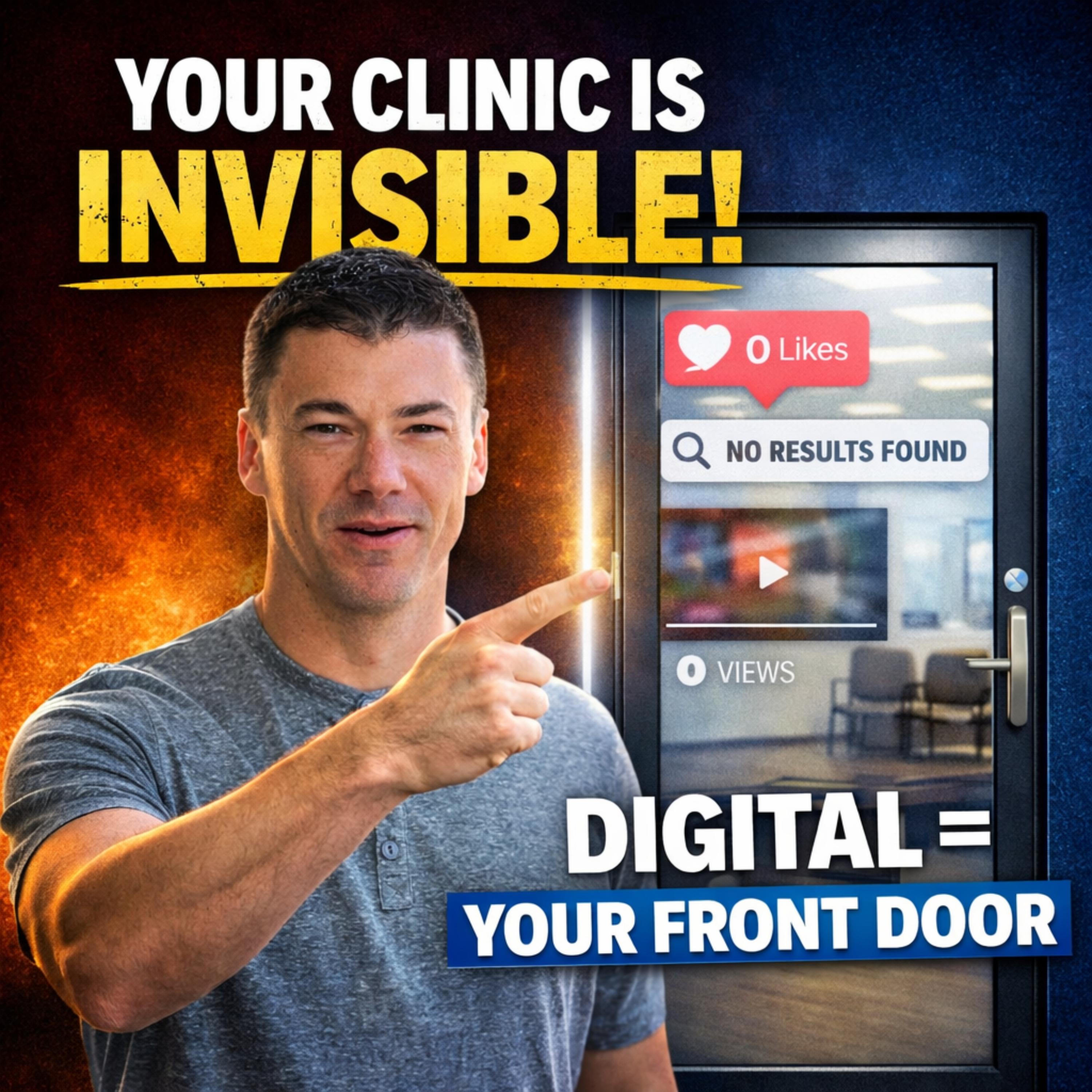
because I have to know you, then hopefully I like you. Eventually, maybe, maybe, maybe if you earn my trust. Somebody asked me, how many impressions does someone need to have of me to earn my trust? And I'm like, it could be one really great one. It could be a billion that don't do anything. I don't know the answer. Did you earn it? That's like, that's too many locks and too many keys. I don't know. I could lie to you, but that's not the answer. The front door to healthcare used to be a referral. I, in 2026, in March, now say it is a feed. It's a social feed. It's a digital front door.
It is now the front door. Digital is now the front door for healthcare. Referrals absolutely have a place. It is the veranda. What's the door inside the door to the mudroom? I don't have that kind of house, but when you walk in and there's another door, that's the second door. I don't know what it's called, but it's like the second entryway door. It is. Digital is, right? I posted on LinkedIn, I don't know, Friday maybe. I decided which PT.
in my i've worked with local pts i decided which pt i was going to based on their digital personal decision digital experience and i'll tell you and what you know you talk about referrals Digital is also the front door, whether you are being referred by your provider or in this, like this is just the way it is. And I've had so many conversations with clinic clinical or provider founders and CEOs around this, but our business is a referral business. Sure. But that being said, that provider isn't hand delivering that patient to you. That provider is saying you need PT or you need X specialists. And then you're going home or sitting in your car and going PT near me. Correct.
That's just what you're doing. Or they're saying, hey, go check out Jimmy McKay's. Great. What's the first thing people do now? They're going to look on their phone. And then they're going, yeah, my doctor said, this happened to me last year. My dentist was like, oh, go, you have to, like, whatever, had to go to a specialist. And they told me which one to go to. And I went, I looked, I looked at reviews. I looked at the website. I looked at the clinical staff on their website. And I was like, nope, this isn't the place for me. I did my own research and went somewhere else.
But you were told where to go, Andrea. How dare you do your own research on your decision? Right. So it's the digital front door, even if you are a 100% referral business. Also, how do you think those referring providers find out about people? They're humans too, you know. I'm not saying don't knock on doors. That's marketing. I'm not saying don't shake hands. That's marketing. I'm telling you they're humans too. They live here in the interwebs as well. People. When someone says this could be an entire episode, right? This idea I'm about to say. We don't need digital. We have word of mouth.
How does that person know what words to come out of their mouth when they refer you? You have to give them the ingredients to put it there. Right? That is right. And when I hear CEOs say that, and I have heard them say that, that's usually when I say one of my favorite, and I think one of your favorite immediate lines too, is what got you here is not going to get you there. So that's cool that over the last 20 years, you grew through word of mouth, but you are not going to grow through word of mouth going forward if you have zero presence or worse, you have a negative online experience and people are talking. That's called negative word of mouth. Negative word of mouth. Bad word of bad mouth. Question is like, hey, ask yourself this. This is a little exercise. We can refine it probably with AI. Let's refine this little exercise.
Your exercise today for your clinic owner is go to your staff and say, if someone were to say one sentence about us, what is it? What do you hope it is? What do you hope it is? And then write all those answers down from your staff who are internal and trained by you. They are drinking the Kool-Aid. They are hearing the Kool-Aid being made. They're watching the Kool-Aid being stirred every day. Ask them, what is the best thing you hope everybody says about us? And then if you have a good relationship with a referral provider, the next time you're just hanging out, be like, hey, I'm curious. When you tell people about us, what do you say? And then ask, because what if they're wrong? I send people to you because you're the ankle guy.
oh, no, I'm actually much better with knees. I didn't know that. I sent that one ankle person to you three years ago, and she said, that was great. I didn't think of you as knees or hips or elbows. Nope. So everybody's like, word of mouth, man, because that's trust. What words are coming out of their mouth? And how'd they get there? And how do you put better words or more accurate words or truer words or more impactful words? You just hope they what? Know everything about you, but you're not telling them, or even better, I would say.
We in show business, baby. Show me. Because they're busy. They're not researching you and going, the next time I talk to a patient who needs what Jimmy can provide, I'm going to say the following sentence. They need to be reminded every damn day. Every damn day. And if you're not doing that, I'm saying, well, you're not doing the part. You're not doing your part, which is constantly reminding and educating.
Make that referral. Make those words pop out of their mouth. Right. And word of mouth is still alive. It just looks different. And so you need to be telling people to sort of combat or overcome or drive the narrative as you're saying of what that is. Like Reddit. Reddit. People are talking about their experiences on Reddit. So if you're not part of that conversation or you otherwise are not visible, sort of driving that narrative, you're behind. I'm putting this on the screen and this will be like a big, what you just said. Word of mouth isn't dead. It's just different.
If you're just like, well, we sent over some donuts once a year. Yeah, you know what? You should go see Jimmy. He's a great PT. Loves munchkins from Dunkin' Donuts. Loves them. That's what I know about them. Cool. No, you know what? I hear him every once in a while when I'm on the Instagrams, you know, I hear him talking and I align with that. Everything that sort of comes out of his mouth, I sort of like, yeah, most of it. I trust him. Or God forbid, he's who I use. When I need that, I go to him. Isn't that a great word of mouth? But how do you get the word? How do you get the thoughts in their head so they can process it to make the words fall out of their mouth hole? If you're just like, well, they just know. Not enough. Right. Not enough.
So consumer brands are doing this. You should be. GLP One companies have understood this. Pharmaceutical companies under. I mean, think of the cliche line that pharmaceutical companies say. Not side effects may include. They have to have that. Ask your doctor if insert is right for you. Whoever wrote that, I hope they're sitting on a beach drinking a Mai Tai right now because that's a good line. It's a good line. Because what they said there was, don't take R word for it. Ask the person you trust already. They hijacked trust with that line.
I'm sure they have to. Maybe doctors feel good because they're like, well, you're the expert. You are the authority. Wouldn't that be a great campaign? Here's a campaign. You're an established provider in a town. I don't care what your specialty is. You're established or you're brand spanking new. And you go to 10 providers who could be referral sources. And you say, what do you need to know about how do I earn your trust? And then shut up. And then whatever they say, all your line is, listen, ask your local doctor if this clinic is right for you. There was a great line. There was a great move by Bumble. Remember Bumble? I do.
Bumble was the, I was going to say knockoff, but it was made by a woman who was founded Tinder and then sort of got screwed out of Tinder. And she's like, oh yeah, how hard could it be? I did it once. And then she went and created Bumble, which one I whooped an ass. She's like, we now had to educate about Bumble. And it's like, it's a weird word. How do we say it? So they printed out signs and put them on college campuses in libraries. It doesn't make any sense. Okay. And the signs were, this is like gorilla, gorilla, grass, broods, gorilla. The sign was no Facebook, no Instagram, like while you're here, no using Facebook, no Instagram, no Twitter, no Bumble.
No one knew about Bumble. But people were like, whoa, whoa, whoa, what was that? What's the first thing you're going to do when you're told not to do something when you're 19, 20, 22 years old? Well, not do that. Don't jump off the roof into the pool. Oh, yeah? Guess what my next move is? A double backflip off the pool, off the roof of the pool. Seems dangerous. Bumble understood the assignment. So how do you put...
how do you put your name in their mouths and you have to earn it? Like you can't just send them donuts. I in fact think that's negative. Like I wouldn't do that. No, I was gonna say you have to earn it. You have to educate. Like I'm thinking about PT specifically is how do we get right? Like, and this is a whole conversation of itself. It's like.
So you have to make the touch point matter, right? So if you're going to a primary care provider, they're super busy. They just want to give you ibuprofen. This is the thing I just wrote about the other day, right? Like I did all my research. I know that I need to go to PT. My PCP is the authority. So I go to her first. I get there. It's a different doctor. He goes, oh yeah, just take some ibuprofen. And I'm like, yeah, yeah, sure. Cool, cool, cool. Left there and was like, do, do, do PT. How do we make sure we are educating? And then to your point, we're hitting them consistently. So we are always in front of them. Effort.
Right. AI is not the answer. It's part of the answer. Right. It's not the answer. It's not. Early in AI, early in chat GPT, like going live, I had a friend who was in charge of a very major PT association. Came to me because he's like, you're tech savvy. And I'm like, okay, I know how to use stuff, but I ain't building stuff. But you do podcasts, Jimmy. Hey, I know how to push record. And he's like, how do we make physical therapy be the answer when someone chat GPTs what's up with my lower back? And I leaned in and I was like.
you need to be the answer according to however it's searching for things he's like but yeah but how do we like hack it and like game it and i'm like you can't you just have to be the answer you just have to produce more good right i'm very sorry like but uh great job security for people like us right which is like i'm very sorry i work with an organization now who's like hey people online trash what we do it's like a butt of a joke like they like to put it down this particular type of treatment and i'm like well we could call the internet police but that's not a thing so then we could ask them all kindly to stop right that's sort of their business model is trashing things and getting attention for it and i was like do you guys want to know what option three is they're like yes and i'm like sharing good information about what you do do you want i'm like do you honestly believe that what you do is good like yes i'm like then you talk about a lot huh and they've done it for two years and now we're starting to see results and i was like i gotta be honest like you making one video about this drop in the ocean not a bucket ocean and i'm like i'm not gonna sugarcoat i'm like you don't have to hire me but you gotta do this this is the playbook and i gave him the playbook i was like you need to launch a podcast that comes out every week not a week that you get skipped everything goes to video and then like here's your media flywheel
there's your free advice. But I'm like, you have to now do the pushups. I gave you the plan. You need to do the pushups. And now, and I like it too, because like YouTube and podcasting and social now gives really actionable charts and graphs and data, like stuff that I would never get into. But I'm like, look at this up into the right. Good. But I'm like, now we need to measure other things. Like, is your membership going up? Is your revenue going up? And if not, that's okay. We got to figure out why. We got to go backwards. It tells a story. So I think the front door to health used to be a referral. I still think it's important. I think we've just put a step in for an opportunity in front of it, which is imagine you could be, you could earn their attention.
properly the right way the people who could refer you are doing it honestly and enthusiastically and correctly like they're giving the right information to the right person at the right time right wouldn't that be great and i've heard from so many providers a lot of them are now like well maybe this is something because i got my close friends my close friends who being like no one makes decisions not how people decide things and i was like okay and i would push back i'm like just because you're not making decisions on instagram doesn't mean other people aren't Right. I'm very sorry. And I think providers who have been in the business for a long time are used to the days where it's like we go out to the golf course. Like I learned golf in my 20s because I was like, this is where business decisions are made. Like the guys would come back to the office and be like, oh, we put it. And I'm like, I'm learning. This is it. I'm doing it. Now I play golf and I love golf. And but that being said, you can't just take a provider out to play golf now. And that's like a guaranteed business. Yep. Can I get a sneaky one that I would do if I were starting? I would do a little research and I love front desk people because my mom was like a career front desk person at all types of places. My mom worked for Catholic charities in New York City, like adoptions for kids.
and insurance places and clinics and all those things. My mom was the person you wanted to see first. Cause she's like, I got it. What you like, if you walked in and you were like, you know, you had your kid in tow and you were like, ah, she's like, everyone move out of the way. This one's first sort of got it. Right. I would go. So I'll call the front desk person, Patty. It's my mom's name. I would say you are never going to get to the doctor. Not because they're gatekeeping you. They might be, they probably are. They don't have time, dude. They ain't big timing you. They got to do.
Patty also got to do, but she understands like, whatever. I would go to Patty's and she's like, listen, I'm Jimmy. I know you're busy. New PT in town. How do I earn respect? Hey, listen, Dr. Andrea, what is her favorite charity? And like, I don't know. Like, but what's she into? She's like pets. Does she like kids? Does she like, you know, is there a disease that like she wishes were eradicated? And then take that information, go away, make a $100 donation in that person's name and send them the certificate and do it every year. Right? Or you could buy them donuts or you could buy them Panera bread, which they shouldn't be eating either. Right.
I was always very confused by the donut play. And I'm like, but why are we eating donuts? Because it's cheap and easy. And I'm like, do you want your relationship to be cheap and easy? Some people do. There's a time and place for a cheap and easy relationship. This shouldn't be it. But $100 to ASPCA or $100 to the Leukemia and Lymphoma Society or $100 to pancreatic cancer. It's like, oh, you did the research. That's cool. All right, cool. I'm not saying they'll turn and send everybody that they need to you. It's better. Send it along with donuts.
If you really need, maybe the box of munchkins is your Trojan horse. But the thing inside the Trojan horse is we dropped a hundred bucks and here's why. Listen, we know this isn't going to cure anything, but we see you. Oprah said people want to be seen, heard, and understood. Do you think Oprah's magic? Oprah understood one thing. This person in front of me is evil or great or whatever. They are the person of the moment and I have a chance. My only job is to make them seen, feel, seen, heard, and understood. Not a gotcha. Not, I'm important. Oprah understood early that I am famous because I'm the person next to all the famous people. And then why do the famous people want to get there? They sit next to her. They might not have even known, but like whenever someone sits with Oprah.
you know, the person cries and like Howard Stern was, was a shock jock, but was very good at getting that person to say things. And he, in his books, it said, and I got a chance to watch him do it in person for a summer. He was, he started his career as the guy who would like shock everybody, but he did have this element is like, you go to Howard. It's like, why? It's like, he gets things out of you. It's because he would like, I'm gonna go off script here. Do you remember Jurassic Park when they were talking about the Raptors and how the Raptors were like testing the fence? Yes. They never tested the fence the same place twice. They'd like go here. Then they go two miles down. They'd come a mile back. They were like probing because they were looking for the weak point. Yep.
That's what Howard did. Howard did that in a bad way in the beginning of his career. And now in my opinion, he's become like, oh, I was like an ass. Now I'm just like, I just want to have great. He always wanted a great conversation. He thought the only way he could be good was by being an asshole. Exactly. And now he's like, he talked about, I think Robin Williams, that was his biggest regret because he like treated Robin Williams very poorly or like tried to get a rise out of him. And now he's like, the real value is getting the human out of him or anybody.
That's my point with this, is you can buy munchkins all day, every day. And okay, if that's the way in the door or to get it, oh, what's that? Oh, munchkins. Oh, okay. Do you think they ask who it's from? No. What flavor? Right. I had a friend who couldn't get a job at a radio station, so we laminated their resume in a funny way. Huge. Like a foot and a half by a foot and a half. And we put it in a box. And we put a pizza on top of it. It was a pizza box.
Do you think it got looked at? Yeah, damn right. Sure did. My only goal was get it looked at. I don't know if it got on the job, but it got him looked at. And it went, huh. And I think the message we put is like, man, if I could sneak into your radio station here, what could I do if I actually worked here? That's a good one. That's a good one. So yeah, if your answer is, well, food, munchkins and whatever. Good. That's the Trojan horse. What's inside the horse? If it's $100 to Leukemia and Lymphoma Society, that says something. Yeah, I know I needed to bribe you to sneak in, but I'm actually willing to work for it. Think about it from their point of view.
So I don't know how I got on a tangent there, but the front door, and it's the same approach for referrals and customers, right? Like know who it is and then do something meaningful to connect with them. Yeah. All right. So what did I say the prompt was for next week? The prompt was six, the six best, specifically marketing, the six best ways to use AI in marketing. And by best, I mean.
makes your job, right? It's a chainsaw. And if your job is to chop down trees and you're not using a chainsaw and you're using an X, I'm going to go, okay, cool. But if the goal is more trees, I'm going to use the chainsaw, right? So it's on your end, but also it's got to be the output. Because if you use the chainsaw, but it mangles the tree so you don't get a lot of wood out of it, I'd go, not a great use. Go back to the X. So it's still got to be good outputs.
So I would say the best, the best ways, six best ways. You'll bring three, I'll bring three, and then we'll just go back and forth. That'll be the format for next week. Great. And parting shots today. Well, we're just talking about AI. And we'll talk more about this next week, but do not use AI to replace your marketing team. And it's coming from marketers. You're like, of course they're saying it. I'm just saying.
Go try it. And then let me know if it works better or not. And then come back to me and go, oh, it didn't feel. You got to taste the cakes. If you're cake boss, they're always doing the sauce. They're always, why? Because they understand. You got to taste. Why is this off? I don't want to find out from anybody down the line that this is off. The only thing I'll add is like, so taste the case before you ship. Taste the marketing before you ship it. Does this sound like us? Feel like us? Does this put the right taste in other people's mouths? And then like the one thing we've talked about before that I'll end on is design your marketing for the person that you're trying to reach, not for your CEO. I know it's a banging brand video.
No one gives a shit. Like, play that at the company retreat to fire up the troops. That doesn't land with the audience. Why the hell are you doing it? We're back next Monday. Andrea, have a great week. Go out there and mark it. That's it for this one. We're just getting warmed up. Smash follow, send it to a friend, or crank up the next episode. Want to go deeper? Hit us at pgpinecast.com. Or find us on YouTube and socials at PG Pinecast. And legally, none of this was advice. It's for entertainment purposes only. See, Keith? We read the script. Happy now?