
EPISODE · Mar 25, 2025 · 10 MIN
Zheng He: From Treasure Fleet Admiral to Navigator of the Modern Cosmos
from The Cogitating Ceviché Podcast · host Conrad T Hannon
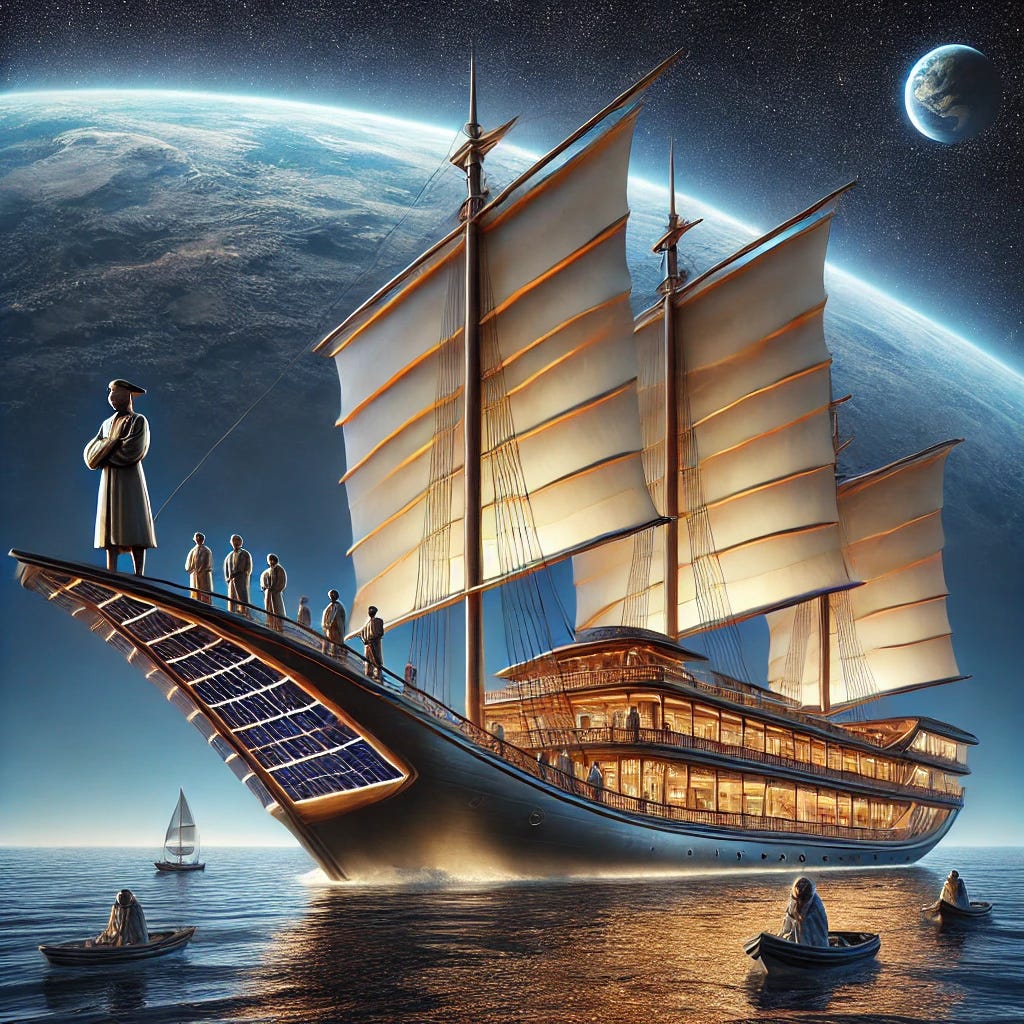
The Cogitating CevichePresentsZheng He: From Treasure Fleet Admiral to Navigator of the Modern CosmosPast Forward: Historical Icons in the Digital Frontier #53By Conrad HannonNarration by Amazon PollyPrefaceWelcome to the fifty-third installment of Past Forward: Historical Icons in the Digital Frontier, where the legacies of history’s visionaries collide with the innovations of the modern world. In this entry, we turn our eyes to the seas—and beyond—with Zheng He, the great Ming Dynasty admiral whose epic voyages in the 15th century brought China to the doorstep of global diplomacy and trade. His fleet of massive treasure ships sailed farther and more grandly than any before, forging diplomatic ties and showcasing Chinese craftsmanship across the Indian Ocean.But what would Zheng He make of today’s navigational precision, satellite-driven exploration, and the boundless frontier of space travel? What might the grand admiral think of international trade powered by algorithms, cargo ships run by AI, and missions not to the Malabar Coast or East Africa—but to Mars?Let us set sail with Zheng He as he surveys the world he once explored and ventures into domains he could only dream of.Arrival: The Admiral Awakens in an Era of Satellites and SkylinesZheng He arrives not in a port city, but atop the deck of a container vessel cutting through the Strait of Malacca. The vessel is enormous—nearly a quarter-mile long—but it lacks sails, flags, or the human orchestration he once commanded with hand signals and booming voice. Steel and silence surround him. There’s no helmsman, no cries of crew members adjusting rigging. Just a hum—mechanical, steady, almost bored.He moves below deck and finds the control room empty but alive with screens: GPS coordinates, satellite imaging, weather projections, and systems diagnostics. A quiet voice—genderless and calm—responds to his puzzled murmurs: it is the ship’s AI-assisted navigation system.Later, ashore in Singapore, he walks through the glass-walled control center of the Maritime and Port Authority. There, he watches hundreds of ships crisscross digital maps in real-time, directed by algorithms, automated cranes, and global positioning systems that can pinpoint a vessel’s location within feet. Where once the stars, monsoon winds, and hand-drawn charts were his tools, Zheng He now witnesses a world where fleets communicate via satellite and shipping lanes are optimized by predictive analytics.His brow furrows, then lifts. The tools have changed, but the principles—the hunger to connect, to navigate, to deliver value—remain.The Legacy of the Treasure Fleet and the Rise of Global TradeIn the early 15th century, Zheng He’s seven voyages under the Yongle Emperor projected Chinese influence across Southeast Asia, India, Arabia, and East Africa. His treasure fleet carried porcelain, silk, and lacquerware, returning with spices, ivory, and exotic animals. His missions combined diplomacy, military power, and cultural exchange—without the intent of permanent colonization. They were performances of presence: China, enormous and self-assured, reminding the world of its reach.Today, he sees echoes of his own armadas in modern shipping giants like Maersk and COSCO. The same Indian Ocean routes his fleet followed are now traveled by massive container ships hauling electronics, textiles, rare earth elements, and microchips. Trade has intensified, diversified, and digitized.But something has changed. Trade now flows as much through fiber-optic cables as through straits and canals. Algorithms make decisions that once took a council of advisors. Blockchain secures transactions that once required imperial seals. In Zheng He’s time, gifts and tribute accompanied diplomacy. Today, he finds diplomacy wrapped in data, trade disputes unfolding over server access, chip supply, and digital infrastructure.His curiosity is piqued. The vast logistics of modern commerce—supply chains, customs harmonization, just-in-time manufacturing—are the modern equivalent of his meticulously choreographed voyages. He meets with international logistics strategists and port engineers in Rotterdam and Shanghai, fascinated by the global choreography that now connects continents every day.Charting New Horizons: Zheng He Discovers Space ExplorationWhen invited to the Kennedy Space Center, Zheng He stares wide-eyed at the Artemis rocket being prepped for lunar exploration. “This is your treasure ship?” he asks, eyes trailing the craft's towering body. “And where does it sail?” The answer—“To the Moon, and then to Mars”—makes him fall silent for the first time since arrival.He studies NASA’s Deep Space Network and the Chinese Lunar Exploration Program. The ground control rooms remind him of his own shipyards—charts, rosters, specialists—but now arranged around missions not across seas, but voids of space. He watches footage from the Mars rover, sees digital terrain scans of alien landscapes, and learns of Elon Musk’s SpaceX reusable rockets. When told that China, too, has ambitions for a space station and lunar base, he smiles with national pride.At JPL, he meets a group of Chinese-American scientists who speak of Zheng He’s expeditions as the first great state-sponsored voyages of exploration. He’s honored, and in return, he challenges them: “If you go to other worlds, do not go as conquerors. Go as guests. Let your banners be respectful, not boastful.”Later, inside a space simulator, he learns to pilot a virtual lunar lander. His instincts as a navigator translate surprisingly well. “The stars have always guided us,” he murmurs. “Now we follow them beyond Earth’s grasp.”Reflections on Power, Trade, and Cultural ExchangeZheng He explores the World Economic Forum and speaks with scholars of international relations. He’s puzzled by a few things: the decentralization of authority, the dominance of corporations, the frequency of war despite global interdependence.In his time, he carried imperial edicts to kings and sultans. But today, power is more fractured—held not only by states but by tech giants and banks, by media and networks. He studies multilateral trade agreements, maritime law, and the role of the UN. He is both impressed and troubled: impressed by global cooperation; troubled by growing distrust and protectionism.He asks hard questions: Why does piracy still exist, if your ships are faster and better armed? Why do poor nations remain poor, when trade is so vast? Why do nations quarrel over islands, when the Earth seen from orbit has no borders?Zheng He begins to propose new initiatives. He suggests a new framework for trade missions that combine cultural exchange with technology transfer. He advocates for floating "embassy ships" that serve as classrooms, clinics, and showcases of green tech—contemporary treasure ships, spreading peace through science.Collaborating Across Centuries: Zheng He and the Navigators of TodayAt MIT’s Department of Aeronautics and Astronautics, Zheng He partners with orbital engineers and AI ethicists. He co-designs a “Voyager Protocol” for autonomous exploratory drones, embedding diplomatic etiquette into first-contact missions. “If we are to sail to unknown shores,” he says, “we must arrive with open hands, not clenched fists.”At the International Maritime Organization, he helps draft ethical frameworks for AI-driven shipping to protect small ports and developing nations. He consults on design principles for autonomous fleets that mirror the discipline and coordination of his Ming-era armadas.He is even invited to guest lecture at the Naval Academy. He tells young officers about leadership without ego, diplomacy without subjugation, and exploration with respect. His tales of encountering Swahili traders, Indian Brahmins, and Arab navigators mesmerize them.Together with a coalition of maritime historians, engineers, and cultural diplomats, he helps launch the Neo-Treasure Fleet Initiative—a global partnership to build educational ships that retrace ancient trade routes, promote cultural dialogue, and teach the history of navigation and exploration. The ships combine sail and solar, tradition and technology.Legacy Rewritten: The Compass Still Points ForwardAs Zheng He prepares to return—or perhaps to stay—he gazes once more at Earth, this time from the vantage of the International Space Station. The oceans, once vast and uncharted, now pulse with satellite signals and shipping data. The stars, which once dictated monsoon departures, now serve as guides to other worlds.Zheng He’s spirit, rooted in curiosity, diplomacy, and shared destiny, finds a home in this modern world. He sees that the tools have changed—sextants replaced by satellites, tribute replaced by trade agreements—but the heart of exploration remains: to connect people, to understand difference, to build peace through shared journeys.In today’s fractured global order, Zheng He reminds us that exploration is not only conquest or commerce—it is also gesture, ritual, and relationship. His voyages are not relics of the past but blueprints for the future.And so, in ports and planets, across oceans and orbits, the admiral sails on.Thank you for your time today. Until next time, stay gruntled. This is a public episode. If you'd like to discuss this with other subscribers or get access to bonus episodes, visit thecogitatingceviche.substack.com/subscribe
Embed this episode
NOW PLAYING
Zheng He: From Treasure Fleet Admiral to Navigator of the Modern Cosmos
No transcript for this episode yet
Similar Episodes
No similar episodes found.
Similar Podcasts
No similar podcasts found.