
PODCAST · religion
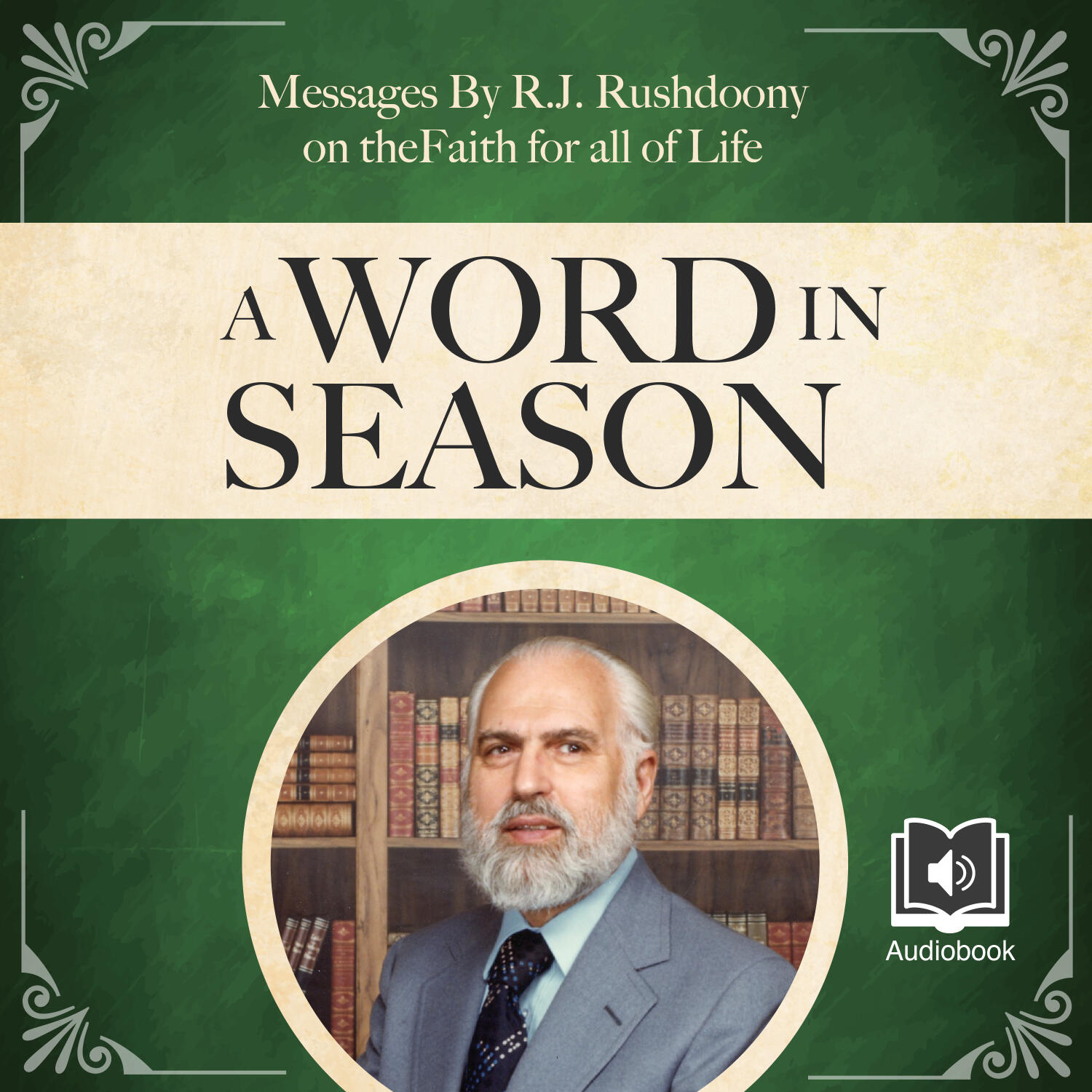
A Word in Season: Messages by R.J. Rushdoony on the Faith for All of Life
by R.J. Rushdoony
Introducing the daily messages by R. J. Rushdoony on the uncompromising faith.These daily messages on the faith for all of life are unlike any compilation of Christian "devotional" ever published. A Word in Season reveals the intense, but simple, approach to applying one's faith to every area of life and thought. This is all done in a format of bite-sized readings on the uncompromising faith.
-
640
Freedom and the Vote
Freedom has never been created at the ballot box. Voting reflects the character of a people it does not transform it. Tyrants aren’t voted out, and revolutions usually just replace one form of slavery with another. Real freedom comes only as men and women are changed inwardly. History shows that freedom rises where Christian faith is strong and declines as that faith fades. A nation becomes free only as its people become free in Christ one life at a time. Elections follow reformation; they do not produce it. The real question isn’t who you vote for but whether there is a free man in your mirror.
-
639
Resources and Advantages
Natural resources and strategic advantages do not guarantee greatness. History proves it. Constantinople lost its power. Egypt’s rich soil did not bring prosperity. What made the difference was not location or wealth but faith and character. Scripture is clear: “Except the LORD build the house, they labour in vain” (Ps. 127:1). No economy, no military, and no natural advantage can save a people who abandon God’s law. The only sure foundation is Jesus Christ. Look to your foundation before the storm strikes.
-
638
Bramble Men
Jotham’s parable warns what happens when productive people refuse power and bramble men seize it instead (Judg. 9). The olive, fig, and vine were busy producing good fruit; the bramble only wanted rule and threatened destruction if others would not submit. So it is today. Bramble men hate producers and seek power by restraining, harming, or controlling those who actually create and sustain life. The issue is stark: will producers be ruled by thorns, or will the power of the bramble be overthrown? Like it or not, we are all on the firing line. The only question is which side are you on?
-
637
Praising the Wicked
Scripture is blunt: when God’s law is abandoned, the wicked are praised instead of restrained (Prov. 28:4). A justice system that protects criminals while penalizing victims is not neutral it has turned justice upside down. Without Biblical law, righteousness and restitution disappear, and evil is treated gently while the innocent pay the cost. When there is no true preaching of God’s Word, “the people run wild” (Prov. 29:18). A society without vision will excuse wickedness, reward injustice, and call it compassion. Abandon God’s law, and praising the wicked becomes inevitable.
-
636
Political Saviors
From ancient Rome to today, rulers have promised salvation through politics. Caesar claimed it, modern politicians repeat it. But Scripture draws a sharp line: “There is none other name under heaven given among men whereby we must be saved” (Acts 4:12). Christ alone saves. Political plans built on man bring ruin, not redemption. Truth is exclusive there are no alternate routes. When leaders offer themselves as saviors, the Christian response remains unchanged: None other name.
-
635
The Foundation
Jesus Christ warned that only a life or a nation built on Him can withstand the storms (Matt. 7:24–27). Built on man instead, it will surely fall. Even Napoleon understood this truth: without fixed religious principles, a nation rests on unstable foundations and descends into chaos, leaving only brute state power to hold it together. Today, Christian foundations are being stripped away and replaced with atheism and humanism, resulting in disunity and conflict. Scripture is clear: “Except the LORD build the house, they labour in vain that build it” (Ps. 127:1). The question remains will we return to the Rock, or will our fall be great?
-
634
Baal Worshippers
When hundreds of laws are rushed through without debate, the deeper problem isn’t politicians it’s the people. Many believe salvation comes through legislation, regulation, and state power, crying out to government as if it were their god. Like the prophets of Baal, they expect the state to deliver paradise, but the result is always the same: more laws, more taxes, and less freedom. Scripture reminds us that when men reject the living God, they will always create a substitute. Only when people look to Jesus Christ for salvation not the state will this cycle change. Who you trust to save you determines who rules you.
-
633
The Right to Lie?
The idea that governments have a “right” to lie is not new it goes back to Plato and later thinkers like Nietzsche, who argued that truth is dangerous or even nonexistent, and that rulers must manage society through deception. This view rests on a deeper belief: if there is no God, there is no truth, no good or evil only power. In such a world, the state plays god by lying “for our good.” Scripture stands in direct opposition. God is the God of truth, and His law forbids false witness (Exod. 20:16). To lie is not just disobedience; it is practical atheism. Christian faith affirms not the right to lie, but the right of truth and its inevitable triumph.
-
632
In the Mind of Christ
Scripture reminds us that “the thoughts of the righteous are right” (Prov. 12:5) not meaning every passing thought, but the governing principles that shape a life. To have “the mind of Christ” (Phil. 2:5) is not mere profession, but living under Christ’s rule so that His Word directs our plans, intentions, and actions. By contrast, the “counsels of the wicked” are deceitful often hidden behind fine words, promises, or even religious language. The real test is not what a person says, but the mind they manifest in action. If we are repeatedly deceived by smooth promises and false solutions, the problem is not only with leaders, but with us: we are no longer thinking with the mind of Christ. Either we live by Christ’s mind or we keep trading truth, wisdom, and freedom for empty promises.
-
631
Danger
“Danger” once meant being under the power of a master not merely facing trouble. In its original sense, we are in danger whenever we live under authorities, debts, or systems that claim dominion beyond what God allows. Scripture warns that “other lords” ruling over us is true danger (Isaiah 26:13). Only under God’s dominion and God-fearing authority are we truly safe. Every power that refuses submission to Christ leads to destruction. Modern society, ruled by false masters, is a dangerous place indeed. The question isn’t just what threatens you but who rules you.
-
630
Cease Ye from Man
A minor pleasure in life is the quiet satisfaction of “I told you so.” I once parked my old car in front of a hotel and locked it as always. A friend pulled up in his brand-new car, laughed, and teased, “What’s the matter? Don’t you trust people?” I replied that, as a Christian, I do not because Scripture declares man a fallen sinner not to be trusted. An hour later I returned to find him furious: a drunk from the hotel bar had climbed into his unlocked backseat, vomited everywhere, and ruined the upholstery. While he searched for rags, I simply noted that locking my doors had spared me the same fate. In more serious ways, countless people who insist on trusting man rather than God reap bitter rewards. Paul and David both affirm, “There is none righteous, no, not one” (Rom. 3:10; Ps. 14:3). There are only two religions: humanism, which trusts in man, or Christianity, which trusts in God. We cannot serve both. Today’s crisis is not a lack of faith but too much faith in man politicians, educators, and systems when only the Lord can save. Isaiah’s warning is urgent: “Cease ye from man, whose breath is in his nostrils: for wherein is he to be accounted of?” (Isa. 2:22). Trust in man will always disappoint; trust in God alone never will. #CeaseYeFromMan #TrustInGod #NotInMan
-
629
Protection Against Men
People are often a problem to us through their sin and folly, and our own and many become obsessed with protecting themselves, their churches, groups, and communities from fools and knaves. Yet no system can fully eliminate the potential for sin as long as humans are present; excessive concern for protection itself becomes a sin. In the early church, some congregations tried to weed out every weak or apostate member after persecutions, but those strict churches perished, while those that required only a profession of faith and dealt with sin through godly discipline survived and thrived. They expected perfection from God alone, not from men, and focused on faithful service rather than self-protection. We can never fully shield ourselves from others or from ourselves but the priority is to “do all to the glory of God” (1 Cor. 10:31) and seek first His kingdom and righteousness (Matt. 6:33). When we put God first, He becomes our surest defense. #ProtectionAgainstMen #SeekFirstTheKingdom #ServeGodFaithfull
-
628
Trick Questions
Asking the wrong questions always yields wrong answers just as the trick question “Have you stopped beating your wife?” forces a false dilemma and incriminating replies. Today we still fall into such traps: “Is it heredity or environment that determines man?” Both sides evade the real issue by denying personal responsibility. Much of modern politics, education, and social debate is built on these misleading questions that obscure rather than solve the crisis. We are told to “fix” economic, racial, political, or environmental problems, yet failure only multiplies because the root problem is not a list of issues but man himself a sinner in rebellion against God. The only question that truly matters is the one the Philippian jailer asked Paul: “What must I do to be saved?” (Acts 16:30). Until we start there, every other question is a distraction or deception. Like God’s piercing word to Adam “Where art thou?” (Gen. 3:9) right questions compel us to face reality, confess sin, and turn to Christ. Only when our questions are rooted in faith, obedience, and the gospel will we find answers that heal instead of deepen the wound. #TrickQuestions #WhatMustIDoToBeSaved #TheRealProblem
-
627
Not by Bread Alone
In A.D. 840, Bertram of Corbie wrote that the soul is not nourished by physical bread but by “the bread of eternal life,” the Word of God and His grace. As Jesus declared, “Man shall not live by bread alone, but by every word that proceedeth out of the mouth of God” (Matt. 4:4). Today we have unprecedented material abundance fine clothes, shelter, and ease yet ulcers, fear, and discontent abound. The substance of life is missing. Students from prosperous homes riot for “rights” and more possessions, ignorant of true poverty, while material solutions alone breed perpetual frustration. Christ warned that the thief comes only to steal, kill, and destroy, but He came that we might have life abundantly (John 10:10). Without Jesus Christ, the true bread of life, no amount of wealth can satisfy. Those who offer only material answers are not helpers but thieves. The faithful, like Bertram centuries ago, still share both spiritual and material life, proving that the substance of life in Christ is the only lasting answer to man’s deepest needs. #NotByBreadAlone #BreadOfLife #AbundantLifeInChris
-
626
Men and Many Sparrows
Our Lord declares in Matthew 10:29–31 that God cares even for the sparrows, yet He affirms, “Fear ye not therefore, ye are of more value than many sparrows.” History has often contradicted this truth: for centuries in England, royal forests and game preserves placed deer and wildlife above the lives of common people farmers could not protect their crops from marauding deer, and better records were kept of the deer in Windsor Forest than of the human population. Oliver Cromwell was beloved by farmers for ending this unnatural priority; when Charles II restored the old order, animals again ranked higher than men. Puritanism fiercely protested such elitism, insisting that man, made in God’s image, is of infinitely greater worth than beasts or birds. Yet today, as faith in Christ fades, the same distortion reappears: many show contempt for their fellow men while lavishing tender mercies on animals and the environment, often proving cruel to people. God’s law calls us to care for creation (Prov. 12:10), but never to exalt it above humanity. Remember Christ’s words: you are worth far more than the flowers of the field, the wildlife, and many sparrows. This is the unchanging truth of God. #MoreValueThanManySparrows #MadeInHisImage #GodsCareForMan
-
625
Loving God
Today, the average Christian gives only about 3 percent of his income to the Lord’s work far less than the biblical tithe yet feels no guilt. Meanwhile, federal, state, and local governments take several tithes from us each year, and the IRS shows no mercy to those who withhold. Do we imagine God is more indulgent? Scripture warns otherwise: “Will a man rob God? … Ye are cursed with a curse” (Mal. 3:8–9). Haggai describes the consequences: “Ye have sown much, and bring in little… he that earneth wages earneth wages to put it into a bag with holes” (Hag. 1:6). In these troubled economic times, many suffer, some with grace, others in blindness yet complain that God neglects them while they have long neglected Him, offering only scraps of time and money. Our Lord commands, “Thou shalt love the Lord thy God with all thy heart, and with all thy soul, and with all thy mind” (Matt. 22:37). True love for God means giving Him our best, not our leftovers, with our time, our money, and our whole selves. Do you? #LovingGod #Tithe #GiveHimYourBest
-
624
The Law as a Song
Our attitude toward God’s law is tragically warped today we view it as a burdensome restraint on human freedom, when in truth it is a gracious gift of love from our covenant God. To the sinner it restrains evil, but to the redeemed it is the very path of righteousness and life. Psalm 119 reveals the heart of the matter: “Thy statutes have been my songs in the house of my pilgrimage” (Ps. 119:54). Astonishingly, the Psalmist calls God’s laws his songs of praise zemir, joyful hymns of delight! Just as a godly America once gave its people something to sing about when doors were unlocked, crime was rare, and church was the heartbeat of the community so obedience to God’s law brings true peace, joy, and communion with Him and with one another. Sin destroys fellowship; faithful obedience restores it. The old hymns once sang, “The precepts of the law are right, and fill the heart with great delight.” If we could once again sing God’s law from the heart, we might again see a land whose joy is in godliness rather than in sin. #TheLawAsASong #Psalm119 #GodsLawIsJoy
-
623
Seizure and Property
The word “seizure” once meant lawful ownership and peaceful possession in old English law, yet today it signifies confiscation by force the very opposite. This reversal mirrors a tragic spiritual decline: when Christ ceased to be King in men’s hearts, “every man did that which was right in his own eyes” (Judg. 21:25), and without godly restraint, power was used to rob rather than protect. Today we see the same drift: property owners face confiscatory taxes, crime, and hostility, while words of peace and love mask hatred and violence. No political reform can truly reverse this; only Christ can change hearts. He claims us as His absolute possession, bought with His blood: “Ye are not your own… ye are bought with a price” (1 Cor. 6:19–20). When we cease seizing our lives from Him and return ourselves and all things to His lordship, He will restore what is rightfully ours. #SeizureAndProperty #ChristIsLord #BoughtWithAPrice
-
622
The Meaning of Words
Charles Curtis once observed that modern legal interpretation concerns itself not with the plain meaning of words but only with their boundaries how far they can be stretched and twisted. This dangerous habit has deep roots in the misuse of Scripture: from the scribes of old to today’s revisionists, men have long perverted the clear words of the Bible to justify abortion, homosexuality, or the rejection of capital punishment even absurdly claiming that the tenth commandment forbids coveting only a neighbor’s wife, leaving strangers fair game! When the Word of God, whose every syllable is sacred, is treated so lightly, is it any wonder that human laws and language lose their integrity? If we will not honor the plain meaning of what God says, we will soon have no reliable meaning left in society at all. Jesus declared, “Man shall not live by bread alone, but by every word that proceedeth out of the mouth of God” (Matt. 4:4). To restore truth, meaning, and justice to our world, we must begin by believing and obeying every word God has spoken because the foundations of all communication, law, and life stand or fall on how we treat His Word. Hear the Lord, and let His every word be final! #MeaningOfWords #EveryWordOfGod #ObeyTheScriptures
-
621
In God We Trust
Men today have no right to complain about the growing crises and collapse around us, for they have reaped exactly what they sowed. When we trust in civil government rather than in God, we get more statist power and less of His grace; when we trust in controls instead of freedom, we receive more slavery and less liberty. Whatever we trust becomes the god we serve, and the true object of our worship is revealed by where we place our hope. Our coins still declare “In God We Trust,” yet too many address their prayers to state capitols and politicians, then wonder why God seems distant. Paul warns us plainly: “Be not deceived; God is not mocked: for whatsoever a man soweth, that shall he also reap” (Gal. 6:7). We have sown unbelief, debt, reliance on the state for salvation, neglect of tithes, and neglect of godly nurture for our children now the harvest is coming. Men want blessings they never sowed for, Sabbath rest they have defiled, and security they never built. The house without foundations will fall in the storms of history, but the life founded on the Rock of Ages, Jesus Christ, will stand secure forever. Examine your foundations: where is your trust? Your life and your future depends on it. #InGodWeTrust #SowingAndReaping #BuiltOnTheRock
-
620
Confounding the Mighty
Paul declares in 1 Corinthians 1:27 that “God hath chosen the foolish things of the world to confound the wise; and God hath chosen the weak things of the world to confound the things which are mighty.” The Greek word for “confound” (kataischuno) means to put to shame, bring to defeat, and utterly dishonor. The world’s self-styled elite those who view themselves as wise and mighty regard believers as foolish and weak, yet God has sovereignly chosen us to overturn and disestablish their arrogant rule. Our calling is to “bring to nought” the powers that oppose Him (1 Cor. 1:28), to be overcomers who break the ungodly grip on history and convert all things to Christ. Just as Christ is our unshakable foundation, we build upon Him with repentance, faith, and good works each act of obedience serving to confound and dismantle every false authority. The mighty of this world may boast today, but their plans are doomed; we who trust and follow Christ are destined to see them put to shame and to witness the triumph of His kingdom. #ConfoundingTheMighty #GodChoosesTheWeak #OvercomersInChrist
-
619
The Work of Faith
Paul thanks God for the Thessalonian believers’ “work of faith, and labour of love, and patience of hope in our Lord Jesus Christ” (1 Thess. 1:3), showing that true Christian life unites faith, love, and hope in action. The “work of faith” is not mere belief but hard, self-giving labor to obey God’s Word and serve His people faith that transforms both heart and hands. The “labour of love” is the sweaty, sacrificial dedication we owe to the Lord, just as Christ’s love for us was proven in the costly work of the cross. And the “patience of hope” is steadfast endurance and persistent action, no matter the obstacles, because we hope in the victorious Christ. In a world more troubled than the early church ever faced plagued by economic distress, political tyranny, and humanistic statism this is no hour for despair. It is time for us to rise and work in faith, love, and hope, confident that our Lord’s triumph is certain and His kingdom will prevail. #WorkOfFaith #LabourOfLove #PatienceOfHope #VictoryInChrist
-
618
Judgment
In Psalm 9, David exults that God executes righteous judgment, declaring, “The LORD shall endure for ever: he hath prepared his throne for judgment. And he shall judge the world in righteousness” (Ps. 9:7–8). Without God’s judgments upon wayward men and nations, life would become unbearable; evil powers rise and fall, yet the Lord remains forever, a refuge for the oppressed and a destroyer of the wicked. God ministers to the world in two ways: grace through the church and justice through the state. When either fails its calling, God judges them both. We too are called to exercise grace and justice in our families and vocations, knowing that we ourselves will be judged if we neglect our duty. David’s prayer “Arise, O LORD; let not man prevail” (Ps. 9:19) reminds us that the alternative to divine judgment is the triumph of sinful man, turning the world into a living hell. Far from being harsh, God’s judgments are acts of grace and mercy, disciplining us as a loving father corrects his child, clearing the ground of history for faithful generations and preserving the possibility of redemption. #GodsJudgment #RighteousJudge #MercyInJustice
-
617
The Exaltation of a People
The founders believed a nation rises or falls not by power or policy, but by righteousness before God. They took Proverbs seriously “Righteousness exalteth a nation, but sin is a reproach to any people” and saw moral decay as a summons to judgment, not progress. To them, national strength was first a spiritual matter, not a political one. If they were right, then our deepest crisis today isn’t constitutional or economic, but religious and moral. The true exaltation of a people comes from God alone and it follows faithfulness, not rebellion.
-
616
A Word of Rebellion
A common complaint today is: “A good God couldn’t allow that to happen,” as if God must conform to our personal standard of goodness or be judged guilty. Yet the real problem lies not with God but with our rebellious hearts like a spoiled child who screams, “You don’t love me!” when denied his demands. In truth, a world in open rebellion against its Creator is neither safe nor easy; it is a fallen place full of penalties, risks, and suffering. We lock our doors and live with danger precisely because this is not heaven. Scripture gives us our marching orders: we are called to bring every realm into captivity to Christ, until the triumphant day when “the kingdoms of this world are become the kingdoms of our Lord, and of his Christ; and he shall reign for ever and ever” (Rev. 11:15). Until that glorious victory, the Lord will not let a rebellious world become a comfortable haven for sin. The question remains: are we faithfully meeting our responsibility to our King? #WorldOfRebellion #ChristIsKing #KingdomCome
-
615
God and the Future
A prominent professor once claimed the future is an open, unbound field with no effect on the present, yet Scripture declares otherwise: God governs every tomorrow just as He does the past and present. “Known unto God are all his works from the beginning of the world” (Acts 15:18); nothing happens apart from His sovereign providence. Our confidence rests in the Lord revealed in Jesus Christ, who alone determines the future not man, tyrants, or any scheme. Amid earthquakes, disasters, and warring nations, the Psalmist trusted unshakably: “God is our refuge and strength… Therefore will not we fear, though the earth be removed” (Ps. 46:1–2). True faith in God means trusting Him over every coming day, fearing Him rather than man or state, and conforming our lives to His will alone. He never surrenders the government of the universe He alone is God, and “beside Him there is none else” (Isa. 45:22). #GodAndTheFuture #SovereignLord #HeIsInControl
-
614
The Resurrection
When Paul stood before King Agrippa, he posed a piercing question: “Why should it be thought a thing incredible with you, that God should raise the dead?” (Acts 26:8). The king had no answer because the resurrection of Jesus Christ was no mere rumor. Over five hundred eyewitnesses had seen the risen Lord at one time alone (1 Cor. 15:6), and the early church proclaimed it with fearless certainty. Yet the Roman Empire could not accept it: for Rome, the highest power was Caesar, who could even deify men. To admit that a crucified Galilean had risen from the dead meant a greater King existed one whose authority towered above the empire itself. So they dismissed the resurrection as superstition and persecuted those who confessed it.Rome has long since crumbled into dust, but the risen Christ remains “the blessed and only Potentate, the King of kings, and Lord of lords” (1 Tim. 6:15). He reigns over every nation, every ruler, every age. In time, every knee will bow and every tongue confess that Jesus Christ is Lord (Phil. 2:10–11). Though human governments have often been wielded by evil hands, the risen Lord stands sovereign behind them all, working all things together for good for His people (Rom. 8:28). The tomb is empty, death is defeated, and the King lives forever. Therefore, rejoice! #TheResurrection #KingOfKings #HeIsRisen #JesusIsLord
-
613
Change
Things change relentlessly in this world: twelve presidents have come and gone since my birth, rivers where I once fished now look unrecognizable, familiar university landmarks have vanished, and even my own reflection tells a story of time’s steady work. Places I knew as a boy are transformed gold mines turned into wooded hills, bulldozed ridges smoothed out reminding us that nothing earthly endures. Yet amid every shift and upheaval, God’s salvation and grace stand utterly unchanged. He declares, “The mountains shall depart, and the hills be removed; but my kindness shall not depart from thee, neither shall the covenant of my peace be removed” (Isa. 54:10). Even stronger: though “the heavens shall vanish away like smoke, and the earth shall wax old like a garment,” His salvation “shall be for ever” and His righteousness “shall not be abolished” (Isa. 51:6). All the changes and earthquakes of life are God’s shaking of what can be shaken, so that only what cannot be shaken remains (Heb. 12:26–29). Therefore, hold fast to Christ the same yesterday, today, and forever who alone is unshakable. Let every change strengthen our faith, making us steadfast and immovable in Him. #UnchangingGod #SameYesterdayTodayForever #SteadfastFaith
-
612
The King of Kings
Paul declares Jesus Christ “the blessed and only Potentate, the King of kings, and Lord of lords” (1 Tim. 6:15) the Great King who stands behind every throne and every power in history. He permits men and nations to chase their evil dreams until those very dreams become their curse, sweeping away everything not built on the Rock. As Hebrews 12:27–29 warns, God is shaking the heavens and the earth so that only what cannot be shaken will remain. Crises, trials, and upheavals are not accidents; they come from the King to test and prove His people. We have no right to expect an easy path. Isaac Watts rightly asked, “Must I be carried to the skies on flow’ry beds of ease, while others fought to win the prize and sailed through bloody seas?” The answer is clear: “Sure I must fight if I would reign.” In this hour of shaking, when the world’s foundations tremble, the vital question is not whether we will be shaken, but whether we are earthquake-proof grounded so deeply in Christ, the unshakable King of kings, that we cannot be moved. #KingOfKings #EarthquakeProof #StandFirmInChrist
-
611
"Another King, One Jesus"
In the pagan cities of the Roman Empire where abortion, homosexuality, and state-sanctioned prostitution were not only tolerated but celebrated the early Christians were accused of treason: “These all do contrary to the decrees of Caesar, saying there is another king, one Jesus” (Acts 17:7). They boldly proclaimed Jesus Christ as the true King of kings, God’s anointed Lord whose law stands above every human decree. By calling Him Messiah, they declared that every nation and every soul must bow to Him or face destruction, just as Isaiah 60:12 warned: “The nation and kingdom that will not serve thee shall perish.” While the world pursued its pleasures and power, the church confronted evil with the higher law of King Jesus, and through faith, persecution, and unwavering obedience they triumphed proving that “whatsoever is born of God overcometh the world” (1 John 5:4). Today, as our culture again normalizes the same ancient sins, the same charge rings out: we follow another King. Will we share the holy boldness of those first believers, trusting the victorious Christ who alone reigns forever? #AnotherKing #OneJesus #ChristIsKing #FaithThatOvercomes
-
610
Light at Evening Time
When the shadows of evening fall when darkness seems to swallow the world, when history appears locked in a downward spiral of sin, disaster, and despair God declares a different reality. Zechariah 14:7 promises a day “not day, nor night,” when “at evening time it shall be light.” What nature calls the end of day, the Lord turns into a miracle of sudden illumination. The Creator who governs history, not nature, repeatedly reverses the expected decline: in the darkest hours, He brings forth light, regenerates hearts, redirects nations, and fulfills His sovereign purposes. Though sin daily deepens the gloom around us, the greater truth is not our darkness but Christ’s lordship over it. He is King over sin, death, and every evening time. Therefore, as Paul commands, we rejoice always, give thanks in everything, and trust the God who makes all things work together for good (Rom. 8:28) and who, even at evening time, brings forth light. #LightAtEveningTime #Zechariah147 #GodBringsLight #HopeInDarkness
-
609
Born of the Virgin Mary
The Apostles’ Creed boldly declares the personal faith of every believer: “I believe… in Jesus Christ His only Son our Lord: Who was conceived by the Holy Ghost, Born of the Virgin Mary.” This Virgin Birth is no mere detail it is the miracle of a new creation. In Christ, the second Adam, God begins a new humanity, free from the sin and death inherited from the first Adam, born instead to righteousness and everlasting life. While the world pins its hopes for a better age on politics, education, science, or social reform hoping to remake man by remaking his environment the gospel proclaims the only true path: Jesus Christ remakes the heart. “As many as received him, to them gave he power to become the sons of God… which were born, not of blood, nor of the will of the flesh, nor of the will of man, but of God” (John 1:12–13). The Virgin Birth guarantees that the Savior is both truly God and truly man, able to regenerate us, preserve us from darkness, and bring history to its glorious climax: “The kingdoms of this world are become the kingdoms of our Lord, and of his Christ; and he shall reign for ever and ever” (Rev. 11:15). In the Virgin-born Savior we have a glorious destiny! #VirginBirth #NewCreation #BornOfGod #JesusIsLord
-
608
The Future
We all wonder and often fear what the future holds: aging, disappointments, pain, and the shadow of death seem to loom large, while the world around us appears to unravel. Yet Scripture offers a far greater certainty than our anxious guesses. Paul declares in Romans 8:28 that “all things work together for good to them that love God, to them who are the called according to his purpose.” Even when we cannot know what tomorrow will bring, we know Who is bringing it the sovereign Lord who rules over heaven and earth, and who cannot be stopped or questioned (Dan. 4:35). The God who already gave His only Son for our redemption on the cross will surely care for us in every trial. As Peter, who endured far more suffering than most of us, urged: “Casting all your care upon him; for he careth for you” (1 Pet. 5:7). Whatever the future brings, it is in the hands of the One who has already secured our victory in Christ. Peace be with you all who are in Christ Jesus! #TheFuture #Romans828 #GodIsInControl
-
607
Ferocious Time
The apostles declared that we are living in the “last days” the intense era that began with Christ’s first coming and will end with His return. In these “latter times,” Paul warned, many will depart from the faith, seduced by demonic doctrines, becoming “fierce, despisers of those that are good,” trucebreakers, and lovers of every evil (1 Tim. 4:1; 2 Tim. 3:1–3). The result is not mere difficulty but “perilous times” literally ferocious times when civilization itself clothes malice and hatred of righteousness in polished forms. The civilized barbarian has emerged, breaking treaties, despising truth, and unleashing open war against Christ and His people. Yet Paul, who faced this ferocity firsthand, declared with unshakable confidence, “The Lord shall deliver me from every evil work” (2 Tim. 4:18). In these ferocious last days, the battle is fierce, but the victory is certain: Christ is Lord over all, and we are more than conquerors in Him. #FerociousTimes #LastDays #VictoryInChrist
-
606
Fearing Tomorrow
In 1139, the Lateran Council condemned the crossbow as too deadly for Christian warriors, yet the weapon soon became a standard of warfare because yesterday’s fears rarely stop tomorrow’s progress. The same fear of change that paralyzed men then still cripples many today, making us shrink from the blessings and challenges God has prepared for the future. Yet Scripture promises that “all things work together for good to them that love God” (Romans 8:28). When we trust the sovereign Lord who ordains every tomorrow, we need not dread what lies ahead each day, no matter how difficult, serves His holy purpose and leads us to victory. To fear tomorrow is to fear the life God has given; walk by faith instead, and discover that every dawn is on the side of the faithful. #FearingTomorrow #Romans828 #GodsSovereignPlan
-
605
Festival of Time
In the Bible, every new month and every new year was a festival, a holy day consecrated to God, not to nature or human schemes. While pagans marked time by the sun and seasons, the Hebrews celebrated time as God’s sovereign gift, numbering years from creation, months from His deliverance, and days from His faithfulness. The Christian calendar continues this tradition: we date our history Anno Domini, “in the year of our Lord,” because time belongs to Jesus Christ, not to revolutions or five-year plans. The French and Russian Revolutions tried to seize control of time, only to fail miserably man cannot be god over the calendar. Yet the believer can joyfully greet each new day, month, season, or year with confidence, knowing time is not our enemy but God’s servant, unfolding His perfect purpose and frustrating every modern Tower of Babel. Time works for the godly and against the ungodly, for the Creator alone governs it. #FestivalOfTime #AnnoDomini #TimeBelongsToGod
-
604
Time
We can soar across oceans or even touch the moon, yet no one can leap over time neither backward to relive childhood nor forward to escape today’s trials. Longing for peaceful yesterdays or a trouble-free tomorrow is futile, for God gives us time one moment at a time, in perfect sequence, as both a test and an opportunity. Time is our life’s true wealth: it cannot be hoarded, traded, or skipped. Moses prayed, “Teach us to number our days, that we may apply our hearts unto wisdom” (Psalm 90:12), and Paul urged us to redeem the time in these evil days (Ephesians 5:16). Only when we invest each day in God’s service does time multiply its value here and for eternity. Instead of dreaming of escaping time, let us embrace it as His precious gift and live it fully for Him. #RedeemTheTime #NumberYourDays #GodsGiftOfTime
-
603
The Prince of Peace
In a world where violent marches claim the name of peace, and cities burn while crowds scramble for gold instead of guarding it, true peace remains impossible without righteousness. A hundred years ago, honor held society together; today, the loss of Christian character breeds chaos and insecurity. The Bible declares that only the Prince of Peace Jesus Christ can transform corrupt hearts and bring lasting order, justice, and joy. As Isaiah prophesied, His peace shall have no end. This Christmas, amid the clamor for counterfeit peace, return to the Savior born to save us from our astray ways. O tidings of comfort and joy! #PrinceOfPeace #ChristmasTruth #TruePeace
-
602
The Power of the Word
In a world where violent marches claim the name of peace, and cities burn while crowds scramble for gold instead of guarding it, true peace remains impossible without righteousness. A hundred years ago, honor held society together; today, the loss of Christian character breeds chaos and insecurity. The Bible declares that only the Prince of Peace Jesus Christ can transform corrupt hearts and bring lasting order, justice, and joy. As Isaiah prophesied, His peace shall have no end. This Christmas, amid the clamor for counterfeit peace, return to the Savior born to save us from our astray ways. O tidings of comfort and joy! #PrinceOfPeace #ChristmasTruth #TruePeace
-
601
The Unchanging Word
Times, tastes, and customs change but the church remains alive only by the one thing that never does: the Word of God. Hymns, forms, and preferences may differ from generation to generation, yet believers across centuries recognize one another by their shared submission to Scripture. When the Bible is treated as absolute truth, the church is timeless; when it is denied, what remains is only a counterfeit. Real progress isn’t chasing change it’s applying God’s unchanging truth to changing times. The church doesn’t need to reinvent itself; it needs to reclaim the Word.
-
600
On Eating Our Gifts
What we give to God has a way of coming back to us. A man who cut corners on a house meant as a retirement gift ended up living in the very mess he built a living picture of a biblical truth: we eat our own offerings. Scripture required that gifts to God be the best, because much of what was offered returned to the giver. When people give God only leftovers time, money, care, or obedience they eventually live with the results. God is not mocked: what we sow, we reap. The question is sobering are we offering God our best, or preparing a house we ourselves will have to live in?
-
599
A Vulture Society vs. A Diaconal Society
Jesus sets a stark choice before every society: service or predation. A culture built on the lust for power becomes a vulture society devouring, distrustful, and cruel while a diaconal society is marked by humility, service, and sacrifice. True ministry can’t be manufactured by the state or sustained by ideology; it flows only from Christ, who came not to be served but to serve. If He does not govern us, something else will and it will not be gentle. The choice is unavoidable, and the cost is real: Christ, or the vultures.
-
598
The Congregation of the Dead
People are quick to demand sacrifices so long as someone else pays the cost. Whether for recreation, ideology, or sentiment, wisdom disappears when God’s Word is ignored and the burden is shifted onto others. Scripture warns that those who abandon understanding and justice drift into “the congregation of the dead.” A society that pursues its desires without counting the cost or seeking God’s will isn’t advancing it’s moving toward death. The real test is simple: are we willing to bear the cost of what we demand, and submit our wants to God’s law?
-
597
Sensitive Church Members
One of the quiet weaknesses of many churches is not open rebellion, but hypersensitivity. People quick to criticize others often cannot bear the smallest correction themselves, reading offense into every word and gesture. Scripture calls believers to something far stronger: forbearance, forgiveness, and charity the bond that holds Christ’s body together. The church cannot move forward when its members are easily wounded and slow to forgive. The question is not who else this describes, but whether we are willing to put on love, let go of offense, and grow up into the maturity Christ requires.
-
596
Like People, Like Priest
Scripture reminds us that corruption is never confined to one group “like people, like priest.” When faith and character decay at the roots of a society, the fruit will show it in politics, churches, schools, and homes alike. Complaining about leaders may be justified, but leaders usually reflect the people who produce and choose them. Lasting change cannot be outsourced to government or institutions; it begins with regeneration and reformation in families, churches, and schools. As a people are, so their society will be and renewal starts at the roots.
-
595
The Stolen Church
The church belongs to Jesus Christ, yet in many places it has been taken over in His name and turned against His purpose. When Christ’s Word is replaced with ideology and social agendas, faithful believers are pushed aside and the church is stolen both from its Lord and from His people. Property and institutions may be lost, but Christianity itself cannot be captured or destroyed, because it is God’s work, not man’s. The call is clear: do not support what denies Christ, but rebuild His church on the foundation of Scripture, faithfulness, and obedience standing firm, even when the cost is great.
-
594
Church and Government
We confuse ourselves when we reduce “government” to the state and “church” to an institution. Scripture and earlier Christian thought saw government first as self-government under God, then family, church, school, and community civil government being only one among many. Likewise, the church is not merely a building or denomination, but the living Body of Christ, to which institutions are faithful only insofar as they obey Him. When we forget these meanings, we surrender responsibility and drift toward dependency and spiritual poverty. How we use these words reveals what we truly trust and whether we live under God’s order or man’s substitutes.
-
593
True Prayer
True prayer isn’t a ritual recited at set times it’s an ongoing conversation with God woven into everyday life. We speak to Him in brief, honest moments: asking for patience, confessing failure, seeking wisdom, or simply giving thanks. When God is real to us, He becomes our constant companion and “very present help,” shaping how we face every task and trial. This kind of prayer replaces anxiety with peace, because it keeps our hearts and minds anchored in Christ throughout the day.
-
592
Prayer
Prayer is not about persuading God to change it’s about allowing Him to change us. Like Columbus, we often begin by asking God to fix our circumstances, only to discover that the deeper problem lies in our own hearts, sins, and misplaced desires. True prayer moves from complaint to confession, from demanding answers to seeking transformation. God’s greatest gift is not altered circumstances but renewing grace in Christ. The real question prayer presses upon us is this: are we asking God to serve our plans, or are we surrendering ourselves to His will?
-
591
The Water of Life
We take water for granted until it’s gone. Scripture uses that reality to press a deeper truth: without Christ, the Water of Life, man becomes a spiritual desert. Just as land without water turns barren and lifeless, so a soul or a nation that despises God’s Word dries up into emptiness and decay. Jesus’ invitation is urgent and gracious: come and drink. Those who hunger and thirst for righteousness are not mocked they are promised fullness. The question isn’t whether we’re thirsty, but whether we’ll drink.
We're indexing this podcast's transcripts for the first time — this can take a minute or two. We'll show results as soon as they're ready.
No matches for "" in this podcast's transcripts.
No topics indexed yet for this podcast.
Loading reviews...
ABOUT THIS SHOW
Introducing the daily messages by R. J. Rushdoony on the uncompromising faith.These daily messages on the faith for all of life are unlike any compilation of Christian "devotional" ever published. A Word in Season reveals the intense, but simple, approach to applying one's faith to every area of life and thought. This is all done in a format of bite-sized readings on the uncompromising faith.
HOSTED BY
R.J. Rushdoony
CATEGORIES
Loading similar podcasts...
Frequently Asked Questions
How many episodes does A Word in Season: Messages by R.J. Rushdoony on the Faith for All of Life have?
A Word in Season: Messages by R.J. Rushdoony on the Faith for All of Life currently has 50 episodes available on PodParley. New episodes are automatically indexed when they're published to the podcast feed.
What is A Word in Season: Messages by R.J. Rushdoony on the Faith for All of Life about?
Introducing the daily messages by R. J. Rushdoony on the uncompromising faith.These daily messages on the faith for all of life are unlike any compilation of Christian "devotional" ever published. A Word in Season reveals the intense, but simple, approach to applying one's faith to every area of...
How often does A Word in Season: Messages by R.J. Rushdoony on the Faith for All of Life release new episodes?
A Word in Season: Messages by R.J. Rushdoony on the Faith for All of Life has 50 episodes. Check the episode list to see recent publication dates and frequency.
Where can I listen to A Word in Season: Messages by R.J. Rushdoony on the Faith for All of Life?
You can listen to A Word in Season: Messages by R.J. Rushdoony on the Faith for All of Life on PodParley by clicking any episode. We provide an embedded audio player for direct listening, and you can also subscribe via your preferred podcast app using the RSS feed.
Who hosts A Word in Season: Messages by R.J. Rushdoony on the Faith for All of Life?
A Word in Season: Messages by R.J. Rushdoony on the Faith for All of Life is created and hosted by R.J. Rushdoony.
URL copied to clipboard!