
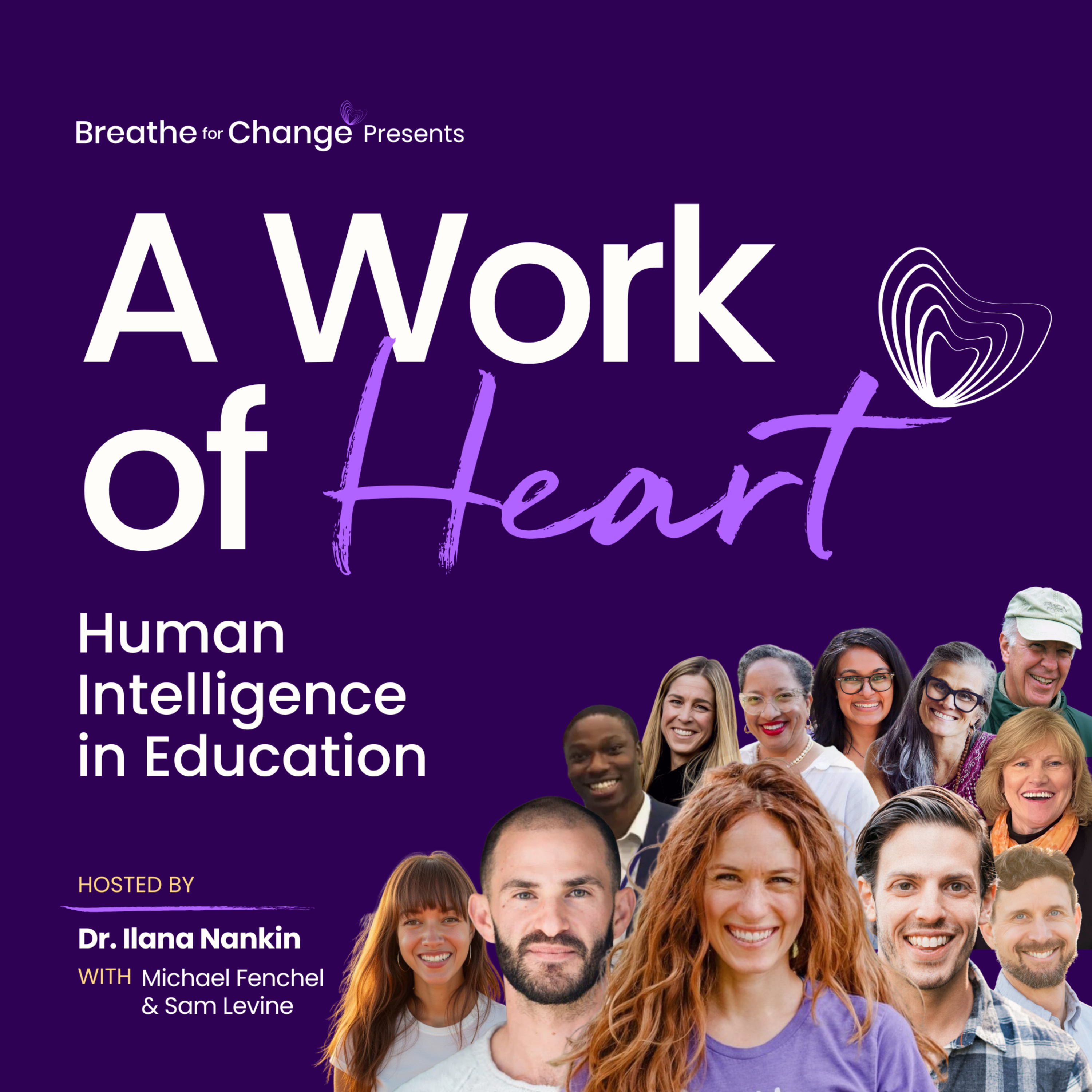
PODCAST · education
A Work of Heart: Human Intelligence in Education
by Breathe For Change
A Work of Heart: Human Intelligence in Education is a podcast by Dr. Ilana Nankin and Michael Fenchel, co-founders of Breathe For Change. After certifying 20,000 educators and impacting millions of students, they’re digging deeper into what really drives learning: Human Intelligence. Each week, they explore how empathy, presence, and purpose can help educators rediscover joy, belonging, and balance—and reimagine education from the inside out.
-
16
Why Classroom Management Stops Working in Month Two
By the second month of a school year, most classrooms look nothing like they did in September. The agreements have loosened, the routines have slipped, and behaviors are surfacing that no teacher preparation program ever covered. Nearly every educator moves through it privately convinced they are the only one.Most of us were handed exactly one tool for these moments: the consequence. Dr. Ilana Nankin and Sam Levine make the case that it is not simply ineffective, it is escalating. A student who is acting out is not choosing defiance. They are communicating with the only signal available to them, and a nervous system in fight, flight, or shutdown cannot be corrected into calm.What works instead is not softer, it is more structured. Consistency means rituals a student can predict, which for many children is the only reliable rhythm in their day. Safety means attending to the nervous system first, because a child who does not feel settled in their body cannot reach anything you prepared for them. Love means knowing who a student actually is and building from their gifts rather than scanning for what might go wrong.Underneath all three sits the question most classroom management advice skips: how is the adult in the room doing? Regulation travels in both directions, and Ilana and Sam are honest about the days they were the ones who walked in unsettled. Listeners come away with practices to put in place before the next hard moment arrives, including Feel Your Roots, guided in full, and 3 Collective Breaths, both from the Somatic Intelligence layer of the Human Intelligence framework. These are not just classroom tools. They are lifelong skills.For any educator in month two right now, quietly certain they are getting it wrong: they are not. This is simply the part of the year where the real work begins.Best Moments -The student on a three strike system, and what "strike one" teaches a child about himself-Ilana on the day she realized she had never once asked a child what was happening for him-Feel Your Roots, guided live, for anyone listening in a car or between classes-"Mr. Levine, you seem angry," and what a teacher does with feedback he was not ready to hear-Why a morning ritual with a singing bowl and a two word check in does more than any rule chartWhat You'll Learn -Why consequences escalate the behaviors they are meant to stop, and what to reach for instead-How to tell a hyper aroused nervous system from a shut down one, and what each one needs from you-How to build arrival and transition rituals that make a classroom feel predictable to a child whose life is not-How to teach regulation proactively, when students can actually hear it, rather than in the middle of a hard moment-How to catch the deficit stories you may be telling yourself about a student, and what changes when you swap them for strengths-How to model repair out loud when you are the one who is dysregulatedEpisode Highlights00:00 - Intro: Consequences vs. Student Needs01:16 - When Reality Sets In After the First Weeks of School02:54 - The Gap in Teacher Prep & Behavior Management06:17 - Rethinking Consequences: Lessons from Melvin & Javier12:16 - The 3 Core Pillars: Consistency, Safety, and Love16:15 - Creating Consistent Classroom Routines & Rituals20:47 - The Science of the Nervous System: Fight vs. Flight24:14 - Guided Somatic Practice: "Feel Your Roots"26:38 - De-escalation & Understanding Hypo-Arousal (Shutdown)31:40 - Co-Regulation: How Educator Energy Impacts Students37:10 - Proactive Regulation & The 5 Intelligence Layers42:40 - Leading with Radical Acceptance & Strengths-Based Teaching47:16 - Focusing on Growth & Co-Creating Community Agreements51:00 - Final Encouragement & Breathe for Change Resources#ClassroomManagement #TeacherWellness #Education
-
15
Teacher Burnout Isn't Your Fault. Here's What Actually Helps
You are not burning out because you are bad at this job. You are burning out because no one trained you for the part of the job that actually breaks people, and because the story you have been telling yourself about it has gone unchallenged for years.That story usually sounds like this: I am a failure. I can't do this. I don't have what it takes. It feels like an assessment. It is actually a habit, and habits can be rewritten.Dr. Ilana Nankin and Beth Schreiber have both lived on the wrong end of that sentence. "Burnout was our story," Ilana says, and between them they have spent more than a decade building the thing they needed and could not find: a practice set that treats the educator as the intervention, not the delivery mechanism. This episode hands you three of those practices and walks you through the hardest one live, on tape, with Beth as the volunteer.The tools come from the Emotional Intelligence layer of the Human Intelligence framework. Feeling Finder gives you a way to locate the emotion sitting underneath the tight shoulders and the fast drive to school, before it starts making decisions for you. Story I Tell Myself surfaces the belief driving the feeling. Re-THINK Your Story takes that belief apart with five questions, asking whether it is true, helpful, inspiring, necessary, and kind, and then rebuilds it into one you can actually work from. By the end of the hour, the sentence that nearly ended Beth's career has become something usable: I am feeling depleted right now, and I am deserving of refueling. Same starting point. Different life.You will also get the reason any of this holds. Shame does not survive being spoken out loud to another person who has been there, which is why these practices are built for community rather than for willpower, and why Beth's own school data shifted the way it did when she brought a handful of colleagues and her principal into a weekly practice.Best Moments-Why the profession runs on "not knowing yet" in a world that has stopped tolerating any waiting at all-The five question sequence that dismantles a limiting belief in under ninety seconds-What the window of tolerance is, and how to tell when you are above it or below it-The four kinds of intelligence school never trained you to teach, and why they are the ones AI cannot touchWhat You'll Learn-How to name what you are feeling before it starts running your classroom, using Feeling Finder-How to find the belief underneath the feeling, and why that belief is driving your actions more than your circumstances are-The full Re-THINK sequence, and how to use the same acronym in reverse to build a story worth keeping-Why isolation is the mechanism of burnout, and what changes the moment another educator says "me too"Episode Highlights00:00 - Open: The Most Burnt Out Profession in America01:25 - Welcome: Addressing the Educator Burnout Crisis03:08 - Why Burnout Hits Teachers So Hard07:42 - What Traditional Teacher Preparation Programs Miss10:00 - Overcoming Isolation, Shame, and the "Itty Bitty Shitty Committee"11:30 - Ilana's Personal Story: From Rock Bottom to First Breath14:34 - Integrating Simple Mindfulness Practices in the Classroom18:02 - The PhD Research Behind Breathe for Change23:00 - The Healing Power of Community and Vulnerability27:00 - Internal vs. External Obstacles: Shifting Your Narrative33:20 - Why Educator Transformation Must Come First41:40 - The Human Intelligence Framework vs. Artificial Intelligence46:50 - Somatic Intelligence & The Window of Tolerance48:10 - Practical Tool 1: The "Feelings Finder" Practice51:33 - Practical Tool 2: "The Story I Tell Myself" & The THINK Acronym55:20 - Real Results: How 6 Weeks of Practice Flipped Stress & Satisfaction Data59:55 - Closing Encouragement & Breathe for Change Resources#TeacherWellness #TeacherBurnout #Education #SocialEmotionalLearning #Mindfulness #BreatheForChange
-
14
Back to School Series | Episode 6: How Teachers Can Use AI Without Losing the Human Side of Teaching
AI arrived in classrooms faster than any guidance for using it. Most educators are being handed the tools without being handed a framework, and the result is a lot of quiet uncertainty about what counts as appropriate use, what counts as cheating, and what is worth protecting regardless.This conversation offers a way through. Dr. Ilana Nankin is joined by Khushali Narechania, Director of Learning at aiEDU, a former high school math teacher who spent a decade developing educators before moving into the AI and education space. Together they work through what these tools actually are, where they genuinely help inside a teacher's week, and which parts of teaching and learning should stay untouched.Educators will come away with practical entry points that require no technical background, a working understanding of why AI produces what it produces, and clearer language for talking about all of it with students.Building context, thinking with AI rather than handing your thinking over, considering impact — these are the three skills at the heart of Breathe for Change's AI, Teaching, and Learning course. This conversation is where they start.Best MomentsA student flagged for fully AI-generated writing, and the five-minute assignment that revealed what actually happenedThe elementary classroom where AI wrote the skits and students did all the acting, reading, and revisingWhy AI is a prediction machine, not an answer machine - and what changes for teachers once that clicksWhy oral arguments and in-class presentations are coming back as assessmentWhy productive struggle has to stay protected, even when a tool could remove itWhat You'll LearnWhere to start with AI if you've never used it, without putting student data anywhere near a toolHow to give AI enough context that the output is worth editing instead of rewritingHow to design assignments so the skill you're assessing is the skill actually being demonstratedHow to build AI expectations with students as classroom culture rather than enforcementWhich parts of your week need a person, and which can take an assistWhat to hold onto as the tools keep changingEpisode Highlights00:00 - Opening: Preparing Students for AI-Driven Careers01:16 - Guest Welcome: Khushali02:54 - The Current Landscape of AI Policy in Education08:43 - Core Opportunities and Risks of AI in the Classroom11:31 - Shifting Educator Mindsets from Resistance to Empowerment15:22 - Demystifying the Technology: Math and Probability vs. Fact-Giver20:08 - The 3 Meta Skills: Context Building, Thinking with AI, & Impact27:01 - Practical AI Use Cases for Teacher Efficiency & Differentiation33:06 - Adapting AI Strategies for Elementary vs. Secondary Students36:50 - Rethinking Student Assessment & Academic Integrity47:32 - Real-World Examples of Successful Classroom AI Integration52:18 - Simple First Steps for Educators Dabbling in AI58:00 - The Future of Education & School as a Human Convening Space1:02:37 - Closing Thoughts & Breathe for Change Course Preview#Education #TeacherWellness #ClassroomManagement #SocialEmotionalLearning #AIinEducation #FutureOfLearning #BreatheForChange
-
13
Back-to-School Series | Episode 5: Classroom Management, Reframed
What Nobody Taught You About Classroom ManagementNobody teaches you how to run a classroom. Kristy Herrera cannot remember a single lecture on it in her teacher preparation program. Chrizia Dela Rosa was told to be strict and not to smile until December.Between them, they now hold two of the most visible roles an educator in California can hold. Chrizia Dela Rosa was named California Teacher of the Year. Kristy Herrera was elected teacher union president. Neither of them got there by learning to control a room. Kristy describes the shift that changed her practice as moving away from managing student behavior and toward “figuring out what they needed.”Dr. Ilana Nankin brings them together - one kindergarten teacher and one high school math teacher - to ask whether the work of classroom management is actually the same across thirteen years of student development. It is. The language changes. The underlying human needs do not.Together, they get practical about what that means: what to do on day one, what to do when your structures get tested, and what to do when the classroom comes apart anyway. And beneath every strategy is a deeper shift: from managing behavior to understanding the whole human being in front of you - and creating the conditions for every student to feel, connect, learn, and thrive.Best MomentsWhy Chrizia was taught not to smile until December, and what she does insteadThe first-day family photograph that stays on Kristy’s classroom wall all yearThe question almost no teacher asks families: “Who should I call when your child does something well?”What changes when you stop asking what is wrong with a student and start asking what they needThe three C’s - culture, consistency, and connection - invented live in the final minutes of the conversationWhat You’ll LearnHow to build classroom agreements students will actually hold each other to - from kindergarten through high schoolA practical first-week approach for learning who is actually in your room, not just who is on your rosterHow to create a calm-down space that supports regulation rather than becoming a rewardWhy consistency matters when building a classroom rooted in trust and connectionHow to hold meaningful consequences without abandoning a relationship-centered approachEpisode Highlights00:00 - Opening: Educator Energy and Student Connection01:21 - Introduction: Rethinking Classroom Management03:14 - Back-to-School Check-In: Feeling "Scare-Cited"04:05 - Redefining "Classroom Management" Beyond Control05:34 - Shifting from Compliance to Whole-Child Support11:03 - Co-Creating Classroom Agreements vs. Rules18:48 - Intentional Ways to Build Student & Family Relationships27:05 - Streamlining Daily Check-Ins & Data with AI31:31 - Cultivating Belonging Through Presence & Eye Contact37:40 - Trauma-Informed Teaching: Choice, Voice & Emotion Naming47:43 - Safe & Predictable Routines to Foster Self-Regulation52:56 - Navigating Escalation, Accountability & Restorative Consequences56:26 - Conflict Resolution & Nonviolent Communication (Peace Corner)1:00:50 - The 3 C's: Culture, Consistency, and Connection1:01:46 - Resources at Breathe for ChangeAbout Breathe for ChangeBreathe For Change is leading the movement to transform education through human intelligence, starting with the people who make it possible. As a transformative higher education institution, we offer teacher trainings, certifications, and graduate degree programs that empower educators to enhance well-being, improve educational outcomes, and reach their full human potential.Connect With UsLearn more about Breathe for Change's Master of Education and discover how to bring these practices into your classroom, career, and life: https://breatheforchange.com/#BreatheForChange #HumanIntelligence #ClassroomManagement #Teachers #Educators #TeacherWellbeing #StudentWellbeing #SocialEmotionalLearning #WholeChildEducation #EducationPodcast
-
12
Back to School Series | Episode 4: How to Understand and Support Student Mental Health
Every fall, educators walk into classrooms full of students they don't yet know, watching for who might be struggling and unsure how to read what they see. Dr. Ilana Nankin sits down with child psychologist Dr. Allison Briosche-Smith to unpack something every teacher needs and few were ever taught: how to actually understand student mental health, not as something stable or fixed, but as something that moves.This conversation gives teachers exactly that: how to notice when a student has genuinely moved outside their usual range, and once they've noticed, what to actually do about it.Practice WalkthroughGrounded in Relational and Emotional Intelligence, Allison and Ilana get specific about what this looks like in the first weeks of school: replacing "what's wrong with you?" with "what happened, and what need is being communicated?" co-creating classroom agreements instead of just posting rules, and narrating behavior back to students ("when I see you doing this, it tells me...") instead of telling them how they feel. From there, the conversation lands on trauma-informed care as the practical answer underneath all of it: not a specialized add-on, but simply the highest quality of care, built on predictable structure and flagging transitions before they happen. Best Moments- Allison reframes mental health as fluctuation, not stability, and why that distinction matters for how kids are learning to feel- How to recognize when a student has moved outside their normal window: not a hard day, but a sustained change from baseline- The shift from "what's wrong with you" to "what happened, and what need is being communicated"- Trauma-informed care reframed as simply the highest quality of care, not a specialized add-on- Two working parents swap real stories about their own kids melting down, tired, and needing spaceWhat You'll Learn- How to tell normal emotional fluctuation apart from a genuine shift in a student's baseline- Why a teacher's job is to notice and connect, not to solve every problem alone- How to ask "what happened" instead of "what's wrong" in the moment- Concrete, trauma-informed ways to build classroom structure that helps every student feel safe- How to narrate behavior back to a student without telling them what they feel- What "window of tolerance" means and how to use it to know when a student needs supportTimestamps00:00 - Episode Highlights01:13 - Introduction: Emotional Realities in the School Year02:31 - Defining Mental Health in a School Context03:38 - Normalizing Emotional Fluctuations & Wholeness06:01 - The Educator's Role: Frontline Observation vs. Solving Problems08:20 - Trauma-Informed Care: "What Has Happened?" vs. "What Is Wrong?"11:29 - Building Classroom Safety: Curiosity and Containment15:07 - Recognizing Distress & Navigating the Window of Tolerance21:17 - Communicating Observed Behaviors Without Blame26:02 - Navigating Educator Mental Health & Vicarious Trauma28:45 - Embracing "Gumption" & Fierce Self-Compassion33:45 - Why Trauma-Informed Teaching Benefits All Students40:09 - Growth Mindset & Strengths-Based Approaches44:18 - Closing Hopes for Educators & Breathe for Change ResourcesAbout Breathe for ChangeBreathe For Change is leading the movement to transform education through human intelligence, starting with the people who make it possible. As a transformative higher education institution, we offer teacher trainings, certifications, and graduate degree programs that empower educators to enhance well-being, improve educational outcomes, and reach their full human potential.Connect With UsLearn more about Breathe for Change's Master of Education and discover how to bring these practices into your classroom, career, and life: https://breatheforchange.com/
-
11
Back-to-School Series | Episode 3: The Relationship-Building Toolkit Every Classroom Needs
Every teacher has met someone like this: the colleague who somehow gets kids to behave, gets the whole staff on the same page, and makes it look effortless. In Part 3 of our Back to School Series, Dr. Ilana Nankin sits down with Beth Schreiber to name exactly what that "effortless" thing actually is, and to prove it's learnable. "It's not magic," Beth says of the skill that took her from a depleted classroom teacher to her district's Director of Curriculum. "I just happened to have a very big toolkit." This conversation hands that toolkit over.Ilana and Beth spend the full episode inside one layer of the Human Intelligence Framework, relational intelligence, and its five competencies: interpersonal awareness, empathy, repair, belonging, and connection. Paired with each one are is a practices educators can use starting the first week of school: reading a room through Word Watcher, Cue Detective, and Vibe Tracker; building real empathy through mindful listening; resolving conflict without blame through the four-step Peace Process; and creating belonging through Community Agreements, the Name Game, and Equitable Sharing. Along the way, the two hosts turn the practices on each other, including an unscripted moment that catches them both off guard, and says as much about their friendship as it does about the practice itself.In Part 3, Dr. Ilana Nankin and Beth Schreiber go deep on the layer that makes every other practice possible: relationships.Best Moments:Beth's "super spreader" story: from burned-out classroom teacher to her district's Director of CurriculumThe four-step Peace Process, modeled live: how Ilana and Beth actually repair conflict without blameAn unscripted, emotional moment between two hosts who clearly mean every wordIlana's closing line: why relational intelligence is the one thing no machine can ever replaceRelational Intelligence Teaching Toolkit1. Interpersonal Awareness I attune to cues and dynamics in my interactions with others.Word Watcher | Notice key words and meaning in what others sayCue Detective | Read nonverbal signals to deepen understandingVibe Tracker | Notice shifts in relational dynamics2. Empathy I connect with others’ experiences while honoring my own boundaries.Mindful Listening | Understand other’s experience through deep presence Step Into Their Shoes | Feel into another person’s experience and express careStay Anchored | Remain grounded in yourself while relating to others3. RepairI communicate vulnerably, listen with care, and take responsibility for my impact.Peace Process | Repair conflict through nonviolent communication4. BelongingI cultivate inclusive communities where people are valued, seen, and celebrated for who they are.Community Agreements | Build shared sense of belonging in how we show up All About Me | Celebrate self expression and authenticityEquitable Sharing | Create space for all voices to be heard and valued5. Connection I create a world where people experience intimate human connection.Accountabili-Buddies | Build accountability, motivation, and connectionPeer Cheer | Acknowledge and celebrate peersAppreciation Circle | Foster an attitude of gratitude in communityEpisode Highlights:00:00:00 - Introduction & The Relational Intelligence Toolkit00:01:26 - Back to School Series: The Power of Community Building00:05:43 - Breathe for Change Human Intelligence Framework00:07:07 - Competency 1: Interpersonal Awareness00:16:29 - Competency 2: Empathy & Mindful Listening00:24:17 - Competency 3: Repair & The Peace Process00:35:13 - Competency 4: Cultivating Belonging00:47:53 - Competency 5: Fostering Human Connection00:58:46 - Appreciation Circles01:03:17 - Summary of the Relational Intelligence Toolkit01:06:58 - Final Thoughts: The Essence of Connection in Education#Education #TeacherWellness #ClassroomManagement #RelationalIntelligence #BreatheForChange #ConflictResolution #Belonging
-
10
Back-to-School Series | Episode 2: Your Start-of-Year Teaching Toolkit
As educators, we want our students to begin the school year feeling safe, connected, confident, and ready to learn. But those conditions don’t happen automatically. They’re built through intentional, consistent practice.In Part 2 of our Breathe For Change Back-to-School Podcast Series, Dr. Ilana Nankin and Sam Levine share 13 practical, evidence-based strategies you can use from the very first day of school to help students regulate their bodies, understand and express their emotions, focus their attention, think creatively, build trusting relationships, and connect to a deeper sense of purpose.These simple, classroom-ready practices can be integrated into morning meetings, transitions, lessons, and closing routines to strengthen student well-being, engagement, belonging, and learning throughout the school year.Episode Highlights00:00:00 Introduction & Human Intelligence Framework Overview00:02:54 Somatic Intelligence: Overview00:03:21 Practice 1: Three Collective Breaths00:06:27 Practice 2: The Body Scan00:15:23 Practice 3: Mindful Movement (Sun Breath)00:18:40 Emotional Intelligence: Overview00:19:08 Practice 4: Two-Word Check-In00:24:29 Practice 5: The Weather Report00:25:41 Practice 6: Affirmations00:30:05 Cognitive Intelligence: Overview00:30:31 Practice 7: Thought Clouds00:34:53 Practice 8: Protect the Field00:36:03 Practice 9: Yes, And Mindset00:37:09 Relational Intelligence: Overview00:37:38 Practice 10: Community Agreements00:38:51 Practice 11: Equitable Sharing Protocol00:41:00 Practice 12: Appreciation Circle00:42:52 Universal Intelligence: Overview00:43:20 Practice 13: Hopes and Dreams00:44:51 Practice 14: Intention Setting00:46:44 Wrap-Up & Closing RemarksYOUR TEACHING TOOLKITSomatic | Help students regulate and become ready to learn.3 Collective BreathsSun BreathsEmotional | Build emotional awareness, expression, and confidence.2-Word Check-InWeather ReportAffirmationCognitive | Strengthen focus, flexible thinking, and creativity.Thought CloudsProtect the FieldYes, AndRelational | Build trust, equitable participation, and belonging.Community AgreementsEquitable SharingAppreciation CircleUniversal | Connect learning to purpose, hope, and possibility.Hopes & DreamsIntention SettingThese aren’t just first-week activities. They’re repeatable practices that help create the conditions every student needs to learn, contribute, and thrive all year long.#BreatheForChange #BackToSchool #TeachingStrategies #StudentWellBeing #HumanIntelligence
-
9
Back-to-School Series | Episode 1: Educator Well-Being (Starts with YOU!)
As educators, our first instinct at the beginning of every school year is to focus on everyone else.We think about our students, lesson plans, classroom routines, curriculum, families, and all of the ways we can help others thrive.But before we can sustainably care for our students, we have to care for ourselves.That's easier said than done. Educators are the most burned-out profession in the United States, and one of the biggest reasons is that we consistently put our own well-being last. We tell ourselves we'll rest later, breathe later, reconnect later... but later rarely comes.That's why we're kicking off our Back-to-School Series with the most important topic of all: your well-being.Episode Highlights00:00:00 - Introduction & Welcome to Back-to-School Series00:01:24 - Prioritizing Self Over Survival in the New School Year00:04:44 - Overview: The Human Intelligence Framework (5 Layers)00:08:48 - Layer 1: Somatic Intelligence & 3 Collective Breaths00:14:11 - Setting Daily Intentions & Embodying Your Word00:16:31 - Guided Practice: Breaths, Intention & Movement00:22:17 - Daily Reflection Routines (Beginning, Middle & End of Day)00:24:50 - Layer 2: Emotional Intelligence & The Two-Word Check-In00:28:07 - Emotional Wholeness & Processing Uncomfortable Feelings00:31:18 - Affirmations & Reprogramming Limiting Beliefs00:36:02 - Layer 3: Cognitive Intelligence & Tapping into Creativity00:37:42 - Focus Strategies: Protect Your Field & Shine Your Spotlight00:42:20 - Problem No Problem: Focus on Your Locus of Control00:48:48 - Layer 4: Relational Intelligence & Staying Anchored00:57:16 - The Desires, Fears, and Requests Framework01:01:02 - Layer 5: Universal Intelligence & Connection to Purpose01:02:37 - Guided Practice: Loving Kindness Meditation01:08:10 - Guided Practice: Hopes and Dreams Reflection01:12:01 - Summary & Full Well-Being Toolkit Recap In this episode, Dr. Ilana Nankin and Beth Schreiber explore why educator well-being is the foundation for everything else you hope to create this school year. Together, we'll introduce Breathe For Change's Human Intelligence Framework and guide you through practical, evidence-based strategies you can begin using today to strengthen your resilience, enhance your well-being, and help you sustain your passion for teaching all year long.Your Educator Well-Being ToolkitIn this Breathe For Change episode, you'll learn 11 Human Intelligence practices you can return to throughout the school year whenever you need to reset, refocus, reconnect, or recharge.Somatic | Regulate your nervous system and begin each day with intention.- 3 Collective Breaths- Daily Intention SettingEmotional | Build emotional awareness and practice self-compassion.- 2-Word Check-In- AffirmationsCognitive | Focus your attention on what matters and navigate challenges with clarity.- Protect the Field- Shine Your Spotlight- Problem? No Problem.Relational | Strengthen your relationship with yourself and the people around you.- Stay Anchored- Desires, Fears, and RequestsUniversal | Reconnect with your purpose and the inspiration behind your work.- Loving-Kindness - Hopes and DreamsThe school year is a marathon, not a sprint. Let's build a foundation that helps you not only make it through this year - but truly thrive throughout it.#BreatheforChange #AWorkOfHeart #BackToSchool #EducatorWellness #HumanIntelligence #TeacherSelfCare
-
8
Stop Pouring from an Empty Cup: How Educators Can Reconnect with Purpose This Summer
Educators are deeply purpose-driven. But what happens when the work that gives you meaning also leaves you exhausted?In this episode of A Work of Heart, co-founders Dr. Ilana Nankin and Michael Fenchel explore the Universal Intelligence layer of Breathe for Change's Human Intelligence framework. Together, they unpack the paradox so many teachers and education leaders know well: you can feel called to this work and still feel burned out by it.This conversation is a summer invitation to pause, breathe, receive, and reconnect with the deeper why that brought you into education in the first place. Ilana and Michael walk through five Universal Intelligence competencies - wonder, trust, integrity, gratitude, and purpose - with practical reflection prompts for educators who want to replenish their energy before the next school year begins.Best Moments: - The purpose-and-burnout paradox- The shift from giving to receiving- Michael's "universe's cup" metaphor- Ilana's mission statement story- The closing practice sequence for reconnecting with purpose.What You'll Learn:- Why purpose can light educators up and burn them out at the same time- How Universal Intelligence helps educators receive support instead of only giving- Why wonder, trust, integrity, gratitude, and purpose matter for sustainable teaching- A simple mission-statement practice to clarify what you are here for- How to use summer as a real reset instead of just an escape from exhaustionEpisode Highlights:00:00 - Cold Open: Purpose & Burnout Paradox01:22 - Reconnecting to Your "Why" This Summer04:57 - The 5 Layers of Human Intelligence06:57 - Purpose Without Burnout: Giving vs. Receiving12:30 - Competency 1: Wonder15:28 - Practices: Wonder Wander & Noticing Synchronicities18:36 - Competency 2: Trust24:42 - Guided Practice: Connect the Dots29:43 - Competency 3: Integrity37:32 - Practices: Choose What's True & Fly Your Wings40:55 - Competency 4: Gratitude43:36 - Practice: See the Web & Living in Awe51:33 - Competency 5: Purpose56:28 - Rejuvenation Strategies & Crafting Your Life's Mission#TeacherBurnout #EducatorWellbeing #BreatheForChange #HumanIntelligence #TeacherWellness #PurposeDrivenTeaching #SummerReset #AWorkOfHeartAbout Breathe for ChangeBreathe for Change empowers educators, school leaders, and community changemakers with research-backed practices that cultivate well-being, emotional intelligence, mindfulness, human connection, and purpose.Through our Master of Education in Human Intelligence, educators develop the skills needed to help students thrive in an increasingly complex and rapidly changing world.Connect With UsWebsite: breatheforchange.comInstagram: @breathe4change
-
7
Why Education Needs Human Intelligence Now
How do we teach, learn, and lead when navigating the combined pressures of a student mental health epidemic, widespread teacher burnout, and the rise of AI changing everything students access and create? In this episode of A Work of Heart, Dr. Ilana Nankin, Michael Fenchel, and Sam Levine introduce Breathe for Change's Human Intelligence framework as a response to three pressures educators are navigating right now: teacher burnout, student mental health, and the rise of AI in every classroom. Rather than treating those challenges as separate problems, this conversation names a deeper truth: education was not built to develop the full potential of the humans inside it.Together, they walk through the five layers of Human Intelligence: somatic, emotional, cognitive, relational, and universal. Each layer helps educators reconnect with the capacities students need most in a changing world: vitality, wholeness, creativity, connection, and purpose.This is a practical and visionary conversation for educators, school leaders, coaches, and anyone asking how schools can prepare educators and young people for a future without losing what makes us human.Best MomentsIlana names teacher burnout, student mental health, and AI as symptoms of one deeper failure.Michael and Sam share the educators who changed the direction of their own lives.The group explains why Human Intelligence is more important, not less, in the age of AI.Diving deeper into the five core competencies: Why true regulation means listening and giving the body what it needs. The closing sequence names Human Intelligence as the future of education.What You'll LearnWhy Breathe for Change frames Human Intelligence as essential for the AI eraHow somatic, emotional, cognitive, relational, and universal intelligence work togetherWhy student behavior and educator burnout cannot be separated from whole-person well-beingHow relational intelligence supports belonging, repair, and connectionWhy purpose, wonder, and meaning belong in the future of educationEpisode Highlights00:00 - Introduction: Human Intelligence vs. AI01:14 - Welcome & Reimagining the Education System02:56 - Centering Practice: Deep Breaths Together03:31 - The Two-Word Check-In04:21 - Reflecting on Transformative Educators07:35 - The Three Symptoms of Systemic Failure11:31 - Overview of the Human Intelligence Framework15:44 - Layer 1: Somatic Intelligence & Vitality25:23 - Layer 2: Emotional Intelligence & Wholeness33:56 - Layer 3: Cognitive Intelligence & Creativity41:18 - Layer 4: Relational Intelligence & Connection49:16 - Layer 5: Universal Intelligence & Purpose53:54 - Conclusion: Defining the Future of EducationLearn more about Breathe for Change's Master of Education in Human Intelligence and discover how to bring these practices into your classroom, career, and life.#BreatheForChange #HumanIntelligence #TeacherWellness #AIinEducation #SocialEmotionalLearning #FutureOfEducation #educatorsupport About Breathe for ChangeBreathe for Change empowers educators, school leaders, and community changemakers with research-backed practices that cultivate well-being, emotional intelligence, mindfulness, human connection, and purpose.Through our Master of Education in Human Intelligence, educators develop the skills needed to help students thrive in an increasingly complex and rapidly changing world.Connect With UsWebsite: breatheforchange.comInstagram: @breathe4change
-
6
How the 2026 California Teacher of the Year Builds Belonging - and Beats Burnout
In this inspiring conversation, Dr. Ilana Nankin sits down with California 2026 Teacher of the Year Chrizia Dela Rosa to explore a journey of belonging, resilience, and the transformative power of education.After immigrating to the United States from the Philippines at age six without speaking English, Chrizia struggled to find her place in school. Everything changed when a teacher helped her feel valued, understood, and capable of thriving.Years later, those experiences would shape the educator she would become.In this conversation, Chrizia reflects on her path from English learner to award-winning educator, the importance of relationships in the classroom, and the practices she uses to help students feel safe, connected, and ready to learn. She also shares how mindfulness, social-emotional learning, and human intelligence transformed both her teaching and her life.At the heart of her story is a powerful reminder: one caring educator can change the trajectory of a student's life.Chapter Markers00:00:00 - Episode Introduction00:00:58 - Meet Chrizia Dela Rosa: California Teacher of the Year00:02:45 - The Immigrant Experience: Struggling to Assimilate00:03:52 - Basketball as a Second Language00:05:10 - How Miss Tran Created Real Classroom Belonging00:08:20 - Facing the Pivot: Moving to a New Community00:11:50 - Discovering the Addictive Magic of Teaching00:16:05 - Teach for America, Miami, & First-Year Burnout00:19:55 - Why Teacher Prep Programs Set Educators Up to Fail00:22:00 - Leaning into Personal Strengths over Rigid Discipline00:24:25 - The Catalyst: Discovering Breathe for Change00:30:40 - Bringing Brain Science into the Math Classroom00:34:20 - The Power of Equitable Sharing & Mindful Listening00:42:45 - Proactive vs. Responsive Classroom Strategies00:45:00 - Positive Greetings at the Door & Daily Check-Ins00:48:00 - Using Somatic Games & Movement to Shift Low Energy00:55:50 - Deep Dive: The Five Layers of Human Intelligence01:00:10 - Drop the Puck: Celebrating a Once-In-A-Lifetime Journey01:06:00 - "Find Your People": Final Words of Wisdom for EducatorsBest Moments in This EpisodeChrizia's experience immigrating to the United States at age sixThe teacher who helped her feel seen and supportedHow basketball became her second languageWhy relationships are foundational to learningPractical classroom strategies that build belonging and connectionHow mindfulness transformed her teachingWhat it means to teach the whole human beingHer journey to becoming California Teacher of the YearWhat You'll LearnWhy belonging is essential for learningHow educators can build stronger classroom communitiesPractical strategies for emotional check-ins and student connectionThe role of mindfulness and self-awareness in educationHow relationships shape student successWhy representation and identity matter in schools#TeacherWellness #Education #Belonging #SocialEmotionalLearning #HumanIntelligence #breatheforchange About Breathe for ChangeBreathe for Change empowers educators, school leaders, and community changemakers with research-backed practices that cultivate well-being, emotional intelligence, mindfulness, human connection, and purpose.Through our Master of Education in Human Intelligence, educators develop the skills needed to help students thrive in an increasingly complex and rapidly changing world.Connect With UsWebsite: breatheforchange.comInstagram: @breathe4change
-
5
From Burned Out Teacher to Union President
What happens when an educator discovers that their voice matters?In this inspiring conversation, Dr. Ilana Nankin sits down with longtime kindergarten teacher, educator leader, and newly elected teachers union president Kristy Herrera to explore a remarkable journey of growth, leadership, and advocacy.In this conversation, she shares how daily practices like emotional check-ins, morning circles, and kindness rituals transformed her classroom, strengthened her confidence as an educator, and ultimately helped her find her voice as an advocate for students and teachers alike.Whether you're a classroom teacher, school leader, or simply passionate about the future of education, Kristy's story is a powerful reminder that meaningful change often begins with a single educator willing to speak up.Chapter Markers00:00:00 - Episode Teaser: The Kindergarten Classroom as an ER00:01:03 - Reconnecting: From Burnout to Cohort Mentorship00:03:01 - Career Pivot: Leaving Commercial Interior Design for Teaching00:05:53 - The Reality Check: What Credential Programs Fail to Teach You00:08:18 - Discovering Breathe for Change & The Power of Practice00:10:58 - Inside the Kindergarten Morning Circle & Sentence Frames00:13:51 - "Buying Back Time": The Quantifiable ROI of Mindfulness00:15:58 - Expanding Emotional Vocabulary & The Classroom Calm-Down Spot00:19:22 - Stepping Out of the Comfort Zone: Sharing Practices with Adults00:22:14 - Smashed Assumptions: Cultivating Lifelong Tribes Online00:25:58 - Shifting School Site Culture via Morning Announcements00:27:55 - Entering Higher Ed: Overcoming Pay-Scale Constraints00:31:21 - Smashing Baselines: Action Research on Language Acquisition00:33:56 - Becoming an Action Researcher vs. Academic Imposter Syndrome00:35:58 - Ilana's Story: Writing a Dissertation in 48 Hours 00:40:19 - System Innovation: The Kindness Ambassador & Peace Tickets00:44:06 - Evolving the Initiative: Out-of-the-Box Classroom Brainstorming00:45:31 - The Toughest Year: Special Needs & Pandemic Mask Rebound Reality00:48:05 - Advocating for Children Within a Broken, Rules-First Bureaucracy00:51:59 - Stepping Into the Fire: Fighting for Smaller Class Sizes00:54:09 - Re-Enacting the Emergency Room Triage Metaphor Speech00:56:06 - Finding Her Loud Voice: Becoming Union President00:58:54 - Owning Leadership: Stepping Fully Into Community Trust01:00:06 - A New Strategy: Moving from Union Savvy to "Human Savvy"01:03:04 - Aligning District Inequities (West Side Wealth vs. East Side Trauma)01:05:04 - Postponing Retirement: Committing to the Next ChapterBest Moments in This EpisodeWhy Kristy left a successful career to become a teacherWhat teacher preparation programs often fail to teachHow social-emotional learning transformed her classroomThe impact of daily morning circles and emotional check-insResearch findings from her work with multilingual kindergarten studentsHow she found the confidence to become a union leaderWhy advocacy begins with caring deeply about studentsWhat You'll LearnHow educator well-being impacts student successWhy belonging and emotional safety matter in classroomsPractical ways to build connection and community with studentsHow educators can grow into leadership rolesThe power of advocacy, purpose, and human-centered leadershipAbout Breathe for ChangeBreathe for Change empowers educators, school leaders, and community changemakers with research-backed practices that cultivate well-being, emotional intelligence, mindfulness, human connection, and purpose.Through our Master of Education in Human Intelligence, educators develop the skills needed to help students thrive in an increasingly complex and rapidly changing world.Connect With UsWebsite: breatheforchange.comInstagram: @breathe4change#TeacherWellness #Education #TeacherLeadership #SocialEmotionalLearning #HumanIntelligence #BreatheforChange
-
4
Why Play Matters More Than Ever for Educators
What if play isn't just something children need?What if it's one of the most important capacities we have as human beings?As educators transition into summer, many find themselves moving from months of constant activity into a season of unexpected space. And while that space can feel restorative, it can also feel uncomfortable. Without lesson plans, meetings, and endless to-do lists, many educators are left asking:What do I do now?In this thought-provoking conversation, Dr. Ilana Nankin sits down with neuroscientist, psychiatrist, and cousin Dr. Michael Jacob to explore the neuroscience of play, creativity, imagination, and possibility.Together, they examine why play is far more than a childhood activity, how it has shaped human evolution, and why creating space for wonder, curiosity, and exploration may be essential for our well-being.They also explore what makes us uniquely human in an age of artificial intelligence and why creativity, compassion, imagination, and purpose remain at the heart of education.SHOW HIGHLIGHTS00:00 - Episode Hook: Play is Possibility01:06 - Breathe for Change Intro01:11 - Welcoming Michael: Neuroscience Meets the Classroom01:41 - The Summer Crash: Why Teachers Collapse After Nine Months03:36 - Circadian Rhythms & The Cortisol Biological Shift04:59 - Balancing the Autonomic Nervous System07:21 - Human Beings vs. Human Doings: Sifting Through Control09:55 - Deconstructing Play Beyond Child’s Rug Activities11:25 - Play in the Gears: The Mechanical Metaphor13:22 - Terrence Deacon & The Evolutionary Biology of Play17:43 - The Play Deficit & The Student Mental Health Crisis23:26 - Daydreaming Circuits: Activating the Default Mode Network26:11 - Moving From Brain Jargon into Vulnerable Artistic Mediums30:04 - Anthropology of the Heart: Compassion as a Biological Co-Evolution32:27 - The Five Layers of the Human Intelligence Framework33:31 - Human Creativity vs. Large Statistical Language Models45:39 - DeepMind Insights: Why LLMs Can't Make Radical Leaps47:39 - John Searle's Chinese Room Thought Experiment49:10 - The Standardized Testing Trap & John Dewey’s Vision52:44 - The ChatGPT Birthday Lesson: Meaning Requires Human Intention56:53 - Summer Offerings: Stepping Far Outside Your Comfort Zone58:39 - From Kung Fu Expeditions to Living in Spain01:00:18 - Letting Go of Control & Rainbow Heart EarringsBest Moments in This EpisodeWhy summer can feel surprisingly difficult for educatorsThe biological importance of rest and recoveryMichael's powerful definition of play as "possibility"What neuroscience teaches us about creativity and imaginationThe connection between play and mental healthWhy curiosity and wonder matter for learningWhat separates human intelligence from artificial intelligenceHow educators can create more space for play this summerWhat You'll LearnWhy play is essential for human development and well-beingHow imagination and creativity support learningThe role of rest, recovery, and open space in innovationWhy play isn't just for childrenWhat neuroscience reveals about curiosity and possibilityHow to reconnect with joy, wonder, and creativityWhy the most human skills may become even more important in the future#TeacherWellness #Play #Education #HumanIntelligence #Creativity #Mindfulness #BreatheforChange
-
3
How Teachers Can Actually Recover This Summer
In this restorative conversation, Dr. Ilana Nankin sits down with longtime educator and Breathe for Change faculty member Beth Schrieber to explore one of the most overlooked aspects of educator well-being: the intelligence of the body.As the school year comes to a close, many educators find themselves carrying exhaustion, stress, compassion fatigue, and the emotional weight of supporting students for months on end. Yet few have been taught how to listen to their bodies, understand what they need, or intentionally restore their energy.Together, Ilana and Beth unpack the foundations of Somatic Intelligence and share practical tools for helping educators reconnect with themselves, regulate their nervous systems, and move from depletion to vitality.Through guided body scans, grounding practices, breathwork, and reflection, this episode offers simple yet powerful ways to create a more restorative, joyful, and sustainable summer.Whether you're feeling energized, overwhelmed, exhausted, or somewhere in between, these practices can help you reconnect with what your body has been trying to tell you all along.CHAPTER MARKERS00:00 - The Reality of Summer Fatigue for Educators01:10 - Welcome & Taking a Collective Breath Together04:44 - Acknowledging the Daunting Transition to Summer06:59 - Shifting from Total Collapse to Integration12:42 - Introduction to the Human Intelligence Framework16:19 - Competency 1: Interoception (Noticing Your Body)19:15 - How to Practice a Quick Turn-In Body Scan22:20 - Competency 2: Attunement (Decoding Your Body's Signals)25:20 - Guided Practice: The Full Body Scan Experience30:15 - Guided Practice: Tuning In to What You Need Right Now35:38 - Competency 3: Regulation (Adapting dynamically to Your Body)38:00 - Guided Practice: Feeling Your Roots (Grounding with Mother Earth)44:00 - Guided Practice: The 4-to-6 Breath (Calming the Nervous System)50:45 - Guided Practice: The 6-to-4 Breath (Activating Energy)54:00 - Guided Practice: Sun Breaths (Invigorating Joy & Spinal Expansion)56:45 - Guided Practice: Tension Release & Shaking It Out59:00 - Competency 4: Co-Regulation (Your Regulatory Impact on Others)1:04:20 - Competency 5: Vitality (Reconnecting to Aliveness)1:05:32 - Blueprint: Beginning, Middle, and End of Day Practices1:09:05 - Closing Practice: Setting & Embodying Your Daily Intention1:11:05 - Final Thoughts & Wishing You a Restorative SummerBest Moments in This Episode - Why so many educators feel depleted when summer begins - Understanding compassion fatigue and nervous system exhaustion - The power of body awareness and attunement - Guided somatic practices for stress relief and restoration - Grounding techniques educators can use anywhere - Breathwork for calming and energizing the nervous system - How Somatic Intelligence supports long-term educator well-beingWhat You'll Learn - What Somatic Intelligence is and why it matters - How to recognize the signals your body is sending - The difference between awareness, attunement, and regulation - Practical tools for restoring your energy this summer - How to support your nervous system during times of stress - Why vitality begins with listening to your body
-
2
What Educators Need to Teach in the Age of AI
Artificial intelligence is transforming education faster than most schools can adapt.As AI becomes increasingly integrated into our daily lives, educators are faced with an important question:What skills will students need to thrive in a world where information, answers, and expertise are more accessible than ever before?In this thought-provoking conversation, Dr. Ilana Nankin sits down with her husband, longtime collaborator, and early-stage investor Danh Trang at South Park Commons to explore the future of education in an AI-powered world. Together, they examine both the promise and the challenges of emerging technologies and what they mean for students, teachers, and schools.From personalized learning and critical thinking to creativity, resilience, communication, and purpose, this conversation highlights why human skills may become even more valuable as technology continues to evolve.Rather than asking whether AI belongs in education, Ilana and Danh explore how educators can thoughtfully integrate these tools while continuing to cultivate the uniquely human qualities that help students thrive.Best Moments in This EpisodeWhy optimism and curiosity matter in times of rapid changeThe skills that will remain essential in an AI-driven futureHow AI can support teachers by reducing workload and increasing personalizationWhy critical thinking may become more important than everThe opportunities and risks of integrating AI into schoolsWhat students are telling us about their relationship with AIHow human intelligence complements artificial intelligenceWhy purpose, creativity, and connection remain at the heart of educationWhat You'll LearnHow AI is changing the future of teaching and learningWhy resilience, communication, empathy, and critical thinking are still essentialWays educators can thoughtfully integrate AI into the classroomHow AI can support differentiated and personalized instructionThe role of educators in helping students navigate emerging technologiesWhy human-centered skills may become even more valuable in the years aheadHow curiosity can help us navigate uncertainty and changeEpisode Highlights00:00 Rethinking the Future of Work & Education00:01:46 Intro00:01:52 Meeting at 14: Our Origin Story00:04:18 Is Modern Education Keeping Up with AI?00:06:46 Core Human Skills vs. Cognitive Automation00:10:32 The Story of the AI Walkie-Talkie00:13:12 Holding Two Truths: AI Safety vs. Great Potential00:14:54 Teacher Burnout & Saving 6 Hours a Week with AI00:17:07 The Gap: Student AI Use vs. Explicit Teacher Guidance00:21:10 Why Reading & Writing Matter More Than Ever00:24:20 The Mental Model of the Always-On Personalized Tutor00:30:00 The Screen Time Debate & The Encyclopedia Analogy00:33:31 Democratizing Education & Supporting All Learners00:37:47 Workflow Efficiency: Brisk Teaching & Core AI Platforms00:41:41 Beyond Cognitive Learning: The 4 Layers of Intelligence00:45:24 Giving Kids Creative Agency to Build and Innovate00:46:27 Navigating Student Anxiety & Classroom Dissonance00:50:11 What an Early-Stage Investor Looks For in Founders00:54:13 Designing the Ideal Future School for Our Kids00:56:45 Finding Your "Founding Story" in Everyday Moments00:59:22 Outro: Splicing Home Conversations onto the MicAbout Breathe for ChangeBreathe for Change empowers educators, school leaders, and changemakers with research-backed tools to enhance well-being, strengthen relationships, and transform teaching and learning.Through the accredited Master’s of Education in Human Intelligence, educators cultivate the skills needed to help students thrive while reconnecting with their own purpose and well-being.Learn MoreLearn more about the William Jewell College Master’s of Education in partnership with Breathe for Change and discover how to bring these practices into your classroom, career, and life.Connect With UsWebsite: breatheforchange.comInstagram: @breathe4change
-
1
From Burnout to Breakthrough: How One Teacher Transformed an Entire School District
What happens when an educator on the verge of leaving the profession discovers the tools to heal, reconnect, and lead with renewed purpose?In this inspiring conversation, Dr. Ilana Nankin sits down with educator and Director of Curriculum Beth Schreiber and Superintendent Jon Konen of Stevensville School District in Montana to explore how one educator’s personal transformation can create powerful ripple effects across an entire school system.Beth shares how severe burnout once left her questioning whether she could continue teaching. Through the practices she learned with Breathe for Change, she began caring for her own well-being, regulating stress, and creating a more connected classroom culture. The changes she experienced personally transformed her students' experience and eventually led her into district leadership, where she now helps shape the culture and learning experiences of educators and students across the district.Jon reflects on the profound impact Beth has had throughout Stevensville School District and why educator well-being, vulnerability, accountability, and relational trust are essential for building healthy school communities.Together, they offer a hopeful vision for education, one where educators fill their own cups first so they can help students, colleagues, and communities thrive.Best Moments in This EpisodeBeth's honest story of reaching the brink of burnoutThe Breathe for Change training that changed everythingClassroom practices that transformed student behavior and belongingHow Beth's personal growth led to district-wide leadership and impactThe power of nonviolent communication and restorative practicesA moving story of Beth's students supporting her through cancer treatmentWhat You’ll LearnWhy educator well-being is the foundation of effective teachingHow community and belonging reduce burnoutPractical classroom rituals that strengthen emotional safetyHow simple breathing and check-in practices improve learningWhy healthy school culture starts with vulnerable leadershipTools for navigating conflict with greater empathy and connectionHow one educator can influence an entire districtHIGHLIGHTS00:00 Episode Sneak Peek01:07 Introduction: Meet Beth Schreiber & John Canan04:22 The Reality of Teacher Burnout & The Sunday Scaries09:14 The Shift: Validating Shared Experience & Looking Inward15:10 Classroom Strategies: Breaths, Check-Ins, and Weather Reports21:23 From Classroom to District: Questioning Protocols & Human Intelligence29:09 Vulnerable Systems & Organizational Health36:14 Empowering Educators with Nonviolent Communication (NVC)41:21 The Dignity Index as a Self-Scoring Tool47:31 Navigating a Cancer Journey: The Power of a Wish Circle54:02 Closing Thoughts: Putting Your Oxygen Mask on FirstAbout Breathe for ChangeBreathe for Change empowers educators, school leaders, and changemakers with research-backed tools to enhance well-being, strengthen relationships, and transform teaching and learning.Through the accredited Master’s of Education in Human Intelligence, educators cultivate the skills needed to help students thrive while reconnecting with their own purpose and well-being.Learn MoreLearn more about the William Jewell College Master’s of Education in partnership with Breathe for Change and discover how to bring these practices into your classroom, career, and life.Connect With UsWebsite: breatheforchange.comInstagram: @breathe4change
-
0
Teacher Burnout Recovery: How to Process and Integrate the Year You Just Had
As another school year comes to a close, many educators are carrying more than exhaustion. They are carrying the emotional weight of months spent supporting students, managing stress, navigating uncertainty, and showing up day after day with extraordinary care.In this deeply reflective episode, Dr. Ilana Nankin and Sam Levine create space for educators to pause, breathe, and reconnect with themselves after a demanding school year.Together, they guide listeners through powerful mindfulness and emotional intelligence practices designed to help educators process stress, release self-criticism, reflect on the stories they are carrying, and intentionally move into summer with greater compassion, clarity, and hope.Through honest conversation and practical tools, this episode reminds educators that they are enough, that their work matters deeply, and that rest is not a luxury. It is essential.Whether you are feeling overwhelmed, depleted, proud, grateful, or all of the above, this conversation offers a meaningful opportunity to slow down, honor your experience, and reconnect with your hopes and dreams for the season ahead.Best Moments in This Episode - Why so many educators experience “collapse” at the end of the school year - Understanding hyperarousal, burnout, and nervous system overwhelm - A guided emotional reflection practice for processing the school year - How self-critical stories shape the way educators experience themselves - The THINK framework for reframing limiting beliefs - Why educators deserve rest, compassion, and renewal - A simple daily mindfulness practice for summer and beyondWhat You’ll Learn - How chronic stress impacts the nervous system - Why reflection is essential for healing and growth - Practical mindfulness practices to regulate emotions and reduce overwhelm - How to identify and reframe limiting self-beliefs - Why awareness is the first step toward transformation - The power of intention setting and embodied movement - How small daily practices can support long-term well-beingTimestamps00:00 Episode Introduction00:55 Welcome & Reflecting on the School Year02:04 Grounding Practice: The Body Scan03:58 Grounding Practice: The Stress Test04:54 Emotional Awareness & Teacher Burnout11:38 Emotional Intelligence: The Emotion Visitor Practice15:22 Processing the Weight of the Classroom19:26 Unpacking the Stories We Tell Ourselves24:52 Personal Shares: Overcoming Unexpected Challenges28:38 Challenging Limiting Beliefs with "THINK"33:36 Swapping Out Narratives with Self-Kindness35:53 Vulnerability & Accountability Buddies37:11 Embracing Your Extraordinary Worth40:45 Visualizing Your Hopes & Dreams for Summer43:52 Intentional Living: Shifting from Doing to Being47:05 The Daily 3-Part Practice Secret Sauce 52:59 Final Summer Wishes & Closing WordsAbout Breathe for ChangeBreathe for Change empowers educators, school leaders, and change makers with research-backed tools to enhance well-being, strengthen relationships, and transform teaching and learning.Through the accredited Master’s of Education in Human Intelligence, educators cultivate the skills needed to help students thrive while reconnecting with their own purpose and well-being.Learn MoreLearn more about the William Jewell College Master’s of Education in partnership with Breathe for Change and discover how to bring these practices into your classroom, career, and life.Connect With UsWebsite: https://breatheforchange.com/Instagram: @breathe4change
-
-1
Mindfulness, Meta-Awareness, and the Science of Paying Attention
What if one of the most important skills we can teach is the ability to notice where our attention is and intentionally bring it back?In this powerful conversation, Dr. Ilana Nankin sits down with longtime friend and collaborator Dr. Kris Evans to explore the science and practice of mindfulness and meta-awareness.Kris recently completed his PhD at Stanford University, where his research focused on attention, mindset, and human agency. Together, Ilana and Kris unpack how mindful awareness helps us recognize our thoughts, emotions, and behaviors and gives us the power to choose how we respond.They also share research conducted with Breathe For Change educators during the COVID-19 pandemic, which revealed remarkable improvements in stress, anxiety, well-being, mindfulness, and belonging during one of the most challenging periods in modern history.In a world increasingly shaped by AI, distraction, and constant stimulation, this conversation is a powerful reminder that our ability to pay attention may be one of the most important human capacities we can cultivate.Best Moments in This Episode - How Kris’s journey from Stanford football player to mindfulness researcher began - The difference between mindfulness and meta-awareness - Why attention is essential for learning and well-being - What Breathe For Change research revealed during the pandemic - How boredom can unlock creativity and insight - Why awareness is the foundation of human agencyWhat You’ll Learn - What mindfulness actually means beyond meditation - How meta-awareness helps us observe our thoughts and emotions - Why attention shapes learning, relationships, and health - Practical ways to reduce phone distraction and protect focus - How educators can explicitly teach awareness to students - Why community and belonging are essential for well-being - How these practices help us respond more intentionally to lifeEpisode Highlights00:00 - Episode Introduction00:54 - How Kris Evans and Ilana First Connected04:15 - Why Self-Awareness Changes Everything08:42 - Understanding the Mind Behind Human Behavior13:27 - The Difference Between Attention and Awareness18:11 - Why Mindfulness Is More Than an Internal Practice22:46 - The Power of Emotional Regulation27:18 - How Awareness Shapes Relationships and Leadership32:05 - Bringing Science and Evidence Into Mindfulness37:41 - The Connection Between Nervous Systems and Human Performance43:12 - Practical Mindfulness for Educators and Daily Life48:36 - Building Better Habits Through Awareness53:02 - Creating the Future Through Conscious Choice57:10 - Final Reflections on Presence, Purpose, and GrowthAbout Breathe For ChangeBreathe For Change empowers educators, school leaders, and community change makers with research-backed tools to enhance well-being, strengthen relationships, and transform teaching and learning.Through our accredited Master of Education in Human Intelligence, educators cultivate the skills needed to help students thrive while reconnecting with their own purpose and well-being.Learn MoreLearn more about Breathe For Change’s Master of Education in Human Intelligence and discover how to bring these practices into your classroom, career, and life.Connect With UsWebsite: Breathe For ChangeInstagram: @breathe4change
-
-2
Relational Intelligence: The Human Skill AI Can’t Replace
In this episode of A Work of Heart, Dr. Ilana Nankin and Sam Levine dive into one of the most essential and uniquely human capacities we possess: our ability to build meaningful relationships. As part of Breathe For Change’s Human Intelligence Framework, they explore Relational Intelligence and the five competencies that help us create deeper connection in our classrooms, communities, and personal lives.At a time when artificial intelligence is reshaping education and human interaction, this conversation reminds us that empathy, belonging, repair, and authentic connection are skills technology can never replace. Drawing on research from Harvard, Brené Brown, and Marshall Rosenberg, Ilana and Sam share practical strategies educators can use to reduce loneliness, navigate conflict, and foster classrooms where every student feels seen, heard, and valued.From the Peace Process that eliminated tattling in Ilana’s pre-K classroom to the powerful distinction between intention and impact, this episode offers both a compelling vision and concrete tools for strengthening relationships at every level.Best MomentsWhy nearly 50% of Americans report feeling lonely and what the Harvard Study of Adult Development reveals about fulfillment.How Relational Intelligence helps students and educators build empathy, belonging, and connection.The four-step Peace Process that transformed Ilana’s classroom and empowered students to resolve conflict independently.Why holding both intention and impact is essential for authentic repair.A live demonstration of the “Into Me I See” intimacy practice.What You’ll Learn- The 5 competencies of Relational Intelligence: Interpersonal Awareness, Empathy, Repair, Belonging, and Connection.- - Word Watcher and Cue Detective: Practical tools for mindful listening and reading nonverbal communication.- How to step into another person’s shoes while honoring your own boundaries. - The Peace Process: A simple framework for resolving conflict using observations, feelings, needs, and requests.- Intention & Impact: How to repair harm without sacrificing connection.- Equitable Sharing and Concentric Circles: Strategies to cultivate belonging in classrooms and communities.- Into Me I See: A practice for deepening intimacy and authentic human connection.Episode Timestamps00:00 Introduction: Loneliness, AI, and the Need for Human Connection01:07 The Five Layers of Human Intelligence05:03 Relational Intelligence and the Epidemic of Loneliness09:40 What Relational Intelligence Actually Means15:07 Interpersonal Awareness and Reading Social Cues19:53 Empathy, Emotional Resonance, and Deep Listening25:23 Vulnerability, Boundaries, and Authentic Connection30:51 The Risks of AI Replacing Human Relationships35:51 Teaching Conflict Resolution Through the “Peace Corner”40:42 Intent vs. Impact in Relationships45:52 Belonging, Psychological Safety, and Community50:47 Practical Exercises for Building Connection55:43 Modeling Emotional Honesty and Relational Skills01:00:26 Final Reflections on Relational IntelligenceAbout Breathe For ChangeWe empower educators to unlock Human Intelligence through our accredited Master’s program. When educators deepen their capacity for connection, classrooms and communities are transformed.Connect With UsSubscribe to A Work of Heart on your favorite platform. Learn more about our Master’s of Education at BreatheForChange.com and follow our journey on social media.
-
-3
Teacher Appreciation Week — 7 Gratitude Practices for You and Your Students (No Pizza Required)
In this special episode of A Work of Heart, Dr. Ilana Nankin and Michael Fenchel celebrate Teacher Appreciation Week by moving beyond pizza parties to explore the radical impact of gratitude. Research shows only 25% of teachers feel recognized—we’re here to close that gap. Learn how shifting your mindset to an "Attitude of Gratitude" can enhance your well-being, rekindle your passion, and create a more connected classroom. We share three tangible practices from our Master’s program that you can use immediately to "fill your own cup" and support your students.Best MomentsWhy gratitude is a functional tool for surviving the burnout crisis in education.Ilana shares the "miracle" of her recovery after a 44ft climbing fall and how it changed her perspective on being alive.The moving story of Susan Givens and how gratitude sustained her through her final days.A live "Pure Cheer" exchange between Ilana and Michael that demonstrates the power of being truly seen.What You’ll LearnThe 3 Depths of Gratitude: How to apply appreciation to yourself, your relationships, and the world at large.Grateful For Me: A simple 4-step practice to honor your own mind, body, and heart.The Treasure Chest: A visualization tool to store and recall moments of joy during challenging times.Pure Cheer: How to give and—more importantly—actually receive appreciation without brushing it off.Episode Timestamps 00:00 — Closing the Teacher Recognition Gap 02:33 — Collective Breaths of Gratitude 03:18 — The Science and Power of a Gratitude Mindset 11:04 — Practice #1: Grateful For Me 17:50 — Practice #2: The Treasure Chest (Attitude of Gratitude) 26:44 — Practice #3: Pure Cheer (Giving and Receiving) 30:55 — Live Practice: Michael and Ilana’s ExchangeAbout Breathe For Change We empower educators to unlock Human Intelligence through our accredited Master’s program. When you learn to breathe, the whole system changes.Connect With Us Subscribe to A Work of Heart on your favorite platform. Learn more about our Master’s of Education at BreatheForChange.com and follow our community’s journey on social media.
-
-4
How Trauma-Informed Teaching Transformed My Inclusive Classroom
In this episode of A Work of Heart, Dr. Ilana Nankin sits down with Dr. Salina Gray, a veteran educator whose career spans over three decades across middle, high, and elementary school settings, and now, special education. Salina’s story is a profound example of the "Transformation of Self." She shares her vulnerable journey from an unconsciously dysregulated teacher—who unintentionally caused harm while trying to "fix" her students—to becoming a trauma-informed educator who leads with presence, compassion, and mindful listening. If you have ever felt like you are carrying too much or wondered how your own state of being impacts your classroom, this conversation offers a powerful roadmap for healing and sustainable, heart-centered teaching.Best Moments from the EpisodeSalina describes the pivotal shift from asking, "What is wrong with me/my students?" to "What happened to me?" and how that language change unlocked her ability to heal.We discuss the courage required to face past pedagogical mistakes, apologize to former students, and accept responsibility for unintended harm.Salina shares why "Mindful Listening"—witnessing without the urge to fix, judge, or advise—is the single most transformational practice in her classroom.You will hear how rituals, play-based learning, and morning affirmations have created a classroom culture so regulated that students who struggle with attention are able to engage in rigorous academic work for 30–45 minutes at a time.The conversation highlights how the same tools used for trauma-informed teaching are naturally aligned with supporting neurodiverse students in a Special Day Class (SDC) setting.What You’ll Learn in This Episode You will learn why the most effective tool in your classroom is your own regulated nervous system. We explore the practice of mindful listening as a strategy for building deep social-emotional intelligence and how to implement it even with the youngest learners. You will gain insight into how to structure a classroom day—from morning tubs to affirmations—that builds agency and safety. Finally, you will hear how one educator’s commitment to her own internal "excavation work" led to a professional rebirth, allowing her to serve her students with more clarity and joy than ever before.Meet Your Guest Dr. Salina Gray is a veteran educator with over 30 years of experience, having taught in middle, high, and elementary school settings. She holds a PhD in Education from Stanford University and currently works with neurodiverse students in a Special Day Class (SDC). A dedicated member of the Breathe For Change community, Dr. Gray is a passionate mentor, faculty member, and advocate for trauma-informed, somatic-based education that honors the wisdom of the body.Episode Timestamps00:00 — A 30-Year Career: From Middle School to Special Education02:19 — Healing the Self: "What Happened to Me" vs. "What is Wrong With Me"09:57 — The Mirror of the Past: Realizing Unintended Harm16:04 — The Breathe For Change Transformation25:57 — Mindful Listening: The Ultimate Game Changer33:46 — Inside Dr. Gray’s Classroom: Rituals, Play, and Regulation37:32 — How to Enable Academic Stamina Through ConnectionAbout Breathe For Change We are on a mission to unlock the Human Intelligence in every educator and student through our accredited master's program and certification. When you learn to breathe again, the whole system begins to change.Connect With Us Subscribe to A Work of Heart on your favorite platform. You can learn more about the Breathe For Change Masters of Education on our website and follow our community's journey of transformation on social media.
-
-5
The Hidden Curriculum of Co-Regulation: Somatic Intelligence in the Classroom
In this episode of A Work of Heart, Dr. Ilana Nankin sits down with Adriana Robertson to explore the transformative power of Somatic Intelligence. For many educators, the body is treated as a separate entity from the mind, but our internal states actually dictate our ability to connect, regulate, and lead. If you have ever felt bottled up or overwhelmed by classroom chaos, this conversation offers a warm and practical path back to your own vitality. You will learn how to honor the messages your body sends and discover why interoception and regulation are the keys to thriving in the classroom and beyond. Adriana Robertson is a somatic educator and curriculum developer at Breathe For Change. She works to create transformative learning experiences that empower educators to embody their wellness. With a deep passion for the wisdom of the body, Adriana is dedicated to helping teachers and students reconnect with themselves and each other. She believes that when we bridge the gap between mind and body, we unlock the resilience, regulation, and joy that make teaching sustainable and transformative.Best Moments from the EpisodeYou will hear why the body is an essential tool for teaching and how the physical sensations you feel serve as vital data for your experience.We discuss rewiring for vitality through neuroplasticity and how you can transform old ways of being into new patterns that support your daily energy.The conversation offers practical ways to manage outbursts and shutdown states by first stabilizing your own nervous system.We explore interoception in action and how learning to listen to your body improves your capacity for personal regulation with your students.Finally, we discuss the gift of somatic practice and why teaching students to honor their bodies is a radical act of empowerment.What You Will Learn in This Episode You will understand how to implement somatic practices to regulate your own nervous system before your school day begins. We explore the connection between interoception and your ability to respond with calm and compassion when student behaviors become challenging. You will learn why the principle of firing together and wiring together applies to your emotional health and how you can begin the process of rewiring your brain for sustainable teaching. We also discuss how to create a classroom environment where students feel safe to move, breathe, and embody their own wisdom.Episode Timestamps 00:04 — Recognizing the Need for Somatic Intelligence 00:43 — Overcoming Classroom Dysregulation through Personal Regulation 01:19 — The Power of Attunement and Connecting to Your Body 12:30 — Understanding Interoception as a Foundational Skill 25:15 — Moving from Burnout to Vitality 35:54 — Neuroplasticity: Rewiring Old Ways of Being 36:47 — Practical Strategies for Integrating Movement into Your Day 59:30 — Final Thoughts on Living Life Inside OutAbout Breathe For Change We are on a mission to unlock the Human Intelligence in every educator and student through our accredited master's program and certification. When you learn to breathe again, the whole system begins to change.Connect With Us Subscribe to A Work of Heart on your favorite platform.Learn more about the Breathe For Change Masters of Education.https://breatheforchange.com/degrees-certificates/masters-of-education/
-
-6
Burnout, Belonging, and Why Being Present Is Enough" with Dr. Beatrice Rabkin
In this moving episode of A Work of Heart, Dr. Ilana Nankin sits down with her lifelong friend and brilliant psychiatrist, Dr. Beatrice Rabkin, to discuss the mental health crisis currently facing our schools. They move past multiplication tables and surface-level wellness to explore what it really means to hold space for suffering while maintaining your own well-being. Whether you are navigating student hopelessness or your own professional exhaustion, this conversation offers a warm and practical path back to your humanity.Here are some of the best moments from the episode:The Power of Presence: Why simply "witnessing" a student's experience can be the catalyst for their healing journey.Naming the Crisis: A look at why 75% of students are reporting deep sadness and how educators can respond without burning out.Understanding Moral Distress: Dr. Beatrice explains why the pain of being unable to help is a real clinical experience for teachers.Vulnerability as Strength: Reimagining your "humanity" not as a liability, but as your most effective teaching tool.The Second Grade Connection: A heartwarming look at how a lifelong friendship informs a shared mission to heal education.What You’ll Learn in This EpisodeYou'll discover why vulnerability is your greatest tool for connection in the classroom.Dr. Beatrice Rabkin explains the concept of "moral distress" and why your care for others shouldn't have to cost you your health.You'll learn how to implement a "Two-Word Check-In" to gauge the emotional pulse of your community and yourself.We discuss practical ways to reconnect with your purpose when the systems around you feel dehumanizing.Episode Timestamps00:42 — Reconnecting from Second Grade: A Lifelong Friendship01:32 — The Mental Health Crisis in Today’s Classrooms05:15 — Moving Beyond "Self-Care Sundays" to Real Healing12:40 — Defining Moral Distress in the Teaching Profession22:10 — The Importance of Being a "Witness" to Student Suffering35:50 — Reclaiming Purpose Through Human Intelligence48:15 — Practical Strategies for Holding Space Without Depletion59:30 — Closing Thoughts: Why the Future of Education is HumanAbout Our Guest Dr. Beatrice Rabkin is a psychiatrist and mental health advocate dedicated to supporting the well-being of individuals within high-stress systems.About Breathe For Change We're on a mission to unlock the Human Intelligence in every educator and student through our accredited master's program and certification. When you learn to breathe again, the whole system begins to change.Connect With UsSubscribe to A Work of Heart on your favorite platform.Learn more about the Breathe For Change Masters of Education.
-
-7
Radical Trust: Teaching and Leading Within with Justin Dent
What does it really mean to trust yourself — especially when the system you work in doesn't trust you back? In this episode, Dr. Ilana Nankin and Michael Fenchel sit down with Justin Dent, founder and CEO of Our School, for a deeply human conversation about radical trust as a practice, a pedagogy, and a way of leading. Justin opens his heart and shares how losing both of his parents within three years became the crucible that revealed just how strong his inner foundation was — and what it truly means to choose trust when the world falls out from underneath you. This is a conversation for every educator who has ever silenced their inner knowing in favor of what the system demands, and who is ready to lead from the inside out.Here are some of the best moments from the episode:The Earthquake and the Foundation: Justin reflects on how losing his mother and then his father two years later tested his trust in himself like nothing else — and ultimately revealed that the foundation he had quietly built would hold.Opening the Window: A powerful metaphor for the moment Justin chose to let universal intelligence in — and how that single act became the doorway to everything that followed.The Education System Doesn't Trust Itself: Justin and Ilana name the hard truth — when schools are built around performance and compliance, they strip trust from educators, who then can't model it for students or families.Why Giving Families Money Wasn't Enough: Justin shares a pivotal lesson from his work at Out School — families in under-resourced communities didn't use enrichment funds, not because they didn't care, but because they didn't trust themselves to make the right choice.Deficit Beliefs in the Classroom: Ilana shares her PhD research revealing how educators' unconscious beliefs about Black and brown families lowered student expectations — and how awareness alone began to transform outcomes.Children and Elders as Spiritual Anchors: Justin draws on indigenous wisdom — that children and elders are the closest to universal knowing — and asks why our education system so often silences both.Listen to this episode of A Work of Heart and sit with this question before your next lesson: what would it look like to trust yourself fully in the classroom today — not despite the system, but through it? Start small. Notice when you override your inner knowing. Notice when you listen to it. That distinction is where radical trust begins to take root. Thank you for the courageous, human-centered work you do every day. When educators lead from within, students learn to do the same.Breathe for Change is on a mission to transform education by developing the full Human Intelligence of every educator. Through our accredited Master's program and Human Intelligence Certification, we give educators the human skills, science-backed practices, and community they need to thrive — so their students can too.Earn your Master's in Human-Centered Education (FAFSA-eligible, 100% online, 12–18 months): https://www.breatheforchange.com/masters-programGet certified in Human Intelligence (13 weeks, online): https://www.breatheforchange.com/human-intelligence-certification
-
-8
Emotional Intelligence – The Journey to Wholeness
In this episode of A Work of Heart, Dr. Ilana Nankin and Sam Levine dive into the heart of Human Intelligence: Emotional Intelligence. They move beyond the traditional definition of "managing" feelings to explore a more profound goal—wholeness. This conversation is an invitation to stop suppressing the "difficult" emotions like anger, shame, and anxiety, and instead cultivate an empowering relationship with every feeling that arises.If you have ever felt like you had to leave your emotions at the classroom door, this hour is for you. Ilana and Sam discuss how our emotions hold essential wisdom and how teaching students to "notice and name" their feelings can literally change the trajectory of their lives. They share personal stories of educator burnout, the "righteous" feeling of classroom anger, and the life-changing power of simply feeling heard.Here are some of the best moments from the episode:The Power of Being Seen: Why research shows a student only needs one consistent person who believes in them to change their entire life path.Wholeness Over Happiness: Moving away from "acceptable" vs. "unacceptable" emotions to embrace every part of our human experience.The Two-Word Check-In: A simple, 60-second practice to build emotional literacy and settle a classroom.Affective Awareness: The science of "noticing and naming" and why granular language (beyond just "mad" or "sad") relaxes the nervous system.The Weather Report Metaphor: Using nature to help students (and adults) express internal states when they don't have the exact words.Breaking the Silence on Shame and Anger: Sam’s personal journey with "toxic masculinity" and the "simmering anger" that many male educators are taught to suppress.Meaning Making: Understanding the stories we tell ourselves about our emotions—like moving from "I'm a bad teacher" to understanding an unmet need.The Responsibilities of the "First Responder of the Soul": Why educators are uniquely positioned to teach the emotional skills that AI can never replicate.Healing the Educator First: Why Ilana’s own burnout led to the realization that an educator’s well-being is the foundation for student success.The "Rainbow in the Thunderstorm": How to honor your current emotional "weather" without trying to force it to change.Listen to this episode of A Work of Heart and try a Two-Word Check-In with your students or colleagues this week. Notice how the simple act of naming a feeling creates the space for a more human connection. Thank you for the heart-centered work you do every day. When teachers come alive, students do too.Episode Timestamps00:00 — The Gift of Being Deeply Heard 01:10 — The "One Person" Rule: Changing a Student's Trajectory 02:18 — Practice: The Two-Word Check-In 04:09 — The Origin of the Human Intelligence Framework 06:53 — Beyond Cognitive Intelligence: The Wisdom of the Body09:07 — Addressing Inequities Through a Broader Lens of Intelligence11:54 — Wholeness: Creating an Empowering Relationship with Every Emotion14:20 — Sam’s Journey: Making Peace with Anger and Shame18:47 — The "Burnout" Catalyst: Why Ilana Started Breathe For Change21:19 — Competency 1: Affective (Emotional) Awareness25:13 — Practice: The Internal Weather Report28:32 — Using Emotional Pulse-Checks to Improve Teaching30:39 — Competency 2: Meaning Making and the Stories We Tell33:01 — From Righteous Anger to Vulnerable Truth
-
-9
Cognitive Intelligence in the Age of AI: Reclaiming Our Agency as Educators
The first episode of A Work of Heart is a foundational conversation for anyone who believes that the future of education starts with the human beings in the classroom. Dr. Ilana Nankin and Michael Fenchel dive into the first layer of the Human Intelligence Framework to explore how we can reclaim our agency in a world that feels increasingly driven by data and artificial intelligence. They move beyond the outdated models of memorization to show how focusing on our internal well-being actually enhances our professional practice.If you are navigating the pressure of standardized testing while trying to stay connected to your students, this conversation offers a way forward. We explore how to turn AI from a replacement brain into a thought partner and how the simple act of reclaiming your focus can transform a chaotic classroom into a space of shared creativity. Dr. Ilana Nankin and Michael Fenchel remind us that while the education system is in a period of intense change, the skills that technology cannot replicate such as empathy, presence, and collective innovation are exactly what our schools need most right now.Here are some of the best moments from the episode:Why human intelligence is the essential partner to artificial intelligence in the modern classroomHow to navigate the cognitive overload of the current education system without burning outThe shift from treating AI as a replacement brain to using it as a collaborative thought partnerWhy focus is the necessary foundation for all forms of learning and student engagementHow critical thinking helps us find truth within the information overload students face dailyThe power of agency and how our mindsets dictate the quality of our daily decisionsWhy intelligence is collective rather than individual and how to foster collaborationThe origin story of Breathe for Change and the poem that sparked a movementHow innovation serves as the ultimate expression of cognitive intelligence and professional actionA practical Attention with Intention practice to help you stay present when the day feels overwhelmingListen to this episode of A Work of Heart and try taking the Attention with Intention practice into your classroom this week to see how it shifts the energy for you and your students. Thank you for the vital work you do every day. When teachers come alive, students do too.🧘🏽♀️Breathe For Change offers the world’s only Mindfulness, Social-Emotional Learning, and Yoga Teacher Training designed specifically for educators and changemakers. Improve the mental health of you and your students through research-backed mindfulness and SEL strategies. Become a Certified Yoga Teacher and Social-Emotional Learning Facilitator, all from the comfort of your own home.✨Join an upcoming cohort today: https://www.breatheforchange.com/digital-yoga-teacher-training👩🏻🏫Start your free trial of our Educator Wellness & SEL Platform here: https://www.breatheforchange.com/educator-wellness-sel-platform#SEL #socialemotionallearning #educator #teacherlife #teachersday #teacherappreciationweek #teacherappreciation #teachersofinstagram #teachertraining #teacherresources #classroomteaching #classroomactivity #teachingideas #k12education #k12community #teachingstrategies #teacherburnout #educators
-
-10
What 20 Years of Teaching Taught Me About Filling My Own Cup
Teaching is the most burned out profession in America. And Beth Schreiber lived that statistic for two decades before finding her way back.Beth is a 20-year classroom teacher, Master's degree graduate of Breathe for Change's inaugural cohort, and now Director of Curriculum for her entire district in Montana. She walked into her career with her whole heart and spent years pouring everything she had into her students, until the year she finally had nothing left. In this warm and deeply honest conversation, Beth shares how discovering Breathe for Change in her hardest year transformed not just her classroom, but her entire relationship with herself, her colleagues, and the work she was always meant to do.Ilana met Beth in 2022 during her very first Breathe for Change training, and has had the privilege of watching her go from depleted classroom teacher to keynote speaker at the Montana State Administrative Conference, to faculty in the Master's program she once graduated from. Along the way, Beth conducted original research that showed how just six weeks of simple wellness practices dramatically reduced stress and reignited job satisfaction in the educators at her school.This episode is a deeply human exploration of what it means to practice Human Intelligence as an educator:Somatic intelligence to finally listen to what your body needsEmotional intelligence to name what you feel and stop running from itSocial intelligence to find community when isolation is making everything harderUniversal intelligence to reconnect with the purpose that pulled you into teaching in the first placeYou will learn:Why Beth was ready to leave after 20 years and what changed everything in just six weeksThe research data that showed stress and job satisfaction can completely flip in a single semesterHow bringing simple wellness practices to her colleagues transformed the culture of her entire schoolWhat the "itty bitty shitty committee" is and how to stop letting it run the showWhy student apathy is not a student problem, and what happens when we ask them what they care aboutHow Beth went from one classroom to keynoting her state's administrative conferenceThe three practices you can start using tomorrow that take under five minutes eachWhy filling your own cup first is the most generous thing you can do for your studentsIf you have ever felt like you were running on empty and wondered how much longer you could keep going, this episode will make you feel seen, validated, and ready to give something back to yourself. 💜Check out the full episode, then share it with an educator in your life who needs permission to fill their cup first.
-
-11
How this Denver Superintendent Hit Record Graduation Rates by Building Coherence (Not Chaos) with Dr. Alex Marrero
Public education is under pressure. And Dr. Alex Marrero is leading right in the center of the storm.Dr. Marrero is the first Latino superintendent of Denver Public Schools, Colorado’s largest district, and he’s not here to “win every moment.” He’s here to make decisions he can live with indefinitely. In this conversation, Alex takes us inside the real job of leadership: the backlash, the weight, the loneliness, the moral math, and the courage required to stay anchored in what he calls the “best interest of students.”Ilana met Alex five years ago during a leadership development program at the height of Covid, when Ilana was guiding him through breathing practices and mindful movement in one-on-one sessions. Since then, Alex has stepped into a superintendent role he says he “did not know what he was signing up for,” inherited a “district of schools,” and helped move Denver toward coherence, shared expectations, and record graduation rates.This episode is a masterclass in Human Intelligence for educators and leaders:- Cognitive intelligence to think clearly through noise- Emotional intelligence to stay grounded under attack- Somatic intelligence to regulate the body before making high-stakes calls- Social intelligence to build trust and real community power- Universal intelligence to stay anchored in purpose when it gets hardYou’ll learn- The mindset shift Alex uses to survive criticism: “I have to live with my decisions indefinitely”- How he thinks about community power, choice, and why families can “make or break” a district- The difference between community engagement, involvement, and real empowerment- What it means to “relinquish power” without losing leadership- How Denver moved from a “district of schools” to a real school district with coherence and shared expectations- Why he keeps “Fire Marrero” signs as motivation (and what it taught him about leadership)- How to stay true to yourself when pressure, privilege, and politics try to bend you- The quiet-time practices and trusted colleagues that help him make better decisions- The origin story behind community hubs that became a lifeline for families, including thousands of new arrivalsIf you lead a classroom, a school, or a district, this episode will make you feel seen and give you language for the moments when doing the right thing is unpopular.Check out the full episode, then share it with a leader in education who needs a little more courage right now.
-
-12
How a Child Psychologist is Helping Educators Bridge Differences & Build Belonging with Curiosity | Dr. Allison Briscoe-Smith
What if cynicism and optimism are actually two sides of the same broken coin? Dr. Allison Briscoe-Smith (clinical psychologist, trauma expert, Senior Fellow at UC Berkeley's Greater Good Science Center, and co-architect of Breathe For Change's Human Intelligence framework) joins Sam and Ilana for a conversation that might just change how you show up in your classroom tomorrow.Allison defines cynicism not as pessimism, but as 100% certainty that everything will be terrible: a definition that reveals something surprising. It requires exactly zero action on your part. Just like toxic optimism. Both strip you of agency. Both move you toward learned helplessness. And both are spreading fast through schools right now.The antidote is curiosity. It can be used as a daily practice for educators: asking "what happened?" instead of "what's wrong?", wondering instead of knowing, and building the muscle of hopeful skepticism one degree at a time.Sam and Allison also dig into co-regulation, resilience, the difference between protection and preparation, why kids always assume your bad mood is their fault, and what it looks like to show up as a fully human educator (without oversharing or shutting down).If you've ever felt burned out, jaded, or like your best days in the classroom are behind you, this one's for you.Episode Timestamps:0:00 — Cynicism is 100% surety everything will be terrible7:20 — How the system accelerates teacher burnout14:30 — Curiosity as the antidote: hopeful skepticism in practice21:40 — Trauma-informed care: asking "what happened?" not "what's wrong?"28:00 — Co-regulation, mirror neurons, and how educators' emotions travel35:10 — When should educators share how they're really feeling?41:00 — Resilience: the difference between a shield and a bounce-back47:30 — Why boredom is a skill we've stopped teaching52:00 — Three steps back from burnout: awareness, inventory, curiosity56:15 — Resilience stories as resistance: finding hope in a heavy moment
-
-13
The Superintendent Who Got Yoga Certified: Dr. Barbara Malkas on Ending Chronic Absenteeism Through Educator Wellness
What happens when a superintendent watches her teachers burn out and decides to get 200-hour certified in yoga instead of handing them another curriculum?Dr. Barbara Malkas, the 2024 Massachusetts Superintendent of the Year, transformed the post-pandemic education crisis. And her secret wasn't stricter policies, better test prep, or a new academic program. It was three deep breaths.When Barbara saw her educators completely fried in 2021, she made a radical choice: she trained with Breathe For Change, opened up her school library on Friday afternoons, and invited her staff to join her on the mat. What started with 10 teachers doing yoga together turned into a district-wide movement that changed everything.The results were remarkable: an 11% drop in chronic absenteeism, a Golden Basketball Award from the Boston Celtics for ranking in the top 10 for attendance statewide, and a fourth-grade classroom that went an entire year with zero disciplinary referrals. Perhaps most powerful? Third-graders started asking each other, "Are you angry or frustrated right now?”The data tells a clear story: when we invest in human intelligence, emotional regulation, self-awareness, empathy, and connection, schools transform in measurable ways.In this episode, Barbara breaks down why educator wellness is a must-have, how to implement SEL practices district-wide (even with pushback), the difference between human intelligence and artificial intelligence in education, and what it really means to regulate before you educate.If you're an educator feeling the weight of burnout, a parent worried about your child's engagement, or a leader wondering how to create real, lasting change: this conversation is for you.You can't pour from an empty cup. But you CAN fill it back up. And Barbara shows you exactly how.Episode Timestamps0:00 - Intro: The Golden Basketball & what mindfulness did for attendance1:57 - How it all started8:30 - Leading Friday yoga in the library13:47 - From a small pilot to 46 certified teachers districtwide15:16 - Caring for the whole educator, not just the whole child19:00 - The data: fewer office referrals, faster de-escalation, better attendance26:00 - How to get buy-in from teachers, parents & school boards32:57 - Handling skeptics & navigating the controversy around yoga in schools43:30 - Human intelligence vs. AI48:55 - Barbara's legacy & what's next after 36 years in education
-
-14
Why the Brain Isn’t a Computer (and What That Means for Educators) with Dr. Michael Jacob
What if we’ve misunderstood intelligence all along? In this powerful and deeply personal episode, Ilana Nankin sits down with Dr. Michael Jacob, a neuroscientist and psychiatrist at UCSF and her cousin, to explore what it really means to be human in the age of AI.Michael has spent his career studying how the brain, heart, and body communicate and how meaning, emotion, and creativity shape our minds. Together they unpack why the brain isn’t a machine, how heart-brain coherence changes the way we experience stress and learning, and why connection and belonging are as vital to cognition as logic or memory.Along the way, you’ll learn:- Why test scores and IQ barely scratch the surface of *real* intelligence- The science behind how breathing and awareness can rewire your nervous system- What distinguishes human intelligence from artificial intelligence- How art, music, and story awaken the brain’s creative potential- Practical ways educators can nurture emotional and somatic awareness in the classroomThis is a love letter to humanity and how educators can transform their roles in their students’ lives from the inside out. Because as Michael reminds us: our brains don’t just compute… they create.
-
-15
Parker J. Palmer: The Courage to Teach Today with Vulnerability, Authority, and Real Connection
Parker J. Palmer is a legend in education. He’s the author of The Courage to Teach, Let Your Life Speak, and Healing the Heart of Democracy, founder of the Center for Courage & Renewal, mentor to generations of educators, and now in his mid-80s, he remains one of the clearest voices reminding us that teaching begins with who we are. He had essentially stopped doing interviews. He said yes to this conversation because he loves teachers and believes what we are doing together at Breathe for Change matters.If you teach, this hour is for you. We talk about classrooms that breathe, why student stories belong at the center, how vulnerability can strengthen authority, and the simple practices that rebuild relational trust when a day is running on fumes. Parker also offers a blessing every educator deserves to hear: you are valued, you are treasured, you are loved.Here are some of the best moments from the episode:- Why “we teach who we are” is not philosophy, it is practice you can feel- How to stop “phoning it in” and re-enter the room with presence in 60 seconds- A definition of truth that turns lessons into living conversations- How student stories “warm up” the big ideas so learning sticks- What appropriate vulnerability looks like, and how it builds authority- The link between educator well-being and student outcomes, and what to do when you are depleted- Somatic tools that regulate nervous systems before you teach (three breaths, longer exhale)- Two-way teaching: why great mentors learn from their students- How to move from rows to circles and make belonging the baseline for rigor- A communal view of legacy: the change we co-create and carry forward togetherListen to this episode of “A Work of Heart” with Parker Palmer and try taking one practice into your classroom this week, and tell us what changed. Thank you for the work you do every day. When teachers come alive, students do too.Episode Timestamps00:00 — Not at Home in Academia00:26 — Failing Organic Chemistry → Finding Purpose00:53 — The Power of Vulnerability in Teaching01:43 — Ilana’s Dream Guest Becomes Reality03:38 — Education as a Communal Act08:57 — Parker’s Definition of Truth11:18 — Learning in Circles, Not Rows13:54 — From College Circles to Pre-K Classrooms15:15 — Self-Care as Stewardship17:42 — Teaching with Your True Self22:53 — The Story of Failure Every Student Needs to Hear26:44 — Turning Pain Into Presence29:49 — The Sacred Space of Being Heard33:34 — Carrying Parker’s Legacy Forward37:20 — All Good Work Is Relational43:43 — Students See Who We Are46:13 — Teachers as First Responders of the Soul48:07 — The Art of Self-Care and Small Steps53:37 — Parker’s Final Message to Educators57:58 — “Keep Breathing. Keep Loving. Keep Teaching.”
-
-16
I Fell 44 Feet. Here’s What Saved Me (And How It’s Made Our Work in Education More Urgent)
A few months ago, Ilana nearly died. Eight days later, we hit record.After a 44-foot rock-climbing fall that should have ended in tragedy, Ilana sits with co-host and co-founder Michael to share what happened in the air, in the ER, and inside her body. The accident made something very clear. We teach Human Intelligence for a reason. When life gets loud, we need tools that bring us back to center. Regulate first. Then learn.This launch episode sets the tone for the series. We explore the five layers of Human Intelligence and how they live in real classrooms and real lives. Cognitive for clarity. Emotional for awareness. Somatic for breath and body. Social for belonging. Universal for meaning and purpose. You will hear the story behind why this show has been ten years in the making and how a second shot at life made it urgent.Coming up this season: legendary educator Parker J. Palmer on the inner life of teaching, neurologist Michael Jacob, MD PhD, on what stress does to learning, and superintendents from across the country on building cultures that heal and help students thrive.You’ll hear:The moment Ilana realized she was falling and what happened nextHow three breaths with a longer exhale shifted her nervous system in the ambulanceWhy secondhand trauma shows up in families and classrooms and how to name itThe gratitude practice that quieted the inner critic after crisisWhat Universal Intelligence means when it is not theoreticalThe five layers of Human Intelligence and how to translate them into schoolThree simple regulation practices any teacher can use tomorrowEpisode Timestamps00:00 — Cold open and intention05:10 — “Last week, I nearly died”11:54 — Michael’s reaction and his own brush with danger12:50 — The fall, the rope, and the ER’s disbelief16:43 — How high is 44 feet and what that means for the body17:28 — The unexpected hip change18:30 — In the gurney, back to breath with a longer exhale21:59 — Four days of calm and a tidal wave of community23:22 — Gratitude and the quieting of the inner critic25:44 — Universal Intelligence lands as a lived experience29:09 — A new anchor for perspective and presence30:40 — Trauma in the body and parenting after the fall34:03 — Secondhand trauma for families and for teachers35:47 — The case for well-being first in school37:22 — The tool: three breaths, then respond from awareness41:11 — Origin flashback and why this movement exists45:39 — Call to action and what comes next—Listen now to the launch episode of A Work of Heart and subscribe for weekly episodes that give you tools you can use to reinvent education.
We're indexing this podcast's transcripts for the first time — this can take a minute or two. We'll show results as soon as they're ready.
No matches for "" in this podcast's transcripts.
No topics indexed yet for this podcast.
Loading reviews...
ABOUT THIS SHOW
A Work of Heart: Human Intelligence in Education is a podcast by Dr. Ilana Nankin and Michael Fenchel, co-founders of Breathe For Change. After certifying 20,000 educators and impacting millions of students, they’re digging deeper into what really drives learning: Human Intelligence. Each week, they explore how empathy, presence, and purpose can help educators rediscover joy, belonging, and balance—and reimagine education from the inside out.
HOSTED BY
Breathe For Change
CATEGORIES
Loading similar podcasts...
Frequently Asked Questions
How many episodes does A Work of Heart: Human Intelligence in Education have?
A Work of Heart: Human Intelligence in Education currently has 33 episodes available on PodParley. New episodes are automatically indexed when they're published to the podcast feed.
What is A Work of Heart: Human Intelligence in Education about?
A Work of Heart: Human Intelligence in Education is a podcast by Dr. Ilana Nankin and Michael Fenchel, co-founders of Breathe For Change. After certifying 20,000 educators and impacting millions of students, they’re digging deeper into what really drives learning: Human Intelligence. Each week,...
How often does A Work of Heart: Human Intelligence in Education release new episodes?
A Work of Heart: Human Intelligence in Education has 33 episodes. Check the episode list to see recent publication dates and frequency.
Where can I listen to A Work of Heart: Human Intelligence in Education?
You can listen to A Work of Heart: Human Intelligence in Education on PodParley by clicking any episode. We provide an embedded audio player for direct listening, and you can also subscribe via your preferred podcast app using the RSS feed.
Who hosts A Work of Heart: Human Intelligence in Education?
A Work of Heart: Human Intelligence in Education is created and hosted by Breathe For Change.
URL copied to clipboard!