
PODCAST · news
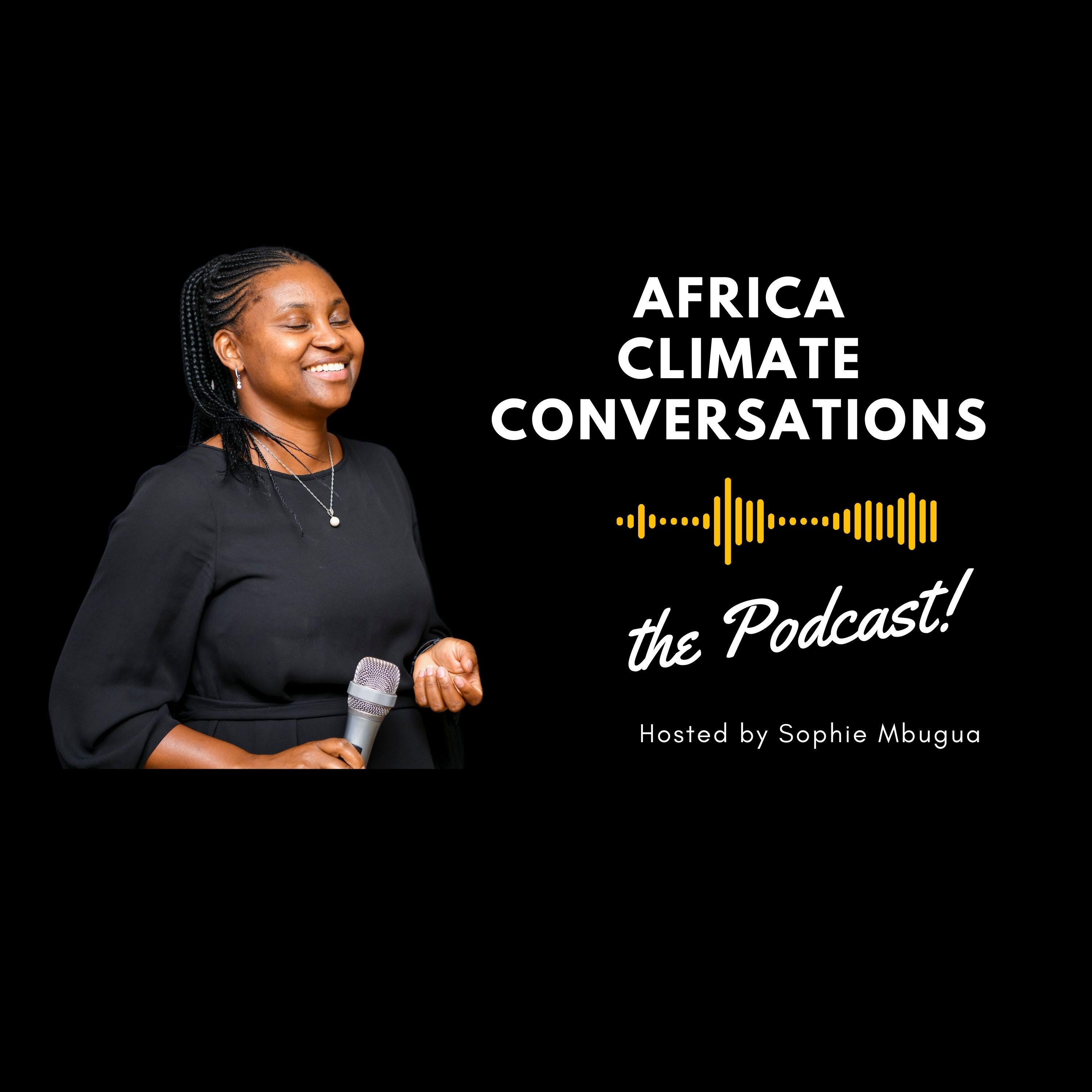
Africa Climate Conversations.
by Sophie Mbugua
The Africa Climate Conversations podcast channel purpose is to shape climate change and environmental narratives in Africa through in-depth news features from the field, conversations with African experts, and opinions. Hello, and welcome. My name is Sophie Mbugua, and I am from Kenya. I am an environmental journalist passionate about Africa, my motherland, nature, and travel.I started this podcast in 2022 after reporting for numerous international, local, and regional media outlets on climate change and the environment. But over the years, I have noted huge gaps in reporting these narratives from an African perspective.In a world where Africa is heating faster than the rest of the world, its population expected to double, home to critical minerals for a green revolution, Africa cannot afford to leave its media behind. As an African journalist, producing this podcast is my contribution to the Africa we want for us and our future generations.There, please subscribe, listen, and shar
Episodes
-
What Are the Hidden Environmental Costs of Solar Energy?
Wind, solar, hydro, geothermal, and biofuels are some of the renewable energy resources. They are said to be green because they come from natural sources, are constantly replenished, and produce fewer greenhouse gas emissions compared to coal, oil, and gas. But, if these technologies end up in…
more -
The untold story of Kenya's Lake Naivasha floods.
The area around Kenya's Lake Naivasha, including Kihoto, is considered part of the broader Lake Naivasha wetland ecosystem, as it is within its riparian land. On this episode we look into the history of flooding in Lake Naivasha and how settlements like Kihoto came about, as well as why this...
-
Weaving for Survival.
As the climate crisis continues, come with me to Syethe village, southeast of Kenya's capital, Nairobi where we meet a group of women earning a living by weaving and selling handbags in addition to farming. With these easily accessible skills, materials and capitalising on technologies such as...
-
Legislative Frameworks: The Key to an Energy Transition Focused on Human Rights
Clear frameworks for community benefit sharing in the mining and renewable energy sectors are essential. However, Manson Gwanyanya, the researcher and representative for South and Anglophone Africa at the Business & Human Rights Resource Centre, told the African Climate Conversations podcast that...
-
How can airlines help bridge existing weather data gaps?
Sensors on aeroplanes measure wind speed, humidity, and temperature, which is crucial for weather forecasting. As climate-related extreme events increase in frequency and intensity, effective weather-related infrastructure is critical not just for the agriculture sector but also development…
more -
Meet a Kenyan teacher teaching children crucial environmental skills.
Our children are the next generation. We, as humans, pass on our legacy to them, whether good or bad. The environment underpins humans' survival today and tomorrow. As the world warms, it's important to remember the vital role the environment's natural resources, such as forests, play in…
more -
How WhatsApp transformed 70-year-old Kenyan woman's beaded basket sales
This week, I was visiting a town in Makueni County, located in the southeastern part of Kenya. About an hour's drive from Makueni's capital town Wote, I met a 70-year-old lady who, after a severe three-year drought hit the village, learned how to weave beaded baskets. She is relying on WhatsApp,...
-
Critical Minerals: has Africa learned from its past experience?
African nations are blessed with 30% of the world's critical minerals. Mineral that the world needs to develop solar panels, wind turbines, renewable energy storage, electric vehicles, defence infrastructures, communication infrastructure, digital economy and many more. However, past mining...
-
Human Greed: The Silent Destroyer of Nature's Fragile Balance
Humanly speaking, forests, minerals, oceans, water bodies, and other natural resources are seen as infinite by the human eye. Infinite in the sense that there are more resources to be mined or prospected for, more land to be utilized, a vast ocean and waterbodies that can handle enormous levels…
more -
Why planting mangroves is not the solution.
Mangroves are versatile and flexible forests that can cope with enormous disturbances. Dr. Judith Okello, a senior research scientist and mangrove ecologist at the Kenya Marine and Fisheries Research Institute, says that when sedimentation occurs, the mangroves can form a new cable rooting system...
-
Empowering Women, Revitalizing Mangroves: A Story from Kenya
Featured today are a group of ladies who are establishing a livelihood by planting mangroves. About sixty kilometres south of Mombasa in Kwale County, in the small fishing town of Msambweni, a group of fifteen women from the Munje village joined together during the COVID-19 outbreak. A...
-
Meet a Kenyan community saving the coral reefs.
Today we meet a Kenyan community saving the coral reefs along the Kenyan coast. Coral reefs along the Lamu-Kiunga area in Lamu County, a small archipelago north of Mombasa in Kenya, have degraded over the years. Pate Island, the largest island in the Lamu Archipelago, lies between the towns of…
more -
Spring water changing lives in Kenya.
Women in Olailamutia, a town in Kenya's Narok County, have had problems with diarrhoea, stomachaches, and skin rashes for many years. Having access to clean drinking water from a spring is helping to get rid of these problems. Families here got water to drink from a river where they also took...
-
Cabins made of plastic helping keep Kenya's Masai Mara clean.
In today's episode, we meet Isaac Macharia, a Kenyan social entrepreneur who makes cabins out of plastic to keep Kenya's Masai Mara clean. In 2015, Macharia was on his usual tour-guiding routine at the Masai Mara in Kenya. It bothered him. He decided to construct cabins using not only plastic...
-
Meet a young Kenyan lady repurposing waste glass at Masai Mara.
Picture this. It's a lovely evening. You and your loved one are seated somewhere, enjoying some juice or beer from a glass made out of liquor bottles collected from a dumping site. How does that sound? On today's episode, meet a young Kenyan lady – Mary Njoki, repurposing waste glass at Masai Mara.
-
"Africa needs to create It's specific facility for climate action" says AGN.
For effective climate action in Africa to take shape, the African Group of negotiators lead negotiator on finance, Ambassador Mohamed Nasr, told the Africa Climate Conversations that the continent must self-assess and work on its own modalities to achieve climate action. Among the things the...
-
COP28: How can Africa solve the climate finance access challenge?
The climate finance needs of developing countries have risen way beyond the 100 billion USD promised by developed countries 15 years ago. The recent UN 2023 adaptation gap report estimates the cost of adaptation at US$215 billion per year this decade. Access to finance, including means of...
-
COP28 kicks off with high promises to deliver on finance.
COP28 takes place against the backdrop of increased financial needs to address climate change adaptation, mitigation, as well as loss and damage. Just to mention, the 2023 UNEP adaptation gap report estimates the cost of adaptation in developing countries at US$215 billion per year this decade.…
more -
African Lead Negotiator: "I hope the loss and damage fund does not become a bargaining chip at COP28."
A 24-member transitional committee on loss and damage issued a proposal for a new loss and damage fund ahead of the 28th UN Climate Summit (COP28) taking place in Dubai this November. According to Alpha Oumar Kaloga, the African group's lead negotiator on loss and damage, the final decision was...
-
Lake Ol' Bolossat community volunteers saving Kenyan endangered bird.
Lake Ol' Bolossat is the only lake in the Kenyan highlands, situated in Nyandarua County, about a three and a half-hour drive from Kenya's capital, Nairobi. The lake is situated in the valley between the northwestern slopes of the AberdareRange of Mountains and Dundori Ridge. The lake forms the...
-
Loss and Damage Fund must be fair and just.
Economic and non-economic loss and damage associated with the extreme event are increasing in developing countries. Extreme events such as droughts, floods, cyclones, tropical storms, and forest fires have significantly increased globally in intensity, frequency, and scope. The devastating floods...
-
71% of African conservation NGOs say global partnerships need reforms.
Not only are local communities and organisations essential for conservation but also for addressing issues of sustainability, poverty reduction, and economic development in Africa. However, local organisations collaborate with international organisations to assist these communities in protecting...
-
Global Stocktake: African climate needs should be smart and measurable.
During the 28th United Nations climate summit, hosted by the Government of the United Arab Emirates (UAE) in December 2023, the first global stocktake, which is intended to map out the path to achieving the Paris Agreement's main objectives, will conclude. The global stocktake, which is…
more -
How have religion, colonialism, and education affected Barotse Floodplain conservation?
"After colonialism, religion depicted that we "Africans" lived in a satanic manner," argues Florence Monde. Mwauluka, a woman of 85 years old, founded the Limulunga la Makuwa craft women's club in the Mongu district of Zambia's Western Province. In today's episode, Mwaluka recalls her childhood...
-
Barotseland: where women protecting the floodplain has nothing to show financially.
Meet Florence Monde. Mwauluka is an 85-year-old woman popularly known here as Auntie Flo. She is the founder of the Limulunga la Makuwa craft women's club in Mongu district, Western Province, Zambia. Here, 10 women join up to weave mats, mattresses, hats, and baskets, as well as mould pots used…
more -
Is there a solution to the persisting water crisis in Zimbabwe?
Is there a solution to the persisting water crisis in Zimbabwe? I ask Professor Tamuka Nhiwatiwa, a Senior Lecturer at the Department of Biological Sciences, University Lake Kariba Research Station, at the University of Zimbabwe. Tamuka says Harare city in Zimbabwe is built on its catchment area....
-
How African spiritualism has helped conserve Zambia's Barotse floodplain
When the Lozi people migrated to the Barotse Floodplains in western Zambia about 400 years ago, they heaped soil on platforms and settled in the floodplain without destroying it. The Lozi developed canals they use to access villages and farmlands and instilled African cultural and spiritual…
more -
The Barotse floodplain: it's importance threats and solutions.
Did you know that the Barotse floodplain, located in the upper Zambezi basin in Zambia's western province, has over 339 bird species and over 129 documented fish species? When flooded, it can reach over 550 000 hectares, acting as a sponge that slowly releases water to the nearby regions that...
-
Why Zambia's key water resources face an eminent threat.
In order to manage and safeguard the nation's forests, Zambia has a proactive 2015 forest act that brings together stakeholders, including local communities. However, extensive deforestation is being caused by the prospecting for new minerals, the logging of indigenous trees like rosewood and...
-
Can the world solve the climate crisis without tackling degradation?
It's nature that gives humans food, air, and medicine; hence, you must give back to nature. But, decades of development have not prioritised safeguarding the environment and the people who depend on it—as a result, leading to pollution, waste disposal, deforestation, ocean acidification, the rise...
-
Wool spinning means more birds and money in Kenya.
At the foot of the Aberdare mountains in Kenya, about an hour's drive to Lake Naivasha, a youth group is encouraging farmers to preserve the grasslands to conserve the Sharpe's Longclaw bird species. The Njambini Wool Crafters buy wool from these farmers to ensure they generate income through...
-
Kinangop Grasslands Kenya: A birds paradise now lost to farming
About an hour and a half drive from Kenya's capital city Nairobi exists the Kinangop Plateau. It is the middle catchment area between the Aberdares /Nyandarua range of mountains and Lake Naivasha. Initially, the grassland was a 70 000 hectares of expansive treeless tussocky grasses, bogs and...
-
Largest Kenyan solar plant but little benefit to locals.
The Raya residents in Garissa - North east of Kenya - say they gave up 85 hectares (210 acres) of their land to make way for the solar power plant - the largest grid-connected solar power plant in East and Central Africa launched in December 2019, but have so far seen few benefits in return. So,...
-
How a Kenyan community is saving one tree at a time.
Today, I am visiting Kenya's Kereita forest - a critical water catchment area and home to the endangered Abbott's Starling bird and threatened tree species like the Prunus Africana threatened for its medical value. I am here to discover what a community forty kilometers from Kenya's capital has...
-
Biodiversity is not just about Wild animals but humanity's survival.
About 30 years ago in Rio de Janeiro, Brazil, agenda 21 recognized that humanity stands at a defining moment in history, confronted by worsening poverty, hunger, ill health, and the continuing deterioration of the ecosystems on which we all depend for our well-being. Years later, world leaders...
-
2022: another hottest year on record! Welcome Back!
Happy New Year: 2023. Last year the year 2022, the average global temperature was about 1.15 degrees Celsius. 2022 marks the 8th consecutive year from 2015-2022 where each year the annual global temperatures have reached at least 1°C above pre-industrial levels. This is according to datasets...
-
Good policies but not enough to protect forests in Kenya.
Kenya's Standard Gauge Railway (SGR) has come with its fair share of blessings in terms of communication and transport. The Mombasa to the Kenyan capital Nairobi line was completed in 2017. Phase two of the railway aimed to link Nairobi with Malaba on the Kenya–Uganda border cut through the...
-
Did the COP27 benefit the African Continent?
The Sharm el-Sheikh, decision was reached early morning on last Sunday the 20th as official plenary started at 4am. Among the wins for the Continent was the establishment of a loss and damage facility which was pushed hard by the G77 and China- Africa is in this group - as well as the civil...
-
African nations must strengthen their institutions to adapt to climate change
The 27th UN Climate summit is already underway till next week in Egypt's coastal city of Sharm el-Sheikh. It is essential to recognize that this is the 27th meeting of the parties in about 30 years. Also, remember that Africa is the continent that contributes the least to global emissions – about…
more -
Lack of conservation values killing Kenya's Oloolua forest.
Forests and savannahs provide a wide variety of ecosystem services. They provide food and fuel. Additionally, they clean the air, filter water, and control floods, and erosion, while sustaining biodiversity. However, over the years human beings have plundered the earth prioritizing development...
-
COP27 not the answer to the global climate crisis.
Human activities led to roughly 1.1°C of warming between 1850-1900. If this trend continues, scientists warn that global warming will exceed 1.5°C between 2030 and 2052, meaning more severe and extreme weather events. The earth exists not just as an investment opportunity but as a trust passed on...
-
With Droughts, Migration becomes urgent in the Horn of Africa.
In the Horn of Africa, pastoralists have often moved. The movement is a crucial driver for community resilience. However, the slow onset of events like droughts, desertification, water scarcity, rising sea levels, and coastal erosion has increased climate-induced migration. By 2050, the World…
more -
"Time for Action, not Backtracking," Says COP27 Presidency.
The 27th United nation Climate summit (COP27) is eight weeks away. COP27 occurs when several climate-related emergency crises, such as floods, drought, wildfires, storms, and cyclones, devastate communities, economies, and ecosystems. Today we welcome the COP27 President Special Representative...
-
Timely weather texts rescues Kenyan farmers.
In many African communities, traditional weather forecasting was relied upon to determine when famers would plant. Still among many communities it remains the most accessible and affordable source of weather information. However recurrent and persistent drought, has disrupted the weather patterns...
-
Why Natural Gas must power Africa Energy transition.
Africa is home to about 560 million people out of over 700 million without access to electricity worldwide. In July 2022, the African Union commission and its member states unveiled what they say is a practical approach to tackling the energy crisis in the continent. The African Common Position…
more -
COP27: Energy transition must be just to Africa.
Hydro energy comprises of 83percent of Zambia's installed capacity. In 2015, climate change impacts reduced Zambia energy generation capacity by more than 50 percent. In 2020 Zambia had to load shed for more than 12 hours again when inadequate rainfall again led to a loss of more than 800 MW.…
more -
COP27: Africa must do more to push for Climate Justice.
Africa is a continent hard hit by climate change though least emitter. Erratic rains and floods, prolonged droughts, climate related migration and conflict, combined with Covid-19 are exposing nations to further debts. In addition, the continent being energy deficient, many nations lack energy…
more -
Kenyan pastoralists on edge due to drought.
Drought situation continues to worsen in Kenya. In Kenya's Rift Valley, local says they last harvested since 2018. This year it has rained for four days. Cows have died, goats – their remaining source of food - are dying of diseases. The Worse hit are nineteen of the 23 Arid and Semi-Arid Land...
-
Endorois women in Kenya rally villagers to save community swamp.
Kenyan minority indigenous community - the Endorois live around Lake Bogoria in Baringo County in Kenya's Rift valley. In 1970's they lost their grazing ground when Lake Baringo was registered a national reserve. The remaining swamp - Kiborgoch or Loboi swamp stated shrinking in the 1990's due to...
-
Special Episode with DW's Living Planet
Today in a special program swap with DW- Living Planet we here how climate change is impacting women in girls, in Kenya. As temperature continue to rise, how is it impacting people's mental health in South Africa? How about the peatlands in the Democratic republic of Congo?
We're indexing this podcast's transcripts for the first time — this can take a minute or two. We'll show results as soon as they're ready.
No matches for "" in this podcast's transcripts.
No topics indexed yet for this podcast.
Loading reviews...
ABOUT THIS SHOW
The Africa Climate Conversations podcast channel purpose is to shape climate change and environmental narratives in Africa through in-depth news features from the field, conversations with African experts, and opinions. Hello, and welcome. My name is Sophie Mbugua, and I am from Kenya. I am an environmental journalist passionate about Africa, my motherland, nature, and travel.I started this podcast in 2022 after reporting for numerous international, local, and regional media outlets on climate change and the environment. But over the years, I have noted huge gaps in reporting these narratives from an African perspective.In a world where Africa is heating faster than the rest of the world, its population expected to double, home to critical minerals for a green revolution, Africa cannot afford to leave its media behind. As an African journalist, producing this podcast is my contribution to the Africa we want for us and our future generations.There, please subscribe, listen, and shar
HOSTED BY
Sophie Mbugua
Loading similar podcasts...
Frequently Asked Questions
How many episodes does Africa Climate Conversations. have?
Africa Climate Conversations. currently has 143 episodes available on PodParley. New episodes are automatically indexed when they're published to the podcast feed.
What is Africa Climate Conversations. about?
The Africa Climate Conversations podcast channel purpose is to shape climate change and environmental narratives in Africa through in-depth news features from the field, conversations with African experts, and opinions. Hello, and welcome. My name is Sophie Mbugua, and I am from Kenya. I am an...
How often does Africa Climate Conversations. release new episodes?
Africa Climate Conversations. publishes regularly with 143 episodes available. Check the episode list for the typical release schedule.
Where can I listen to Africa Climate Conversations.?
You can listen to Africa Climate Conversations. on PodParley by clicking any episode. We provide an embedded audio player for direct listening, and you can also subscribe via your preferred podcast app using the RSS feed.
Who hosts Africa Climate Conversations.?
Africa Climate Conversations. is created and hosted by Sophie Mbugua.
URL copied to clipboard!