
PODCAST · technology
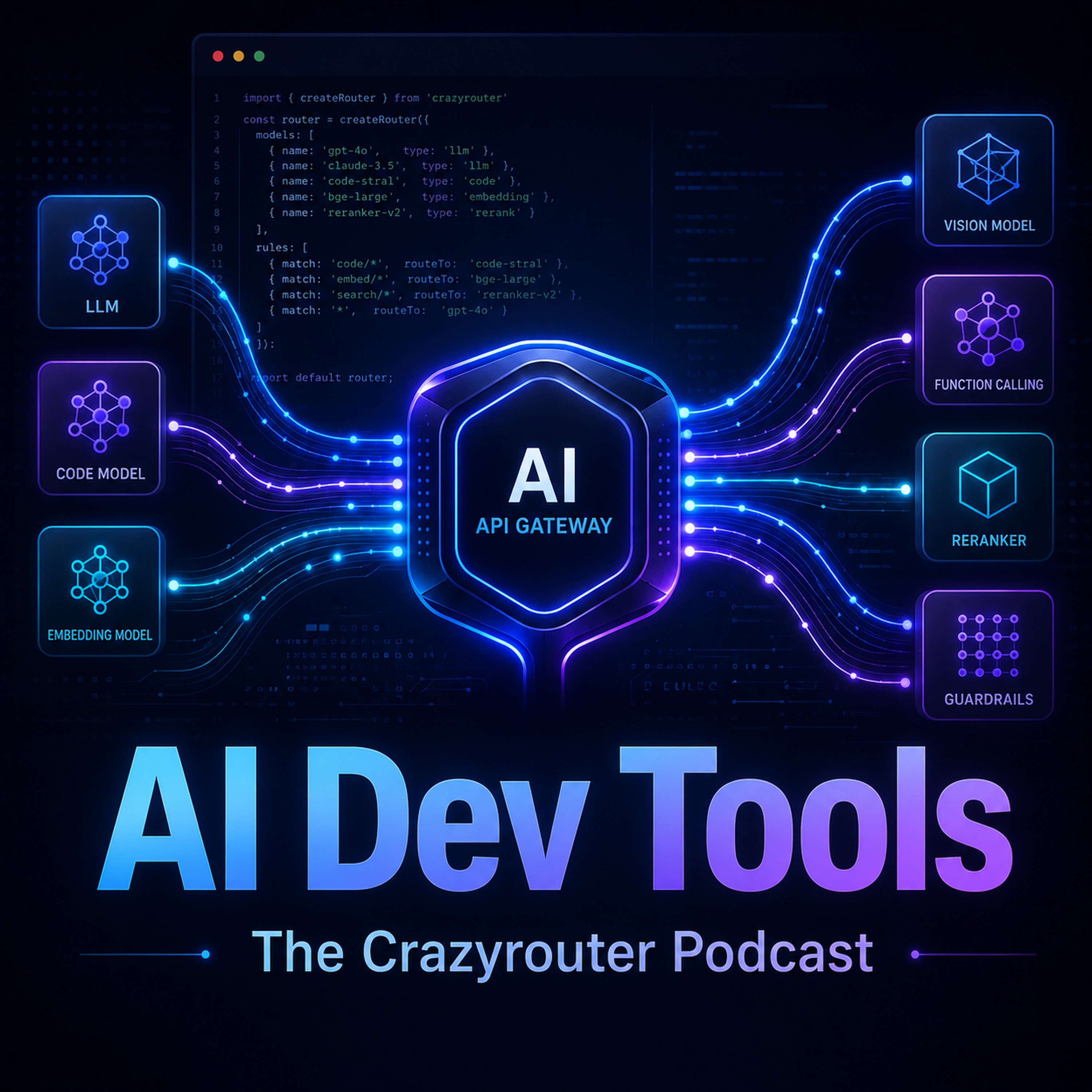
AI Dev Tools — The Crazyrouter Podcast
by Crazyrouter
Your weekly breakdown of AI development tools, API gateways, model pricing, and building with GPT, Claude, Gemini, and DeepSeek. Hosted by Crazyrouter — one API key for 627+ AI models.
-
84
EP088: Vision Benchmarks Need User-Centric Metrics
A practical episode about turning vision model benchmarks into production decisions: accuracy, latency, tail latency, cost per successful image, media handling, usage signals, failure modes, and user-facing routing strategy.
-
83
EP087: Vision Model Routing Is Really Media Routing
A practical episode about image understanding APIs, URL image inputs, Gemini and Claude inline media conversion, Qwen and OpenAI-style URL passthrough, and why production AI gateways need media-aware routing instead of just model-aware routing.
-
82
EP086: DeepSeek Rate Limits Are Not One Number
A practical episode about DeepSeek official concurrency limits, cloud-provider TPM and RPM quotas, and why AI gateways need structured capacity routing instead of a single rate-limit number.
-
81
EP085: Service Accounts Beat Refresh Tokens for AI Ops Analytics
A practical episode about why AI operations dashboards should use service accounts for GA4 and Search Console, how expired OAuth refresh tokens break growth reports, and why analytics credentials are part of production infrastructure.
-
80
EP084: AI API Failovers, Regional Endpoints, and Hidden Reliability Work
A practical episode about the reliability work behind AI API products: regional base URLs, routing, failover policy, balance-related pauses, support clarity, and turning repeated support cases into better developer infrastructure.
-
79
EP083: Claude Code, World Cup Predictors, and Validated AI Workflows
A practical episode about using coding agents for prediction workflows: deterministic probability models, model-written explanations, JSON validation, and why AI apps need evidence checks instead of vibe-based answers.
-
78
EP082: Payload Compatibility Is Part of Model Quality
A practical episode about why model quality includes payload compatibility, endpoint fit, retries, and real workflow success rather than only benchmark headlines.
-
77
EP081: Turning Claude Code Guides into Developer Growth Infrastructure
A practical episode on how a Claude Code guide repository can become developer growth infrastructure: correct base URL rules, UTM discipline, searchable docs, setup scripts, FAQs, and multi-platform content distribution built from validated developer onboarding.
-
76
EP080: GPT-5 Parameters, Claude Code Setup, and API Hygiene
A practical episode on why GPT-5-style reasoning models need cleaner request payloads, how to handle max_tokens versus max_completion_tokens, when to use reasoning_effort and verbosity, and why config-only Claude Code onboarding is better for users who already installed the CLI.
-
75
EP079: Cost per Accepted Image Is the Metric That Matters
Image generation pricing is misleading if teams only compare cost per request. This episode explains cost per accepted image, why model demos are not enough, and how developers can use a repeatable test matrix across GPT Image, Imagen, Qwen Image, and FLUX-style models before choosing production routes.
-
74
EP078: One-Click Configuration Is Developer Onboarding Infrastructure
One-click setup scripts are more than convenience. This episode explains how WorkBuddy-style custom model configuration, local models.json files, Base URL normalization, backups, API key handling, and troubleshooting checklists turn fragile AI tool setup into repeatable developer onboarding infrastructure.
-
73
EP077: Base URL Bugs Are Developer Experience Bugs
API Base URL mistakes are one of the most common AI developer onboarding failures. This episode explains why missing /v1, wrong environment variables, UTM parameters in API endpoints, region endpoints, and unclear error paths turn small configuration details into support load — and how guides, generators, and troubleshooting pages convert support questions into growth assets.
-
72
EP076: Dynamic Workflows for AI Coding Agents
Dynamic workflows are changing AI coding from one long agent chat into structured orchestration. This episode explains planner, implementer, adversarial reviewer, and verifier packets; why ultracode-style workflows can get expensive; and how model routing through an API gateway helps teams control cost, latency, and evidence.
-
71
EP075: API Billing Is Product Infrastructure
API billing is no longer just an accounting detail. This episode explains why Anthropic and Claude API cost depends on payload design, long context, output length, retries, agent loops, and fallback strategy — and why production teams should measure cost per successful task instead of raw token price.
-
70
EP074: API Key Hygiene Is Part of AI Reliability
API key hygiene is a production AI reliability issue. This episode explains why invalid tokens, missing Authorization headers, rotated credentials, stale workers, and forgotten environment variables should be tracked separately from model failures — and how gateways make authentication problems easier to diagnose.
-
69
EP073: Why AI Gateway Reliability Is More Than Uptime
AI gateway reliability is more than uptime or HTTP 200s. This episode explains provider availability, payload compatibility, output validity, task success, and cost stability — and why production AI teams should measure cost per successful task instead of raw token price.
-
68
EP072: Why MCP Needs the Same Gateway Discipline as APIs
MCP gives AI agents access to tools, but production teams need more than direct tool wiring. This episode explains why MCP needs gateway discipline: identity, policy, approvals, tool shaping, observability, and cost-aware routing across the full agent workflow.
-
67
EP071: The Quiet Problem With AI Pricing Pages
AI pricing pages show unit costs, but production teams need routing decisions. This episode explains why real AI cost depends on success rate, retries, latency, payload compatibility, and task-level economics — and why model pricing should become a living routing layer inside your AI infrastructure.
-
66
EP070: Gemini 2.5 Flash Lite and the Automation Tier
Gemini 2.5 Flash Lite is best understood as a lightweight automation tier: fast, cheap, and useful for classification, extraction, summarization, routing, validation, and first-pass analysis before escalating harder tasks to stronger models. This episode explains how to use lightweight models in production without trusting them blindly.
-
65
EP069: Payload Compatibility Is Part of AI Model Quality
A real Claude Jupiter v1-p vs GPT-5.5 benchmark showed that model quality is not just intelligence. Payload compatibility matters too: Jupiter failed with temperature=0 but passed once the payload was adjusted. This episode explains why exact-payload health checks, fallback routing, and cost per successful task are now core AI infrastructure.
-
64
EP068: Distribution Infrastructure for AI Developer Products
Distribution is infrastructure for AI developer products. This episode explains how to build a content distribution graph across your main blog, developer communities, Git-based pages, open source platforms, social networks, and podcasts — with platform-aware syndication, UTM tracking, and measurable outcomes instead of random posting.
-
63
EP067: Cost per Successful Task — The AI Metric That Actually Matters
Token price is only the beginning of AI cost. This episode explains why production teams should optimize for cost per successful task, including retries, invalid outputs, fallback calls, latency, and user completion — and how an API gateway helps route by task, risk, and validation result instead of hard-coding one model for everything.
-
62
EP066: Model Orchestration — The Missing Layer in Production AI Apps
Model orchestration is the practical layer between a prompt and a production AI system. This episode explains how to route by task instead of brand, validate outputs beyond HTTP 200, design fallbacks based on failure type, escalate only when needed, and measure cost per successful task instead of raw token spend.
-
61
EP065: Gemini 3.5 Flash vs Claude — Why Response Tiers Matter
Gemini 3.5 Flash is best understood as a strong fast-tier production model, not a direct Claude Opus replacement. We break down real API test results against Claude Haiku and Sonnet-style routes, the max_tokens pitfall that can return HTTP 200 with empty content, and how developers should design model routing, fallback, validation, and escalation by task instead of by brand.
-
60
EP064: MCP Gateways Are Becoming the Security Layer for AI Agents
MCP gateways are becoming the control layer for production AI agents. We break down why tool access needs identity, permissions, approvals, and observability, and how gateway thinking helps teams make agents capable without making them reckless.
-
59
EP063: GPT Pricing Changes and Why API Cost Strategy Matters
GPT-series pricing is changing, and that is a reminder that model pricing is product infrastructure. We break down Crazyrouter's GPT discount adjustment, why upstream cost changes happen, and how developers can design AI apps with routing layers, value-based model tiers, fallback options, and cost-per-outcome tracking so pricing changes do not break the product.
-
58
EP062: Fallback Routing Is the Feature That Makes AI Apps Feel Reliable
Fallback routing is the reliability layer that makes production AI apps feel dependable. We break down why fallback is not just a backup model, how to design task-aware routing rules, when not to fallback, and why logging fallback reasons, latency, errors, and user outcomes turns model routing into real infrastructure.
-
57
EP061: AI Image APIs Are Becoming Product Infrastructure
AI image generation is moving from novelty to product infrastructure. We break down why developers should evaluate image models by use case, not hype: text rendering, product accuracy, latency, edit support, routing, fallback, logging, and observability — and why image generation now needs the same gateway pattern as LLMs.
-
56
EP060: MCP Gateways Are the New Control Plane for AI Agents
MCP is moving from integration convenience to production governance. We break down why MCP gateways are becoming the control layer between AI agents and external tools, how they mirror the API gateway pattern for microservices, and why model routing plus tool routing need to be observed together for safe agent platforms.
-
55
EP059: Agents Are Infrastructure Now — Why Control Planes Matter More Than Prompts
AI agents are no longer just chatbot features — they are becoming actors inside software systems. We break down why agent identity, permissions, audit logs, routing, observability, and cost controls are now core infrastructure, and why multi-model API gateways are becoming the control plane for safe autonomous workflows.
-
54
EP058: Blitzy Raises $200M for Autonomous Software Dev + OpenAI Ships GPT-5.5 Instant as Default
Two big stories today: Blitzy, an autonomous software development startup, just raised $200M to build AI that writes entire enterprise applications end-to-end. Meanwhile, OpenAI quietly shipped GPT-5.5 Instant as the new default ChatGPT model, replacing GPT-5.3 Instant. We break down what both moves mean for developers, API pricing, and the future of AI-powered coding tools.
-
53
EP057: Cloudflare Just Let AI Agents Deploy Full Apps — The Infrastructure Layer Goes Agentic
Cloudflare announced that AI agents can now create accounts, buy domains via Stripe, and deploy applications — all programmatically with zero human intervention. We break down how it works, what it means for the future of autonomous development workflows, the security implications of giving agents spending authority, and why API gateways become your critical safety net when your agents go fully autonomous.
-
52
EP056: The Celebrity AI Gateway Wars — When Crypto Kings and Tech CEOs Enter Your Market
Justin Sun launched b.ai with "every model, half off" and Fu Sheng brought EasyRouter.io with "zero platform fee." Two massive internet celebrities just entered the AI API gateway space. We break down what this means for the market, why celebrity-driven platforms have a specific playbook (and specific weaknesses), and how developer-focused gateways can actually benefit from the attention flood.
-
51
EP055: AI-Powered Code Review — From Bottleneck to Superpower
Code review has always been a necessary bottleneck in software development. In 2026, AI-powered code review tools have matured to the point where they catch real bugs, security vulnerabilities, and performance issues — not just lint errors. We break down what's working, how to build your own review pipeline with an API gateway, the two-pass workflow that cuts review cycle time by 50-60%, and the gotchas to watch out for.
-
50
EP054: The Hybrid AI Coding Stack — Why Developers Are Running Local and Cloud LLMs Side by Side
More developers are building hybrid AI coding stacks that combine local open-weight models like Qwen3 Coder and DeepSeek V3.2 with cloud models like Claude Opus and GPT-5. We break down why this pattern is taking off, how to set it up with a local inference server and an API gateway, and why the economics, privacy benefits, and reliability gains make it the default architecture for serious AI-powered development in 2026.
-
49
EP053: DeepClaude — 17x Cheaper Agent Loops by Splitting Thinking from Coding
A new open-source project called DeepClaude is turning heads by splitting the AI coding agent loop into two models: DeepSeek V4 Pro for reasoning and planning, Claude for code generation and tool use. The result? 17x cheaper than running Claude end-to-end, with comparable output quality. We break down how model-splitting architectures work, why this validates the multi-model routing thesis, the tradeoffs developers should know about, and how to implement similar patterns with any gateway today.
-
48
EP052: Palo Alto Networks Just Bought an AI Gateway — What It Means for Every Developer
Palo Alto Networks acquires Portkey, one of the most prominent AI gateway startups, folding it into Prisma AIRS as a mission-critical control plane for autonomous agents. We break down what this 120-billion-dollar cybersecurity company buying a gateway means for the category: validation that AI gateways are infrastructure, the enterprise security angle that changes everything, and why the acquisition creates a wide-open lane for developer-focused gateways. Plus: what the rise of autonomous AI agents means for gateway architecture and why lightweight tools like Crazyrouter are more relevant than ever.
-
47
EP051: OpenAI's Symphony — How Coding Agents Are Becoming Autonomous Dev Teams
OpenAI open-sourced Symphony, the orchestration spec behind Codex. We break down the conductor-worker architecture that lets multiple AI agents collaborate on a codebase simultaneously — writing code, running tests, and submitting PRs autonomously. Plus: the Bedrock integration bringing OpenAI models into AWS VPCs, why specification skills are becoming more valuable than implementation skills, and practical steps to start building with agent-driven development today.
-
46
EP050: The AI Agent Protocol Wars — MCP vs A2A and Why Developers Need a Strategy Now
Episode fifty dives into the agent protocol wars reshaping AI development. We break down Anthropic's Model Context Protocol (MCP) — the USB-C of AI tool integration — and Google's Agent-to-Agent protocol (A2A) for multi-agent collaboration. MCP solves the N-times-M integration problem with a client-server model for connecting AI apps to external tools. A2A enables peer-to-peer agent discovery and coordination for complex workflows. They're not competing — they're complementary layers. Plus: a practical four-step strategy for adopting both protocols, and a concrete architecture for building modular, provider-independent agent systems.
-
45
EP049: OpenAI's For-Profit Pivot — What It Really Means for API Pricing and Developers
OpenAI's transition from nonprofit to for-profit is under the spotlight as the Musk vs Altman trial unfolds. We break down what this corporate restructuring means for API pricing, model availability, and vendor lock-in. Expect price segmentation to increase, exclusive model windows to expand, and switching costs to rise. The developer playbook: abstract your dependencies, use multi-provider routing, and match models to tasks for 30-50% cost savings. Don't bet your architecture on any single provider's pricing staying stable.
-
44
EP048: The AI Robotics SDK Moment — Why Every Developer Should Be Paying Attention
AI-powered robotics just crossed a major threshold. Eka Robotics demonstrated human-level dexterity, but the real story is the software stack underneath. We break down the new three-layer robotics developer stack — foundation models for perception, LLMs for task planning, and specialized models for motion execution — and explain why the barrier to entry just dropped from a PhD to an API key. Plus: practical steps to start building with NVIDIA Isaac, LeRobot, and MuJoCo today.
-
43
EP047: The Hidden Cost of AI — Water, Energy, and Why Your Model Choice Matters
Every token you generate has a physical footprint — water, electricity, carbon. A single large data center can consume over ten million gallons of water per day for cooling. We break down the real environmental cost of AI inference, why model selection is green engineering, and three levers developers control today: choosing efficient models, writing better prompts, and picking providers with sustainable infrastructure. Plus: a practical tiered workload framework to cut your resource consumption across every dimension.
-
42
EP046: The AI Content Labeling Era — Watermarks, Verified Badges, and What Developers Need to Build For
Platforms are now requiring developers to answer "is this AI or human?" programmatically. Spotify is rolling out verified human badges, YouTube requires AI content disclosure, Meta labels AI images, and the EU AI Act's transparency requirements kick in this year. We break down three layers every developer needs: C2PA metadata for provenance, invisible watermarking with SynthID and similar tools, and platform-specific disclosure APIs. Plus: practical code patterns for adding content labeling to your AI pipeline today.
-
41
EP045: GPT-image-2 Is a Money Machine — 6 Viral Use Cases Developers Are Building Right Now
GPT-image-2's killer feature is text rendering — and developers are turning it into real products. We break down six viral use cases: AI palm reading infographics, face reading and color analysis, action figure generators, Ghibli-style photo transformation, future baby prediction, and AI meme and coloring book creators. Each one is a single API call, costs 4-8 cents per generation, and can be monetized at 90%+ margins. Full code examples available on the Crazyrouter blog in English, Chinese, and Russian.
-
40
EP044: Claude Opus 4.7 Drops, and May's Model Avalanche Is Just Getting Started
Anthropic just released Claude Opus 4.7 with a 13% coding benchmark improvement over Opus 4.6, better vision, and same pricing. Meanwhile, Claude Mythos sits in restricted preview with jaw-dropping benchmarks, GPT-5.5-Cyber is rolling out, DeepSeek V4 full release is imminent, and Meta's Avocado model targets May or June. We break down what each release means for developers, why model switching is no longer optional, and how the cybersecurity gating trend signals a new era of capability-based API access.
-
39
EP043: The AI API Gateway Market Just Got Crowded — How to Pick the Right One
The AI API gateway market exploded in 2026 with new players like TrueFoundry, TensorZero, ZenMux, and EvoLink. We break down why the market is growing so fast, introduce a four-C framework for choosing the right gateway (Coverage, Cost, Complexity, Control), compare pricing models, and give practical recommendations by team size. Plus: why Generative Engine Optimization is the new SEO for developer tools.
-
38
EP042: Microsoft and OpenAI Break Up Their Exclusive Deal — What It Means for Developers
Microsoft and OpenAI just ended their exclusive partnership. OpenAI can now serve models on any cloud provider, not just Azure. We break down the new non-exclusive license through 2032, the flipped revenue sharing structure, what this means for multi-cloud deployment, why the AI model layer is becoming commoditized, and how API gateways become even more critical in a fragmented infrastructure world.
-
37
EP041: The 2 Million Token Context Window Era — What It Actually Changes for Developers
We explore how 2M token context windows from Grok 4.1 and Gemini are reshaping application architecture. From eliminating RAG pipelines to enabling full-codebase coding assistants, we break down the real impact, the gotchas, and the cost math that makes massive context surprisingly affordable.
-
36
EP040: The Real Cost of AI APIs in 2026 — Who's Cheapest, Who's Worth It, and Where the Hidden Fees Are
We go deep on what AI APIs actually cost in production. Covering 18 models across 5 providers — OpenAI, Anthropic, Google, xAI, and Chinese providers — we break down base pricing, caching mechanics (and why they differ), Batch API discounts, the Chinese model wild card, and a practical framework for picking the right model for your workload. Plus: how stacking Crazyrouter discounts with caching can save you 80-90%.
-
35
EP039: Google's $40B Anthropic Bet, OpenAI's Privacy Filter, and the AI Regulation Showdown
Three big stories this week: Google is investing up to $40 billion in Anthropic, reshaping the competitive landscape for Claude and Gemini. OpenAI open-sources Privacy Filter, a local PII detection model that could change how developers handle user data. And the US DOJ joins a lawsuit against Colorado's AI regulation law. We break down what each means for API developers.
We're indexing this podcast's transcripts for the first time — this can take a minute or two. We'll show results as soon as they're ready.
No matches for "" in this podcast's transcripts.
No topics indexed yet for this podcast.
Loading reviews...
ABOUT THIS SHOW
Your weekly breakdown of AI development tools, API gateways, model pricing, and building with GPT, Claude, Gemini, and DeepSeek. Hosted by Crazyrouter — one API key for 627+ AI models.
HOSTED BY
Crazyrouter
CATEGORIES
Loading similar podcasts...
Frequently Asked Questions
How many episodes does AI Dev Tools — The Crazyrouter Podcast have?
AI Dev Tools — The Crazyrouter Podcast currently has 50 episodes available on PodParley. New episodes are automatically indexed when they're published to the podcast feed.
What is AI Dev Tools — The Crazyrouter Podcast about?
Your weekly breakdown of AI development tools, API gateways, model pricing, and building with GPT, Claude, Gemini, and DeepSeek. Hosted by Crazyrouter — one API key for 627+ AI models.
How often does AI Dev Tools — The Crazyrouter Podcast release new episodes?
AI Dev Tools — The Crazyrouter Podcast has 50 episodes. Check the episode list to see recent publication dates and frequency.
Where can I listen to AI Dev Tools — The Crazyrouter Podcast?
You can listen to AI Dev Tools — The Crazyrouter Podcast on PodParley by clicking any episode. We provide an embedded audio player for direct listening, and you can also subscribe via your preferred podcast app using the RSS feed.
Who hosts AI Dev Tools — The Crazyrouter Podcast?
AI Dev Tools — The Crazyrouter Podcast is created and hosted by Crazyrouter.
URL copied to clipboard!